
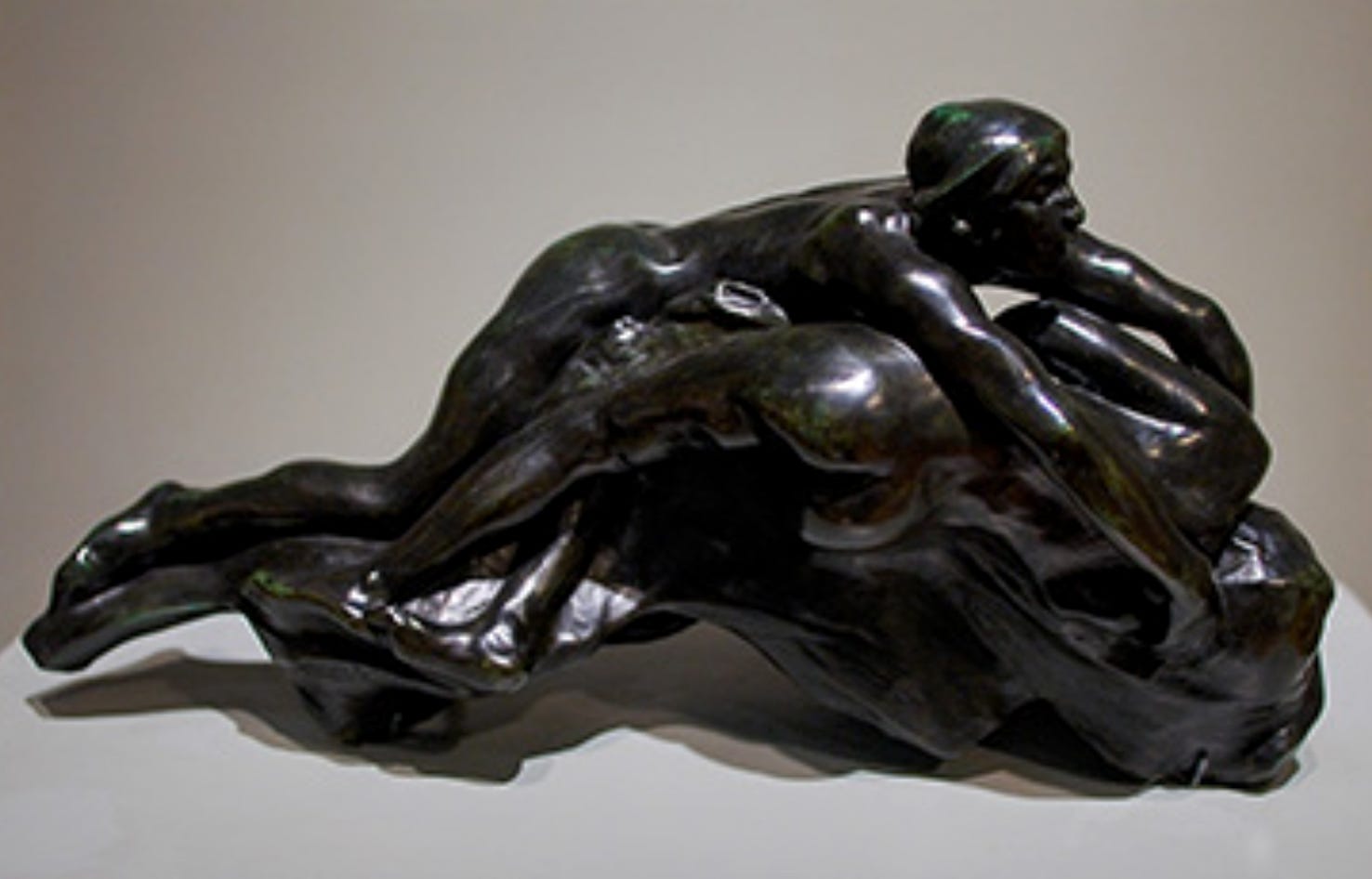
Auguste Rodin - Paola and Francesca (Musee Rodin)
i thought we had a summer love. it was easy to fuck in the heat, your air conditioner clunking arthritically and lana del rey up loud. you said your love was a fleeting thing and we planned a couple weeks’ affair. we were always in bed, you all copper brown and cat like you’d go days without texting back and back then i didn’t care. when you left you told me to call you if I got too sad but i didn’t take that seriously. there was nothing between us but the gossamer cloth of two sundresses. summer love is easy that way.
winter is hard here. the world freezes to ice and the temperature drops down down to where it’s edging zero. Streets disappear underneath snow and roads get rife with salt trucks and sliding southerners. i’m not easy either it’s all fight and flight with me you put away your short shorts and swathe up in long underwear and fuzzy sweaters i try it all: crying, fighting, drama, despair you outwait me like the spring beneath the snow. I was mistaken – we have a winter love.
Trinity Lewis
I was reading a review of Gilles Deleuze’s On Painting this morning and came across the quote above, about stories slipping into or tending to slip into the space between two figures. An interesting claim. A self-evident claim, I’d assume, at least if you’re a writer. ‘Tend,’ in this case, should be given its stricter definition. Deleuze reinforces his “always slip into” with “tends” (in the translation, of course) to suggest the ‘always’ is the result of something in the character of stories. Stories, by their nature, move into the space between two figures.
Peter Salmon, in his review (see Notes below), presents Deleuze’s view of the process of creation as “of a piece with what is created.” The paragraph that particularly caught my attention was this one – “The first battle, for Deleuze, is against the canvas, but this is not the battle that has become a platitude in theorizing about art. For Deleuze, the idea of a ‘blank canvas’ is a ‘stupidity’ – rather, the canvas teems with things that must be defeated, in particular cliché. When approaching the white space on which they will create their art, the painter (as with the writer and the blank page) confronts not a void, but a multitude, ‘utterly cluttered’ with the facile. ‘Before they begin any painting,’ says Deleuze, ‘the canvas is already full. Full of what? Full of everything that is most awful. That is why painting is a form of work.’”
“For Deleuze, what the painter [or writer] confronts each time they approach a canvas is not only a teeming set of facile temptations, but also what he terms a ‘catastrophe’ – a locus of forces that somehow must be ordered, if never mastered.”
All this reminded me of the poem above, by Trinity Lewis. Lewis’s work often leaves no discernible space between figures, unless one counts the molecular spaces in the friction shield provided by sweat, but this piece is a little different. The closed space between figures is remembered, not explicitly presented. There is little context. A bed, a clunking air conditioner, light sundresses, Lana del Rey turned up loud. There is mention of winter roads in the present tense, and drama, despair. Not much to go on. A lot of facile temptations have been overcome, and yet, there is a story there, because there are questions there, and where there are questions, the mind looks for answers. Why Lana del Rey? Why the crying and screaming? What’s with the focus on roads and the state of them? Anything to do with fight and flight? The other in the poem appears to be girding themselves. Long johns and fuzzy sweaters are perhaps safer than all that gossamer? In the space of a friction barrier, a tale develops about the shifting nature of love, the way relationships change and develop, perhaps about the movement of the two bodies involved in the poem toward or into their own narrative. It seems inevitable, but is it?
Deleuze discusses Francis Bacon as an example of “preventing any sort of narrative from emerging” from a work. But does he succeed? I don’t think he does. No more than Lewis does, assuming she was trying to. Even when figures are reduced to haunches of meat with screaming mouths, or a group of contorted swellings and bulges in cadaverous colours surrounded by next to nothing, the mind moves toward the story in the space between them. The space beckons. Invites. The narrative cannot resist. “We need not,” Salmon writes, create a narrative when confronted with the screaming Pope in Bacon’s Study after Velazquez’s Portrait of Pope Innocent X. But “we are forced to engage with its visceral facticity: a mouth, teeth and a scream.” Perhaps we “need not,” but we definitely tend, by our very nature, as stories tend, by theirs, to fill the space between the figures. To refrain would be paramount to creating an outline of the world, of life, and being content with only that.
Notes
Capturing the Scream – A Parisian philosopher’s battle with the canvas. Peter Salmon, reviewing Courses. March-June 1981, by Gilles Deleuze. The Times Literary Supplement, December 12, 2025.
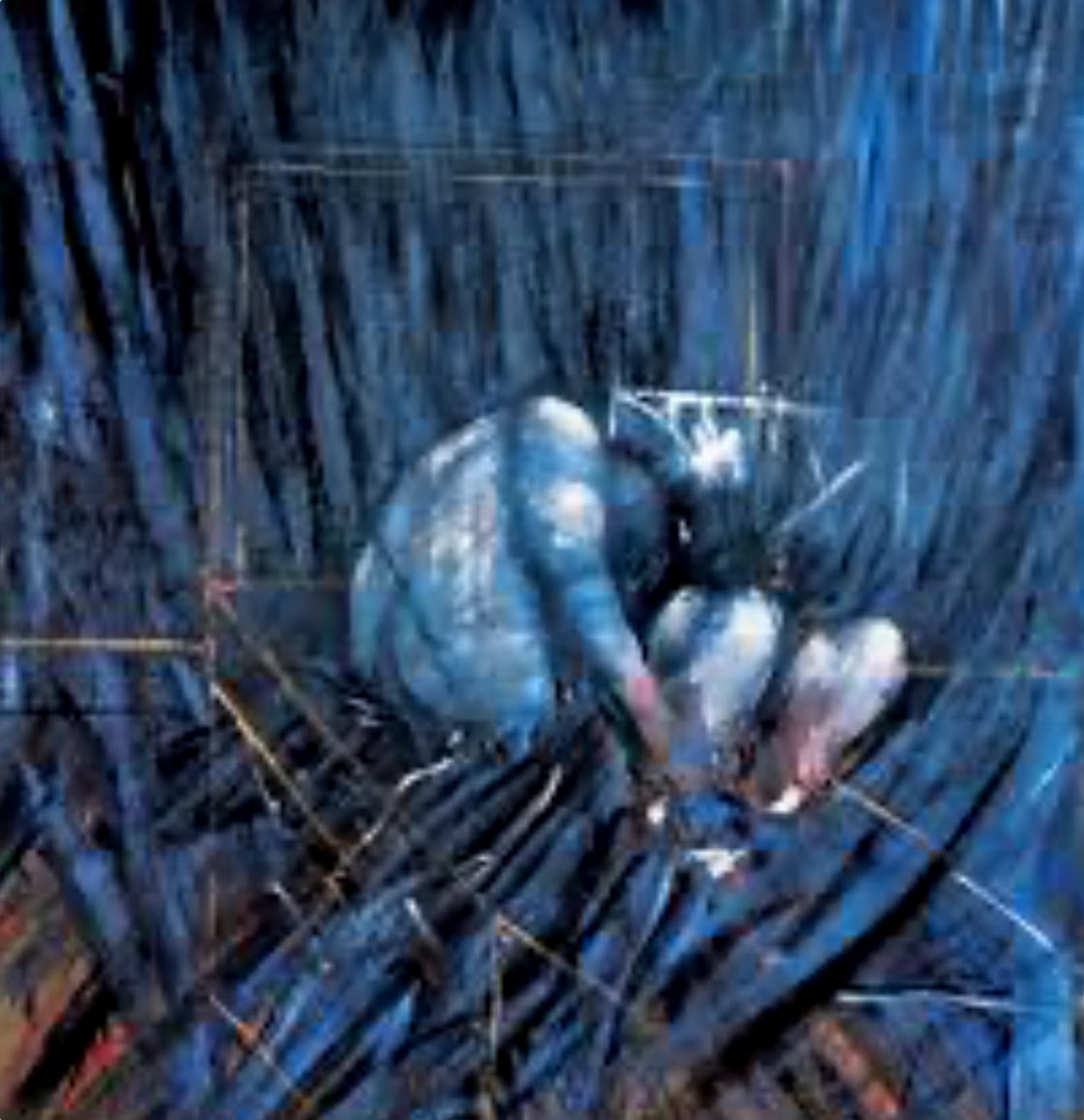
Francis Bacon - Two Figures in the Grass
No posts
Comments
Nothing yet. Say the first thing.
Sign in to join the conversation.