
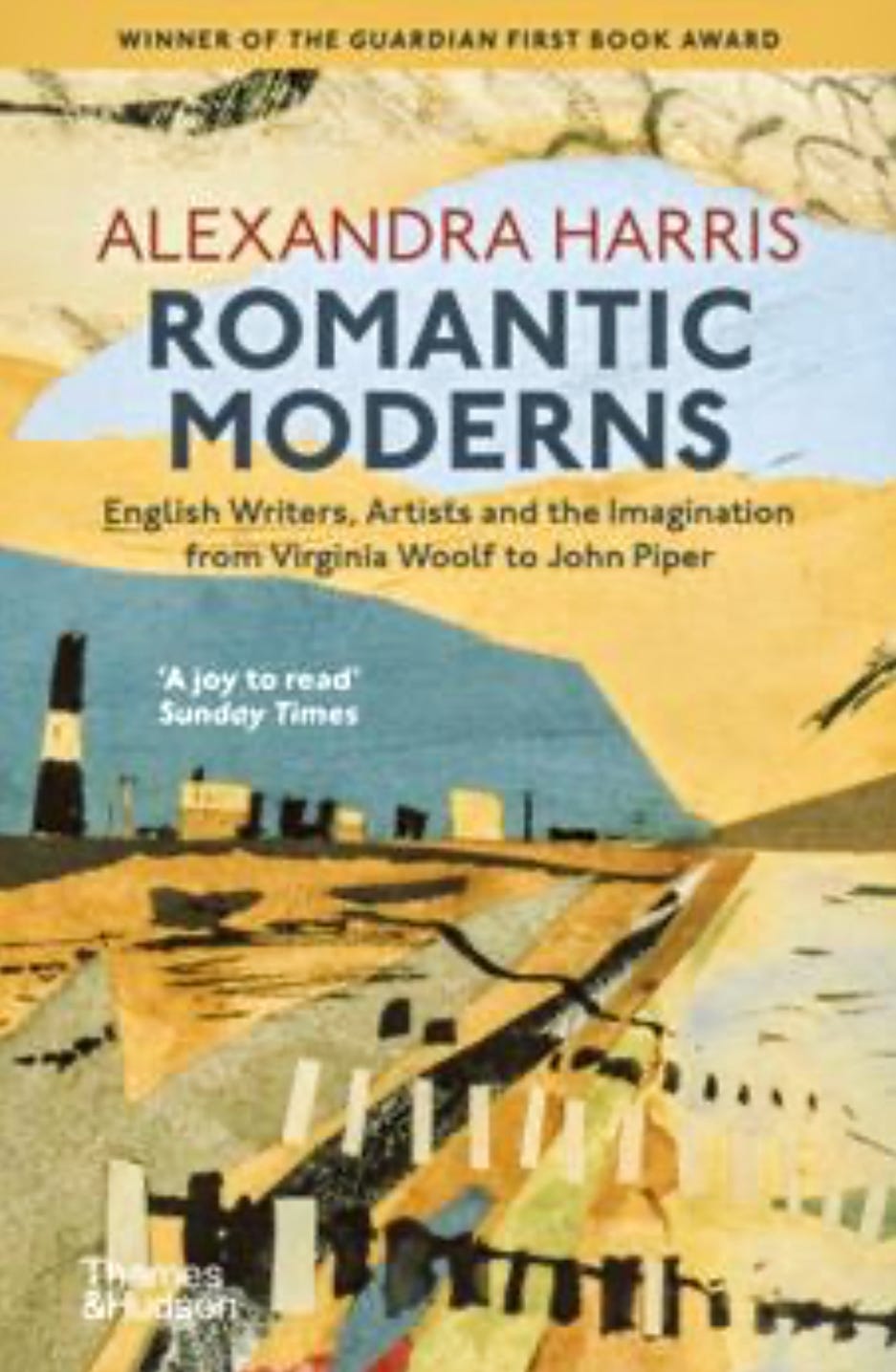
Alexandra Harris remarks, in Romantic Moderns that “anthologies and novels are closely related: they are cumulative literary forms which resent containment.” Therefore, a species of hand bag, like Henry James’ “large loose baggy monsters, with their queer elements of the accidental and arbitrary.” Not all are, of course. Just the generous ones. Romantic Moderns – English Writers, Artists, and the Imagination, from Viginia Woolf to John Piper, is a generous anthology (etymologically, a gathering of flowers, and flowers, Harris notes somewhere, refuse to be edited from the English imagination) of connected pieces on England in the 1930s and 1940s and, like novels and old-fashioned hand bags, it resents containment. It, like Harris’s second book The Rising Down, has little interest in being kept within limits. Harris notes in the Preface to the Second Edition that the most strikingly repeated words in Romantic Moderns are ‘elasticity,’ ‘stretch,’ and ‘conversation.’
“The difficulty with anthologies,” she says,” is finding a place to stop,” but Pompey Casmillus (the heroine of Stevie Smith’s two novels, discussed in Chapter 6 - The Canon Revised) has firm tactics for the problem of endings: “I shall know when to stop, and I shall stop. And whatever I write then will be Volume Two.” Harris seems to have taken Pompey’s approach. There was just too much of interest to talk about, so when she knew it was time to stop, she stopped, and whatever she wrote after that became The Rising Down. We can hope she applied the same reasonable principles to that book and is busy writing Volume Three.
“Wartime encyclopaedists, aware that there may not be time for Volume Two, squeezed their belongings into tighter containers. The literature of 1939 and 1940 is full of references to bags, pockets and boxes. In a wartime essay on Coleridge, Virginia Woolf described his long sentences ‘pocketed with parentheses,’ imagining the brackets as handy places to put extra bits and pieces...Everything must go down that one can remember,” declared Henry Green, “all one’s toolbox, one’s packet of Wrigley’s.”
The bag referred to is, I’m sure, an old leather bag with handles to it, such as Miss Prism, or Mary Poppins carried. Somewhat battered. – “Here is the injury it received through the upsetting of the Gower Street omnibus… here is the stain on the lining caused by the explosion of a temperance beverage”(Wilde). Personally, I think the bag should have a snap shut closure. One of those narrow at the top and broad across the beam designs. A somewhat large (capacious) bag, equipped with TARDIS technology, which can easily hold your lunch, your phone, whatever you happen to be reading, and a baby. Or the manuscript of a triple decker novel. An anthology of a bag.
Alexandra Harris packs an immense amount into her bag. We can eliminate the possibility of either pockets or boxes. No pocket could be large enough, no box flexible or expandible or durable enough to work. Durability is essential. How else to allow even the surface of the container to carry critical clues and information. (What, exactly, happened on the Gower Street bus, and what had Miss Prism to do with it?) Harris has put into her bag - neatly rolled, in the way sailors pack their duffle bags for maximum use of the space available, without crumpling or cramming – a long rebuttal of the claim made by Christoper Wilk, curator of the “landmark exhibition ”Modernism: Designing a New World, 1914-1939, that there were so few English works in the show because “Englishness and modernism were antithetical. ‘Modenism was cosmopolitan … and English art was pastoral.’” Harris makes a long and fascinating argument for modernism being “elastic enough” to include, within the subtitle’s parameters of Virginia Woolf and John Piper, Myfanwy Evans, Eric Railious, Paul Nash, Henry Moore, the Sitwells, the Picasso-esque 12th century font in the church at Toler Fratnum (estimated population 10, in the most recent estimate by Dorset County Council) , Vita Sackville West’s roses, John Betjamin’s topophilia, T.S. Elliot’s ‘significant soil,’ Auden’s socially integrated poets, Stevie Smith’s compulsive anthologist, Pompey Casmillus ( I was forced to order the two novels featuring P.C. after Harris’s account of her), Elizabeth Bowen’s speed freak Emmaline, in her speed freak culture, set against the lost childhood home she compulsively catalogued … I could go on and on, but the items in the list aren’t the point. There are people and places dealt with in Romantic Moderns that I’d never heard of or never bothered to pay attention to. Harris has filled in many gaps and shown me the error of my negligent and biased ways. At some point it becomes clear that it isn’t just the people and places that are of interest, but the web of connection and significance woven around and through them, the portrait of a time and place under threat. There is a thread of cataloguing and putting away in a safe (and commodious) place running through Harris’s account. Of loss, disinheritance, the fragility of things and places that are ‘beloved, familiar.’ Mapping, painting, recording and just appreciating what has survived but might at any moment be lost, became an imperative. Harris makes the connection between and the relevance of the 30s and 40s in England to us, now, wherever we are, recognizing, “vividly, Myfanwy Evans’s description of pressuring voices at the studio door: have you seen - do you realise – can you imagine – don’t you see you’re bound to be implicated – it’s a matter of principle.” The feeling in our own time and place of Elizabeth Strout’s Lucy, that “mostly I couldn’t trust myself: to know what to do these days.”
Houses, real and imagined – Bowen’s Court, Manderly, Brideshead, Piers Court, Virginia Woolf’s childhood home at 22 Hyde Park Gate, the enchanted Little Holland House, the “thin shell” of the house in Tavistock Square, “providing little protection from the world” and soon to be reduced to falling plaster and rubble by German bombing - are also anthologies or novels, with the same issues arising around where to stop. The walls of the room I’m sitting in, for instance, are covered with pictures from toddler eye level to ceiling, and over doors and windows. I haven’t resolved the argument for or against pictures hanging on the sloped part of the ceiling. It’s a pressing matter.
In Bowen’s novel To the North, her heroine, Emmaline, “longs to be fixed,” to “watch even an hour complete round one object its little changes of light, to see out the little and greater cycles of day and season in one place, beloved, familiar.’ But To the North is about dizziness, speed and vertigo. “Nobody can go anywhere, but nobody can return home. Home, the beloved familiar place is “fragile: temporarily adopted or liable to fall apart.” The “attachment of people to places was to be dreaded as a possible source of too much pain.” For Bowen, as for many others, “the idealized antithesis of compulsory movement is the settled life of the country house,” and “its dissolution is a dire symbol of the modern world, which offers no shelter or continuity.” Bowen wrote a history of her home place in Ireland, which narrowly escaped destruction by the IRA, during the blitz. “A book about walls and rooms at a time when walls and ‘rooms were being blown apart.”
Bowen used physical things - portraits, furnishings, windows – as structuring principles in the narrative, resisting material voids. Every corner of the house had a story…” Knowing she was the last Bowen of Bowen’s Court, “she made [her] book an archive, reproducing family portraits, collaging extracts from letters and diaries . . . She wanted to give a sense of the jumbled, evocative relics with which she was working,” which seems to be a good part of what Harris is doing in her books. There is something of Jane Stevenson’s antiquarianism, “with its focus on numinous associational objects,” in her approach, with “its concern to evoke the living spirit of the past” but without the antiquarian association of being “irretrievably concerned with what is dead.” England isn’t dead in Romantic Moderns book, just under threat. Jules David Prown claims we can “engage, not abstractly or intellectually, but make affective contact” with the past, through its material culture, which “has a truth and immediacy which words and abstractions can fail to convey.” That may be, but Harris does an admirable job of putting the material culture of her chosen period into words that allow her readers to make affective contact with it.
Woolf, Harris says, “put her reader in the place of biographer, surrounded by passports, hotel bills and straying sand from the building site, Bowen evoked, with good humour, the task of family historian” and “in times that left one feeling ‘heady and disembodied,’ the response of many artists and writers was to make a kind of art that is about em bodiment.” She ends with John Piper’s observation that ‘the tradition once more, has to stretch,” adopt TARDIS technology, like the novels and the anthologies, the hand bags, the bookshelves and libraries, and the houses. All must become bigger on the inside.
The other day, I read an article by Julian Evans in the TLS about having the books belonging to some other writer in your library. Are you one of those people who, like Evans, built bookcases to house your books, plus 20% -“a decent margin for expansion,” - and now find books stacked everywhere, “placed as it were unobtrusively,” without the advantage of either a table of contents or an index, but holding an encyclopaedist’s collection or six of treasures?
Having inherited a good chunk of a library, Evans talks about having the books of another writer in your house feels like having the other writer actually in your house, and how some of the DNA of the books the other writer wrote also resides with you, because what the writer read influenced what he or she wrote. The same is surely true of the books we read, the old objects we live with, the houses we live in, assuming they aren’t new-built boxes empty of history, unconnected to the past. I would like to have some of the books in Alexandra Harris’s library, in my library, along with some of the DNA of the books she’s written. I won’t wish for a bit of the writer herself. She needs all her bits in one place to write another broad-bottomed, infinitely expansive and expandible, endlessly interesting book.
Notes
Alexandra Harris – Romantic Moderns- English Writers, Artists and the Imagination from Virginia Woolf to Jon Piper
Oscar Wilde. The Importance of Being Earnest.
Julian Evans – Inheriting Norman Lewis’s Library. Times Literary Supplement January 23, 2026
Jane Stevenson. Past Masters – Things 12 Summer 2000 at www.thingsmagazine.net/text/t12/antiquarian.htm
Jules David Prown – The Truth of Material Culture: History or Fiction? Included in American Artifacts: Essays in Material Culture. Michigan State University Press, 2000
No posts
Comments
Nothing yet. Say the first thing.
Sign in to join the conversation.