
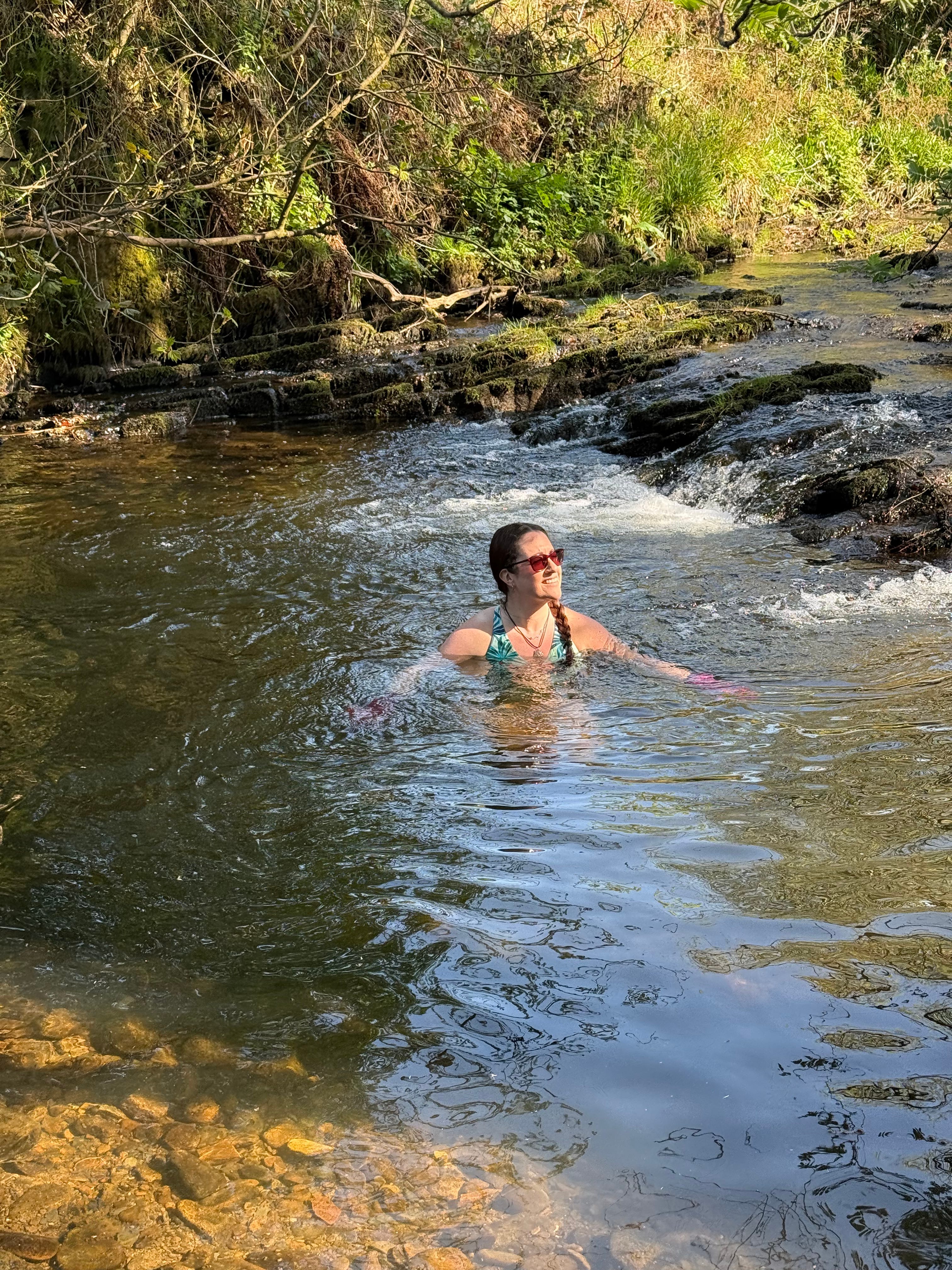
It was December, The reservoir in the Peak District was 1 degree according to the temperature in my friends campervan. I stood at the edge in a costume which was 0% effective in keeping me warm, looking at the water, wondering if I had genuinely lost my mind. Also regretting agreeing to it after my friend had been asking me to do it for years!
I have hypermiobility and chronic pain. I had been been tired from not sleeping well. My nervous system was, by any reasonable measure, not in a state that suggested getting into a cold reservoir was a good idea. But, with support from my friend, I got in anyway. What happened next is difficult to describe precisely, because it happened very fast and very completely. The cold hit my skin and something in me went entirely, suddenly quiet. My mind - which is usually running in three directions simultaneously, processing, planning, worrying - stopped. For the first time in a long time, I was completely and only here. In my body. In the water. Present.
I went home feeling lighter than I had in months. And I started to ask: what actually just happened?
The neuroscience - what cold does to the brain
Cold water immersion triggers an immediate norepinephrine response in the brain. Research has found that swimming in cold water increases norepinephrine by up to 300%. Norepinephrine is a neurotransmitter that plays a key role in pain modulation, mood regulation, and nervous system arousal. At the same time, cold exposure activates the vagus nerve - the primary nerve of the parasympathetic “rest and digest” system.
Regular cold exposure has been shown to increase vagal tone, meaning the body becomes more efficient at returning to a calm baseline after stress. For those of us with central sensitisation, whose nervous systems have been running at high alert, this is directly therapeutic. Cold water also triggers the release of beta-endorphins — the body’s natural pain relievers — and has been shown in clinical research to reduce inflammatory markers. A 2022 study found regular cold water immersion significantly reduced chronic pain scores in participants with fibromyalgia and other central sensitisation conditions. The mechanism is real. The research is growing.
The gate control theory in action
There is also a simpler mechanism at work, one that connects directly to how chronic pain operates. Gate Control Theory - developed by Melzack and Wall in the 1960s and still central to pain science today - proposes that pain signals travelling to the brain can be modulated by competing sensory inputs.
Non-painful sensory stimulation can “close the gate,” reducing how much pain signal gets through. Cold immersion is an extraordinarily powerful competing stimulus. The sensory intensity of cold water on skin produces such a strong signal that it effectively drowns out many pain signals travelling in parallel. This is part of why the first minutes in cold water often feel, paradoxically, less painful than the moments before - and why many people with chronic pain report that cold immersion provides periods of genuine relief.
The soul side - why I keep going back
I want to be honest about what cold water swimming does for mebeyond the physiology. Because the physiology, while real and important, doesn’t fully capture it. I live with a body that is often unreliable. Joints that move too far, pain that arrives without clear reason, fatigue that doesn’t map neatly onto effort. My relationship with my body has been, at times, adversarial - a management problem rather than a collaboration.
Cold water is one of the few experiences that changes that. When I am in the water, I am not managing my body. I am in it. Completely. The cold demands full presence in a way that nothing else quite does. It is impossible to be dissociated from a body in cold water. And in that forced presence, something shifts - a recognition that this body, difficult and unpredictable as it is, is also capable of this. Of feeling this alive. That is not small. For those of us who have spent years at war with our bodies, a few minutes of feeling in them - not despite the pain, but alongside it- can change something fundamental about the relationship.
“Cold water doesn’t fix my pain. But it gives me several minutes of not being at war with my body. And those minutes accumulate into something that feels like peace.”
A word about safety and access
Cold water swimming is not for everyone, and it requires real attention to safety- gradual acclimatisation, not swimming alone, knowing your limits, understanding that some conditions are contraindicated. Please don’t leap into a cold reservoir because a therapist on the internet described it nicely.
But the principle - cold exposure in safe, graduated forms - is accessible to more people than full immersion swimming. A cold shower at the end of your normal shower. Splashing cold water on your face during a moment of overwhelm. These activate some of the same pathways, at lower intensity.
The science is real. The starting point can be small.
From the bank of a reservoir I’ll be back at next week.
With Love,
Sheena xx
P S Y C H O T H E R A P I S T · T H E P A I N T H E R A P I S T · S C I E N C E M E E T S S O U L
No posts
Comments
Nothing yet. Say the first thing.
Sign in to join the conversation.