
The narrative we hold in our mind is powerful. It can be one we crafted ourselves or crafted by another that we allowed in.
As a child my parents instilled a value of hard work. It wasn’t really optional, we had to pull our weight, that’s how we survived. In that my father cultivated a mindset of hurry. “Pick up your feet lets go” was a common line we heard when getting out of the car. Bringing groceries in or stacking firewood he would often look at me and say “hustle boy”. Looking back now he just wanted his son to be competent, it was always in a fun tone making a game of it, but he himself had a lot of anxiety so that became projected into the life lessons. At a young age I pushed back a lot (we fought a lot) but I eventually adapted to survive and a hurried demeanor became engrained and while I wasn’t prone to anxiety a fast pace became my baseline. I walked fast, ate fast and moved fast. Coworkers joked everywhere I worked that Shea runs everywhere. One co-worker would always say “Where’s the zombie?” because he said I moved like a zombie was chasing me.
Fast forward 25yrs, I have a child of my own and I catch myself looking at my 2yr old and saying “lets hustle”. In the moment it was cute and she would swing her little arms at her side pretending to run. But then came the push back and I realized I was subconsciously repeating a pattern. Telling her to hurry created anxiety and that made her react poorly making things not go so smoothly. The mindset I brought to the interaction determined the response.
This is really no different for my relationship to myself. If I make something out to be a big deal in my mind it will feel more difficult than if I approach it with a calculated measured response. In many ways I already knew this. I had worked at incredibly high stakes. I knew what it meant when minutes counted and how to keep a clear head. But watching that play out with my daughter somehow connected the dots to the present which was woodworking.
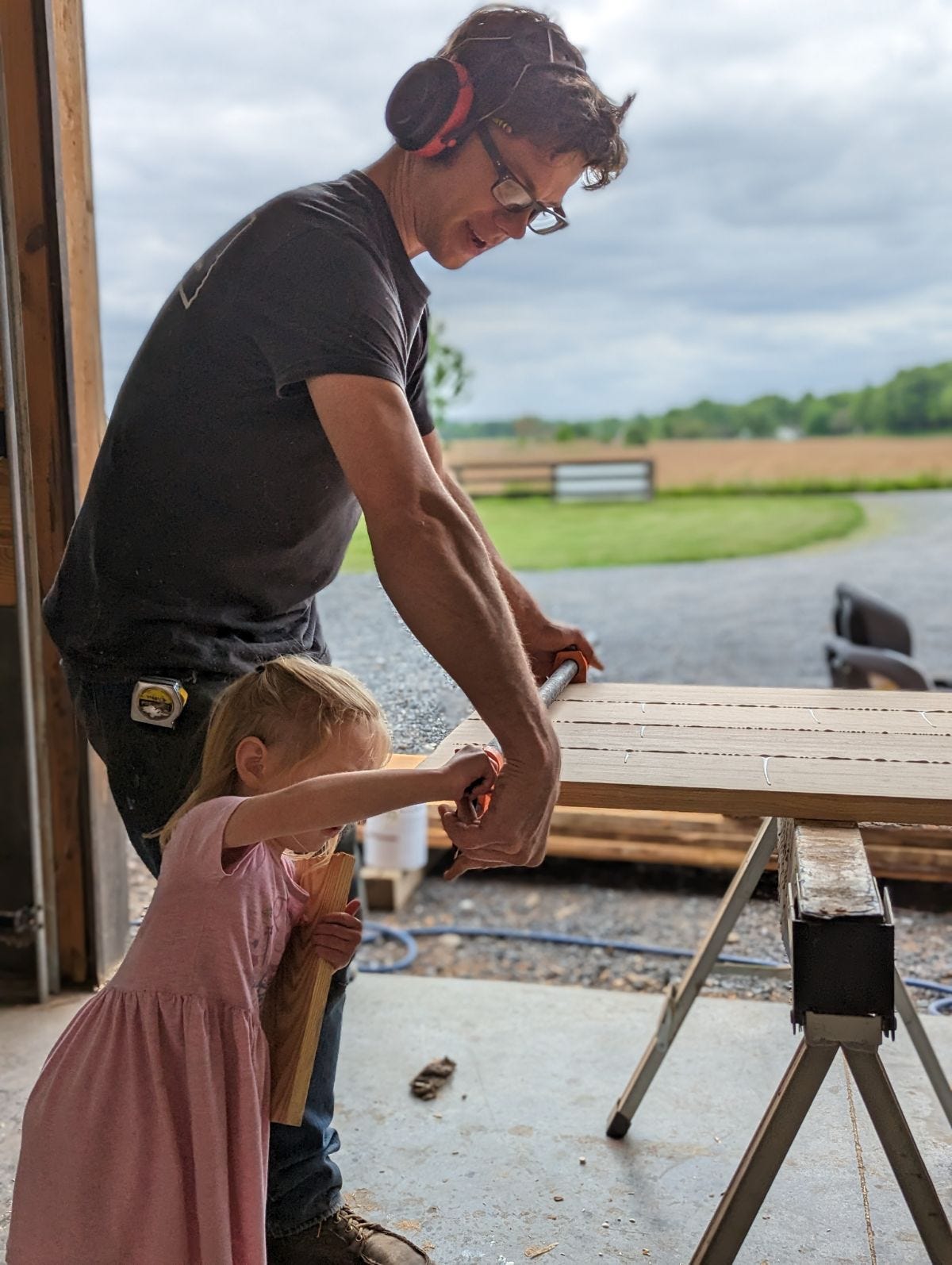
When I finally quit my corporate job to do woodworking fulltime It was prompted by my wife’s health. She needed a major bone reconstruction surgery which meant months unable to walk unassisted and over 2yrs of physical therapy. Our daughter was 18mo old and I worked 7 days a week in both a demanding corporate job and a very busy woodworking business with employees. I realized even if I closed the woodworking business there was no way for me to take care of my wife and keep my corporate job. So I left and the first 2 years of woodworking fulltime was also taking care of my wife and daughter. This put my daughter in the shop with me a lot. And almost daily I had to find a way to do glue ups with her underfoot. The best solution? Letting her help.
Many processes in woodworking have cultivated mindsets attached to them. Steam bending and glue ups often carry a narrative of hurry. Hurry is different from swiftness. Hurry carries a sense of frenzy while swiftness is smooth and controlled. I’ve found that allowing my children to help me with these tasks is an instant feedback mechanism. If I act swiftly they are helpful if I hurry they become anxious. A swift glue up with a 2yr old goes by quickly and they don’t realize there was a timeline. A hurried one and they are yelling and sabotaging the process by the end. Understanding this has also helped me be a better teacher. I’ve seen a lot of teachers stress that something needs to be done quickly. All this does is build a narrative of anxiety. I want my students to watch me do a demo and see it as effortless. Not because it is (there is years of experience and familiarity behind that) but because that is the mindset I want them to approach the task with.
When we hurry our mental state is operating in that flight mode (the zombie is chasing me) we are unable to observe and take in important information. Swiftness is calculated; our speed and movement is determined by our familiarity of the situation and experience with the predictable outcomes. This means the less familiar we are the slower we move. The slower we move the more time we have to correct the course. When I was 16yrs old a boss of mine was teaching me to back up a trailer. After my third try he reached in the truck and shifted it into 4wheel drive low. “How’s that going to help?” I asked. “It will force you to go slow so you have more time to correct,” he said. I backed into the bay perfectly the next try. Slower was faster.
Years ago when Jeff Lefkowitz taught me to build a ladderback chair, routing the slat mortises was a touch intimidating. Here I had prepared a blank successfully, steam bent it and shaped it. If I messed up now that was a lot of work for naught. I would carve out a large chunk of time to focus on that task. A few weeks ago (years and untold number of chairs later) I routed 3 chairs worth in 20min before I had to leave for a dentist appointment. That was a calculated decision to drag out jigs and router I had not used in awhile set it up and execute knowing I only had 20 min. That was swift, but that was backed by familiarity.
So the next time you feel like you have to hurry, slow down, calm your mind and move forward with observation. We are only woodworking after all, what’s the worst that could happen? Wipe the glue off and start over? Put the part back in the steamer? No, the worst would be that in our haste we don’t have time to correct course like that. And we break something.
Comments
Nothing yet. Say the first thing.
Sign in to join the conversation.