
This week’s Gospel is not exactly warm-and-fuzzy Jesus.
No sheep.
No lost coin.
No gentle parable about seeds.
No life-giving cup of fresh water.
Instead, Jesus says things like:
“I have not come to bring peace but a sword.”
“Whoever does not take up the cross…”
Not exactly cross-stitch-on-a-pillow material. Although I'm not sure I’m as convinced about that anymore. And yet, I think Jesus is being deeply pastoral here.
Because Jesus is doing something important: He is telling the truth.
Following Him will not always be easy. In fact, rarely is it.
It will not always make sense to the people around us.
It will not always be welcomed.
It will not always feel comfortable.
That lands differently today than it once did.
There was a time when churchgoing was part of the cultural rhythm. Sunday morning meant church. Children were baptized. Families showed up. Faith had a place in the weekly pattern of life.
That world has changed.
And many people feel that change deeply.
I often hear the following statements. In fact, all of them 3 weeks ago, after I was visiting and preaching to a congregation:
“My kids don’t go to church anymore.”
“My grandkids have never really been part of church.”
“It makes me sad.”
If that’s your story, I want to say this plainly: that sadness is real grief.
It’s not just nostalgia or frustration.
It’s grief.
You brought your children to church. You taught them prayers. You made sure they heard the classic Bible stories. You took them to Sunday School, youth group, and confirmation.
You tried.
And now many of them are somewhere else. Busy, skeptical, disillusioned, indifferent, or perhaps carrying wounds from church somewhere along the way.
And beneath the sadness and grief is often a deeper question:
Did I fail?
Did I do something wrong?
Why didn’t “it” stick?
If that is you, I hope you can hear this: Their choices are not entirely your burden to carry.
You are influential, but you are not sovereign.
Only God saves.
Only the Holy Spirit changes hearts.
Only Jesus calls people to himself.
You planted.
You watered.
You prayed.
And sometimes we forget that God is still at work long after someone stops showing up in a pew. Sometimes seeds lie dormant for years. Yes. Years.
And then something happens. Loss, beauty, crisis, exhaustion, wonder and suddenly old prayers return. Words learned in childhood surface again.
So don’t stop praying.
And don’t assume God is finished.
Jesus repeats something three times in this passage:
“Do not be afraid.”
Three times. If Jesus says it three times, take notice.
Why the highlight? Because fear gets into everything!
And fear doesn’t always look dramatic. Sometimes it sounds very respectable.
What happens to this church when we’re gone?
Will there be enough money?
Will there be enough people?
Can this parish survive?
But Jesus says: “Do not be afraid.”
Not because those concerns are imaginary. They’re real. But because fear makes a terrible shepherd.
Fear makes churches cling and shrink.
Fear makes us spend all our energy preserving instead of proclaiming.
Jesus keeps calling His disciples back to trust.
He points to something wonderfully ordinary:
“Are not two sparrows sold for a penny? Yet not one of them will fall to the ground apart from your Father.”
Jesus points to birds.
Tiny, ordinary birds.
The kind you barely notice.
The ones on fence posts.
The ones in the trees.
The ones pecking around the yard.
And He says: God sees every single one. Every sparrow. So if God notices sparrows…
Do we really think He has lost sight of our children?
Our grandchildren?
Our churches?
No.
He has not forgotten them. And He has not forgotten us.
But Jesus doesn’t only comfort us here. He also challenges us.
He says:
“Everyone who acknowledges me before others…”
That doesn’t mean being loud, pushy, or performative.
But it does raise an uncomfortable question: What kind of witness are we offering now?
Too often we assume the main problem is, They don’t come to church anymore.
But there’s another question worth asking.
When our children and grandchildren look at us, what do they see?
Do they see anxiety or peace?
Bitterness or grace?
Fear or hope?
Do they see people desperately trying to prop up an institution? Or people deeply alive in Jesus?
That matters more than we think.
Faith is often caught before it is taught.
People are rarely drawn by guilt.
They are drawn by life.
By joy.
By peace.
By something that feels real.
I wonder if our witness in this season is less about persuading with words and more about showing what a life with Jesus actually looks like.
A steady life.
A gracious life.
A hopeful life.
A life with deep roots.
A life that can say:
I’ve known sorrow.
I’ve known loss.
I’ve known uncertainty.
And Christ has held me.
That kind of witness speaks loudly.
Even when words are few.
Then Jesus says the hard thing:
“Those who find their life will lose it, and those who lose their life for my sake will find it.”
This is a kingdom paradox.
The tighter we grip: control, certainty, comfort, the past, the more anxious we become.
Churches do this too.
We cling to what used to work.
What used to be full.
What used to feel normal.
We are invited into a posture of ‘open hands.’ Because resurrection life is rarely found in clinging. It is found in surrender. In trust.
In praying a hard prayer, like:
Lord, this is your Church.
These are your people.
These are my children, but they belong to you even more than to me.
I release what I cannot control.
That is not an easy prayer. But it is a holy one.
If you’re carrying grief today for a son, daughter, grandson, or granddaughter, or [insert loved one here]; bring that grief to Jesus.
Speak their names in prayer.
Keep loving and welcoming them.
Resist the urge to nag or guilt. Yes - you. Stop that!
Keep trusting that God can work in ways you cannot see.
Because the story may not be over.
And for all of us, Jesus gives the same invitation:
Do not be afraid.
Our hope has never been in numbers.
Our hope has never been in cultural influence or in being the majority.
Our hope is Christ. The crucified and risen Christ.
The One who knows every sparrow.
Every grief.
Every prayer whispered through tears.
The One who still builds his Church.
And He is not finished.
Not with your family.
Not with your church.
Not with you.
So keep showing up.
Keep praying.
And loving.
And trusting.
And be gracious to yourself.
Christ is still at work.
Even now.
Even here.
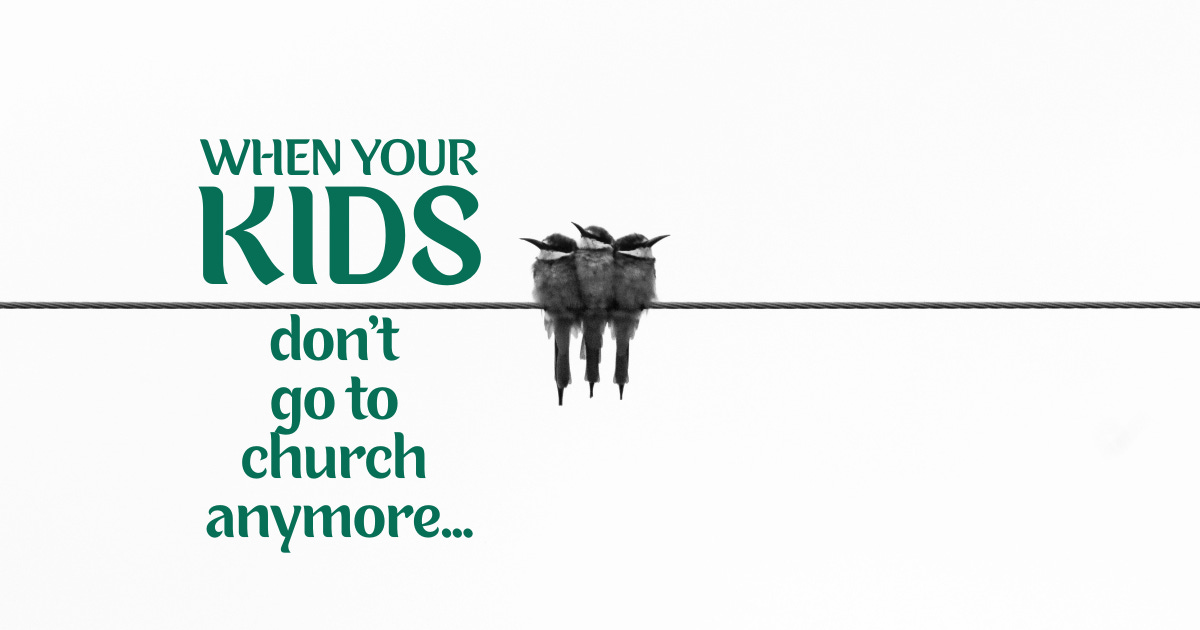
Photo by Glen Carrie on Unsplash
No posts
Comments
Nothing yet. Say the first thing.
Sign in to join the conversation.