
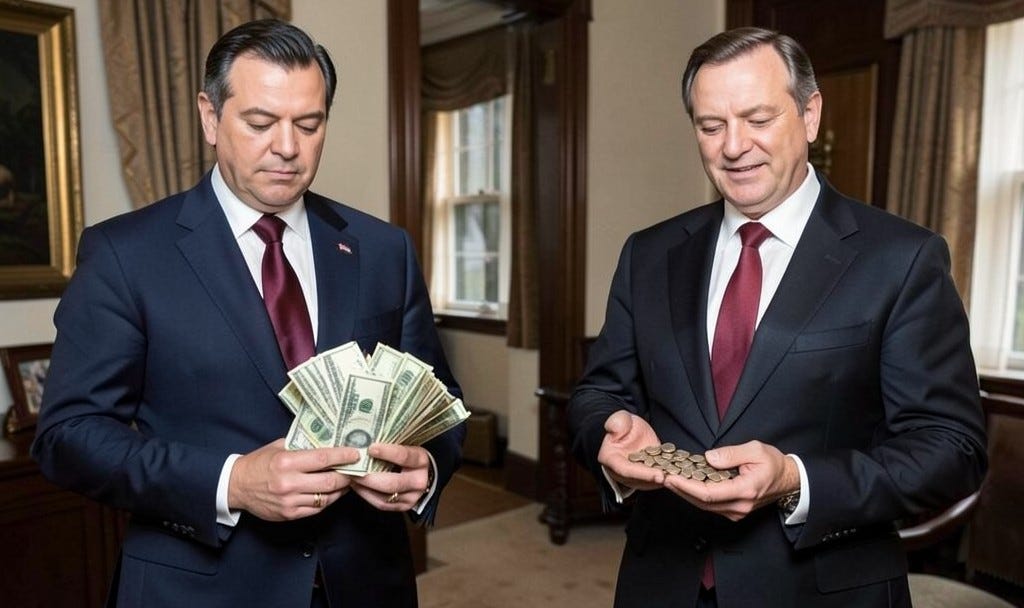
Heading into the Midterm Elections, Democrats face a giant cash shortfall, especially compared to Republicans. Things are so tight on the Democrat side, the Democratic National Committee (DNC) has asked some vendors to delay billing for payment until after the midterms. And DNC officials have said the party will not make the customary payments to the funds that support Democrats running for Congress— a break from longstanding practice.

As of the end of June, the Democratic National Committee (DNC) reported it had more debt than cash, leaving it $2.2 million in the red. That’s $16.3 million in cash alongside roughly $18.5 million in debt.
Meantime, the Republican National Committee (RNC) set successive monthly records for cash-on-hand.
The disparity extends well beyond the national party committees. Taken together, the three main Republican party committees plus their two main super Political Action Committees (PACs) and the pro-Trump super PAC: MAGA Inc., counted $800 million compared to $334 million for Democrats. (Super PACs are officially known as “independent expenditure-only political committees.” Unlike limits imposed on candidate’s fundraising and regular PACs, there’s no limit to what Super PACs can raise or spend. Initially, they were not permitted to give money directly to candidates or coordinate with their campaigns. However, Democrats stretched the rules and a Supreme Court decision lifted those limits on coordinated spending.)
Read on for details.
According to Ballotpedia, through June 30, 2026, showed the three Republican committees had raised $633 million and spent $408 million. The three Democrat committees (DNC, DSCC, DCCC) had raised a cumulative $546 million and spent $467 million in the cycle.
Here is the cash on hand reported in the House and Senate:
$93 million: The National Republican Congressional Committee (NRCC)
$79 million: The Democratic Congressional Campaign Committee’s (DNCC)
$56 million: The National Republican Senatorial Committee (NRSC)
$41 million: The Democratic Senatorial Campaign Committee’s (DSCC)
Historical Context
Democrats being behind isn’t surprising. Parties not holding the White House have long faced fundraising headwinds for their national committees. But the current gap is unusually large compared to recent midterm cycles.
At the comparable mid-year point in the last out-of-power midterm cycle, the end of June 2018, the DNC held about $8.7 million cash against roughly $6.2 million in debt. That was a $2.5 million net positive rather than a negative.
In earlier election cycles, the out-party national committee often trailed. But it rarely carried sustained multi-million-dollar net debt this deep into an election year while the in-party committee built nine-figure reserves.
It’s not unprecedented. The last time the DNC finished a full year net negative was 2012, a presidential election year. The DNC had a net shortfall of roughly $4.7 million— about $7.1 million cash versus $11.8 million in debt—and finished with $21.5 million in debt.
At the end of 2010, a midterm year, both parties had more than $15 million in debt.
Why the Shortfall Despite Wealthy Donors?
Several factors help explain the gap.
First, the structural disadvantage. Republicans currently control the White House and both chambers of Congress. As I mentioned, National party committees typically raise more when their party holds the presidency, as donors seek to curry influence and favor with those in power.
Second, according to analysts, there is Democrat donor frustration after the party’s 2024 losses. Rich contributors are said to be withholding or delaying large contributions amid skepticism about the party’s direction, lingering questions over the 2024 campaign, and what they see as the absence of a full public “autopsy.” One Democrat strategist cited in the Washington Examiner described an “institutional confidence issue,” with donors feeling party leaders had painted an incorrectly optimistic picture while soliciting funds.
A third factor is said to be spending choices made under DNC Chair Ken Martin’s leadership. The DNC has focused on making early, consistent payments to state parties, staffing, technology, and organizing infrastructure rather than saving cash reserves for advertising as the Midterms near. USA Today reported the DNC gave $21 million to state parties last year and so far this year— five times what the RNC gave. The DNC also reportedly spent more on payroll even though the RNC has more people on the payroll.
Martin has defended his priorities as building permanent capacity instead of a “boom-and-bust” model that focuses on last-minute media.
A fourth reason behind the DNC shortfall is that it took out a $15 million loan late last year using its Washington D.C. headquarters as collateral. It’s reported to be the DNC’s largest such loan for an off-year election cycle of this type. The building has been pledged in prior credit lines, but the size for this period is said to be exceptional. The DNC has also paid hundreds of thousands in interest alone, averaging over $75,000 per month in some periods, for leftover 2024 obligations.
A fifth reason the DNC is short on cash has to do with the pattern of big-donor giving. As you may know, the famous, or infamous billionaire George Soros and his son Alex are major funders of Democrats. They’ve given big, $103 million, mostly through Democracy PAC and related vehicles into outside groups and candidates. Yet they have not given directly to the DNC. This is different than prior midterms when they contributed hundreds of thousands to more than $1 million.
Some other high-profile donors, including Reid Hoffman, have also given limited or zero direct support to the DNC. They may be supporting individual candidates and congressional campaign committees or super PACs, but they’re steering clear of the national party apparatus.
Democrat candidates themselves have shown stronger fundraising in many competitive races, which helps to partly make up for the DNC’s shortfall.
In his defense, DNC Chair Martin notes that the committee has raised a record sum for any DNC without the White House—more than $207 million in total receipts through June 2026, versus about $109 million in a comparable stretch of the prior Trump-era cycle. He says the current cash shortfall is from deliberate early spending on state parties, infrastructure, staff, and organizing that I described.
The Trump Factor
There’s a clear Trump-related boost to Republican fundraising that’s added to the disparity.
Trump’s personal brand, small-donor network, joint fundraising committees, and super PAC infrastructure amplify his cash advantage beyond the standard presidential effect.
RNC officials and analysts explicitly credit Trump and Vice President Vance for the record cash levels. The totals are larger than the Republican edge at the comparable stage of the 2018 midterms under Trump’s first term.
Money doesn’t guarantee victory, in fact Trump has proven a candidate can raise less and till win. But the disparity does often have real implications. A recent Supreme Court ruling lifted limits on coordinated spending between national party committees and their candidates, amplifying the value of cash on hand.
The RNC’s large reserves now give Republicans more power. The group can coordinate and pour unlimited cash into targeted races for advertising, field operations, data, and rapid response.
Overall, both parties’ fundraising has continued to explode in scale over the years. Nobody can claim to know how the current slant will impact the Midterms, but some strategists have said the Republican outside-money edge could stunt momentum that might otherwise favor a rebound for Democrats.
Comments
Nothing yet. Say the first thing.
Sign in to join the conversation.