
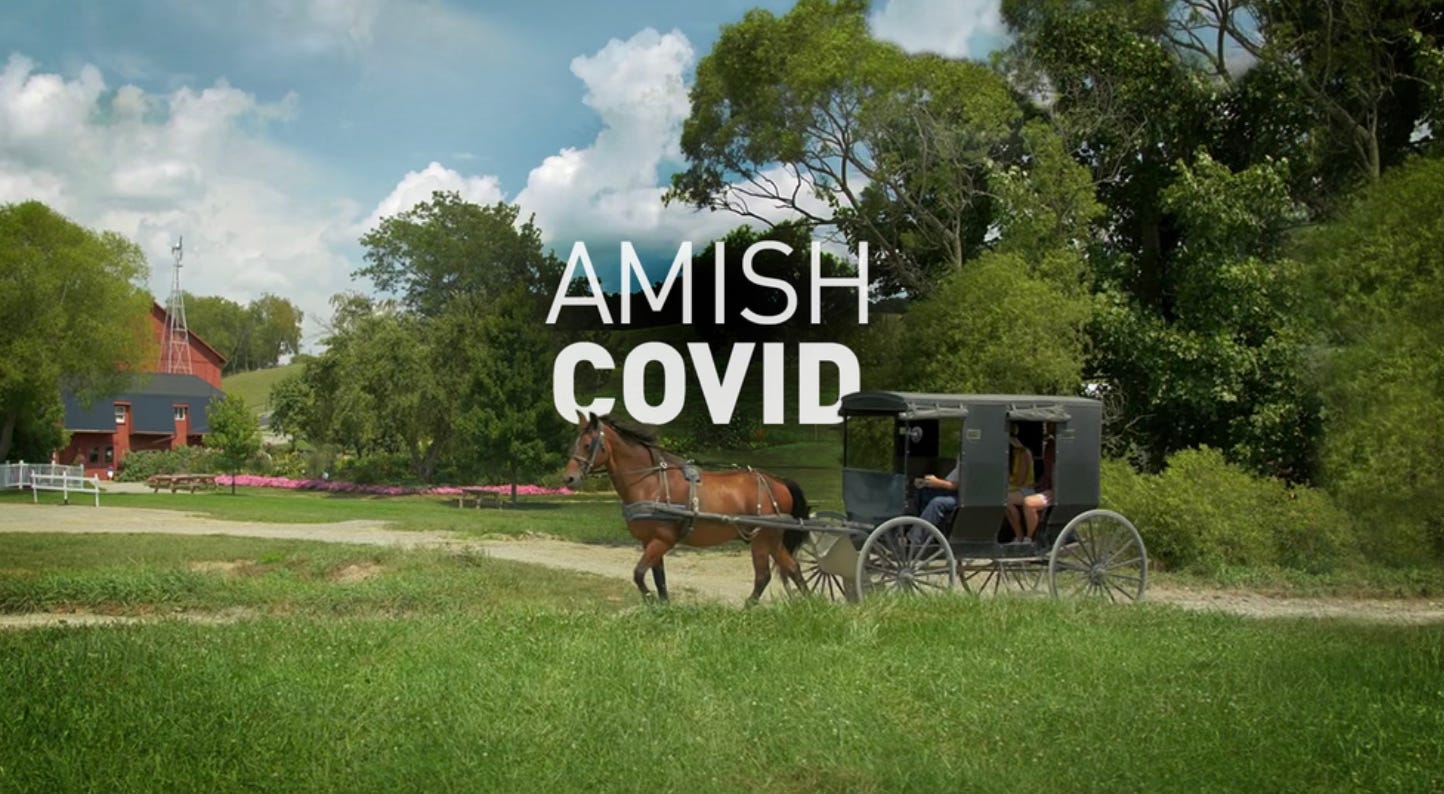
In 2021, I reported on my national television program Full Measure that the largest Amish community in the US, Lancaster Pennsylvania, had rejected masking, vaccines, isolation, testing, and all the other CDC recommendations for Covid… and apparently fared none the worse for having done so.
You can watch my television news report below. The story was of such high interest that even after it aired on TV, it racked up millions more views online.
This attention to the Amish approach and its apparent success obviously didn’t please public health officials and industry advocates who were heavily pushing different narratives. They wanted the public to believe that anyone who wasn’t social distancing, staying home, getting vaccinated, shutting down the works, and taking government-favored prescription drugs were putting themselves and others in grave danger.
As the revelations about the Amish made international headlines, there appeared to be a propaganda-driven effort to make it seem as if the Amish actually suffered far worse than everyone else for having failed to follow CDC’s advice.
A study was published entitled: “Closed but Not Protected: Excess Deaths Among the Amish and Mennonites During the COVID-19 Pandemic.” It appeared in the Journal of Religion and Health on June 11, 2021.
But I noticed serious flaws with the study and decided to challenge it. Among the problems I saw:
For their study population, the researchers grouped together a sample of Mennonite and Amish— even though Mennonites typically followed CDC guidelines while the Amish did not.
They excluded the largest Amish population in the US in Lancaster, the one that was actually the subject of the news reports.
And their study headline was at odds with what their own data showed: even with their skewed sample, the Amish fared no worse than the rest of the US for not having shut down.
After examining the study, I tried to get further information to determine if corrections were warranted. Among other things, I wanted to know:
Who were the peer reviewers who had signed off on a deeply flawed study?
What did the actual study notes and data show about why the most obvious study sample population was excluded?
What were some of the internal communications before and after publication?
With scientific studies, all the data is supposed to be available for public review and replication for obvious reasons. Studies aren’t considered scientifically valid without this kind of transparency. And, in many cases, we actually own the data because our tax money paid for the study—or some of it— or pays the salaries of some of the people involved.
But in this case, as with other with other times I’ve pursued study information, the scientific establishment found a way to exempt itself from the common sense oversight guidelines.

Instead of encouraging open examination, those involved in the study treated the details of their work as if they are proprietary secrets, closely held and guarded like gold in Ft. Knox.
Ultimately, I felt forced to file Freedom of Information Act requests in my effort to get the obviously public information. As usual, they stalled, played games, claimed they couldn’t respond for various reasons, and exempted the most important information. They try to make the requester— me, in this case— give up and if that doesn’t work, they take days, weeks, months, even years beyond what the law supposedly allows, to hand over what little information they decide to let go of.
When I struck out getting vital information regarding the Amish study, I pursued the publisher and outlined my questions. You can read my letter below.
It took a year of prodding, but I finally received a notice from the publisher that it was issuing several corrections to the study because of my challenges.
Unfortunately, the wording of the corrections didn’t do much to fix the problems I identified, and the misleading headline remains in place.
In the end, that study supported my reporting on the Amish approach to Covid.
Importantly, it implied the rest of us could have avoided experimental vaccines that have serious side effects; and circumvented costly shutdowns that devastated the economy, travel, businesses, mental health, and education at the expense of trillions of US tax dollars.
This is an instructive example of some of the flaws with the system that produces “peer reviewed, public studies.” The “tell” is the fact that all concerned seem to work against transparency (which legitimate, well-designed studies should welcome), and treat the public as if they have no right to know whether their tax dollars are being properly spent.
Read details below.
Below is my original letter of concern about the Amish study. The National Science Foundation (NSF), which was involved in funding the study, would not properly respond to my Freedom of Information Act request within the required time and claimed important exemptions. (See NSF letter below). West Virginia University where the research was conducted was much the same story, though they belatedly turned over limited material.
June 17, 2023
Journal of Religion and Health
Dear Editors:
Thank you for the opportunity to raise queries regarding “Closed but Not Protected: Excess Deaths Among the Amish and Mennonites During the COVID-19 Pandemic” published June 11, 2021 by authors Rachel E. Stein, Katie E. Corcoran, Corey J. Colyer, Annette M. Mackay & Sara K. Guthrie.
As you know, author Rachel Stein has declined to answer some important questions arising from this publication, which itself creates a barrier to a thorough scientific understanding of the research. Here are the issues that I hope can be addressed:
The study’s title and conclusions may be misleading in that they seem clearly intended to imply there was a unique spike in deaths among religious communities that shunned Covid-19 vaccinations, masking, isolation, and other CDC-recommended practices. For example, one passage from the publication states: “The large number of excess deaths among the Amish and Mennonite community is concerning.” However, details of the study do not support this implication. The study finds that the excess death rate in the two Closed Religious Communities that were examined in one state mirrored that of the general population. One passage from the publication states, “Our results indicate the Amish/Mennonite excess death rates are similar to the national trends in the USA.”
The study blended data from two very different populations to form a conclusion that may not apply to them individually. When I asked author Stein why the study combined Amish and Mennonite deaths, she replied that “We did not analyze Amish and Mennonite deaths separately. The data didn’t allow for subgroup analysis.” This is a critical and potentially fatal flaw with the study. Amish and Mennonite are distinct religious communities with significantly different practices. Author Stein, who lists herself as an expert in “Old Order Amish,” would likely understand this. Specifically, Mennonites are more likely than Amish to live lives closer to those of ordinary Americans and follow recommended public health practices. By way of example, almost all the residents living at two Mennonite Home Communities in Lancaster, Pennsylvania followed CDC protocols including wearing masks, isolating, social distancing, and getting vaccinated for Covid-19. According to managers of the Mennonite facilities: “Numerous vaccine clinics have been held at [Mennonite Home] and [Woodcrest Villa] resulting in almost all residents being vaccinated against COVID-19 infection.” Likewise, Ohio Mennonite homes promoted Covid vaccinations, are still promoting Covid-19 vaccine boosters for residents, and were masking as recently as January of this year. Therefore, the study scientists incorrectly included a population, undisclosed or unknown in size, that followed CDC practices (Mennonite) to form a conclusion about a population that rejected CDC practices (Amish).
The study failed to include and report on the largest population of Amish in the US. The decision to analyze only the state of Ohio is puzzling since Ohio does not have the largest Amish population in the US: Pennsylvania does—by a significant margin. Larger datasets may yield more accurate results. At the very least, the reasons behind the choice to skip over the largest Amish population should have been clearly addressed in the study.
The focus on Ohio introduces a potential bias into the findings. When I asked author Stein why Pennsylvania was excluded from the study, she indicated she and her colleagues chose Ohio because there was a disproportionately high number of Amish and Mennonite obituaries in Ohio compared to other states, including Pennsylvania. In effect, this could inadvertently result in presenting the worst case scenario for Closed Religious Communities (CRCs). According to Stein, Ohio is “home to approximately 23% of the US Amish population, but contributing 56% of the total obituaries published in the Budget” and “Pennsylvania was not represented to the same degree as Ohio in the data.” The researchers needed to explain whether and how they excluded the possibility that the Pennsylvania death rate among CRCs was significantly lower than that in Ohio. If the authors could not reasonably estimate what proportion of actual deaths in each state was published in the Budget (the publication they used as their source for obituaries) then it seems they did not have the information available to be able to make meaningful death rate comparisons.
The primary graph in the study, Figure 1, did not compare like groups. While it is not clearly labelled, Figure 1, if I understand correctly, apparently compares a national average of deaths over time… to Ohio State Amish and Mennonite deaths in 2020. A more logical and instructive comparison would have been to measure Ohio’s deaths over time to Ohio Amish and Mennonite deaths in 2020 or the national average over time to the to the national Amish and Mennonite figure in 2020.
If the study is accurate as is, it buries important scientific findings. While the study leaves the impression there is special concern about Covid spreading worse or being more lethal in the Mennonite and Amish communities due to their supposed failure to follow public health guidelines, the study notes that the Mennonite/Amish death rate actually mirrored the general US death rate. If true, then stated another way, the Amish-Mennonite communities had no worse outcome for having avoided devastating economic and school shutdowns, masking, isolation, vaccination, and all of the spending on these measures. This is a finding of significant importance; yet the researchers seem not to notice. A second important finding that the researchers seemed to overlook was that if their study is accurate, it means the widely-accepted principle of natural immunity (as being more effective than Covid-19 vaccination) was uniquely turned on its head with the CRC community. This would be an important conclusion, indeed.
The study content does not match the description submitted for the grant. The publicly-published grant proposal does not indicate the study will focus narrowly on only Ohio (to the exclusion of the largest Amish population). The study does not appear to examine “misinformation and specific practices” within CRCs, as promised in the proposal. It also doesn’t seem to address “social distancing and isolation content” or “COVID-19-related official instructions..gathered and tracked over time.” Additionally, “county health district data” over time was not published. When inquired as to whether there was a revision of the envisioned project, Stein told me that those “other aspects of the project” address these things. However, there seems to be nothing in the public grant description that describes this study on excess death rates (absent a misinformation or specific practices context).
In conclusion, there seem to be several outstanding questions. What would the Ohio 2020 CRC death trend look like compared to Ohio-only deaths 2015-2019 (rather than to a national 2015-2019 average)? To what degree does inclusion of the Mennonite population skew the results? What would the results look like if only the Amish were studied? What would the comparison look like if Pennsylvania and other states were included in the analylsis? What proportion of the Ohio Mennonite population followed CDC-recommended practices (if unknowable— then it seems to me the study has little ability to inform the question at hand). And, most important of all, why were the most significant takeaways of international interest seemingly ignored including that the researchers found no evidence that the Amish suffered more harm for not having shut down schools, businesses and church; for not isolating, masking or social distancing; for not Covid testing and vaccinating; and for not having spent a great deal of public funds on various measures.
Thank you for your consideration.
Sharyl Attkisson
Dear Ms. Attkisson,
NSF does not release reviewer names; accordingly, redactions will be made to protect the personal privacy of the reviewers under Exemption (b)(6) of the FOIA. The relevant NSF Privacy Act System of Record Notices further explain that reviewer names will not be released:
NSF-12 Fellowships and Other Awards, NSF-50 Principal Investigator Proposal and Associated Records, NSF-51 Reviewer Proposal File and Associated Records, and NSF-54 Reviewer Fellowships and Other Awards File and Associated Records
Courts have also upheld NSF’s withholding of reviewers’ names under FOIA Exemption (b)(6). See, e.g., Amiri v. NSF, No. 1:20-CV-02006 (TNM), 2021 WL 4438910, at *13 (D.D.C. Sept. 28, 2021) (NSF properly invoked FOIA Exemption (b)(6) to withhold the names of reviewers, in light of their substantial privacy interests and the foreseeable risk of professional harm to them).
NSF will grant your request for expedited processing, but understand we do have a small staff of 2 processors. As of June 16, 2023, we will consider your request perfected and proceed with processing your request.
Sincerely,
Sandra Evans
NSF FOIA/PA Officer
National Science Foundation
Office of the General Counsel
2415 Eisenhower Avenue, Suite W 18200
Alexandria, VA 22314
August 21, 2024
Stein, R.E., Corcoran, K.E., Colyer, C.J. et al. Closed but Not Protected: Excess Deaths Among the Amish and Mennonites During the COVID-19 Pandemic. J Relig Health 60, 3230–3244 (2021).https://doi.org/10.1007/s10943-021-01307-5
Dear Ms. Attkisson,
We are contacting you as you expressed concerns regarding the article detailed above.
Thank you again for providing a detailed overview of your specific concerns about this paper.
All of your claims have been thoroughly assessed by multiple members of the editorial team. Your case has also been considered in detail by our in-house Research Integrity Group. All processes were carried out in line with Committee on Publication Ethics (COPE) guidelines. Thank you for your patience as we completed this process.
Following this detailed investigation, we found that the publication could have been more clear about what data was being shown in some of the included tables, and that one sentence in the abstract could potentially cause some confusion about the conclusions being presented. In view of this, we have corrected the publication. The published correction details the specific changes made to the original article in order to provide some additional clarity to readers.
We thank you for bringing this issue to our attention.
With best wishes,
Kimberly Poss
(she/her/hers)
Associate Publisher | Behavior and Health Sciences Journals
Comments
Nothing yet. Say the first thing.
Sign in to join the conversation.