
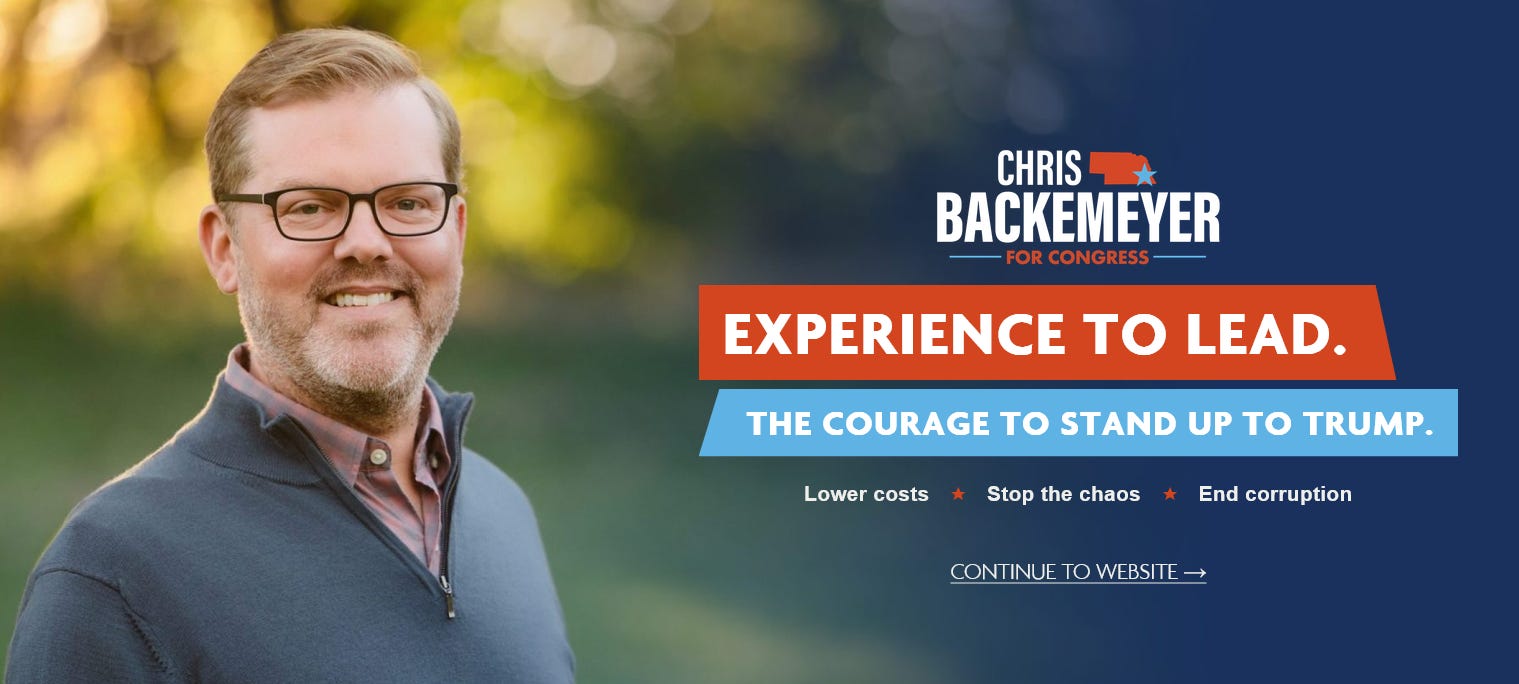
Author’s Note: Being an independent from a red state (Nebraska), I thought I’d take the opportunity to highlight some of the candidates from red states that I believe can/will flip a Senate/House seat from R to either I or D. These include races in Alaska (Senate), Arkansas (Senate), Idaho (Senate), Iowa (Senate), Kansas (Senate), Mississippi (Senate), Montana (Senate & House), Nebraska (House & Senate), South Dakota (Senate) and Texas (lots of House seats in play thanks to mid-Census gerrymandering so I’ve picked the most visible one).
The credentials of the people running are (in my view) astonishing. Moreover, the campaign themes coming from these candidates are worth noting.
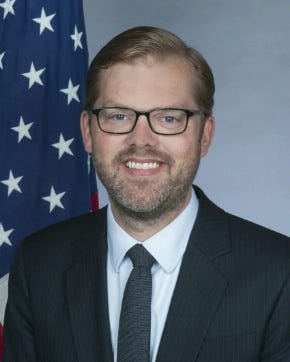
Before returning home to Nebraska, Chris Backemeyer served as "Deputy Assistant Secretary for Assistance Coordination and Regional and Multilateral Affairs in the State Department’s Bureau of Near Eastern Affairs, where he oversaw cross-cutting regional policy issues and coordinates over $7 billion in foreign assistance for the Middle East and North Africa. He is a career member of the Senior Executive Service.
Previously, Mr. Backemeyer served as Special Advisor in the Office of the Vice President, where he advised Vice President Harris on national security and foreign policy issues related to the Middle East, international economics, and climate change.
From 2017 – 2021, he served as Deputy Assistant Secretary for Press and Public Diplomacy and Assistance Coordination in the Bureau of Near Eastern Affairs.
From 2016-2017, Mr. Backemeyer served as the Deputy Assistant Secretary for Iranian Affairs and oversaw the Department’s diplomatic efforts toward Iran.
From 2015-16, he served as the Deputy Coordinator for Sanctions Policy. In this role he represented the United States in the P5+1 negotiations with Iran over its nuclear program, where he served as the lead sanctions negotiator.
From 2012 to 2014, Mr. Backemeyer served as the Director for Iran on the National Security Council staff at the White House, where he was responsible for advising the President, National Security Advisor, and other White House officials on strategic priorities for Iran during a period of burgeoning diplomatic discussions over its nuclear program.
Prior to his time at the White House, Mr. Backemeyer served as the Deputy Director of the Office of Sanctions Policy and Implementation at the State Department, where he was responsible for effectively implementing U.S. sanctions in a variety of areas.
Prior to his service in government, Mr. Backemeyer worked in the banking sector where he focused on commercial financing of corporate and real estate transactions. Mr. Backemeyer is a Chartered Financial Analyst (CFA). He also holds a Master’s degree in International Affairs from the School of International Relations and Pacific Studies at the University of California San Diego and Bachelor’s degrees in Finance and Political Science from Arizona State University.
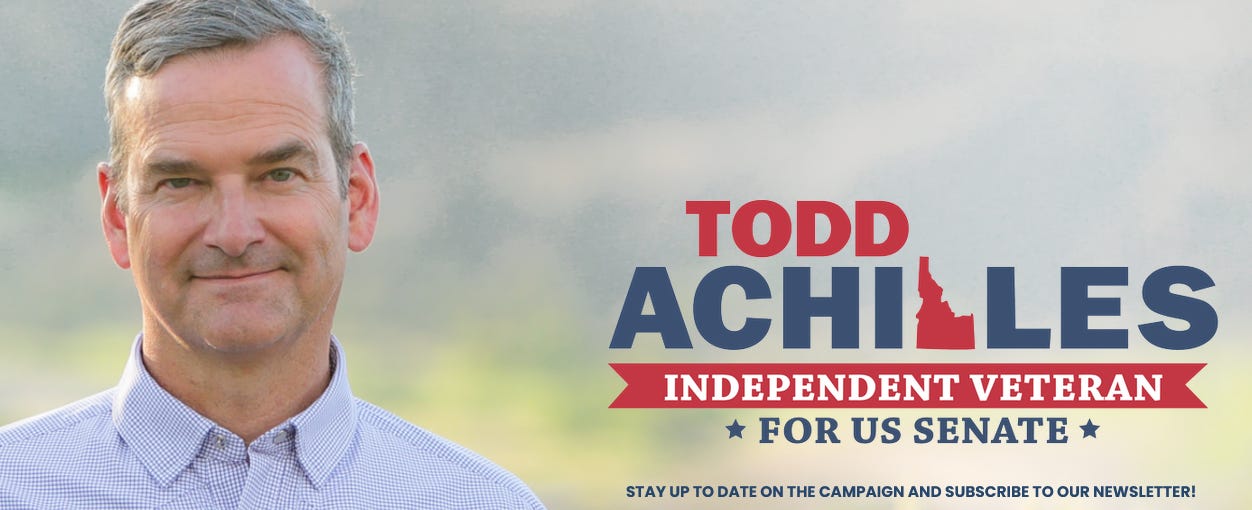
Todd Achilles said he was gassing up his Mercedes-Benz Sprinter van at a convenience store in southeast Idaho when he met the manager: a woman about his own age who’d been running similar stores for about 10 years.
She told him she earned $19 an hour, in a part of the state where the living hourly wage is $23, and had no health insurance plan. It was clear, he said, that she hadn’t had access to dental care, either.
Achilles said he looked up the convenience store company’s financial statements and saw it had earned about $1 billion in net income in 2024 but had spent all of that on share buybacks, giving none of that profit to its employees.
The episode encapsulated for Achilles, 58, the reason he was out in his van — his home while he’s on the campaign trail — in the first place. All over the country, companies are able to pay their workers an unlivable wage, while taxpayers foot the bill for Medicaid, SNAP and other safety net programs as health care costs climb, he said.
“It just speaks to so many issues that are wrong right now,” he told reporters Thursday, after he filed to run as an independent candidate for U.S. Senate against Republican Sen. Jim Risch.
…. Achilles, who served as a Democratic state representative from Boise until 2025, used to hold senior roles at two large companies. He said the concentration of wealth — and the role of corporate money in politics — has worsened in recent years. He compared American politics today with those of the country’s Gilded Age in the late 1800s.
He cited multimillion-dollar political campaigns nationwide, which he called evidence of a “flat-out broken” system. “I’m disgusted by what I see,” he said.
He’s betting that Idahoans see the same thing. At dozens of town halls and campaign events around the state, Achilles said he’s seen an even mix of Democrats, Republicans and independents — even supporters of President Donald Trump — come out in support.
“Two-thirds of Idahoans voted for President Trump because they’re struggling, and President Trump represented that outsider that was going to break up this broken system,” Achilles said. “I think people are looking at this thing now, a year into it, and the shine is kind of coming off of that.”
But few see the Democratic Party as an answer, he’s found. “People are beginning to realize that the issue is not left vs. right. It’s top vs. bottom,” he said. “It’s who’s got the power, and who doesn’t.”
Gallup found that in 2025, a record-high 45% of Americans identified as independents. Achilles changed his own voter registration from Democratic to independent in June, he said. [Sarah Cutler, “‘Flat-out broken’: Independent candidates bet Idaho is fed up with party politics,” Idaho Statesman, February 28, 2026]
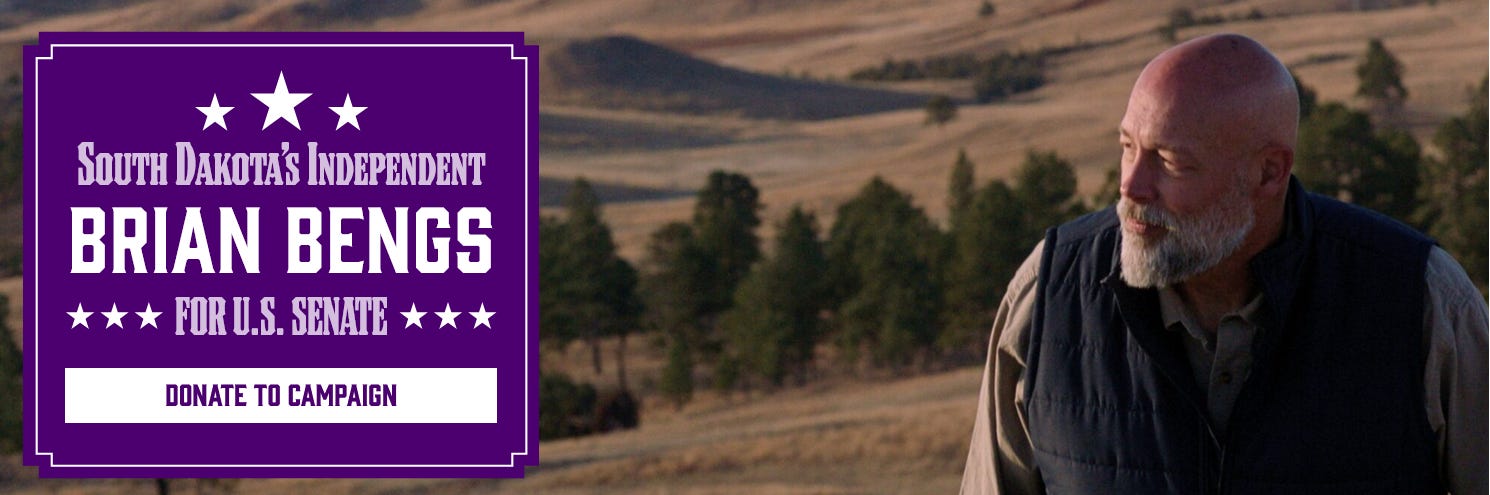
I. The Candidate. Brian Bengs grew up in South Dakota, attended Northern State University, and spent the better part of his adult life as a military officer, serving as a JAG attorney—a military prosecutor and federal ethics advisor—before retiring and returning to the state.
He taught law and society to undergraduates at Northern State, a class he describes with genuine affection:
“I got to pick hot button topics—abortion, affirmative action—and enforce the rules of, we’re going to have a civil discussion about this. You can say whatever you think as long as you’re doing it in a respectful manner, and I’m going to dissect your argument.”
He has a law degree and a deep, working familiarity with constitutional history that surfaces constantly in his policy thinking—he’s the kind of candidate who answers a question about money in politics by tracing the constitutional amendment process back to 1787 and building a novel legal argument from there.
A lifelong independent, he decided to run as a Democrat for Senate in 2022 against John Thune, who now serves as the Senate Majority Leader, losing by 27 points. He’s running again in 2026, this time as an independent, against incumbent Republican Senator Mike Rounds.
II. The Race. Bengs is running against two-term Republican Sen. Mike Rounds. Rounds has raised $3.9 million this cycle and carried $2.7 million cash on hand through May 13, per FEC filings. Bengs has raised $666,000 with $58,000 cash on hand. Democrat Julian Beaudion rounds out the field with $210,000 raised and $3,000 cash on hand. South Dakota has approximately 600,000 registered voters, split roughly 51% Republican, 23% Democrat, and 26% independent. The state has been a Republican stronghold in federal races for decades.
In head-to-head polling between Rounds (Republican) and Beaudion (Democrat), the incumbent handily wins 56-31. But a head-to-head between Rounds and Bengs tells a different story: 44-40, a race within the margin of error, and with Bengs’ name recognition lower than the incumbent’s.
The same polling has the three-way general at 43-23-18, with Bengs running 5 points ahead of the Democrat—a gap that is the foundation of his argument that he, not Beaudion, is the viable path for the roughly 29% of South Dakotans who want a change. While it needs to be noted that the poll in question was sponsored by Bengs, no one—including Beaudion—has released a poll with different results.
III. Why Independent: A Lesson Learned at Parades. Bengs describes himself as a lifelong independent, outside of his brief stint as a Democrat to run for Senate in 2022. On that experience, Bengs in unequivocal: “I would never run as a Democrat again. That was my takeaway. The whole experience from the ‘22 race was soul sucking and exhausting.”
He describes a scene that repeated itself throughout that campaign: approaching voters at parades and county fairs, including people in Trump hats, introducing himself as a candidate, and telling them he could guarantee they’d agree on at least two, probably three things. He’d run down the list—big money controls politics, healthcare should be affordable, Congress needs term limits—and they’d nod along. “Generally it was all three. Yeah, yeah, yeah, that’s good.” Then he’d ask for their vote in November. “And the first words out of their mouth were: So what are you?”
When he said he was running as a Democrat, the conversation ended. “I’ll never vote for a Democrat. Sometimes there was an expletive in there. The takeaway was that the letter was more important than what I was saying. The ideas that they agreed with me on did not matter so much as what team are you playing for, what jersey do you have.”
IV. The Issues That Unite Everyone. Those three issues—money in politics, healthcare affordability, and term limits—are not accidental choices. Bengs has talked to thousands of South Dakotans across the state and says he has “yet to meet a person who disagrees” with the idea that big money controls politicians.
His campaign website frames the entire race around that premise: that Big Money has corrupted both parties to the point where regular people who play by the rules can no longer afford the lifestyle their parents had, and that the only way to fix it is to send people to Washington who don’t owe anything to the system that built the problem.
Term limits poll at 80%+ support nationally and have for 40 years. “There’s some low-hanging fruit that the vast majority of people agree with, and yet the two-party system refuses to address.” His platform calls for term limits of two terms in the Senate and six in the House, and he has pledged to abide by his own limit regardless of whether it becomes law—a pledge shared by at least one other independent Senate candidate this year.
On healthcare, his platform calls for a five-stage overhaul of the system—extending ACA coverage to 30, enhancing ACA subsidies, lowering the Medicare eligibility age to 55, creating a public option, and paying for it by levying taxes on billionaires and corporations. He notes that the structural pricing problems that make U.S. healthcare cost roughly twice what comparable wealthy countries pay per capita also need to be addressed. Medical debt is already the leading cause of personal bankruptcy; the status quo, he argues, isn’t sustainable.
While these three policy areas are central to Bengs’ argument to voters, they’re far from the only policy areas he discusses on his website. Many candidates speak in generalities about their platform, or leave details fuzzy, but Bengs presents long-form articles discussing how he would approach myriad problems. Democrats and Republicans have the benefit of a party platform that allows people to understand how they would approach most policy areas, but independents lack that. Bengs has made sure that, absent a national “independent” platform, voters can understand where he stands on many key issues.
Asked what two things would make his time in the Senate worthwhile: “Getting money out of politics to the maximum extent possible would be the single biggest accomplishment I think of my career and of Congress. And I’d also like to get healthcare affordable, so people don’t have to worry about, ‘Don’t call the ambulance, because I can’t afford that.’”
V. History, Antitrust, and Teddy Roosevelt. Bengs has a historian’s instinct for finding the right precedent. He invokes the 1912 election —Teddy Roosevelt’s Bull Moose run, the antitrust era, the moment when a large section of the American public decided that concentrated corporate power had gone too far and something structural had to change.
He points out that South Dakota gave Roosevelt his highest popular vote margin of any state in that race (by percent of the vote). The history is both inspiration and argument: South Dakota has responded to this message before, and the conditions are similar enough to take seriously.
On antitrust specifically, Bengs uses the example of the meatpacking monopoly, a through-line from Roosevelt’s first term in 1902 and a problem Bengs sees today.
The candidate’s argument? When Roosevelt took his first actions against the big six meat-packing companies, those firms controlled about 50% of the industry. Today, four companies control 80-85% of beef packing in the United States, and they’ve been credibly accused of price fixing within the last decade. “We need to do something about it. We need more competition. That’s the same answer that we need in the political system.”
His platform calls for aggressive antitrust enforcement on Big Ag, and he’s making this argument directly to ranchers who, he says, are getting squeezed on both ends—by consolidation in inputs and in processing.
He connects corporate consolidation directly to inflation: robust antitrust enforcement, he argues, would go “a fair distance to addressing the cost of things immediately” because the current pricing power of consolidated industries flows straight to consumers’ grocery bills and gas receipts.
VI. Money, the Constitution, and a Novel Legal Theory. On campaign finance, Bengs goes beyond the standard “overturn Citizens United” position with a constitutional argument he developed from his international law background that is genuinely unusual in this space. His starting point: the Constitution’s amendment process was written when every state legislature had the authority to amend its own state constitution.
Over the past 75 years, every state except Delaware has shifted to requiring a popular vote to change its state constitution. Bengs’ argument is that this represents a fundamental change in constitutional facts—that state legislatures have ceded the authority they once had to ratify national constitutional amendments, because that power has passed to the people directly.
If correct, it would mean that a constitutional amendment banning unlimited corporate political spending could be ratified by popular vote in every state except Delaware, bypassing the legislatures that have consistently protected the current system.
He frames it as unconventional but grounded: “I’ve got this crazy idea—I’ll be crazy for a bit.”
His fallback, if the legal theory doesn’t hold, is a state-by-state strategy, exemplified by the work being done in neighboring Montana to rein in corporate political spending through a change in corporate chartering using the initiative process. South Dakota, Bengs notes, was the first state to adopt the ballot initiative process.
He also supports a mechanism of drowning out billionaire spending through public financing, highlighting a South Dakota precedent: in 2016, voters passed a ballot initiative providing roughly $100 per registered voter as a voucher to allocate to candidates in small increments.
The legislature nullified it before it went into effect.
“There is an appetite for it,” he said. “And given the amount of money flowing into politics now, if we allowed $100 per registered voter, you’d end up with roughly the amount of money the billionaires are dumping into our elections right now—but it would actually reflect what voters want.”
VII. The Fulcrum and What Bengs Would Demand. Bengs is part of the same coordinated group of independent Senate candidates described in earlier pieces in this series, and he mentioned that the group’s list of their shared platform as to how they’d leverage the fulcrum should be released in the next few weeks. (For more on how other candidates in the group describe the strategy, see our pieces on Todd Achilles, Bob Chew, and Ty Pinkins.)
When discussing the groups’ leverage, Bengs starts with an interesting note: the easiest theoretical option for the two parties would be to cooperate with each other and nullify independent leverage entirely—”but that seems like it does not happen anymore, because of the way the political system is structured.”
If, as he expects, that doesn’t happen, Bengs says he’d push for campaign finance reform, and a national prohibition on gerrymandering, as the concessions a major party would need to make for him to support them (not caucus with them, as the group is very clear in stating).
VIII. Assessment. The obstacles are familiar: a 6- or 7-to-1 fundraising deficit against Rounds, a Democrat in the race who complicates the coalition math, and a state where registered Republicans make up a majority of the electorate.
But Bengs brings something to the race that is harder to quantify than fundraising totals: the combination of a JAG officer’s methodical precision, a professor’s command of the Constitution and our history, and a direct personality that doesn’t shy away from hard questions while refusing to talk down to voters. He’s spending his days traveling throughout the state, campaigning to anyone who will listen.
His practical proposals to restore power to voters, his novel constitutional theory on amendment ratification, his TR-to-today antitrust argument—these aren’t talking points, they’re the product of someone who has been thinking hard about these problems for a long time and is running as an independent because he believes the parties won’t solve any of the problems that he sees facing this country.
The 13-point platform release in the coming days will be worth watching as the clearest statement yet of what the group of independent candidates is prepared to demand. If it reflects the detail and thought that has gone into Bengs’ policy platform, it should give voters a clear view of what they can vote for in November. [Matt Shinners, “He Ran as a Democrat Once. Brian Bengs Says Never Again,” Independent Voter News, June 25, 2026)]
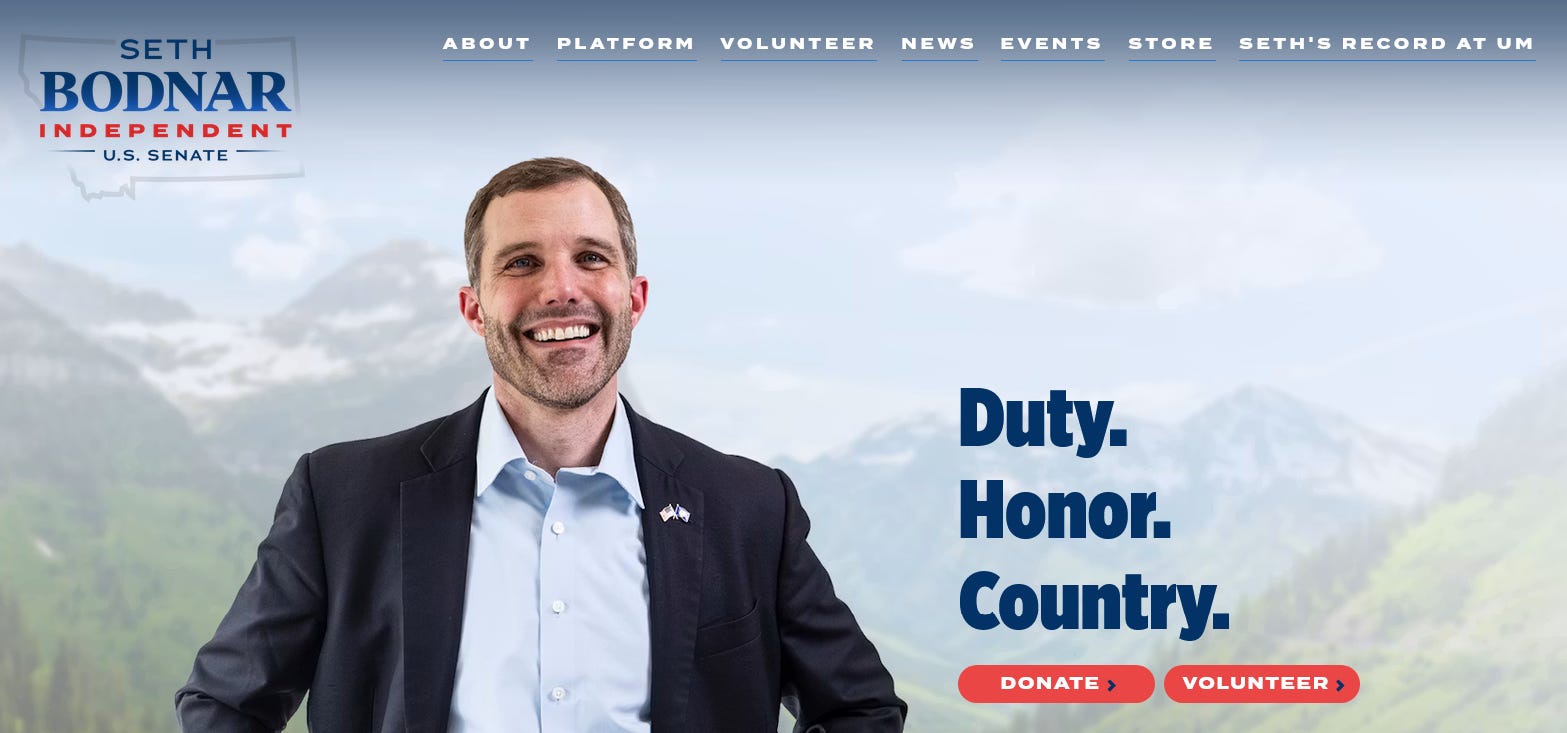
Let’s be real: the American Dream is out of reach for too many Montanans, and our national political system is not working. The division and dysfunction coming out of Washington is tearing this country apart — and it’s hurting us here at home, making it harder for Montana families to make ends meet.
Partisan warriors are spending millions to turn Americans against each other. They stoke anger and outrage, and they keep us focused on fighting our neighbors instead of holding Washington accountable. While the political class wages its endless wars – scoring points, securing their own positions, and enriching themselves – ordinary Montanans are left with higher bills and a bigger mess.
Montana’s farmers have watched export markets dry up while the costs of basic parts and supplies keep climbing. Montana’s next generation can’t afford to buy a home in the towns where they grew up. Our veterans are waiting months for care. Our rural hospitals are running on empty or threatened with closure. These are not casualties of bad luck. They are the predictable results of a political system that works for the people at the top and leaves everyone else to fend for themselves.
In D.C., “the other party” has become the opponent – even when there are real obstacles we need to face together as Americans. Party extremists refuse to work with the other side even when there’s a commonsense solution.. They will shut down the government rather than give the other side a win or compromise on behalf of Americans.
I’m fed up with this, and I reject the notion that how things work in D.C. should dictate how we do things here in Montana. It should be the other way around.
Montanans are an independent people. We don’t ask for help we don’t need, and we don’t tell our neighbors how to live their lives. But anyone who has actually lived here knows the other half of that story: when things get hard, we show up for each other and we take care of each other. That combination of individual liberty and collective responsibility isn’t a contradiction; it’s exactly who we are. And it’s the spirit this campaign is built on.
As an independent senator working for the people of this great state, I will do what’s right for Montana, not what’s best for one political party or the other. I will work with both parties when it makes sense for Montana, and I will stand up to either party when it doesn’t.
I’m running for Senate to revive the American Dream for every single Montanan. And I’m asking you to help me do it.
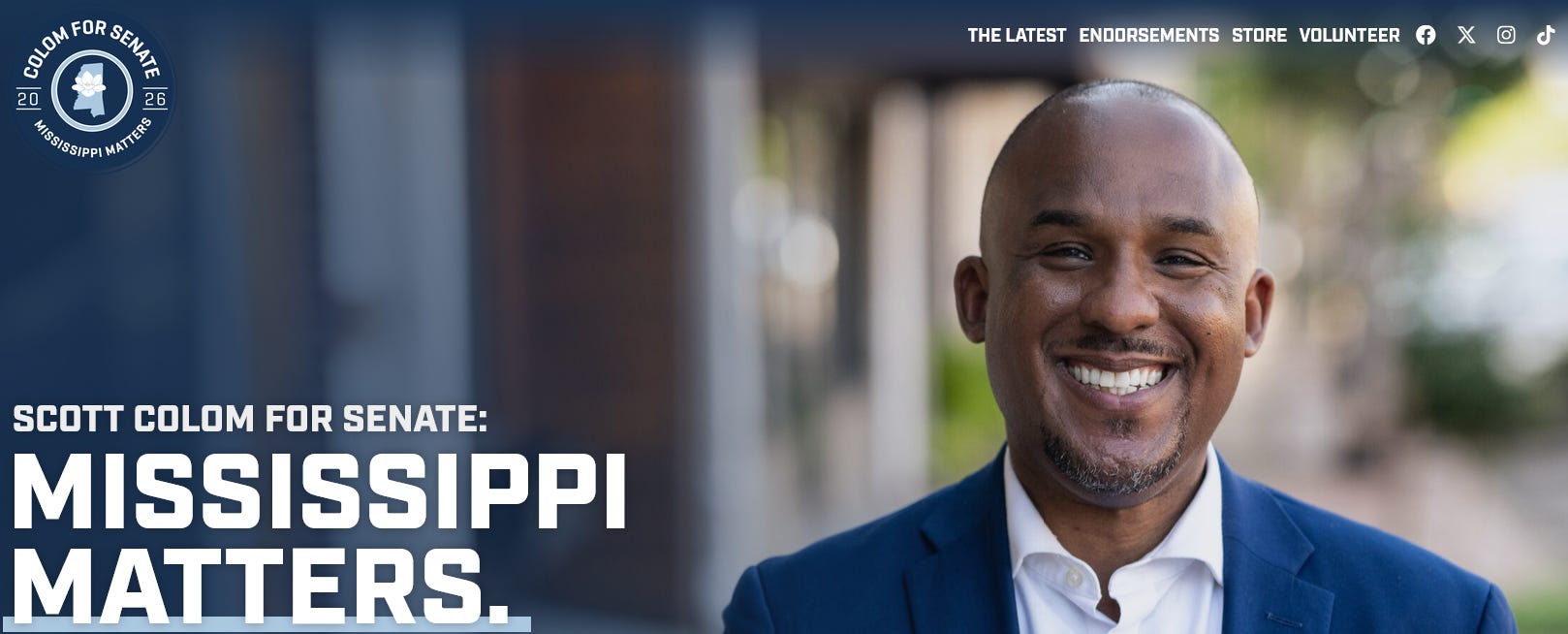
[Speech text] “It’s really powerful to be here, because I practiced law in this courthouse for 10 years. I’ve been honored to be elected district attorney three times, and I’ve stood with victims and their families and helped them through the most difficult times in their lives.
“I’ve looked hundreds of jurors in the eyes and made the case, based on the facts and the law, about what I was asking a jury to do. And I’m proud that I’ve got a 94% conviction rate, and that those jurors believed me, and believed the case I was making.
“I’ve also learned over those 10 years that no one is above the law. Not the powerful, not the well-connected, not the folks who think the rules are for everybody but them.
“Now, I didn’t learn those values in the courtroom. I learned those values at home, from my parents. My mom also had the honor of serving in this courthouse for 24 years, as a chancery court judge, where she treated people fairly, and she passed those values down to me. I also learned those values from my father, who practiced law, and still practices law, and works with both Republicans and Democrats to make our state better.
“They passed down the values to me that we have to serve people, regardless of political party, regardless of financial status; that what true leadership requires is transparency and honesty. That’s how I’ve done this job. I’ve held the powerful accountable, without fear or favor, whoever they are. In the courtroom, your party does not buy you a different set of rules.
“And I’m running for the United States Senate, because that’s not how Washington works anymore. Too many politicians are taking care of themselves, their donors, and their special interests. Everybody except the people who voted to put them in that position. Everyone except the people who need them.
“Too many of them trade stock on information that we would never have. They protect a system that pays off for them, while the cost of our groceries, our gas, our health care keeps going up and up.
“Unfortunately, our junior senator protects that system more than anybody else. She was supposed to go to Washington to look out for us. Instead, she’s working for herself. And let me tell you what I mean by that.
“During the course of this campaign, through FEC reports, we’ve learned that she billed more than $10,000 in Las Vegas hotel stays to her campaign, funded by lobbyist and corporate money. She used it to stay at luxury hotels in Las Vegas and eat at nice restaurants. At least she could have spent the money on the Gulf Coast. But no, she spent it on herself. She collected checks from rich people to pay for her own luxury living.
“And when a federal bill came up that would have required this type of spending to be disclosed, she voted against it. She didn’t want Mississippi to know how she was using corporate lobbyist money to take care of herself.
“She’s also taken money from fertilizer companies that are under investigation for price-fixing. Think about that for a second. She’s the former Secretary of Agriculture. She’s supposed to look out for Mississippi farmers. We’re at a time when Mississippi farmers are struggling, and she’s taking money from fertilizer companies that are under investigation for cheating on prices, while fertilizer costs are up at least 60%, according to Delta Farm Press. The farmers got the bill. She got the donation.
“I also want to talk about the corruption our junior senator will never talk about. At the very top of our government, we’re watching one of the most brazen abuses of public office in American history. That’s not me saying that. That’s Fox News. They called it one of the biggest grifts of all time. The Wall Street Journal called it an unseemly display of using the presidency for family profit. The president launched his own cryptocurrency. He took money from foreign and anonymous buyers we can’t even see. And he recently disclosed that in one year, he pocketed $1.4 billion from the very policies on crypto that he set. That is a pattern, people.
“Our junior senator is not in Washington to help Mississippi. She’s not on our team. She’s on their team. And she’s never denied any of this. She’s never done a town hall. She does not campaign. She barely talks to the press. She would never give Mississippi Today the chance to interview her, to answer a question. She would never do it. All she does is send them statements. That’s because she knows she can’t answer for any of this corruption. And she’s worried that a neighbor might come up and ask her, where in the world have you been, and what have you done for Mississippi?
“But to be clear, it’s not just what she does for herself, and the corruption. It’s the corruption she’s allowed in D.C., and that also costs Mississippi. Let’s talk about health care, just real quick. Our Republican insurance commissioner, and I emphasize Republican, recently said that 53% of the people who get insurance on the Affordable Care Act have now dropped off, because federal support went away. And the reason that support went away is because our junior senator voted for it to go away. Our Republican insurance commissioner estimated that we currently have 400,000 Mississippians who don’t have health insurance. And that’s before we get the Medicaid cuts next year, which are going to be the largest in America’s history. One in five Mississippians is covered by Medicaid, including half our children, and half our births are covered by Medicaid, and our junior senator voted to take that away from the people who need it most. And she did it so that people who live in New York and California could get a tax break. She cut our health care so they could get a tax break.
“Now, as I’ve campaigned all across this state and talked about this corruption, too many people question whether all of our politics are corrupt, whether they can trust anybody. Well, here’s my answer to that. As I said at the beginning, my parents taught me certain values. And one of those values is that you look out for the least of these.
“So when I was district attorney, a female inmate came to me and told me that some of the jailers, deputies, and the sheriff were having sex with her. They were exploiting her. And she told me, ‘Listen, I don’t think you’ll do anything about it, because he’s in your same party, and because you’re here to protect the powerful, not look out for the powerless.’ I said, ‘Listen, ma’am, I will investigate it, like I investigate every case.’ And my office led an investigation, with the help of the Mississippi Bureau of Narcotics. We were able to prove that not only were deputies having sex with her, but that the sheriff was too. We worked with federal partners to get that case indicted. It didn’t matter to me that the sheriff was a Democrat. It didn’t matter that the sheriff had previously supported me. Right is right and wrong is wrong, and when I saw wrong, I investigated it, and I did something about it. That’s the type of leader I am, because my parents raised me to be that way.
“So if you look at my track record, I’m not just here to point at the problem. I have the courage and the values to do something about it. And I also have a plan.
“First, if you write the rules, you should not get rich off them. I will ban members of Congress, their spouses, and their children from cashing in on stocks and secret deals in the industries they’re supposed to regulate, whether it’s Wall Street or the new cryptocurrency the president is using. Full divestment, real-time disclosure, so we can actually see who our senators are supposed to be protecting and what they’re actually doing. When the Senate had a chance to ban members and their spouses from trading individual stock, our junior senator voted to block it. I will fight to pass it.
“Second, ethics rules only matter if you have somebody there to enforce them, just like laws only matter if you have a DA ready to enforce them. I will fight for independent watchdogs with real teeth, tougher penalties for those who sell out the public, and a Senate ethics office that can actually act. Our junior senator, again, voted to block tougher disclosure of secret campaign money. That’s proof of what happens, and why she does it. A rule with no consequence is just a suggestion, and Washington has run on suggestions for far too long.
“Third, corruption should be investigated whether it hides in Washington or at the county courthouse. I will give federal investigators the resources to follow the money. I will protect the whistleblowers brave enough to expose wrongdoing. And I will crack down on the fraud that drains programs in Mississippi, whether it’s health care, disaster relief, or disability. Let me say plainly what should not have to be said: a senator has no business taking money from companies under investigation for cheating Mississippi.
“We have to get big money out of politics. We’ve got to do it, y’all. And I’ll work with anybody, Republican, Democrat, independent, to overturn Citizens United and the Supreme Court cases that have made money too much of a factor in who gets elected. It’s allowed people like our junior senator to hide, to vote against our interests, and never have to account for any of it, because she just relies on big corporate donors to come in and bail her out with big money.
“That’s the plan. Ban self-dealing. Enforce the rules. Prosecute the corruption. And give the government back to the people of Mississippi.
“But I want to leave you with this. Corruption costs Mississippi. It costs us at the pump, at the pharmacy. It costs the farmer at the co-op, and the family at the checkout. And it also costs us something that’s even harder to measure. It costs us the trust in government that’s required for us to truly be a democracy. We have to restore that trust by electing officials who are going to put Mississippi first, and not the corporate donors bailing them out.
“I’m running to change that, because I believe what my parents taught me: in Mississippi, no one is above the law, and no one should be beneath its protection. That’s the standard I brought to this courthouse, and it’s the standard I will bring to Washington.
[See also The Bulwark, “Don’t Eyeroll: Dems Have Mississippi in Their Sights,” April 29, 2026]

My name is Sam Forstag, and I’m asking for your vote to be western Montana’s next congressperson.
Until six months ago, I worked as a smokejumper for the U.S. Forest Service and a leader in my union. When DOGE and their accomplices in Congress decided to fire hundreds of public lands workers across Montana — most of them making less than $20/hour — we organized, held rallies, and fought back.
When I called Congressman Ryan Zinke for help, I got crickets. So, eventually, I decided that if he’s going to come after my co-workers’ jobs, I’m gonna come take his.
I’m running on two basic notions:
First: Every Montanan should be able to work one job and afford housing, healthcare, childcare, and a good retirement. We can afford that as a country, and working people can’t afford to wait any longer.
Second: The people we elect are the policies we get. It’s not too late to build a country that works for working people, but we don’t do that by electing more multi-millionaires, we do it by sending working people to Congress so we can fight for ourselves.
I offer three things in this primary that are unique among the people running: lived experience, policy experience, and the broad coalition we need to win.
I was raised by a mom who picked up extra nursing shifts to make ends meet, and sometimes food stamps kept the fridge full at my dad’s house. I worked three jobs at a time while attending UM and still sometimes came up short on money for rent or books.
Later, even working 1,000 hours of overtime as a smokejumper sometimes meant barely affording the mortgage on my 980-square-foot house. Many Montanans can relate to these experiences, but most members of Congress cannot.
At a time when the average member of Congress is worth 15x the average American, that’s the sort of experience we’re most direly lacking in Congress.
Over the last 10 years, those experiences informed my work fighting for progressive policies in Montana, and winning. Between fire seasons, I worked as an organizer and advocate fighting for public education and libraries, defending civil rights and abortion access, helping pass bills to reform our criminal justice system and help Montanans facing homelessness.
Winning on those issues meant building coalitions, and I’m doing that now by building the broadest coalition of any candidate in this race — the coalition we’ll need to win in November and deliver real change.
That’s the coalition we’re building. Not just Bernie Sanders and AOC, but over 30 elected leaders from across Montana and both parties. Not just my own union, but over a dozen unions across the state. Not just young people ready for change, but Montanans of all ages who still care about the Constitution and the future of this country.
That’s the coalition Democrats had when we won in Montana, that’s what we can build together, today.
Our country’s greatest moments of progress were born from moments like this. The despair of the ‘30s, the tumult of the ‘60s.
Montanans like Mike Mansfield helped meet those moments by creating programs like Medicare and Medicaid. We can meet this moment by fighting for affordable housing, free healthcare for every working-class person, universal childcare and Pre-K, and by sending a new generation of Montanans to Washington to do it ourselves.
I hope to earn your vote on June 2, and I promise to keep doing all I can to fight for the changes we need to make our government work for all of us. [Guest column, Bozeman Daily Chronicle, May 30, 2026]
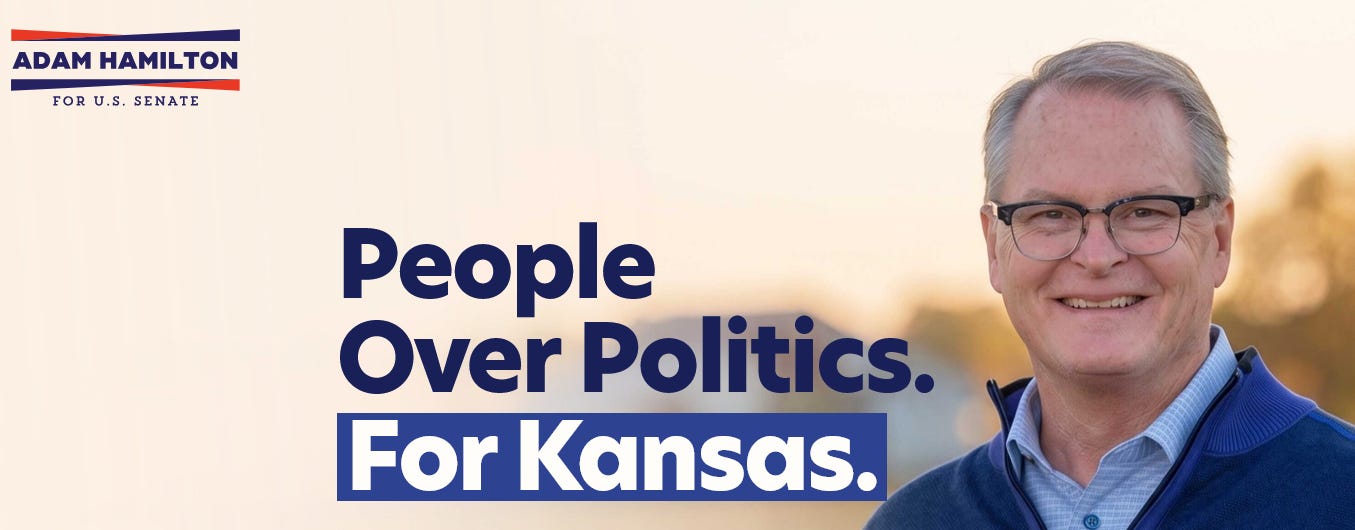
Adam Hamilton is a Democratic candidate for the United States Senate in Kansas who has devoted his life to service. A fifth-generation Kansan, his family came to Dickinson County 147 years ago and helped build the towns of Hope and Elmo. His mother’s parents came to Wichita to work at Beechcraft, and his grandfather went on to fly for TWA.
Adam grew up in Prairie Village and married his high school sweetheart, LaVon, the week after graduation. They celebrated their 44th anniversary this June. They have two daughters, a granddaughter, and two dogs.
In 1990, at 25 years old, Adam and LaVon started a church in the Kansas City area with four people in a borrowed space. For 36 years he has served as pastor of a congregation roughly equal parts Republicans, Democrats and independents, doing the work to bring people together that politicians only talk about.The congregation he built has come together to give hundreds of thousands of volunteer hours and raise tens of millions of dollars to support neighbors and communities in need.
They became the largest source of donated food in Kansas City after the regional food bank and the area’s largest sponsor of blood drives. They gave away thousands of beds to children who didn’t have one, funded a mobile dental clinic that treats 2,700 kids a year at their schools, and invested millions of dollars in the lowest-income elementary schools in the area.
Adam is running for Senate because he believes we need to stop the chaos and corruption in Washington by actually listening to people and working together to get things done for Kansas families. Before deciding to run, he went on a listening tour, visiting communities all across the state to hear from people about their concerns. In his work, his writing, and now his campaign, Adam believes we are all called to serve our communities.
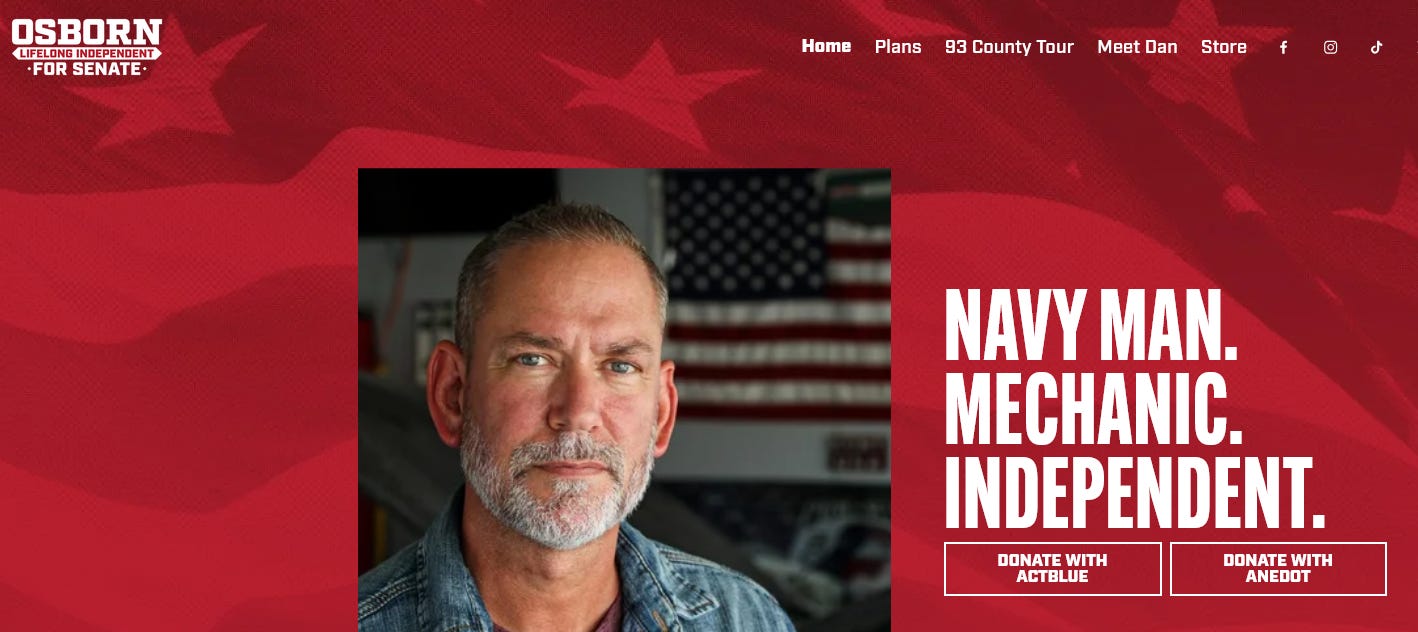
…. American politics feasts on stories of candidates from humble backgrounds who know what it means to be a working stiff. Some such contenders are uncovered as bums or phonies. But some are the real thing.
They would include Dan Osborn of Nebraska. He is the steamfitter and former union organizer from Omaha running for the senate as an independent against Republican Sen. Pete Ricketts.
Osborn now has a decent chance of prevailing in November. His is not a new face. He had run in 2024 as an independent who did surprisingly well against Republican incumbent Deb Fischer. Osborn lost by only 7 points in a state that Donald Trump carried by about 21 points. Osborn clearly has appeal.
After the election, Osborn launched a PAC called the Working Class Heroes Fund. Its stated mission is to support candidates like him, regardless of party label. With Ricketts an heir to a family fortune exceeding $1 billion, Osborn has predictably framed the race as between the “billionaire class” and the working class.
One of his challenges, though, is to minimize the extent to which Democrats openly want him to win. Nebraska Democrats are not running their own candidate and urge their contributors to back Osborn.
To prevail in a conservative state like Nebraska, Osborn needs support from disaffected or moderate Republicans. If elected, he vows not to caucus with either party. And he criticizes Democrats for their focus on white-collar professionals.
Working in his favor is the fact that many Nebraska Republicans are not hard right. Omaha Rep. Don Bacon, for example, is a Republican moderate known for often criticizing Trump. His is a swing district, nationally known as the “blue dot.” Seeing himself at a disadvantage among MAGA Republicans and Democrats desperate for a win, Bacon decided not to seek another term. [Froma Harrop, “Unlike Platner, Nebraska’s Dan Osborn is the Real Deal,” Rocky Mount Telegram, July 29, 2026]
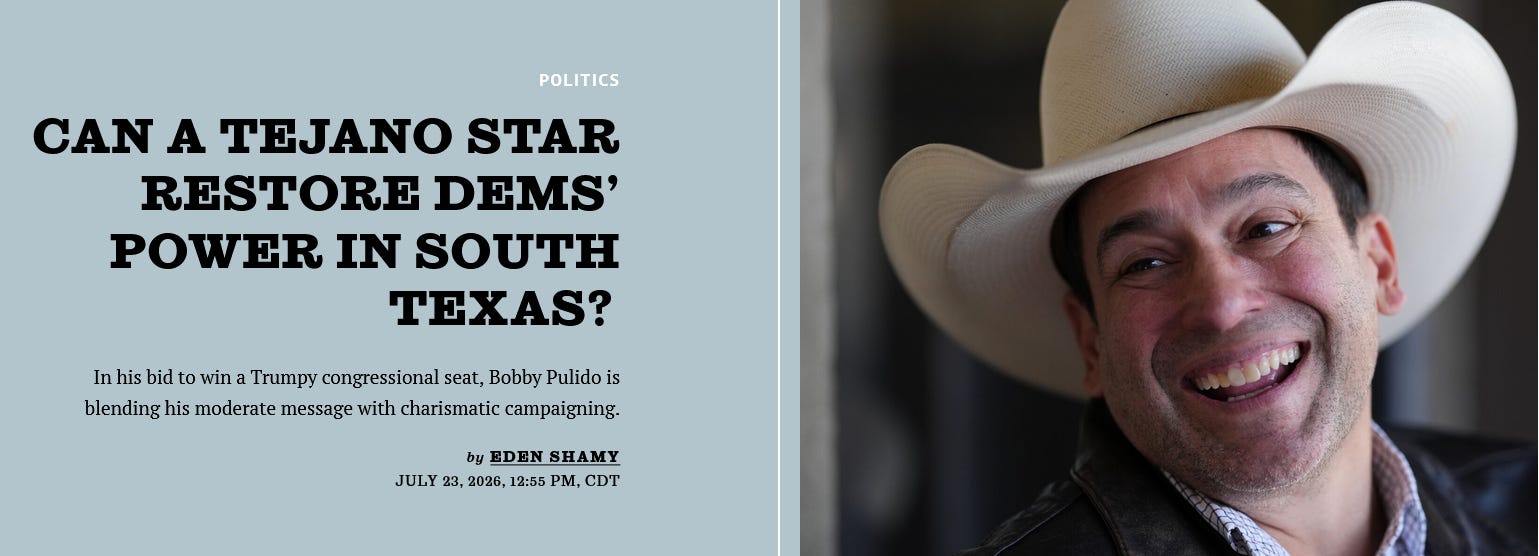
Bobby Pulido descended a staircase bedecked in flowers to face the quinceañara in her shimmering blue ball gown. Her magnificent hoop skirt swayed as the Tejano star-turned-South Texas Democratic congressional candidate launched into a rendition of “Hermoso Cariño.” It was Pulido’s second quince of four that night, part of a marathon run of birthdays, weddings, and even baptisms that have become the cornerstone of his campaign trail strategy. He finished with his hit song “Desvelado,” led the birthday girl by the hand around the dance floor, and gifted her a pink “Make Quinceañaras Great Again” hat.
After 30 years of performing across the United States and Mexico, the two-time Latin Grammy winner officially announced in September 2025 his bid to run for the 15th Congressional District, a newly remodeled majority-Latino South Texas district that’s anchored in McAllen and stretches north all the way to New Braunfels outside San Antonio. Republican Congresswoman Monica De La Cruz flipped that then-open seat back in 2022 and held onto it in 2024 despite it being one of Dems’ top targets in the state.
…. His slogan, “Not team red. Not team blue. Team you,” anchors Pulido as the Democrats’ familiar, moderate champion to reclaim the 15th from De La Cruz. He’s determined to podcast, sing, and dance his way to Congress, brushing off every scandal that seeks to poison his good-vibes campaign. [Eden Shamy, Texas Observer, July 23, 2026]

“A prairie populist’s platform to rebuild the American Dream.”
Life is harder for working class people because Washington is riddled with corrupt politicians who are out of touch and focused on enriching themselves. While Ashley Hinson’s net worth has quadrupled since she got to Washington, Iowa’s economy and personal income growth have plummeted. More and more Iowans are struggling to afford housing, health care, medication, and groceries. Ashley Hinson doesn’t care.
Iowans shouldn’t have to feel like they are constantly pushing uphill just to get by. Josh knows firsthand that the most effective legislators aren’t career politicians, but people who have real experience with the issues. We need someone in Washington who understands the struggles so many Iowans are facing right now – Josh does, because he’s lived it.
Born with Spina Bifida after his dad was exposed to Agent Orange in Vietnam, Josh overcame 21 surgeries by the age of 12. He was born into a working class family that got their clothes from Goodwill and relied on free summer lunch programs.
Not only does Josh have a unique understanding of the issues – he knows how to get stuff done. Josh is one of the most bipartisan Democrats in the Iowa legislature. In just four years, Josh has had a tremendous impact, passing meaningful legislation to strengthen the veterans homestead tax credit and to make it easier for Iowans with disabilities to repair wheelchairs and mobility devices. Now, he is running on a platform that is laser-focused on benefiting the working class and addressing the corruption in Washington.
Each and every American should be able to afford the basics.
Josh knows the American Dream is getting further and further away for too many families who are struggling to put food on the table, make rent, and achieve the dream of homeownership. Washington continues to undermine workers’ rights, hollowing out the middle class, while billionaires and big corporations rake in massive profits.
In the Iowa House, Josh fought to make the dream of owning a home more in reach, sponsoring legislation to cut taxes for first-time homebuyers and to limit the ability of private equity to buy up Iowa homes. Josh also has a long record of fighting for workers’ rights, from sponsoring bills to raise the minimum wage to pushing to protect workers’ right to organize.
In the Senate, Josh will fight to:
Cut taxes for the middle class and working families and close loopholes for billionaires and big corporations.
Impose a federal ban on price gouging on food so Iowans pay less at the grocery store.
Raise the minimum wage and pass legislation that ties regular raises to inflation to ensure a livable wage.
Ban Wall Street private equity firms from purchasing single family homes and farmland to make housing more affordable and protect small family farms.
Simplify permitting so new affordable housing can be built faster.
Pass the PRO Act to strengthen our unions and protect collective bargaining.
Strengthen Social Security by ensuring billionaires pay their fair share.
Take on Big Pharma and pharmacy benefit managers to stop price gouging and ensure affordable prescription drugs for all.
Repeal cuts to SNAP, because every Iowan deserves access to food.
Hold corporations accountable by cracking down on unfair wages and incentivizing policies that benefit workers.
Invest in job training programs and apprenticeships to prepare the next generation of Iowans to fill gaps in the labor market without having to go to college.
Crack down on monopolies that drive up prices for working class Iowans.
Lower costs for child care.
Health care is a human right. All Americans deserve access to basic care.
Born with Spina Bifida, Josh underwent 21 surgeries before the age of 12. He had access to good quality health care thanks to Shriner’s Children’s Hospital and his father’s military service. Josh knows better than most that access to quality, affordable health care is critical – and he knows just how hard it is for so many Iowans to receive.
In the legislature, Josh has been on the front lines of fighting for better health care. He has sponsored legislation to cap insulin costs at $25/month, to expand access to dental services under Medicaid, to protect patients in nursing homes, and to eliminate long waiting lists for Medicaid home and community-based services waivers.
Josh also believes that women should make decisions about their reproductive health care, not politicians, and wrote and sponsored legislation to repeal Iowa’s extreme, near-total abortion ban.
In the Senate, Josh will fight to:
Restore full funding for Medicaid for the 110,000 Iowans who are at risk of losing access to health care due to cuts in the Big Beautiful Bill that Ashley Hinson voted for.
Protect and expand the Affordable Care Act for the 118,000 Iowans that rely on ACA subsidies.
Make Roe v. Wade the law of the land again and address the OB-GYN crisis in Iowa.
Defend and expand Medicare’s ability to negotiate lower prescription drug prices.
Cap costs on prescription drug prices.
Crack down on pharmacy benefit managers that are price gouging prescriptions.
Address vertical integration in health care by prohibiting one company from owning an insurance provider, pharmacy benefit manager, and pharmacy chain.
Invest in mental health care, particularly in rural communities.
Save rural hospitals and expand access to telehealth.
Crack down on private equity purchasing elder care facilities and health care centers, which increases cost and worsens care.
Ensure every Iowan has access to paid family and medical leave.
Introduce a public option so every Iowan has access to health care.
Prohibit insurance companies from denying care that is prescribed by a doctor.
Eliminate surprise medical bills and demand transparency in billing.
Stop the corruption. Politicians should deliver for the people, not enrich themselves.
Politicians in Washington like Ashley Hinson have seen their net worth increase while the people they are supposed to serve struggle. Meanwhile, the proliferation of big money has delivered for billionaires and big corporations, not working people.
Josh is not taking any corporate PAC money, because this campaign is for Iowa and Iowans, not corporations. Josh has sponsored legislation to cap the amount of money that can be given to individual campaigns and political committees, so wealthy donors don’t have outsized influence on our elections.
In the Senate, Josh will fight to:
Address waste, fraud, and abuse in our government.
Ban Members of Congress and their spouses from trading stock.
Ban corporate PAC money in campaigns.
Pass the DISCLOSE Act to increase transparency in campaign contributions.
Pass a constitutional amendment to reverse Citizens United.
Set term limits for Members of Congress and Supreme Court Justices.
Enforce ethics standards on Supreme Court Justices.
Suspend pay and ban travel by Members of Congress during a government shutdown.
Require Members of Congress to hold annual town halls with constituents.
Iowa’s farmers are the best in the world. It’s time we fight for them.
Iowa’s farmers have been hit hard by the chaotic tariffs and trade policies coming out of Washington, supported by Ashley Hinson. Iowa farmers are the best in the world, and they deserve a Senator willing to fight for them to have a level playing field.
Josh has championed meaningful legislation for Iowa farmers, including fighting for a Right to Repair bill so farmers can fix their own equipment and Mandatory Country of Origin labeling. He also sponsored legislation to break up monopolies that drive up input costs, fight consolidation so small farmers and ranchers can compete, and provide farmers incentives to engage in practices that protect water and soil quality.
In the Senate, Josh will fight to:
Pass a Farm Bill and a provision to ensure Congress does not recess if a Farm Bill is set to expire without passage of a new one.
Pass a Right to Repair law at the federal level.
End the chaotic tariffs that are sending farms toward a 1980s-style farm crisis.
Pass Mandatory Country of Origin Labeling legislation.
Crack down on monopolies in agribusiness and meatpacking.
Stop giving bailouts to foreign countries that make it harder for our farmers to compete.
Protect Medicaid, Medicare, and the Affordable Care Act, all of which are vital to rural health care.
Prevent eminent domain for corporate usage.
We must protect and defend our fundamental freedoms.
Josh knows that our fundamental rights and freedoms are under attack from Washington, including our freedom of speech, the freedom to marry who we love, and the freedom for women to make their own decisions about reproductive health care. He spoke out against legislation removing antidiscrimination protections for gender identity from Iowa’s civil rights code, and he wrote and sponsored legislation to repeal Iowa’s extreme, near-total abortion ban.
In the Senate, Josh will fight to:
Make Roe v. Wade the law of the land again and protect access to contraception and IVF.
Protect the freedom of speech and protest.
Defend the right for Americans to marry who they love.
Reform and simplify path to legal citizenship.
Eliminate unnecessary barriers to education, health care, and employment for Americans with disabilities.
Every Iowa child deserves access to the highest quality public education.
Iowa used to be nationally ranked for its public schools. It was a point of personal pride for all Iowans, so much so that we put it on our quarter. Now, we’re middle of the pack – and Iowa kids deserve better. Josh knows firsthand what a difference it makes to have leaders fighting for education. As a child, local Iowa Area Education Agencies (AEAs) gave him access to a quality education.
Josh has sponsored legislation to repeal school vouchers, because public dollars belong in public schools, and to require the state board of education to be transparent about nonpublic school accreditation.
In the Senate, Josh will fight to:
End school vouchers that waste taxpayer dollars and benefit the richest.
Restore Department of Education funding.
Increase funding to public schools so every child has access to a world-class education.
Protect funding for AEAs.
We need to address Iowa’s unique cancer crisis and the water quality crisis that’s driving it.
Iowa is experiencing a cancer crisis and a water quality crisis. Josh knows that personally: he’s currently supporting his sister through treatment for Stage 2 breast cancer, a diagnosis that drove his decision to run for Senate. His sister’s private insurance refused to cover a PET scan to see if the cancer had spread – another example of our broken health care system.
Josh has sponsored legislation to support cancer research, including appropriations specifically for pediatric cancer research, in Iowa. He also sponsored a bill to ban certain medical devices that use known carcinogens. Thanks to the attention Josh brought to the issue, major medical device manufacturers changed their practices, significantly reducing the risk of cancer for Iowans with disabilities. To address the root cause of our water quality crisis, Josh has sponsored legislation to increase funding for water quality sensors.
In the Senate, Josh will fight to:
Address the water quality crisis that is at the core of our cancer crisis by funding water quality sensors and cracking down on chemical companies that pollute our water supply.
Stop cuts to the National Institutes of Health and restore funding for cancer research.
Fight for affordable and accessible health care for every Iowan battling cancer.
Prohibit insurance companies from denying medically necessary care for cancer patients.
Support our military heroes and their families while they serve – and when they come home.
Josh is the proud son of a veteran, whose service provided the VA health care that Josh relies on. He also knows how the government can fail servicemembers and their families.
That’s why Josh is committed to supporting our troops and their families when they are on active duty and when they come home. As an adaptive sports athlete, Josh has played with disabled veterans and worked with veterans as part of sports rehabilitation programs. He passed legislation to strengthen the veteran homestead tax credit. He has also sponsored legislation to increase state funding for the veterans trust and to create a homeowner assistance program for servicemembers. He is also the lead Democratic sponsor on bipartisan legislation to protect Iowa National Guardsmen from being sent into active combat unless Congress has declared war and from being sent into another state without the permission of the governor of that state.
In the Senate, Josh will fight to:
Protect the Department of Veterans Affairs and reverse cuts to VA staffing and health care.
Ensure every veteran has access to quality health care, including mental health care.
Support and expand the PACT Act to ensure veterans exposed to toxic substances during their military service have the care and benefits they need.
Address veteran homelessness.
End unnecessary wars that put American lives at risk.
Ensure disabled veterans, who have given the most to their country, can afford to live comfortably upon returning home.
Support military families through policies that allow military dependents to stay on military health care until age 26, support military spouse employment, and ensure that all military families have a safe and healthy home environment.
Individuals with disabilities deserve access to education, employment, and health care without unnecessary barriers.
Iowans with disabilities deserve to live fulfilling lives with dignity and access to critical services. As the first and only permanently disabled member of the Iowa legislature, Josh has led the charge to support individuals with disabilities in the Iowa House.
Josh wrote and passed a “right to repair” bill that makes it far easier for people to repair wheelchairs and mobility devices covered under Medicaid. He wrote and passed legislation to protect the right for Iowans with disabilities to have service animals when renting.
He is fighting to improve Medicaid benefits for individuals with disabilities, and sponsored legislation to eliminate 14C certificates, which allow for-profit companies to pay disabled workers a subminimum wage.
In the Senate, Josh will fight to:
End 14C certificates on the federal level, which allow for-profit companies to pay individuals with disabilities a subminimum wage.
Raise Social Security income and assets limits for disabled individuals.
Stop the federal lawsuit to gut Section 504, which prohibits discrimination against people with disabilities in any setting that receives federal financial assistance.
Protect and defend the Americans with Disabilities Act.
Our immigration system is broken and needs comprehensive reform.
Our immigration system is broken because politicians in Washington refuse to work across the aisle to fix it. We deserve a functional immigration system that keeps our borders secure and enforces our laws and simplifies the path to citizenship – two goals that are not mutually exclusive. That’s why Josh will work across the aisle to find bipartisan solutions for Iowa. Josh has spoken out against abuses of power from ICE agents, and believes we need an immigration system that provides a pathway to citizenship.
In the Senate, Josh will fight to:
Pass bipartisan immigration legislation that strengthens our borders and simplifies an earned pathway to citizenship.
Secure our border and deport those who come here illegally and commit crimes.
Stop fentanyl from coming across the border.
Ensure regulation and accountability for ICE agents.
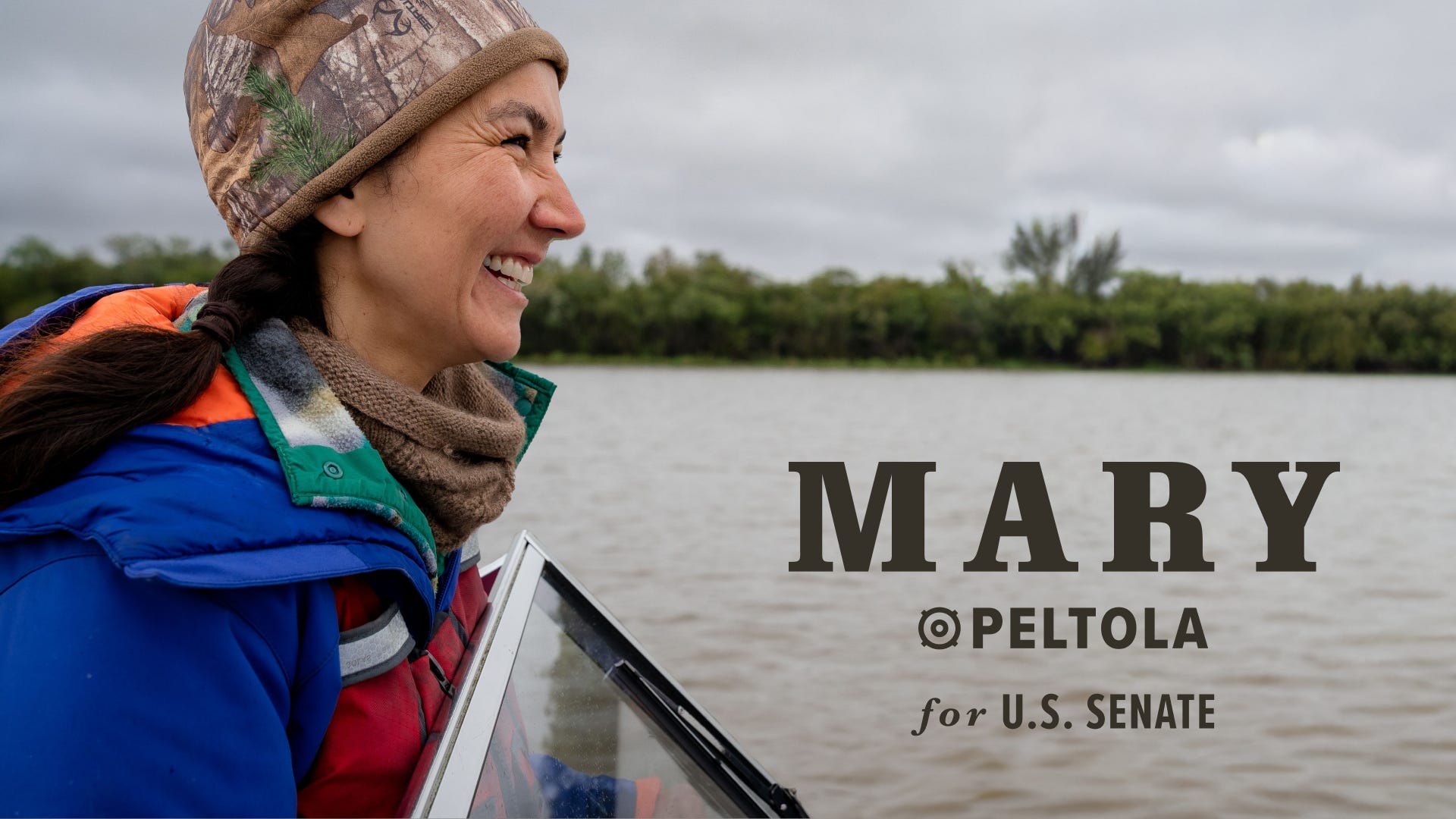
Peltola is the former one-term Congresswoman for Alaska. This election cycle, she stepped up to take on incumbent Dan Sullivan in the non-partisan ranked choice election. Coming out of the August 18 primary, Peltola led Sullivan by more than 5 points there’s a strong, strong possibility for a flip here!

Much to the surprise of pundits everywhere, a recent poll has Hallie Shoffner ahead of Arkansas’s incumbent Senator Tom Cotton.
Comments
Nothing yet. Say the first thing.
Sign in to join the conversation.