
If you’re a developer exploring blockchain for the first time, you’ll inevitably come across the concept of Smart Contracts. You’ll also encounter the word “Dapp,” leading you to realize that, indeed, you can run applications on the blockchain via Smart Contracts. You may even hear about various security incidents involving Dapps.
No matter what domain you’re currently in as a developer, you’ve probably asked yourself at least once:
“Alright, so what makes Smart Contract development different from the kind of development I’m used to (or from general software development)?”
This article is written for those who are wrestling with exactly that question. It is based on the author’s personal experience and opinions.
Put very simply, when developing a typical software product (application), we divide it into a front end (web/app) and a back end (server), using a client-server architecture. The server handles business logic, stores critical data in a database (DB), and provides data to the client. The client, in turn, provides a user interface based on this data.

In a Dapp (Decentralized Application), which runs on the blockchain, the logic is written in a Smart Contract and is executed directly on the blockchain.
So, how is this different from the traditional structure? Think of the blockchain as the database (DB), and the Smart Contract as the server’s business logic. Of course, to handle more complex queries or improve performance, you can add a separate indexing server. But fundamentally, the Smart Contract is in charge of the server’s core logic.
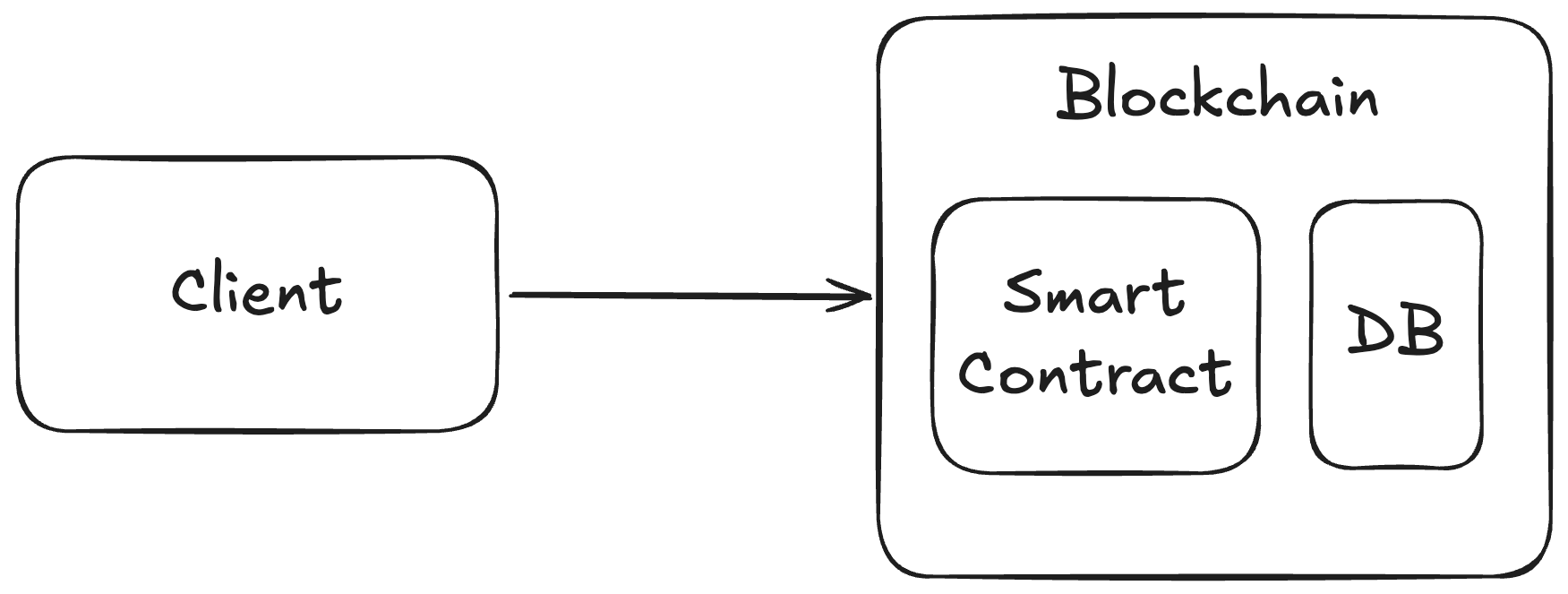
Here’s a question you might ask: “Then, is Smart Contract development basically back-end (server) development?” The answer is, no—it’s not quite the same.
Front-end developers need a basic grasp of how browsers work, the DOM structure, and UI event flows.
Back-end developers need to be comfortable with networking, databases, and request-response structures.
Likewise, a Smart Contract developer must have a thorough understanding of the blockchain’s architecture and how it operates.
There’s a lot to learn, but at the very least, you should be able to answer questions like:
How does a transaction get processed and included in a block? (What is a transaction’s life cycle?)
When a transaction is executed, how does the state change?
Why do transaction fees occur, and how much do they cost?
Just as a server environment requires CPU, memory, and disk resources to run logic or store data, running a Smart Contract on a blockchain also consumes computational and storage resources from blockchain nodes. Because of this, every transaction you submit incurs a fee (e.g., gas), which can vary greatly depending on how you design your contract. In other words, resource efficiency is directly tied to cost efficiency.
Most importantly, blockchains are fundamentally immutable. Once a contract is deployed, it typically can’t be modified. If you have flawed logic or an inefficient state design, you can’t just fix it with a simple patch.
Moreover, each chain has its own structure and unique characteristics that are crucial to understand.
For instance:
Ethereum (EVM-based) uses an Account model, with accounts categorized as EOA (Externally Owned Account) or CA (Contract Account). State data is stored in Contract Accounts, managed in a key-value storage format. Logic and state are defined together within a single contract.
Solana, on the other hand, takes a very different approach. The logic resides in what’s called a Program Account (PA), and the state is stored in a separate account called a Program Derived Address (PDA). The PDA is “owned” by a specific Program Account (PA), and the state data is recorded in the PDA. In other words, logic and state are physically separated, and you, the developer, need to explicitly design how to connect them.
These structural differences go far beyond simple syntax; they alter your entire way of thinking when designing a Smart Contract.
For example, the approach to storing and managing state data, understanding which resources you can access, calculating the associated costs, how complex a single transaction’s logic can be, or whether parallel processing is possible—all of these depend on the specific blockchain’s architecture. Hence, you need to keep each chain’s characteristics and constraints in mind from the very early stages of design.
Ultimately, merely learning the language syntax isn’t enough for proper Smart Contract development. You need a deep understanding of the blockchain as an execution environment. Otherwise, you risk writing contracts that don’t work as intended—or even worse, open the door to catastrophic asset losses.
Let’s look at how all this impacts your code. We’ll use Solidity—arguably the most popular language on the EVM—to illustrate.
// SPDX-License-Identifier: MIT
pragma solidity ^0.8.0;
contract SimpleWallet {
    mapping(address => uint256) public balances;
    address[] public depositors;
    function deposit() external payable {
        bool exists = false;
        for (uint i = 0; i < depositors.length; i++) {
            if (depositors[i] == msg.sender) {
                exists = true;
                break;
            }
        }
        if (!exists) {
            depositors.push(msg.sender);
        }
        balances[msg.sender] += msg.value;
    }
    function withdraw() external {
        uint256 amount = balances[msg.sender];
        (bool sent, ) = msg.sender.call{value: amount}("");
        require(sent, "Transfer failed");
        balances[msg.sender] = 0;
    }
}
Solidity looks a bit like JavaScript, so at first glance it may not seem too difficult to understand. The contract’s functionality is simple: you can deposit ETH, and the contract records the depositor’s address. A depositor can withdraw the exact amount they’ve deposited.
However, this contract has some issues:
There’s no receive function.
To receive ETH in a contract, you need areceivefunction. Without it, depositing ETH will fail (although depositing0 ETHmight succeed).No consideration for gas fees—list traversal.
In Solidity, every operation costs gas. As the list of depositors grows, the for-loop runs longer, causing higher gas fees. Excessive gas usage can lead to failed transactions.Vulnerability to reentrancy attacks.
Reentrancy Attacks
A reentrancy (or “re-entry”) attack occurs when one contract calls an external contract (or address), and the called contract (the attacker) calls back into the original contract’s function before the first execution completes. It’s akin to recursion.
Let’s assume we added a receive function:
// SPDX-License-Identifier: MIT
pragma solidity ^0.8.0;
contract SimpleWallet {
	...
	receive() external payable {}
}
There’s a feature in Solidity:
A contract can call another contract.
Logic is executed sequentially.
When ETH is transferred,
receiveis triggered.
These features allow for a reentrancy attack. With the following exploit contract, an attacker could withdraw more ETH than they originally deposited
contract ReentrancyExploit {
    SimpleWallet public simpleWallet;
    constructor(address _simpleWallet) {
        simpleWallet = SimpleWallet(_simpleWallet);
    }
    // entrancy
    function attack() external payable {
        simpleWallet.deposit{value: msg.value}();
        simpleWallet.withdraw();
    }
    // reentrancy
    receive() external payable {
        if (address(simpleWallet).balance >= msg.value) {
            simpleWallet.withdraw();
        }
    }
}
Here’s how an attack might unfold when attack() is called:
simpleWallet.deposit{value: msg.value}()is called.Then
simpleWallet.withdraw()is called, which executes acallfunction insidesimpleWalletthat sends ETH back toReentrancyExploit.During this call,
ReentrancyExploit’sreceive()function is triggered:
(bool sent, ) = msg.sender.call{value: amount}("");The
receive()function callssimpleWallet.withdraw()again.Since
balances[msg.sender]hasn’t yet been reset to zero, the attacker can continue withdrawing the same amount repeatedly.
Even this simple logic shows how a deeper understanding of the blockchain is necessary to write Smart Contracts.
For more information about reentrancy attacks, see here.
Understanding the transaction life cycle and how transactions are processed is fundamental. You also need to know how each blockchain network’s consensus mechanism and virtual machine (VM) operate.
Moreover, learning about various types of DApps—DeFi, NFTs, and beyond—is extremely helpful when designing and implementing real Smart Contracts.
Although blockchain can be segmented into many areas—DeFi, infrastructure, security, crypto-economics—they’re all interconnected. You should aim for a big-picture understanding that goes beyond a single niche.
Because Smart Contracts run in a blockchain environment, testing and debugging them isn’t as straightforward as in typical applications. The blockchain is immutable, so once a state changes, you can’t roll it back. Transactions are atomic, making state changes mid-execution tough to track, and every state-changing transaction costs money.
This means you can’t rely on some of the standard testing strategies you might use in a typical app—like rolling back a DB to a prior state or stepping through your code with breakpoints in production.
Still, testing and debugging are crucial in Smart Contract development because a single bug can lead directly to asset losses. And once a contract is deployed, it’s nearly impossible to roll back mistakes.
Fortunately, tools like Hardhat, Foundry, and Truffle have emerged to mitigate these challenges. They offer features like console.log debugging, fork testing, and VM-simulated environments. Even so, debugging in a blockchain VM is still difficult, and it ultimately falls on you to implement meticulous logic and thorough tests to ensure everything works as intended.
Blockchain has multiple standards that must be understood. They’re tied not only to ecosystem compatibility but also gas optimization and security.
Take ERC20, the most widely used standard for fungible tokens, as an example. Its transfer function must adhere to this interface
function transfer(address to, uint256 value) external returns (bool)If transfer succeeds, it should return true, otherwise false. What if there’s an ERC20 token that doesn’t actually return a bool?
function withdraw(address token, address to, uint256 amount) external {
   bool isSuccess = IERC20(token).transfer(to, amount);
   require(isSuccess, 'failed to withdraw);
}
In this snippet, transfer is expected to return a bool, but if it doesn’t, decoding fails and the transaction reverts. This scenario can actually happen and cause assets to be stuck (“frozen”).
New standards keep emerging, and existing ones can change via EIPs (Ethereum Improvement Proposals). You need to keep track of these changes and quickly adapt to stay safe and compatible. This ongoing awareness isn’t just academic—it’s vital to real-world development.
All of the above ultimately ties back to rigorous logic and problem-solving skills. Because of blockchain’s immutability and difficulty in patching mistakes, Smart Contracts demand more careful condition checks and error handling than typical applications.
For instance, in back-end development, a bug might be fixable by rolling back the DB or manually correcting data. In Smart Contracts, once a transaction has executed and changed state, there’s no going back.
You can design contracts to be upgradeable, but even that approach introduces new complexities and can pose additional security risks. It’s no magic bullet.
Therefore, a Smart Contract developer’s job isn’t just about producing functional code; it’s about anticipating edge cases and eliminating even minor flaws. This level of thoroughness and logical precision is the most crucial trait of a Smart Contract engineer, more so than any specific skill with tools or languages.
Smart Contracts run on a Virtual Machine, which requires bytecode the VM can understand. We write it in a high-level (human-readable) language that compiles down to that bytecode. On EVM-based platforms, Solidity is the most popular. On Solana (SVM), Rust is the go-to. You’ll need to learn whatever language the platform demands.
Generally, developers stick to Solidity and Rust because of their ecosystems and available tooling. However, these aren’t the only options. For the EVM, there’s also the Python-like Vyper or the low-level Yul language. On Solana, you can even use C/C++. Unless you have a specific need, you’ll likely be most productive with the widely adopted languages and tooling.
Smart Contract development involves compiling, testing, debugging, and deploying. Frameworks exist to streamline each step, boosting your productivity. You can do it all without a framework, but it’s much more cumbersome.
On the EVM side, you can use Hardhat (JavaScript/TypeScript) or Foundry (Solidity native). On Solana, Anchor is widely used. Each has its pros and cons, so choose what suits your needs.
It’s a good idea not to limit yourself. Experiment with tools like Tenderly, Etherscan, or node providers like Infura, Alchemy, or QuickNode. All can significantly enhance your development efficiency.
As with any technology, simply knowing one language or framework won’t guarantee a great piece of software. All knowledge is interconnected and should be applied organically.
In typical development, you assume some mistakes will happen—patches can be deployed, or a database can be updated. But these “safety nets” can also encourage sloppy work or create technical debt: leaving TODOs scattered around the code, skimping on tests, or ignoring error handling. While this might be acceptable in a traditional project as a trade-off, it’s not advisable in Smart Contract development.
A Smart Contract developer must always keep in mind that you “can’t easily fix things” later. You should strive for perfection from the outset. Mistakes directly translate to financial loss, sometimes in the tens or hundreds of millions of dollars. So you have to prioritize security and caution above all else.
Yes, you can design your contracts to be upgradeable, but this also affects the entire architecture and can expose new vulnerabilities. Upgradeability isn’t a silver bullet.
Smart Contract development is about more than just writing code in a specific language. It requires a deep understanding of blockchain’s unique environment and demands meticulous design for code that can’t simply be edited later.
Every line of code, every choice in variable names or structures, can have huge implications for the assets of countless users. The degree of caution required is on another level compared to traditional software development.
On the flip side, once you overcome these challenges, the reward is immense: you’re creating an immutable, decentralized application that lives on the blockchain. That’s both fascinating and incredibly meaningful. I hope this article has offered some insight to those considering Smart Contract development.
We at [Shard Lab] provide a Learning Module designed to help developers deepen their understanding of blockchain. We aim to make it easy for you to gain experience in various blockchain environments—covering core, application, and tooling aspects across multiple chains. We hope it proves to be a valuable experience for you!
Comments
Nothing yet. Say the first thing.
Sign in to join the conversation.