
I recently heard Deep Mind Founder Demis Hassabis speak about what truly excites him about AI’s potential.
I think of Demis as one of the genuinely good Tech Bros. And indeed, he spoke powerfully of the revolutions the technology can create: moving the needle on cancer research, children’s learning and climate change, to name just three.
But let’s be honest - that’s not what the AI industry is really geared around now. Its impatient investors want the big LLMs to focus on much more mundane things - mostly cost reduction from reducing human labour. And that’s creating havoc in the early-career jobs market.
Listen to any of the Tech Bros (Demis was the best I have heard, but he still fell into the trap), and they will talk about needing to “follow the technology.” As though there is a leadership and even moral neutrality about it: we are all just passengers, while the underlying technology drives the car.
In this framing, Legacy is by definition accidental rather than neutral.
We explored this topic deeply with my most recent Oxford cross-generational class of MBA Participants and visiting Senior Leaders. Across both generations, we were pretty optimistic about what AI COULD do - from making work and education feel more purposeful, to meeting the needs of currently under-served last mile customers. The possibilities we explored were endless.
But this is all predicated on the right incentives for the industry to focus on the right things - the things that matter to humankind most. I use the word “incentives” deliberately because I have yet to see a Leader from one of the big Labs really come out with a deeper moral commitment for what AI’s Legacy should really be. For now, incentives are what drive everything.
It’s hard to see foundations or governments (particularly in these challenging fiscal times) have the same financial horsepower as the large labs. Indeed, as I see my country go to its local elections, AI and its potential (positive or negative) is hardly being talked about all.
So we know where the industry will focus: Short-term. Human eliminating rather than Human enhancing.
I find it depressing that companies whose market caps exceed the GDPs of most companies, aren’t thinking more deeply about their own Legacies. And why we as a Society aren’t holding them to account far more. OpenAI’s recent (and first meaningful) public policy statement had some interesting glimmers of what could done at a societal and systems level to adjust. But it largely seemed to abdicate itself from any of the hard graft to actually do any of these things.
In our Oxford class, we discussed ways to mitigate the effects on early and mid careers. Mitigation strategies all stressed the increasing reliance on the “private” - building reputation, demonstrating real intent and substance: showing in essence that we deeply care as individuals about the problem at hand.
There were two ironies. One is that individuals, yet again, are being left to navigate the spillovers of the technology, pretty much by themselves. I have no doubt that the bright and capable group in my class will be fine; but it feels like an absence of leadership for an industry to not see any role whatsoever in helping people navigate it.
The second is that the mindsets and leadership behaviours we were talking about - taking real responsibility, stepping forward to leadership - seem to be noticeably absent in the interests and actions of the big Tech Bros.
I think the AI industry is going through what the soft drinks industry went through some decades ago.
They thought it was ok - even cool -for their drinks to be sugar-free.
Until we learned that what replaced the sugar was much, much worse.
Sugar-free was harmful, yes, for its drinkers.
Legacy-free threatens to be disastrous for us all.
Because it means AI’s enormous positive potential may never fully be realised.
Not because it can’t, but because the systems and structures around us - as one Leader in the class observed - doesn’t care enough to change.
Come on, AI Leaders:
What’s your Legacy really going to be?
PS - I learned a lot from the discussion in my Oxford class, but these views are entirely my own.
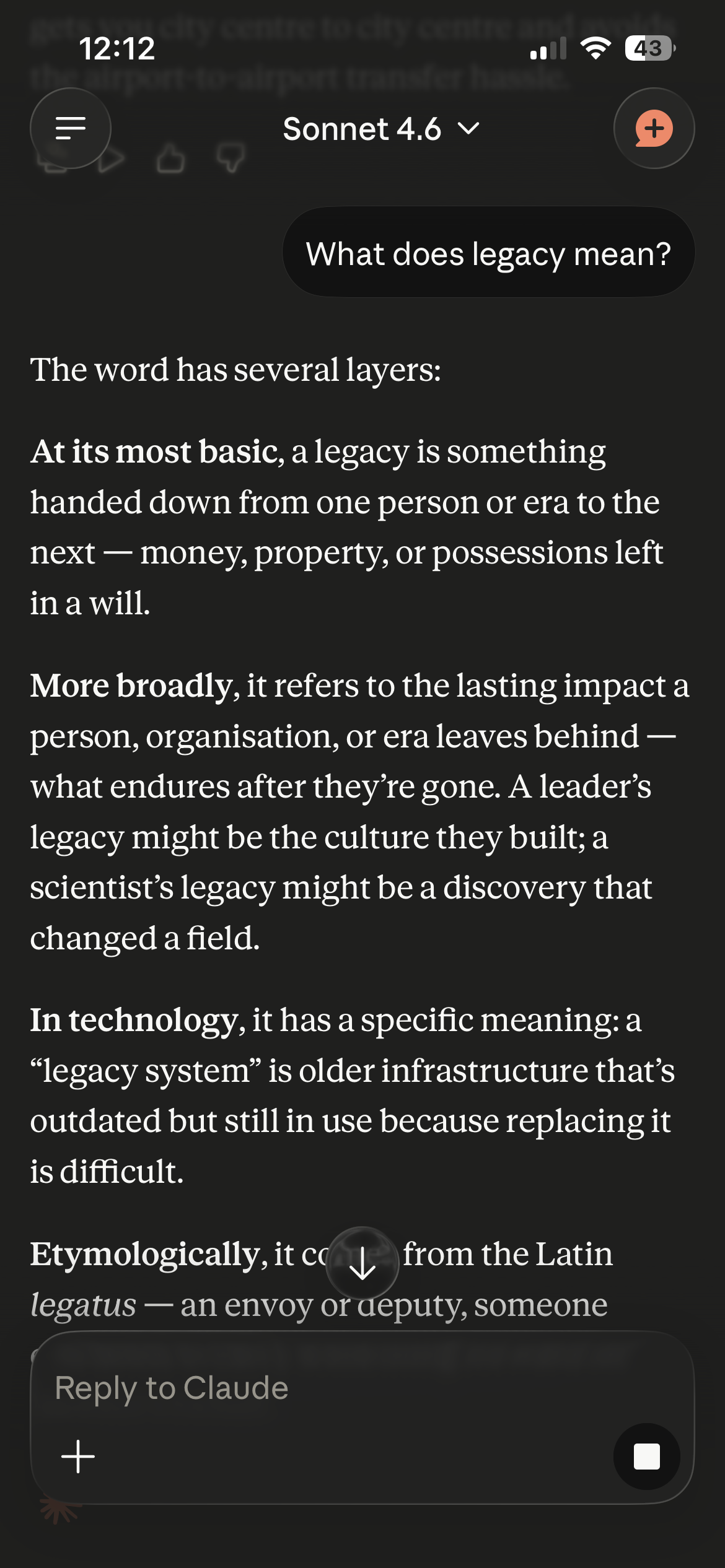
Screenshot below of how Claude defines Legacy:
No posts
Comments
Nothing yet. Say the first thing.
Sign in to join the conversation.