
This week:
Music Question: 1986 at 40. REM. Peter Gabriel. Depeche Mode. XTC. The Triffids. The Chameleons
Next: My weekly new music radio show. Week 1056. Notable Songs of July 2026
Musical Thoughts. Kate Snow on a Cornell podcast.
On a recent road trip, my music-loving brother hit me with one of those deceptively simple questions: “What are your Top 5 bands of all time?”
The first two were instant. Reflexive lock-ins. No brainers. Duh. Or maybe no Duh bands: The Beatles and The Rolling Stones. No debate required. Number three was easy: The Replacements. Number four came just as fast: Pearl Jam.
If you know me—or have spent any time with Shaped By Sound—you probably saw those four coming a mile away.
Then came a pause… Number five.
This one I felt like I needed to think through. I only had 1 left.
I spent the next couple of miles rambling through a shortlist—probably throwing out 20 or 30 brilliant contenders—before the dust finally settled on R.E.M.
Since that roadtrip he also asked for perfect 10 songs - that is way harder. I’m working on that one.
So (foreshadow?) - since that road trip I’ve been going back through all of R.E.M. when it hit me that one of their landmark releases is turning 40. Forty! Are you bloody kidding me?
I spent the rest of the week with my headphones glued on, listening to those timeless tracks on repeat—and it got me thinking. If R.E.M. was dropping magic four decades ago, what else was quietly breaking the mold back then? I decided to dive into the archives and pull together a list to remind us all of a few other phenomenal albums turning 40 this year that still sound like absolute gold.
Drop the needle, turn up the volume, and let’s go back 40 years.
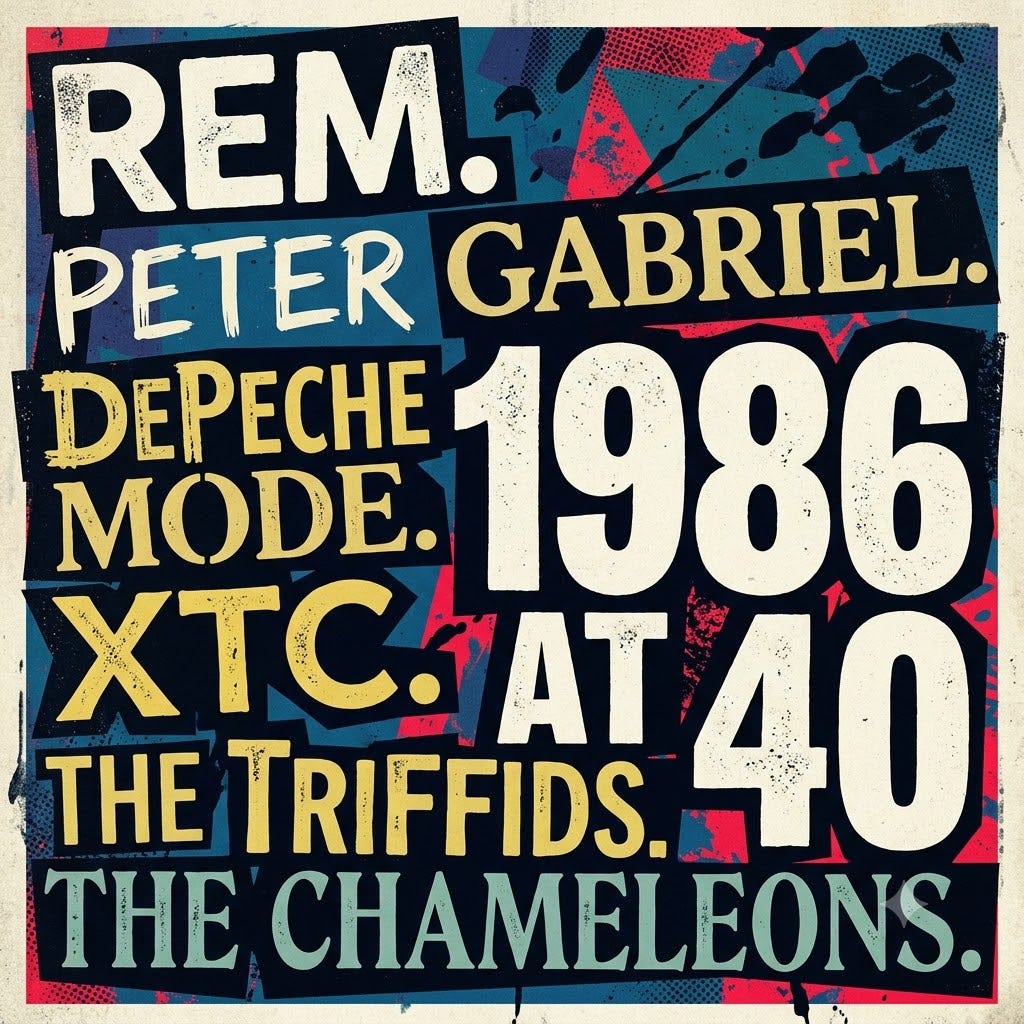
And just to put you in the 1986 mood.
In January, the world watched in collective shock as the Space Shuttle Challenger tragically exploded just 73 seconds after liftoff. We watched that in school. Halley’s Comet completes its once-every-75-years pass through our solar system. In April, horror struck Soviet Ukraine when a catastrophic meltdown at the Chernobyl nuclear power plant sent a radioactive plume across Europe (The HBO show is brilliant). We also saw massive displays of global unity and athletic flair. Over 5 million people held hands across America for hunger relief. Diego Maradona led Argentina to World Cup glory in Mexico with his legendary “Hand of God” and “Goal of the Century” against England.
At the box office - Tom Cruise became a global megastar in Top Gun, a cultural juggernaut. John Hughes cemented his grip on youth culture with the double-header of Ferris Bueller’s Day Off and Pretty in Pink. Rob Reiner captured bittersweet nostalgia in Stand by Me. Audiences also flocked to Crocodile Dundee, Aliens, and Oliver Stone’s Oscar-winning Vietnam drama Platoon. Studio Ghibli released its debut official film, Castle in the Sky, in Japan.
On the small screen. The Oprah Winfrey Show entered national syndication. Groundbreaking shows like Pee-wee’s Playhouse brought avant-garde art and quirky humor to Saturday mornings. Primetime comedy was dominated by The Cosby Show, Family Ties, and ALF. Over in the UK, the BBC debuted its long-running medical drama Casualty, and EastEnders drew a staggering 30 million viewers for its legendary Christmas Day episode. It was also the year Dallas shocked soap opera fans worldwide by resolving an entire season’s cliffhanger as nothing more than a bad dream in a shower.
Fashion in 1986 was all about maximum volume. Power suits outfitted with massive shoulder pads, oversized blazers, and acid-wash denim dominated. Hip-hop culture made a mark when Run-D.M.C. dropped “My Adidas.” - Laceless sneakers, tracksuits, bucket hats, and thick gold chains. Mainstream essentials. Top off the look with stacked Swatch watches, stirrup pants, and a pair of Wayfarers or Aviators. That’s quite the uniform of 1986.
OK in the right head space? On to why I started writing this newsletter. The music.
Released on July 28, 1986. Lifes Rich Pageant is the pivotal inflection point for R.E.M.. Coming off the murky, melancholic, folk-gothic haze of 1985’s Fables of the Reconstruction—an album recorded in rainy London amid severe internal burnout—the band needed a reset. They relocated to Belmont Mall Studios in Indiana and teamed up with producer Don Gehman. He’s best known for his punchy, hit-making work with John Mellencamp.
Gehman did what no producer had managed before: he forced Michael Stipe to step right up to the microphone, enunciate his lyrics, and let his vocal power anchor the band’s sonic wall. The result was a muscular, optimistic, eco-conscious, and politically charged album that 40 years later still stands up.
About a third of the album came from older, unreleased live staples and rough ideas polished up during the intense studio sessions.
R.E.M. Life’s Rich Pageant.
A running inside joke after guitarist Peter Buck watched Inspector Clouseau tumble into a fountain in a Pink Panther film and shrug off the chaos as “life’s rich pageant”.
This album is one of many “Forever Albums” of mine.
If I had to pick one REM song - it would be this one. Or maybe Catapult. Or maybe…
The title nods to Cole Porter’s “Begin the Beguine.” The lyrics - a rallying cry for personal and political awakening (”Silence means approval / Most mistakes are mine”).
The song served as a direct statement. This murky, jangling indie-college band was stepping into arena-rock shoes.
Peter Buck on the song’s energy: We wanted to start the record with something that hit you right in the face. ‘Begin the Begin’ was us saying, ‘Okay, we’re done with the atmospheric, shadowy stuff for a minute—here’s a rock band.
Don Gehman on Stipe’s vocal power: I remember pushing Michael on that track. He had this incredible, booming voice that he’d been hiding behind guitars for three albums. When he hit those opening lines on ‘Begin the Begin,’ everyone in the control room just looked at each other like, ‘Holy crap.
A hyper-caffeinated gallop. Love Bill Berry’s relentless drumming and Buck’s ringing riffs. Lyrically it captures a sense of urgency about political activism and environmental awareness during the height of the Reagan administration.
Michael Stipe on the album’s thematic shift: With Fables, I was looking backward at mythology and history. By the time we got to ‘These Days’ and Pageant, I was looking right at the present moment. It was about taking responsibility for where we were.
Mike Mills on the rhythm: That song is pure propulsion. Bill and I were locked in, just pushing the tempo as hard as we could without letting it fall off the rails.
Frequently cited by critics and Stipe himself as one of R.E.M.’s finest.
Michael Stipe on his affection for the track: If there’s one song from our entire catalog that I’m most proud of, it’s probably ‘Fall on Me.’ It’s a song about the environment, but it’s written in a way that feels human, not preachy.
Mike Mills on the vocal harmonies: Michael and I used to do those classic, folk-style vocal overlaps live, but on ‘Fall on Me,’ Don Gehman really helped us stack them in the studio so both lines hit with equal weight. It became this double-helix of vocals.
Named after the Ohio river that famously caught fire in 1969 due to extreme chemical pollution. “Cuyahoga” uses ecological disaster as a lens to explore Native American displacement and environmental destruction. Michael Stipe turns historical tragedy into a hopeful rally cry for renewal. He’s urging us to “put our heads together, start a new country up / Up underneath the riverbed, we’ll burn the river down.”
Peter Buck on the song’s creation: Mike came up with that bass line and the whole song just unfolded around it. It’s a very gentle song musically, but the lyric carries a lot of weight. It’s about lost promises.
Michael Stipe on the political themes: I was thinking a lot about the American landscape and what had been sacrificed in the name of progress. ‘Cuyahoga’ wasn’t just about a river that caught fire; it was about the idea that we can rewrite our relationship to the land.
A punchy, driving rocker. The song was inspired by the comedian Lord Buckley. And of course it’s funny using the metaphor of a laughing hyena in the wild to comment on media absurdity, human paranoia, and political circus acts.
Peter Buck: We’d been playing ‘Hyena’ on the road for a year before recording it, so it was second nature. But Don [Gehman] tightened up the structure and made it sound much leaner than our live version.
A brief 1 minute and 25 seconds - it serves as a humorous yet eerie interlude reflecting Cold War nuclear paranoia.
Mike Mills on the studio atmosphere: That was us just messing around in the studio and having fun. We were making an album that was pretty serious in terms of themes, so ‘Underneath the Bunker’ was a moment of dark, weird comic relief.
Don’t let the beauty fool you—this is a haunting, deeply political gut-punch. Written about human rights atrocities and covert U.S. intervention in 1980s Central America. Peter Buck unleashes a short, soaring guitar solo that is pure brilliance.
Peter Buck on his guitar solo: I didn’t usually play long, soaring guitar solos—I preferred rhythmic lead-playing. But for ‘Flowers of Guatemala,’ the track was screaming out for something soaring and emotional at the end. I just turned up the amp and let it cry.
Michael Stipe: t was a political song, but disguised as a quiet, beautiful melody. I wanted the song to sound peaceful on the surface, but carry a heavy heart when you listened closer.
This one explodes into bright folk-punk. A manifesto of self-determination.
Michael Stipe on writing the lyrics: wrote a lot of ‘I Believe’ on a train ride. It was a list of my own personal tenets—what I held onto when the world felt crazy. It was meant to be empowering.
Peter Buck on the banjo opening: I picked up a banjo in the studio and just started messing around with that riff. Don Gehman said, ‘Keep that, we’re putting it on the front of the track!’ It gave the song this great country-punk kickstart.
They tackle materialism, isolation, and generosity. Originally written around the time of Reckoning (where an earlier version was titled “Get On You”).
Mike Mills: That song had been sitting in our back pocket for a while. It took us going into a studio with Don [Gehman] to give it the right pop polish so it could really shine.
The oldest song on the record. Goes back to R.E.M.’s earliest days. A raw, garage-punk tune. Originally titled “Baby I.” A homage to early 1970s proto-punk (Patti Smith, Velvet Underground, The Stooges), complete with chaotic energy and screeching guitar. Plus a bonus of Stipe shouting the famously tongue-in-cheek line: “I’m not inspired by the status quo!”
Peter Buck on reviving old songs: We used to play ‘Just a Touch’ in sweaty college basements when we first formed. We pulled it out for Pageant because we wanted one track that was pure, unadulterated garage rock-and-roll.
Michael Stipe on the Patti Smith influence: That song was definitely me channeling my inner Patti Smith or Lou Reed. It was loud, fast, and completely unpretentious.
A tragic, civil-war-themed acoustic folk ballad.
Michael Stipe: I wanted to write a song that sounded like it had been passed down orally from the 1860s. It felt timeless, like an old Appalachian folk song that someone found in an attic.
Peter Buck: We recorded that with simple acoustic instruments to let the room ambiance do the work. It’s one of Michael’s best storytelling moments.
A cover song originally recorded by the obscure 1960s Texas power-pop group The Clique. Sung entirely by bassist Mike Mills (with Stipe providing background harmonies).
Opens with a scratchy Japanese recording from a pull-string Godzilla toy announcing a monster sighting—edited out for the commercial single release (Boo!).
Depending on how you bought Lifes Rich Pageant, the song hit differently. It was the listed finale on tape and wax, but early CD listeners got it as an unlisted bonus tacked on after the acoustic weight of “Swan Swan H.”
Mike Mills on taking the lead vocal: I loved the original version by The Clique, so I pitched doing it as a fun cover. Michael didn’t want to sing it, so I said, ‘Fine, I’ll sing it.’ We put it at the very end as a fun hidden bonus, and then radios went crazy for it!
Peter Buck: We were famous for taking ourselves pretty seriously in the studio, so ending an intense album like Lifes Rich Pageant with a silly, joyous power-pop song about a comic book hero was the perfect palate cleanser.
Peter Gabriel “So”
Released in May 1986. So was the exact moment Peter Gabriel transformed from a brooding, art-rock cult icon into a global megastar. Teaming up with producer Daniel Lanois, Gabriel stepped out of the avant-garde shadows and straight into the pop spotlight. By fusing cutting-edge synths, world-music rhythms, and massive hooks, he crafted an absolute masterpiece that defined the decade.
After releasing four consecutive solo albums with no official titled solo albums (informally referred to by fans as Car, Scratch, Melt (or Melting Face), and Security) - Gabriel’s label finally begged him to use a title for commercial clarity. Gabriel loved minimalist aesthetics and graphic design simplicity, compromised by choosing two-letter words for his albums moving forward (So, Us, Up).
Peter Gabriel on the title: I liked the brevity of it. It’s an anti-title. It doesn’t impose a concept on the music before you’ve even heard a note. Visually, it looks great on a record sleeve, and in English, it’s a word that bridges ideas: ‘So, what’s next?’
We open with a dark, atmospheric storm of sound. Driven by Stewart Copeland’s (The Police) propulsive hi-hat work, Jerry Marotta’s thunderous drums, and Tony Levin’s brooding bassline.
Peter Gabriel on the imagery: It came from a dream I had about a red sea dividing and these big red walls of water... ‘Red Rain’ was about unlocking trauma and letting the emotions pour out instead of keeping them bottled up inside.
Daniel Lanois on Stewart Copeland’s hi-hat: We needed something frantic to cut through the heavy synth textures. Stewart Copeland came in and played that incredible hi-hat track. It gave the song an unbelievable kinetic energy right out of the gate.
I wonder what this one is about? Some day I’ll figure it out.
It’s built on a greasy, Otis Redding-inspired R&B groove. Remember that frame-by-frame claymation video? And that distinctive bamboo flute? (the Prophet-5 synth preset). And holy balls Wayne Jackson’s blistering horn arrangement.
Peter Gabriel on his soul roots: I was obsessed with Otis Redding as a teenager. ‘Sledgehammer’ was my attempt to recreate the spirit of those Stax records I grew up loving. It was a chance to drop the serious artist persona and just have fun.
Tony Levin on the bassline: I played an octaver pedal on my bass to give it that fat, greasy, synth-like low end. When we hit that groove in the studio, everyone started dancing.
A heartbreaking, deeply moving ballad inspired by the economic depression and soaring unemployment in Thatcher-era Britain (as well as the haunting photographs of Dorothea Lange during the American Dust Bowl). Originally asked - Dolly Parton. She turned it down. He turned to his longtime friend and collaborator Kate Bush. Her tender, ethereal vocal against Gabriel’s raspy, desperate lead created something special.
I often wonder about this following Sledehammer…but what do I know?
Peter Gabriel on Bush’s performance: There was a very specific quality to Kate’s voice when she sang that line—’Don’t give up / You have friends’—that felt like a warm embrace. It was pure empathy.
Daniel Lanois on the track’s emotional core: That song wasn’t just a pop duet; it felt like a public service announcement for broken spirits. Gabriel’s vocal was so vulnerable, and Kate brought this angelic comfort to it.
We all have them. The internal critic inside everyone’s head—the judgmental voice that prevents us from expressing love or taking risks. Co-written with guitarist David Rhodes.
Peter Gabriel: We’re always fighting that inner judge, the voice in our head that tells us we’re not good enough or that we shouldn’t trust people. ‘That Voice Again’ is about trying to silence that critic.
A quiet, hypnotic masterpiece dedicated to the troubled American poet Anne Sexton, who tragically died by suicide in 1974.
Peter Gabriel on the dual vocals: was reading Anne Sexton’s poetry and was deeply moved by her honesty. For the vocal on ‘Mercy Street,’ singing an octave below my normal voice gave it this shadowy, internal quality, like a ghost whispering over my shoulder.
A biting, hilarious satire of 1980s yuppie materialism and corporate greed. “Big Time” is famous for its groundbreaking rhythm section trick: bassist Tony Levin wore drumsticks taped to his fingers—a technique dubbed “Supersticking”—and slapped the bass strings while drummer Jerry Marotta played the bass pedals.
Tony Levin on inventing “Funk Fingers”: Jerry [Marotta] held the drumsticks and hit the bass strings while I held the chord shapes on the neck! It sounded so cool that I eventually had little shortened drumsticks strapped to my fingers so I could do it myself.
Peter Gabriel on the satire: It was a parody of the ‘bigger is better’ mentality of the 1980s. I wanted to poke fun at the consumerism of the era, including my own potential success.
The darkest track on the record. It’s about Stanley Milgram’s famous 1961 Yale psychology experiment, which demonstrated how ordinary human beings could be coerced into inflicting severe pain on others simply because an authority figure ordered them to.
Peter Gabriel: The Milgram experiment showed how easily people submit to authority without questioning it. It’s a short, disturbing track, but I felt it was an important reminder on an album that was otherwise very warm.
A collaborative track co-written with avant-garde performance artist Laurie Anderson. a jerky, futuristic art-pop groove. An earlier, slightly different version titled “Excellent Birds” had appeared on Anderson’s 1984 album Mister Heartbreak. Re-worked with producer Daniel Lanois and featuring Nile Rodgers on rhythm guitar.
Laurie Anderson on the collaboration: Peter and I had very different ways of working in the studio. I was very quick and sketchy, and Peter was meticulous—he could spend three days getting a bass drum sound! But combining those two approaches produced something really strange and fun.
Immortalized forever in Cameron Crowe’s 1989 film Say Anything...). A romantic epic that bridges personal love with spiritual devotion. Gabriel anchored the track with African polyrhythms, bringing in Senegalese vocal titan Youssou N’Dour to sing the breathtaking Wolof-language climax.
Peter Gabriel on working with Youssou N’Dour: When Youssou came in and sang those lines at the end, he completely elevated the track to another realm. It took the song from a personal love letter to a universal, spiritual chant.
Daniel Lanois on the arrangement: We worked endlessly on the build-up of ‘In Your Eyes.’ We wanted it to feel like a sunrise—starting soft and building into this massive, euphoric celebration.
Original vinyl releases often swapped the running order of “In Your Eyes” and “This Is the Picture”.
XTC “Skylarking”
Driven indoors by Andy Partridge’s severe stage fright - XTC was strictly a studio unit by 1986. Facing an ultimatum from Virgin Records to break the American market, they were paired with legendary producer Todd Rundgren at his studio in Woodstock, New York. The resulting sessions were a legendary clash of egos—Partridge and Rundgren fought over every chord, mic placement, and mix. Yet, that volatile friction forced a loose collection of songs into a seamless, sun-drenched conceptual masterpiece tracing a single day, a year, and the cycle of life from youth to death.
Andy Partridge on the title: I came across the word ‘skylarking’ in a book on 18th-century nautical terms. It meant fooling around in the rigging, but to me, it conjured up images of sitting in a summer field, looking up at birds, and just daydreaming your life away. It felt like the perfect umbrella for these songs.
Skylarking is the ultimate orchestral-pop record! Sweeping string quartets. Lush vocal harmonies. and intricate acoustic arrangements that capture the heat, romance, and existential anxiety of summer.
The Concept: A journey from the buzzing insect heat of “Summer’s Cauldron” to the tragic, pagan finale of “Sacrificial Bonfire”. Of course we can’t forget the controversial, anti-religious masterpiece “Dear God” famously added to later pressings after American college radio forced the label’s hand.
Pastoral English folk meets American power-pop polish, trading standard rock riffs for chamber-pop elegance.
Andy Partridge on the battle with Rundgren: Todd Rundgren was a bastard to work with, and we fought every single day. But I have to admit, he forged all our mess into a total masterpiece.
Todd Rundgren on shaping the album’s concept: Andy hated the arrangements at first because it wasn’t what he heard in his head. But I told him, ‘You hired me to produce this record, let me do the work.’ It remains one of the pieces I’m proudest of.
Colin Moulding on the album’s lasting magic: It was about capturing nature, young love, and getting old... wrapping up the whole cycle of life in 45 minutes.
Depeche Mode “Black Celebration”
Depeche Mode’s 1986 gothic-industrial landmark.
Before 1986, Depeche Mode were still fighting off their image as squeaky-clean ‘80s synth-pop poster boys. Black Celebration changed everything.
Setting up shop in West Berlin right next to the Cold War wall, the band threw all their chips into the dark side. Despite the ominous title it was about ordinary people grabbing a drink at the end of a soul-crushing day to celebrate just surviving. It’s heavy, hypnotic, and the exact moment they became alternative icons.
The title was taken directly from the album’s opening title track, written by chief songwriter Martin Gore. Despite its ominous, gothic ring, Gore intended “Black Celebration” to be an act of solidarity and comfort. It refers to the ritual of ordinary people coming together at the end of a soul-crushing day to drink, embrace, and celebrate another day surviving in a bleak world. It was about finding joy and connection in spite of the darkness. Not doom and gloom.
The sound: It is a dark, cinematic wall of sound built on innovative real-world sampling (slammed car doors, idling engines, metallic clangs), heavy bass drones, and pitch-black romanticism.
A dark sanctuary for the alienated. The album centers on finding intimacy, comfort, and human connection amid existential dread and the grind of daily life.
It’s a dark, gothic, and incredibly romantic album built on a simple premise: when life gets bleak, you gather your friends, raise a glass, and celebrate making it through another day.
Prost!
Martin Gore on the album’s core meaning: People always assume ‘Black Celebration’ has some sinister meaning, but it really doesn’t. It’s about celebrating the dark times—getting together with your friends when everything seems hopeless and having a drink to celebrate just getting through another day.
Dave Gahan on the Berlin influence: We were looking out at the Berlin Wall every day while recording. That city’s tension crept straight into the tapes. It felt darker, heavier, and much more adult than anything we’d done before.
Alan Wilder on designing their signature sound: We spent an enormous amount of time sampling real-world sounds. On ‘Stripped,’ the main rhythm was actually a sample of a Porsche engine recorded outside the studio, pitched down an octave to give it that heavy, mechanical crunch.
Bonus - quickies. Well quick for Chris Bro.
A few others from 1986. One sweeping across the sun-baked Australian outback, and the other emerging from the rainy, brooding post-punk underground of Manchester.
(Building on last week’s newsletter)
The ultimate Australian gothic-folk record. They built a sun-bleached, cinematic landscape. It’s a lonely, sweeping set of songs about heat and heartbreak that bridges post-punk with rootsy soul.
Born Sandy Devotional remains a must listen to for deep dives of 80s music.
“The Seabirds”: Opens the record with quiet, ominous tides before exploding into a portrait of romantic obsession and madness along a desolate shoreline.
“Wide Open Road”: The band’s signature anthem. Built on a soaring, desperate hook, McComb sings of driving down an endless highway trying to lose the ghost of a past lover. It’s a tragedy disguised as a driving song.
“Stolen Property”: A brooding, slow-burn track driven by a weeping pedal-steel.
“Tender Is the Night (The Long Sleepless Night)”: A delicate, organ-laced ballad that showcases McComb at his most vulnerable and poetically devastated.
A record that directly influenced artists like Nick Cave, The Go-Betweens, and Wilco.
(Released September 29, 1986)
An underappreciated ‘80s post-punk band. Strange Times feels perpetually on the brink of a breakdown. Led by bassist/vocalist Mark Burgess and the shimmering dual-guitar team of Reg Smithies and Dave Fielding. They rarely played standard rhythm/lead roles. They wove interlocking, delay-drenched, chiming guitar patterns that created a massive wall of sound. This album - their third Strange Times was a towering monument of atmospheric, psychedelic guitar rock. Produced by Dave Allen (The Cure),
Setting the stage for 90s shoegaze, Britpop, and modern post-punk revivalists (Interpol, Editors, The Killers).
“Mad Jack”: Opens the LP with a ferocious, chaotic post-punk assault. Driven by driving drums and jagged guitar riffs, Burgess shouts about political absurdity and social madness.
“Caution”: Tension and release. Built on a hypnotic, winding guitar line, the song steadily builds into an overwhelming, cathartic wall of sound.
“Swamp Thing”: The album’s crown jewel.. Opening with an iconic, swirling, chorus-heavy guitar riff, it’s a brilliant, five-minute epic about creeping paranoia and emotional drowning.
“Tears”: A gorgeous, melancholic acoustic-driven ballad that shows the band’s softer, more introspective side without losing an ounce of emotional weight.
“In Answer”: A soaring, mid-tempo anthem that captures the band’s gift for pairing dark, existential questioning with irresistible, shimmering hooks.
Shortly after releasing Strange Times, the band tragically fractured following the sudden death of their manager. This would be their original lineup’s final studio statement. Though mainstream charts largely ignored them, Strange Times is revered by musicians as an untouchable classic of 1980s alternative guitar music.
Welcome to week 1056 of NEXT, the weekly new music broadcast. We are officially closing out another month, which means today is our July Rewind—a full review and reminder of the new tracks that hit our airwaves over the past few weeks. If you missed an episode, were busy at work, or just need a refresher on the artists pushing real music forward right now, consider this your catch up episode. No filler. No algorithms. Just the hand picked sounds of July lined up and ready to roll. Let’s hit rewind and get this show started.
A jagged, high-energy blast of post-punk revival straight out of Brooklyn. It charges forward with urgent, driving basslines, slashing guitar riffs, and a raw vocal performance loaded with downtown NYC attitude. Sounds like: Yeah Yeah Yeahs and Interpol.
A beautifully hazy, slow-burning indie-pop track that feels like watching a rainstorm through a dusty window. It pairs soft, vulnerable vocals with a swelling acoustic atmosphere that gradually builds into something deeply cathartic. Sounds like: Phoebe Bridgers and Big Thief.
Delivering a warm, breeze-touched blend of bedroom-rock and nineties alternative jangle. The light, bossa-nova-infused acoustic rhythm and feather-soft vocals make it feel like an effortless, late-summer afternoon reset. Sounds like: Clairo and Sundara Karma.
A sun-faded, bittersweet wave of nostalgic alternative rock. It wraps tight, melodic hooks in a blanket of warm, fuzzy guitars and driving drums that capture that exact feeling of watching the season change. Sounds like: Real Estate and The Beths.
A high-octane, swaggering dose of modern garage rock that hits the gas pedal immediately. Anchored by soaring vocal harmonies and a relentless, driving rhythm section, this one is tailor-made for turning the car stereo all the way up. Sounds like: The Kooks and Sam Fender.
Unrolling a loose, heavily atmospheric groove that balances raw garage grit with a laid-back, psychedelic bounce. It drifts along on clean, jangly guitar hooks before building into that signature, uninhibited dynamic shift they do best. Sounds like: Young the Giant and Spoon.
Hits with an unmistakable, raspy vocal punch and a heavy, stomping rhythm section. It blends retro soul-rock swagger with an edgy, modern alternative production that completely grabs you by the collar. Sounds like: The Heavy and The Interrupters.
A turn into the delightfully experimental side of art-pop. Coming out of Bristol, this trio weaves together jazz-infused drums, hypnotic dub basslines, and swirling, dreamlike textures into a mesmerizing, late-night groove. Sounds like: Stereolab and Portishead.
An expansive, soul-stirring piece of psychedelic roots-rock. Driven by his unmistakable, reverberating tenor, the track floats effortlessly over steady acoustic strumming and lush, cosmic production. Sounds like: My Morning Jacket and M. Ward.
A devastatingly delicate piece of indie-folk that commands total quiet in the room. Built around intimate acoustic fingerpicking and haunting, double-tracked harmonies, it carries that sharp, emotionally transparent lyricism that hits straight in the chest. Sounds like: Julien Baker and Elliott Smith.
A sweeping, cinematic pop-noir ballad that sounds like it was ripped straight out of a classic mid-century soundtrack. Her massive, soulful vocals soar over dramatic string arrangements and a slow, sultry beat. Sounds like: Angel Olsen and Jenny Lewis.
Drenched in dreamy, mid-tempo nostalgia that bridges classic seventies singer-songwriter warmth with modern indie-pop gloss. Soft piano chords and lush acoustic guitars carry a smoky, reflective vocal about close calls and fading memories. Sounds like: Lana Del Rey and Weyes Blood.
Love the tension and dynamic shifts. It starts at a slow, delicate creep, slowly building up atmospheric weight before dropping away to a sparse moment of just vocals and a plucked guitar—ending abruptly mid-sentence to leave you hanging in the quiet. Sounds like: Low and Wednesday.
Serving up a classic slice of surrealist psychedelic folk-rock. Driven by bright, chiming acoustic guitars and his sharp, whimsical lyricism, it captures that timeless British eccentric charm that feels both classic and totally singular. Sounds like: Syd Barrett and The Soft Boys.
Closing this set out with a surging, organ-driven blast of Madchester alternative rock. It locks straight into a heavy, swirling groove powered by organ hooks, driving basslines, and classic nineties garage-punk energy. Sounds like:The Charlatans and The Stone Roses.
That is going to wrap up week 1056 of NEXT and our look back at the standout music of July 2026. Thank you so much for tuning in, for digging through the music with me every single week, and for keeping your ears open to the real, hand-curated art being made in the present tense.
If any of these July highlights hit you today, make sure to add them to your rotation and share them with someone who appreciates great music—because music is life.
Take care of yourselves, keep supporting real artists, and I will see you next week as we kick off a brand new month for week 1057!
Proud husband brag incoming: My wife Kate was interviewed on the Cornell (Thank) U podcast! She did a fantastic job, and since we never turn down a chance to weave great music into the story (stick around for the back end of the episode), it fits right into the Shaped By Sound universe.
Here is how the podcast introduced her feature:
She’s here!! This interview has been at the top of our wish list for a long time.
Most people know Kate Snow as the journalist they’ve welcomed into their homes for decades. We walked away appreciating her even more—not just for the stories she’s covered, but for the humanity she brings to every one of them.
In this episode, Kate takes us from Cornell to local news, CNN, ABC, and NBC News, sharing the moments that shaped her career—and her. We talk about earning the trust of people during the hardest moments of their lives and why the toughest conversations don’t begin with the first question—they begin before the interview ever starts.
We also get a behind-the-scenes look at live television, hear why music has always been such an important part of Kate’s life, and laugh about a few moments that remind us there’s a really fun and relatable person behind the anchor desk. What stayed with us most is that this conversation isn’t just about Kate’s television career. It’s about curiosity, empathy, resilience, and the extraordinary impact one person can have simply by making others feel seen, heard, and respected.
A special thank you to our friend Dave Price for introducing us to Kate. Dave, you’ve made so many wonderful introductions over the years that we’re starting to think you deserve an honorary producer credit. Thank you for always thinking of us—and for bringing Kate into the Cornell (Thank) U family. Whether you’ve watched Kate for years or are just getting to know her, we hope you’ll finish this episode feeling exactly as we did: inspired by the journalist, grateful for the storyteller, and genuinely touched by the person.
Editor’s Note: Since recording this episode, I (Michelle) had the chance to see Kate and Snowdrift perform live, and they were phenomenal. The energy was incredible, they played so many songs we loved, and the night had an unexpected Cornell twist—I was reunited with one of Kate’s sorority sisters and our former housemate, Donna Pekala Kirsh, and finally got to meet friend of the podcast Joe Marraccino. It made an already special conversation feel even more personal.
Here’s where you can find Kate: Instagram: @TVKateSnow Facebook: @TVKateSnow LinkedIn: Kate Snow https://www.linkedin.com/in/kate-snow-90527013b/
Music (you MUST listen!): https://hyperfollow.com/katesnow
Also on Apple Music and Spotify. Not sponsored by or affiliated with Cornell University.
and if you love someone hug them right now.
Comments
Nothing yet. Say the first thing.
Sign in to join the conversation.