
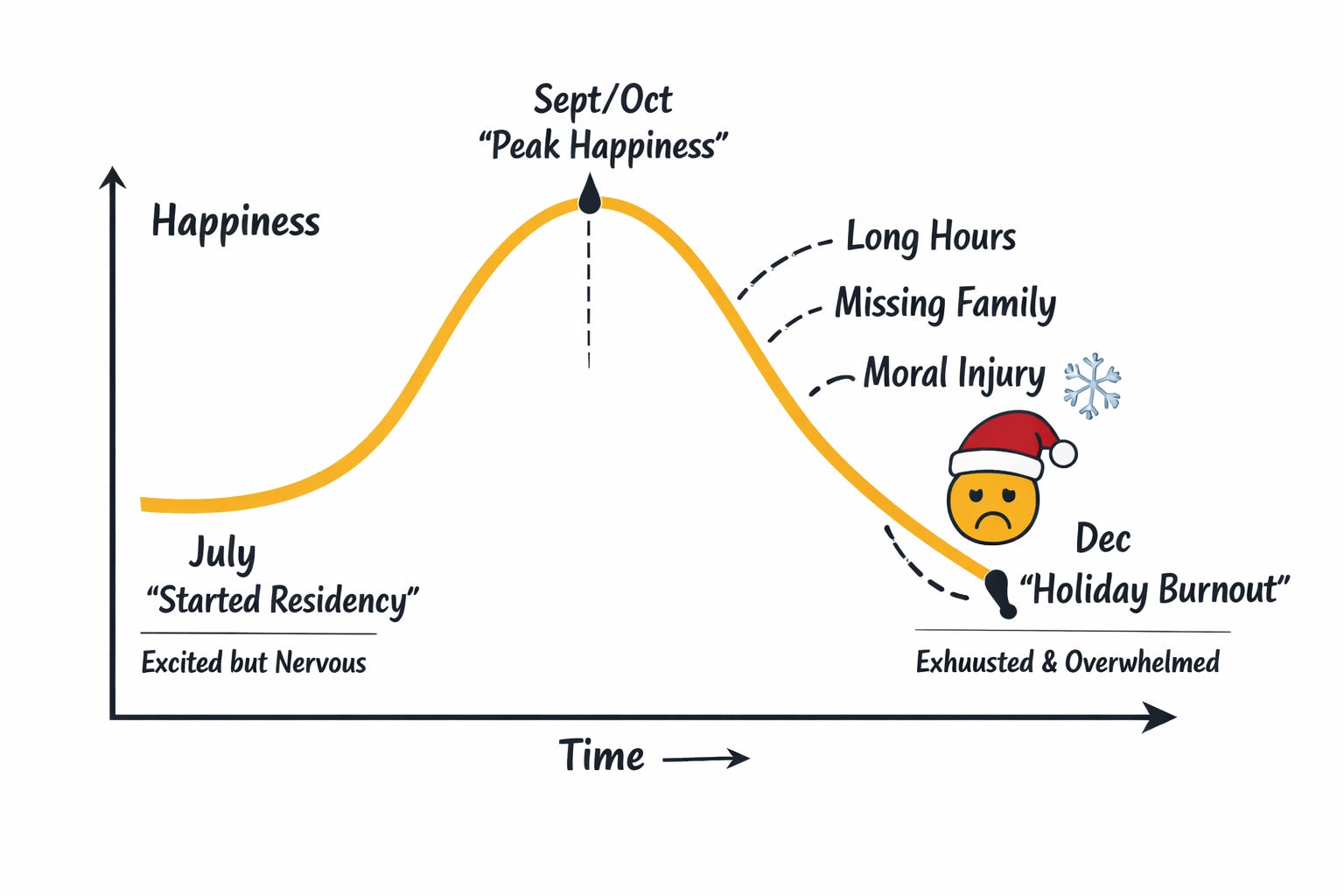
There’s a famous (and painfully accurate) mental graph that circulates among residents and interns.
On the y-axis: happiness.
On the x-axis: time.
In July, when a new crop of doctors begins residency—a grueling 3 to 7 years of training—happiness is somewhere in the middle. There’s the excitement of finally being a doctor, mixed with fear: fear of making mistakes, fear of harming someone, fear of not being good enough.
By September or October, happiness peaks. You’ve figured out the hospital routine. You have your own templates and keyboard shortcuts in the electronic health record. You can handle common admissions and procedures solo. You’re still tired, but you’re learning every day—and it feels meaningful.
Then Thanksgiving hits.
The novelty has worn off. The days are shorter. The weather turns cold. And you’re still in the hospital—missing family and friends, working six- and seven-day weeks, taking overnight call. The moral injury deepens: watching patients bounce back again and again because the root causes of their illness aren’t addressed; seeing patients without insurance or financial means receiving unequal treatment; feeling the weight of a rigid medical hierarchy press down harder each week.
By this time of year, many residents are at their lowest point—FaceTiming loved ones from call rooms, or worse, watching them gather without them on social media—while feeling trapped in a system that is as grueling as it is, at times, futile.
I was once one of those residents.
And although I love practicing medicine now, I was no less burnt out—and toxic—than anyone else. I groaned when I got a new admission. I cursed under my breath when patients ready for discharge refused to leave. I felt agitated when nurses paged me in the middle of the night for routine orders that could have waited until morning.
I’m not proud of it. But it’s the truth.
Part of my frustration came from a deep, unspoken belief that residents and interns bore the brunt of not just our hospitals, but the entire healthcare system. Teaching hospitals are often the backbone of American medicine. They care for patients with the most complex diseases—and often the fewest resources—when no one else will.
And yet, there was very little to support us.
During my internship, an H1N1 outbreak swept through my residency class in the middle of winter. I was called in from vacation to cover shifts. We had multiple attending physicians for every resident, but it was the residents who were expected to step up. The same thing happened during a massive blizzard, when I was called in to cover for a co-resident who couldn’t make it out of their apartment and waited for the only transportation available—the commuter bus—in paper thin scrubs knee deep in snow.
Burnout and moral injury are systemic problems that require systemic solutions—I believe that deeply. But what I remember most from that time was a desperate wish: for someone to say thank you. And the sense that we almost never heard it—or felt it.
So this holiday season, to all the doctors, nurses, and trainees working while the rest of the world celebrates:
THANK YOU for being the glue that keeps our dysfunctional healthcare system running.
THANK YOU for sacrificing time with loved ones to care for people who need you.
THANK YOU for showing up when it’s cold, it’s hard, and it’s the last thing you want to do.
THANK YOU for showing grace in a system that often lacks any.
THANK YOU for caring for those that society has too often failed and forgotten.
The frustration—and even anger—you feel is justified. But I can also tell you this: this moment will pass. And years from now, you will look back on it with pride.
As one of my colleagues once told me during residency, you’ll never be as useful to society as you are today.
That truth may not make your pain any easier.
But it also doesn’t make it any less true.
—Shantanu Rai
No posts
Comments
Nothing yet. Say the first thing.
Sign in to join the conversation.