
When the patient’s vomit arced toward me, I threw myself to the right.
Pure reflex. No thought.
For a split second, muscle memory took over.
Then I caught myself.
I wasn’t in clinic dodging the bodily fluids of a violently ill patient. I was on my couch, watching The Pitt (Season 2).
In that instant, I understood what people meant when they called the show “hyper-realistic.” My body didn’t know the difference.
I loved Season 1. It felt tight, purposeful. Beneath the chaos of the hospital, there was a clear arc: the protagonist’s unresolved PTSD from COVID. Would he confront it and grow? Or would it consume him the way it has consumed so many physicians I know?
Season 2 has felt different. I’ve found myself watching expectantly, engaged but searching for the thread that ties the episodes together. The patients change. The crises rotate. The suffering continues. But the narrative spine feels looser, harder to grasp.
I’ve been paying close attention for more than one reason. People magazine just highlighted my debut novel—out tomorrow—as a top read for fans of The Pitt.
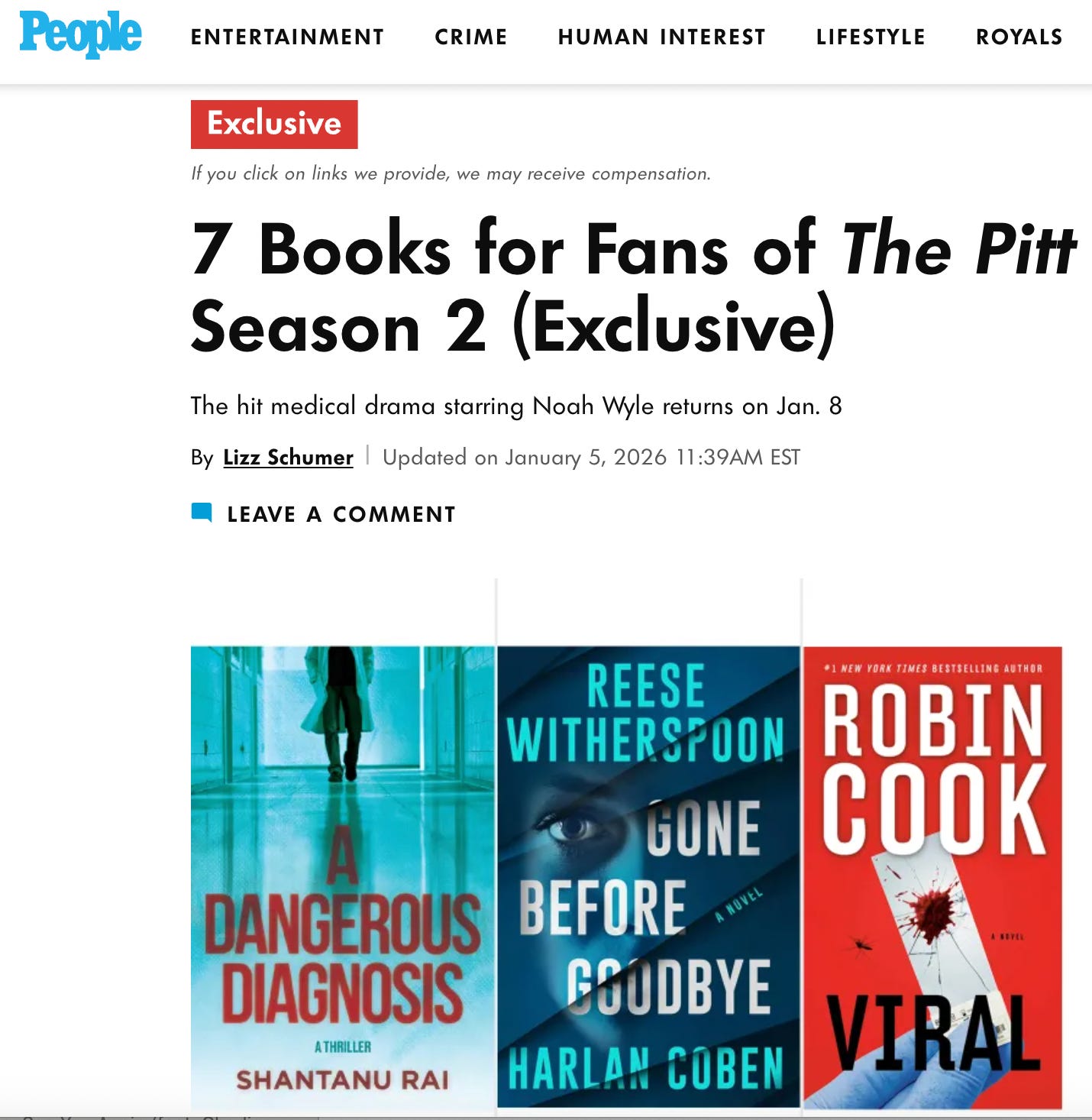
The call out was deeply flattering. But as I’ve watched The Pitt, I’ve wondered whether the similarities end at the obvious: both the show and my novel are set in medicine.
Then that reflexive dodge on my couch made something click.
Maybe The Pitt isn’t trying to tell a story at all.
Maybe a story—at least in the traditional sense—would detract from what it’s attempting to do.
Because in medicine, as I’ve seen firsthand, there often is no satisfying arc. Good patients die. Others who break every rule somehow survive. Brilliant, compassionate physicians burn out. Some die by suicide. The system itself—this sprawling machinery meant to heal—remains the leading cause of personal bankruptcy in the wealthiest country in human history.
One of my favorite lines from Yann Martel’s Life of Pi is: “Fiction is the selective twisting of reality to bring out its essence.”
But what if reality has no discernible essence?
What if the system we rely on to care for our sickest is simply broken?
The Pitt doesn’t try to extract meaning from the madness. It doesn’t offer a grand explanation for why things are the way they are. It simply shows. In Simon Sinek’s “what, how, why” framework, it is committed to the what. This is what it looks like. This is what it feels like. This is what doctors and patients endure.
And in that way, it may be the perfect complement to A Dangerous Diagnosis.
If The Pitt shows the symptom, my novel explores the diagnosis.
It asks why so many good doctors are burning out. Why a system staffed by some of our brightest, most driven people can feel so corrosive. Why the incentives seem misaligned with the very mission of healing. And most importantly—whether anything can be done about it.
If you’ve watched The Pitt and felt that tightening in your chest… if you’ve sensed there’s something deeper beneath the exam room curtain… A Dangerous Diagnosis is for you.
Because sometimes hyper-reality shows us the wound.
But we still need to name—and treat—the disease.
—Shantanu Rai
No posts
Comments
Nothing yet. Say the first thing.
Sign in to join the conversation.