
The patient’s words could not have come at a better time.
I had just finished admitting a 67-year-old man to my hospital service. He had gone into cardiac arrest while playing the piano at church, was resuscitated, and then transferred to my hospital for bypass surgery. He was acutely ill. As is common, he likely aspirated when he lost a pulse, so needed to be intubated, and just hours earlier had finally been able to breathe on his own again—tenuously. We didn’t yet know the extent of his brain injury from the loss of blood flow and oxygen. When I saw him, he could speak, but just barely—his voice hoarse, his throat raw. He would doze off mid-sentence, then wake again. He was hungry, but not yet cleared to eat.
I left his room feeling overwhelmed and, if I’m honest, a bit inadequate.
Where I had trained, patients like this would have been cared for in a surgical ICU before their operation. I had taken care of plenty of patients after cardiac surgery, and plenty after cardiac arrest—but not someone in this in-between state. This precarious, ticking space before surgery. And not in fifteen years. I was largely following the recommendations of the multiple specialists seeing him, trying to synthesize their plans, and wondering what—if anything—I was adding.
Standing over his bedside, I wasn’t sure what to do. His case was outside my expertise, and my answers to the family’s questions were mostly to defer—to ask the other specialists. Lacking much else to say, I mentioned that I, too, play the piano. His eyes lit up. And soon his hospital room was filled with his music, as his wife played a couple of recordings from her phone.
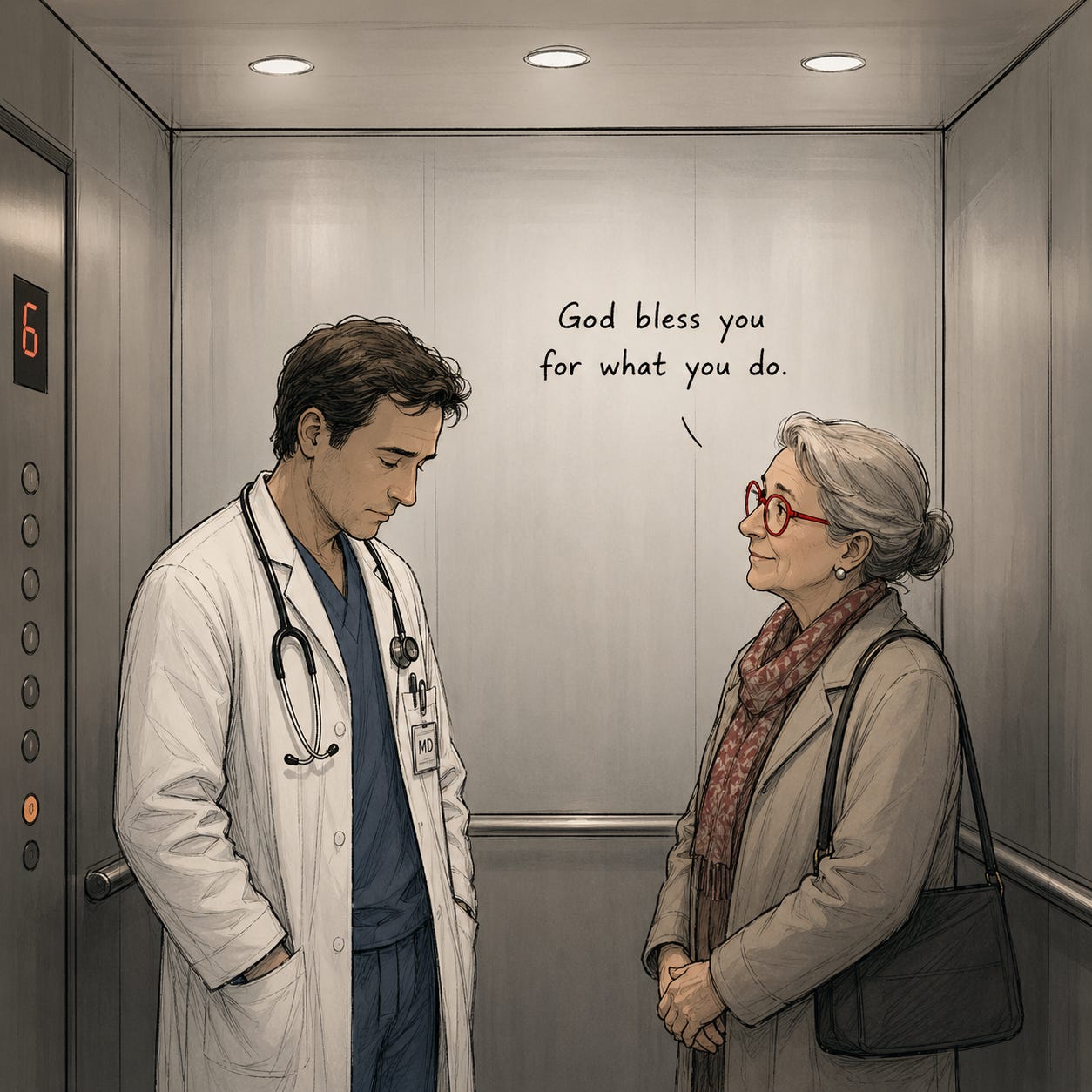
On the elevator ride back to the workroom, I was deep in thought, trying to put the pieces of his case together while also pushing down the quiet rush of emotions that come with feeling lost.
When I looked up as the elevator stopped, an older woman—maybe in her seventies, with red-rimmed glasses—looked directly at me and said, “God bless you for what you do.”
I paused, caught off guard. She didn’t know me. She was likely visiting a family member in the hospital, perhaps a very sick one. But she saw the stethoscope around my neck, and maybe she saw something else too—the concern written across my face—and felt like she needed to say something.
After a pause that felt longer than it was, I managed a smile. “Thank you.”
When I stepped out of the elevator a moment later, something about it didn’t sit right.
Her statement felt almost ironic. It had come at the exact moment I felt least deserving of it. I hadn’t done anything heroic. I hadn’t saved a life. I hadn’t made a breakthrough diagnosis. If anything, I felt like I was doing very little at all.
But then I paused and thought harder.
She hadn’t seen any of that. She hadn’t seen a code, or a procedure, or anything resembling the dramatic moments we tend to associate with this job. She had just seen me—a doctor, standing in an elevator, looking concerned about a patient.
And then it dawned on me.
I had been so focused on what I could add to this patient’s care—what diagnosis I could make, what medication I could prescribe, what insight I could offer—that I had forgotten the simplest, most enduring rule of medicine, one I have told countless residents and students over the years: you may not be able to cure every disease or solve every problem, but you can always listen, and you can always care.
In talking to him about our shared love of music, in taking him—even for a moment—away from his disease and his discomfort, I had done just that. Just not in a way that comes from any medical textbook.
Because often, it’s not us that lift up our patients.
It’s our patients—and sometimes even strangers—who lift us up.
—Shantanu Rai
No posts
Comments
Nothing yet. Say the first thing.
Sign in to join the conversation.