
Everyone you know will die, I said to my sister. We sat, passing through sugar-white clouds and brilliant sky, heading to Florida to mourn with our cousins and aunt after the departure of their beloved father and husband.
Our uncle’s death felt unexpected and shocking; he was 70, healthy, active, strong. And yet, calling it unexpected sounds naive because of the reality of life: everyone we know will die.
As moderns, we are somewhat shielded from the inevitability of death. My mother didn’t die giving birth. None of my aunts, who endured the blessing of 49 births between the 8 of them, died in or after childbirth. Death feels like a distant and hazy reality, and is rarely thrust into our direct line of sight so forcefully and painfully as it was that day in January when my aunt called to let me know that her husband of nearly 40 years was gone.
There is an ancient practice, often called by its Latin name memento mori, which means to “remember you will die.” I do not regularly practice memento mori (though perhaps I should), but I have noticed that there is no event like the death of someone you love to force one to think in a clear-eyed and meaningful way about death and life, and how one should live, how one ought to live. As Richard Rohr said, “It seems we only know what life is when we know what death is.”1
Is contemplating death a depressing and hopeless exercise? I don’t think so. Sarah James, in her excellent essay on memento mori, wrote: “In the midst of death and loss, love centers itself.” She adds, “remembering death—that we and the people we love will die—is not morbid. Rather, it helps us prioritize what is most important.”2
I witnessed this prioritizing firsthand as we all gathered the evening before my uncle’s funeral. Aunts, uncles, cousins, brothers, sisters, mothers, all embracing with love and sadness, and even joy. I noticed that one particular family member—my uncle Mark—seemed particularly touched by the loss of his older brother, as he made his way around the room, eyes shining, hugging each of us in the most tender and meaningful way. In the midst of death and loss, love is made more evident, and manifested more easily. Too often we are time optimists, in the words of Fredrik Backman, and think that we have infinite time to say and do things with the people that we love—we rationalize away a delay in telling each other how much we care. But in the wake of death, on that day, in those moments, we laid aside the cares of the world to look into each others' faces and say, in so many words, I am so glad that we are here together. What a gift it is to know you.
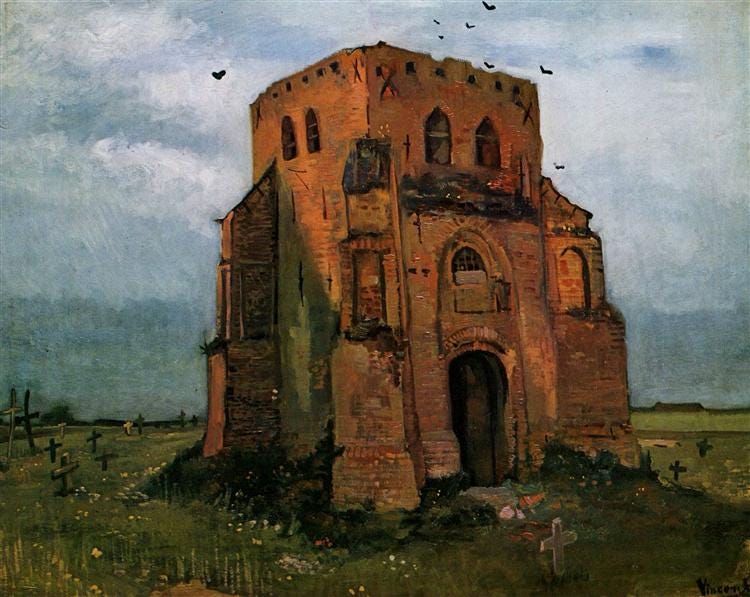
Charles Dickens, in his quirky but delightful novel The Old Curiosity Shop, illustrates the idea of universal death brilliantly:
“Here were the rotten beam, the sinking arch, the sapped and mouldering wall, the lowly trench of earth, the stately tomb on which no epitaph remained,—all, —marble, stone, iron, wood, and dust, one common monument of ruin. The best work and the worst, the plainest and the richest, the stateliest and the least imposing—both of Heaven’s work and Man’s—all found one common level here, and told one common tale.”3
In his description of an old, crumbling church (surrounded of course by graves), Dickens skillfully shows and reminds us that our common fate is death. The common fate of everything we see: every house, building, statue, cathedral—is ruin. Everyone we know will die.
And so, if “the only trustworthy pattern of spiritual transformation is death and resurrection,”4 our meditations on death do not stop there. Indeed, our meditations on death must not stop at death, because those contemplations are fundamentally incomplete. Death is not the end. Death was never meant to be the end. Let us remember that the abolition of death, through Christ, has already been accomplished! Let us remember that, in the words of the poet John Donne,
One short sleep past, we wake eternally
And death shall be no more; Death, thou shalt die.
Keep seeking the virtuous and the lovely,
Shannon
Previously:
AI Disclaimer: No part of this essay was written using AI. All of the organization, ideas, writing and editing are a product of my fallible and finite mind. I have never used AI to write anything, and I never will.
Charles Dickens, The Old Curiosity Shop, (Wordsworth Editions, 1995), 390.
Richard Rohr, “Not Death Avoided, But Death Transformed.”
Comments
Nothing yet. Say the first thing.
Sign in to join the conversation.