
Editor’s Note (2026): Last week I argued that children need more than loving parents—they need cultures filled with adults willing to help shape them. But that raises a deeper question: What exactly are we trying to shape? Modern education talks constantly about skills and achievement. Great parents think first about formation. Before we ask what our children will know, we should ask who they are becoming.
In The Intentional Father, Jon Tyson shares this powerful parable:
Imagine a farmer walked down a backcountry road and saw another farmer repairing a fence. His young sons were helping him.
“Why are you letting your sons help you?” the first farmer asked. “It’s going to take five times as long. You should just do it yourself.”
“Oh, but you’ve made a mistake,” the second farmer said. “You think I’m repairing a fence. I’m not. I’m raising my sons.”
Mic drop, right?
There are many profound implications that we can take from here. I’ll start with one that is so obvious, you might miss it.
This parable is all about priorities. The father claims that he isn’t fixing the fence, he is raising his sons. Clearly he is doing both, but I love that he chooses to focus on raising kids. He knows which task is most important.
As parents we are all called to be teachers.
Once our family’s survival needs are met, this is the primary role of parents and community adults.
Our job is not to provide and protect each kid to the maximum extent possible. It is not to pave the way for our kids, ensuring that they are always optimally comfortable and entertained. Our primary job is not even just to cross off all the tasks required to keep a busy household running.
Rather, the job of parents and adults is to help make our kids more capable and admirable people—to put them on the path to self-actualization. Or, as former Stanford Dean of Freshman, Julia Lythcott-Haims said:
“Our job as parents is to put ourselves out of the job.”
The village imperative is to create great adults.
This is what “parenting” or “raising kids'' once implied. But it is also inconvenient, inefficient, and just plain hard.
It will always be easier to take care of things for our children—to avoid the whining and the hassle. It will always be easier to put the shirt on them when they are young… to tie their shoes, to put up their dirty dishes, or to make their lunch. It is always easier to neglect manners—to let it go when our kids don’t respond or make eye contact with adults. It is always easier to ignore it when kids forget to say “thank you,” or “yes, ma’am,” or to ignore it when they don’t hold a door, or when they put a book back with the spine pointed inwards.
It is easier to let everything go. But instilling the habit of doing things “the right way” is a tremendous gift. It will separate your kids in this world and give them access to a deeper life.
As parents we are constantly confronted with opportunities to slow a task down and teach our children what we’re doing. When they are young this might be showing them how to air up tires or make a sandwich. As they age this might be how to change the oil, invest money, or cook dinner. These moments have the potential to be some of the most profound and influential for our children.
BUT they will also often be an inconvenience.
Similarly, throughout their childhood, there will be many tasks created by the very existence of our children: things like putting up their dirty dishes, dirty clothes, and backpacks, or getting them dressed, fed, and buckled into the car seat. There are an infinite number of jobs, at every age, which our kids are capable of doing (or partially doing), but which it would be far easier for us just to do ourselves.
Life is busy and there always seems to be something we need to rush off to do. Sometimes we all just have to get out the door.
But when possible, we all need to slow down.
Allow kids to struggle through a challenging or awkward task.
Help them find where they are getting stuck.
Show them how to do “adult” tasks.
Make them more self-sufficient.
By doing this, we not only teach our kids valuable skills, but, even more, we show them how to learn and that learning is important.
Along with convenience, there is another common and pernicious reason adults do for kids what the kids ought to do themselves.
Many parents do too much for their kids because it makes them feel necessary. I see this all the time at the high school level. Parents are constantly filling out their kid’s job applications, emailing their kid’s teachers, and even asking their kid’s coaches for more playing time. I even had a parent email me to ask if I’d write a college letter of recommendation for their “young-adult.” (It is no wonder college deans are giving advice like this).
The problem with parental overreaches such as these is that they eliminate essential, natural opportunities for growth, they embed unrealistic expectations, and they create an unhealthy codependency.
When a parent’s need to feel needed supersedes any higher values that they want to instill in their kid, the parent will, consequently, create a needy, dependent child. The need to be needed creates neediness.
This is why one of the greatest gifts we can give our children is to have our own passions, hobbies, and higher order values that go beyond just them. Our kids need to see us living if they are to know how to live well.
The father in this parable recognizes an essential parenting and leadership truth: your model matters most. This is too often overlooked.
With elementary students today, we place a ton of emphasis on arbitrary learning benchmarks, but we tend to completely ignore a far more important predictor of educational success: whether or not a student's parents are learners.
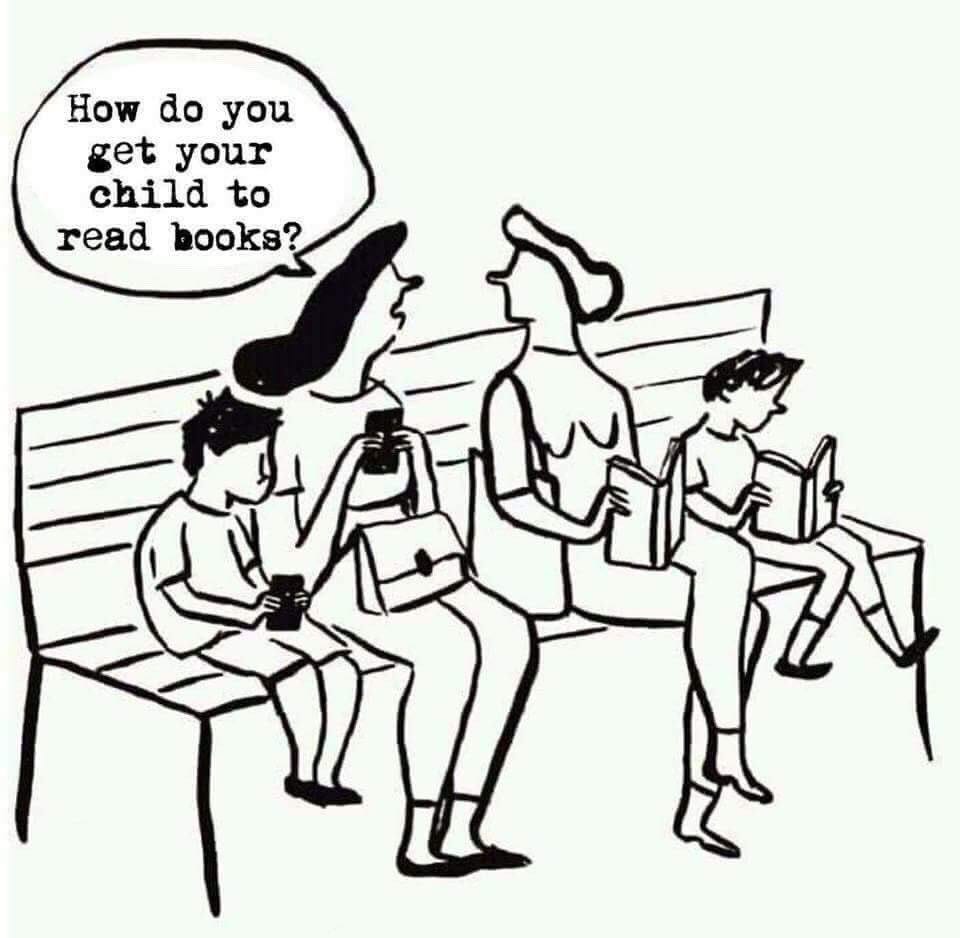
If you are the type of person who reads books, gazes at maps, asks questions, and enjoys learning, you will naturally adopt the teacher role with your children.
Your children will see your model and be far more likely to become lifelong learners. This is, perhaps, the greatest gift you can give them, particularly in our quickly changing modern world.
Let’s bring back a simple, obvious, and profoundly impactful rule:
Don’t do for your kids what they can do for themselves.
In practice, this usually means supporting kids, but gradually weaning them off your assistance until they no longer need you. You want them to face the optimal amount of challenge, but not so much that they feel helpless. Psychologists call this the zone of proximal development.
In The Intentional Father, Jon Tyson gives a fantastic five step template for gradually teaching challenging skills (pp. 171-173):
I do, you watch, we talk.
I do, you help, we talk.
You do, I help, we talk.
You do, I watch, we talk.
You do, someone else watches.
Don’t do for your kids what they can do for themselves.
As a culture, we need this to become the default again.
Our greatest parenting challenge is not simply raising good children . it is rebuilding cultures that make becoming a good person more likely. That’s re-norming.
Thank you so much for reading today!
Please share with any kindred spirits who would enjoy or benefit from this!
Carry the fire!
Shane
No posts
Comments
Nothing yet. Say the first thing.
Sign in to join the conversation.