
I recently had the sobering experience of reading a Citrini Research report about Artificial Intelligence. It was a “left tail risk” assessment; an immersive worst-case scenario written as if it were an economic whitepaper from the year 2028. The report is entitled THE 2028 GLOBAL INTELLIGENCE CRISIS. If you haven’t read it yet, I absolutely recommend it. Though it’s heavy on economic jargon of a very specific type, it’s nevertheless a shocking and incredibly engaging read — in no small part because the distressing scenario the authors describe seems so readily plausible.
On a deeply granular and blow-by-blow level, the fictional future they describe is one in which Artificial Intelligence has sparked a recursive economic death-loop: AI makes human intelligence redundant, white collar layoffs ensue, companies reinvest the money they save from the layoffs back into AI development and from it — more layoffs ensue. At every stage, AI’s abilities to masterfully and efficiently slash through tasks that human beings find tedious proves to make every single facet of the economy cheaper, more efficient, and faster. But at the cost of countless high-paying jobs, the wider economy permanently contracts — and the benefits of this Brave New World are dubious, as everyone is forced to downshift into lower and lower tax brackets with every improvement that AI pushes through. Instability, unrest, and overburdened public coffers seem to be the result.
A response to this piece would warrant a whole essay unto itself (an essay that I would imagine others are far more qualified to write than I am). But one word the authors continually used stuck out to me in a decidedly haunting and ominous way. The word was friction. As I read and meditated on their unique usage of this word, I realized how apt it was — and how now that I’d seen it used in this way, I might never think about the techno-economic precursors to human culture the same again. Here’s a quote:
“Even places we thought insulated by the value of human relationships proved fragile. Real estate, where buyers had tolerated 5-6% commissions for decades because of information asymmetry between agent and consumer, crumbled once AI agents equipped with MLS access and decades of transaction data could replicate the knowledge base instantly. A sell-side piece from March 2027 titled it “agent on agent violence”. The median buy-side commission in major metros had compressed from 2.5-3% to under 1%, and a growing share of transactions were closing with no human agent on the buy side at all.
We had overestimated the value of “human relationships”. Turns out that a lot of what people called relationships was simply friction with a friendly face.”
[emphasis mine]
This specific physical metaphor landed beautifully the way they wrote it. Friction. Sandpaper on oak, skis on gravel. Dragging a boat out of the water and onto the muck. Two surfaces rubbed together under force and pressure, generating heat, requiring more and more power to force across. Of course this is a useful economic metaphor — how else can we describe doing our taxes, or researching which car to buy? How else can we think of the exhaustion inculcated by a day of shopping? So much of that kind of stuff is what most of us sardonically refer to as “a drag.”
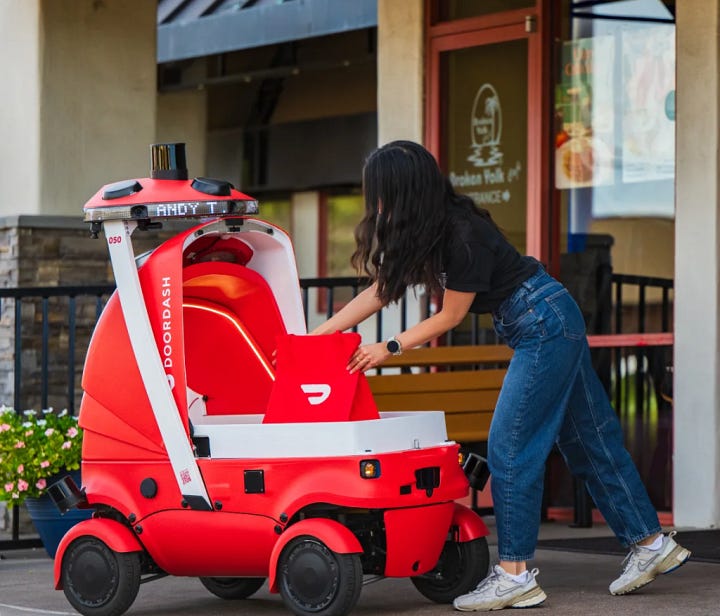
Or in another case, if I wish to buy some maple syrup from my neighbor, it doesn’t appear in my cupboard the moment I decide that I want to buy it. I can’t DoorDash it either. I must call him, put on my boots, brush the snow off the car, start the car, drive to his house, talk to him (maybe for two hours, since he’s a real ‘talker’), and then drive back home to put the syrup in the cupboard.

Moreover, the price of the syrup reflects the “friction” that he must slog through in order to produce the syrup. He’s got to buy the fittings for the sap run — he’s got to run to the hardware store to get some gaskets for the woodstove he boils the sap with (no doubt talking to Gerald down there at the store for an hour as he checks out). It all takes time, costs money, involves relying on often fickle and unreliable human beings and their businesses. Whoever manufactures whatever he buys, too, they also have their own “friction.” At every single level of the economy, there are tasks that must be completed that are not necessarily convenient — they’re time-consuming, costly, and many of them involve interacting with and relying upon other human beings.
Artificial Intelligence can cut all this down, at least in theory. It can source cheaper materials for the manufacturer and refine his process such that he can reduce his biggest expenditure — human labor. It can orchestrate strange backdoor cryptocurrency transactions that evade the fees of major credit card companies, even for mundane purchases. It can “vibe code” apps that compete with DoorDash, draft legal contracts offering the syrup-maker access to a low-fee, automated digital marketplace. It can contract with the syrup-maker’s hardware store such that autonomous vehicles deliver whatever he needs, when he needs it, at practically no extra costs.
Again — I say all of this in theory. The jury’s out regarding whether any of this could actually pan out in the manner the AI gurus lately describe, but certainly, the plausible overlap between science fiction and real life does seem to be increasing dramatically.
To repeat the Citrini article again: “Turns out that a lot of what people called relationships was simply friction with a friendly face.” Reduce the friction and the relationship may end or fizzle out. Decrease the number of requisite interactions required for daily life and doing business — and the webs of relationships we call “communities” will naturally die.
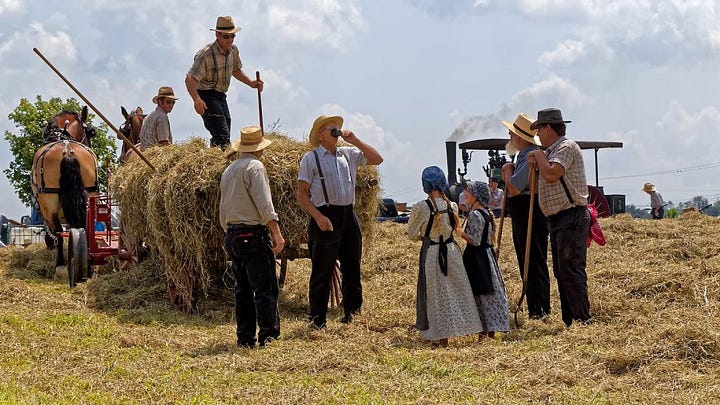
There’s no reason to speak speculatively about this, nor to necessarily assume that AI is the sole purview in which this principle operates. Well before AI was even conceived, dramatic reductions in friction have happened, and if their track record is any gauge — communities have flopped and faltered following each friction-reducing technological revolution. It was not so long ago that to “call on” someone meant physically traveling to their house and knocking on the door. As the telegraph and later telephone liberated callers from this difficulty, “just dropping by” became rarer and rarer until, as is now the case, many young ‘digital natives’ are downright afraid of any social interaction involving door knocking of any kind. That old, antiquarian practice is now irrelevant — and as a result, our homes feel less like living, breathing organisms full of friends coming and going and more like anesthetized tombs or secure-perimeter pods in which we sleep and scroll.
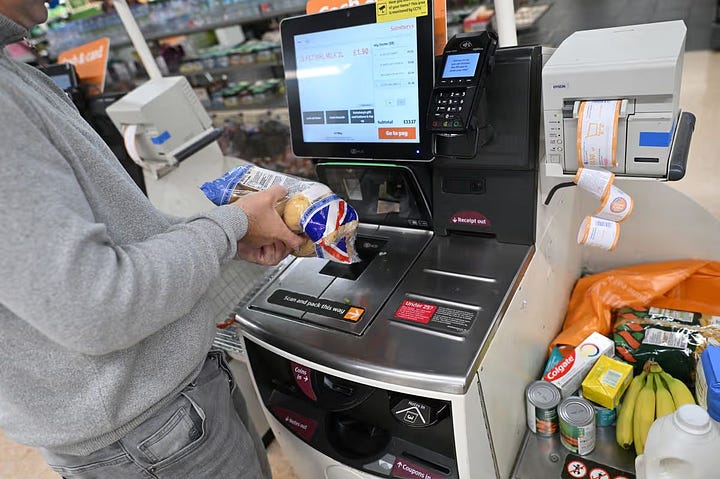
Telephones are only a very elementary example — of course the internet’s arrival hit a hundred times harder. Practically everywhere you look in the internet era, some old, annoyingly difficult, tedious, or awkward chance for human interaction has been reduced to a few motions of a warm finger on a smartphone screen. Courtship is now a bygone memory; now there is Tinder, internet pornography, or even AI-based “girlfriend chatbots.” Where once friends gathered to play football, they now may never gather — and may instead sit alone at home, gambling on the outcomes of televised football games. The handwritten letter has all but died, too; now a brief text message will do. And in the public market, the brick and mortar store as well as the sit-down restaurant have waned considerably: InstaCart and UberEats do the job instead.
The results of this revolution are obvious to most. Now, for the first time in human history, human interaction is more or less optional in practically every domain of life. Consequently, I think, it does not seem like a spurious correlation that we are now lonelier than ever.
Yet, as a general rule, each time a technological revolution has increased the ease with which human beings conduct their social, commercial, or private affairs, we’ve simply gone along with it on the whole. To forego the use of a smartphone or AI might be, for now at least, a vaguely (if awkwardly) acceptable choice for a minority of people to make — but to forego the use of telephones entirely is essentially unthinkable. Likewise with the internet; one may, like the great August Lamm, choose to skip owning a computer at all — but even far-flung renegades like her do find that you’ve got to log in to check emails at the library at least once in a blue moon.
Moreover, the Luddite urge is, in our era, a lonesome urge in so many cases. In so many cases where communities have atrophied upon the advent of advanced information technologies, atomized people have found a surrogate for real community online — and the idea of actually, really, permanently logging off is a form of genuine social suicide. Without any obvious venue for real human interaction in real life, logging off only means adopting the life of a hermit, which is untenable for the great majority of people.
So we find ourselves in a Faustian bargain with “frictionlessness.” Perhaps we’re too far along to turn back now. There’s not any obvious answer to the question of where this train lets off — or if it even does let off at all. At very best, I suspect a tiny minority of offline ‘aristocrats of the soul’ may rise here and there; what few bona fide refuseniks there are may huddle together at the odd pub or library in certain metropolitan areas or eccentric off-grid hubs. But will their techno-skepticism translate to their children? It’s too early to tell, and frankly, by what we are seeing now — it’d be dangerous to assume that that will be the default. So far, tech-skeptical subcultures seem only to flourish when they’re religious, as with the Amish. Perhaps the Catholic Land Movement could prove to be a suitable catalyst for the rest of us — it’s too early to tell.
Perhaps our era is an era in which those who wish to live will find themselves being tasked with the impossible: perhaps now is the finest hour for ardent defenders of human culture and community to buck the trends, to insist upon running contrary to what have until now appeared to be iron laws of the history of technology. If this is to be the case, what will it look like? How will some semblance of “high-friction” human culture be preserved and allowed to flourish in an era when it looks like the great mass of humanity is enthusiastically going the other way?
The answer is not one that most will really like to hear: the answer is that it will be difficult. It will require friction, limitless awkwardness, sacrifice, even relocation. It will require knocking on friends’ doors (and receiving them kindly when they knock) — it will require once again working up the gumption to walk up to a nice young lady and ask her out on a date. And it may require a Renaissance of the physical trades; of bricklaying and of lamb-slaughtering, or even scythe-swinging and making wine by hand. I heartily doubt that there can be any return to the original sociality of all of our pre-internet forebears without an accompanying return to a ‘world made by hand.’
On these fronts, the outlook is not exactly promising, if I am to be frank. There is no obvious “mecca” for those with such interests to congregate around; there is no clear “thing” one who thinks this way must obviously do if they are to live in a manner that is resonant with their analysis and principles. A great many of the efforts at this sort of thing one sees are tainted by the all-seeing eye of social media or with various iterations of a self-conscious mentality — God forbid anyone involved be accused of “LARPing.”
Yet I do suspect that a fair few oddballs may persist in their attempts nonetheless. Somewhat ironically, our present access to information networks like the internet puts us in a solid position to form communities online — which can then later be transposed onto the offline world, at least in theory. At the core of any such effort, I’d think, a sizable proportion of those with any conviction on these matters probably have to be willing to ‘cluster’ together somewhere. We might need to be willing to pull up the stakes and move house in order to establish the all-important networks we’ll need to live a fulfilling and resilient offline life. As AI’s proliferation speeds along, we may find those bonds eventually become crucial not only to our social-emotional welfare but to our material welfare; it’s a fact that when protracted economic crises strike hard, those with solid face-to-face communities are far better equipped to survive than those whose communities are either weak or nonexistent.
However we may try to resist these trends, or to prepare for the worst of what they may produce, I do believe there is still time. There are still possibilities to hold onto the ‘friction’ that makes human culture vibrant and fulfilling. Those who manage to produce serious and durable responses to this crisis may, in so doing, manage to save at least a few viable seeds of genuine human culture worthy of the name. However they do it, I should think that no part of it whatsoever will be convenient — that much is certain.
No posts
Comments
Nothing yet. Say the first thing.
Sign in to join the conversation.