
When you create a native verge garden, you localise it by getting plants and advice from community nurseries. The best plants for Brisbane, Perth, and Melbourne will be different. You also need to check your local council policy. Every council policy is different, even when they are next door to each other.
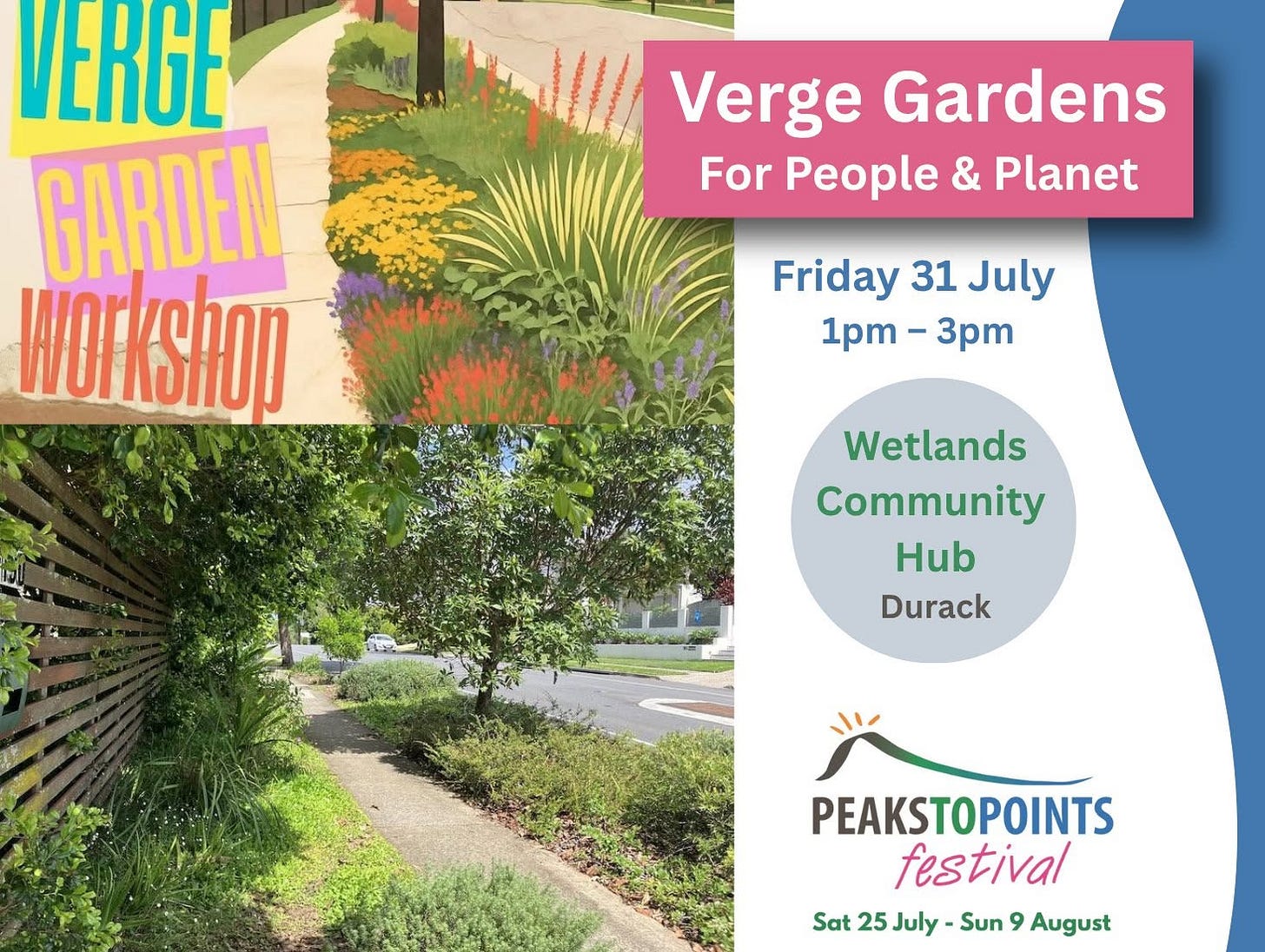
The workshop is part of the Peaks to Points Festival and will be at the Wetlands Community Hub at Durack. Participants will come from Brisbane, Ipswich, and Logan council areas.
In Brisbane, you can go ahead and plant as long as you follow their guidelines: the usual things like low-growing plants, no rocks or garden edges, clear sight-lines and safety for pedestrians. They recommend native plants but don’t insist. This policy is written in easy-to-understand language. Yet, I know there are many residents who ignore the guidelines and complain about the sensible restrictions.
In Ipswich, you can plant adjacent to the property boundary and no wider than 500mm without a permit if you follow guidelines. Beyond that, you need to apply for a permit and provide a sketch plan and list of plants you intend to use. The requirement for a permit is under review. Many verge garden advocates complain that permits stop people planting. I see benefits and drawbacks for both sides of this argument. That’s something we’ll discuss at the workshop.
In Logan, you need to apply for a permit online but they are self-assessable and you don't need to provide drawings if they are constructed in accordance with the guidelines and plant list. However, you can’t plant gardens on a verge less than three metres wide. You need to submit your plan with your application if your garden does not meet Council’s requirements, or uses plants that are not on the approved plant list. They provide a Standard drawing for landscaping areas on footpaths(PDF, 395KB) which most residents, including me, would find overwhelming.
I’ve been watching policies as they emerge and change over the past eight years. After a dispute, they can become more detailed and more restrictive. On the other hand, positive outcomes and good communication can mean they become more flexible. Every council is at a different point in this journey.
Local factors come into play. An inner-city Sydney council is quite different to a council like Brisbane that has to accommodate a range from high-density to semi-rural properties within one policy. Logan council allows some car parking on the verge in narrow streets which presumably affects the verge options on those streets.
Analysis of council policies can show which sections of council have had input. Some are influenced heavily by planning, others by legal liability, community development, and urban forestry. That’s a sign of how complex and contested this area is, and how we are all on a journey to find new governance models to fit shared stewardship of nature in our cities.
There is no point claiming that another council’s policy is better, or worse, than yours. They all have different contexts and history, and the view from outside won’t be complete or accurate. Councils may share ideas and experiences with each other but still need to come up with what suits their situation best.
For residents, the only policy that matters for your verge garden is with your local council. If you think that your council’s policy should be more flexible, community members working co-operatively with their council to reinforce the need for following policies and guidelines is the most effective way to get that.
When councils issue verge garden policies, you could consider the policy as a first cautious offering of a conversation on how we can all work together to green the streets. They are taking a chance on all residents, not just you and me. This is a new form of governance, and there has undoubtedly been debate within their organisation about whether residents can be trusted to plant sensibly.
(Essential Skills in a Networked World, p9)
If we learn and practice building the trust and relationships needed for collaboration to regenerate nature on the verges in front of our homes, we can scale out to do much more to address the issues of biodiversity loss and climate change.
Verge gardening is a first small, doable step. How we approach that activity and all the people involved will determine what comes next.
If you’re in Brisbane, click on the image below for the workshop. Others are on the Shady Lanes What’s on page.
Comments
Nothing yet. Say the first thing.
Sign in to join the conversation.