
Hello SFC-SA Community
Can you believe we are already halfway through the year? June was an absolute watershed month for the smartphone-free movement, both right here in South Africa and across the globe.
As a global community, we’re moving from the early days of feeling like “the odd ones out” to driving a mainstream cultural shift. Parents, schools, and policymakers are waking up to the reality that childhood belongs in the real world, not behind a screen.
Here’s a look back at what we’ve achieved, what we learned, and where the movement is going as we head into the second half of the year.
It’s a small start, but we are heartened to hear the Minister of Basic Education talking about screen-time guidelines - although we firmly support them being implemented beyond the age of 6 years!
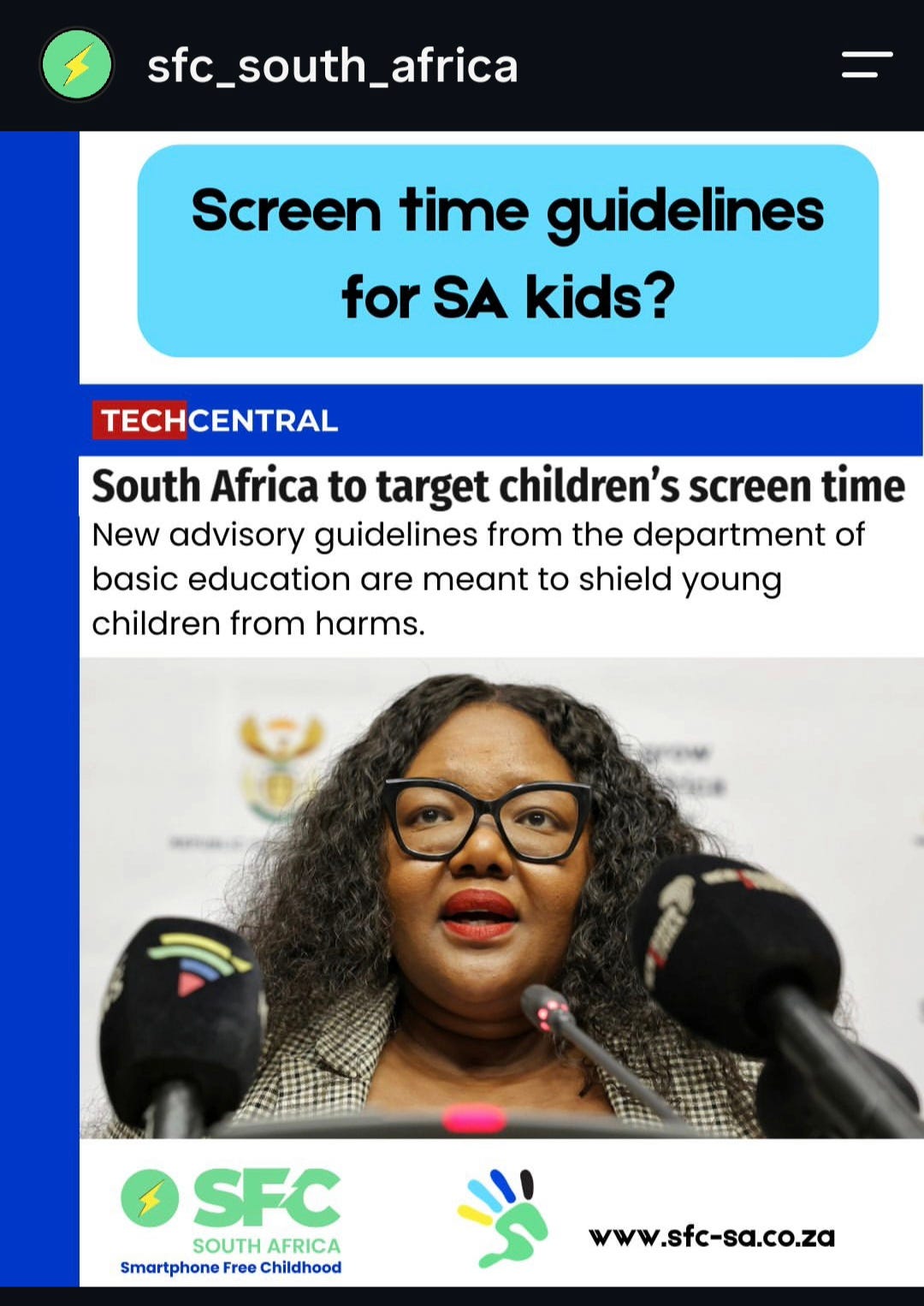
Our own SFC-SA Screentime Guidelines are based on the World Health Organisation standards, and we’ve shared them with the team at DBE in the discussions we’ve been having. We believe they provide clear, developmentally appropriate boundaries for families to push back against premature device reliance:
Under 18 months: Zero screen time (except for family video calls).
2 to 5 years: Maximum 1 hour per day of high-quality, co-viewed educational content.
Primary school (6–12 Years): Consistent, firm limits that prioritise sleep, physical play, and tech-free family zones (like bedrooms and the dinner table) with a maximum of 2 to 2,5 hours of screentime per day.
The teen years (13+): Delaying personal smartphones, keeping social media off limits until at least age 16, and a maximum of 2,5 to 3 hours of screentime per day.
💡 Head over to our website to download more of the guides we’ve been creating including Conversations Around Device-Free Playdates and Screen-Free Activities. They’re designed to give you confidence and help you set warm, positive boundaries with other parents and caregivers without feeling like you’re judging them.
If you ever feel tired swimming against the digital current, look at what’s been happening internationally! The global momentum is moving faster than ever:
SFC UK released a brilliant, darkly funny 60-second campaign film that rebuilt a 1990s video rental shop. When a dad and his kids ask for recommendations, the clerk starts suggesting titles that promote eating disorders, bullying, and befriending online predators. It drove home a powerful point: Why do we tolerate things online that we would never accept in the physical world?
In parallel to a new law that has just taken effect, officially making all English schools phone-free environments by default, the UK government announced it’s intention to legally block social media platforms from providing services to under-16s by early 2027. It places the legal burden, and massive financial fines, squarely on tech companies, not parents.
But will social media bans work? There’s been a lot of heated debate globally around enforcing under-16 social media “bans” (we prefer “age restrictions”). Critics argue that a flat-out prohibition is useless because tech-savvy kids will just use VPNs, lie about their birth years, or find loopholes that Big Tech aren’t incentivised to close.
As Smartphone Free Childhood South Africa, we hear those criticisms. In fact, we agree that setting an age restriction on its own is not a magical silver bullet. A legal line in the sand isn’t the whole solution - but it is the vital missing frame of the puzzle. We also need strict boundaries alongside measures forcing Big Tech to make devices and platforms safer by design. Read our full breakdown on how these pieces fit together in our latest blog post:
How the puzzle pieces fit together
As SFC chapters around the world continue to collaborate in our advocacy efforts, the G7 Digital and Technology Ministers reached a landmark agreement in Paris last month, establishing the G7 Common Set of Principles defining a safer and more secure digital space for minors.
The declaration represents a major shift toward international alignment, moving away from a purely reactive model to one that demands accountability and “safety-by-design” from tech corporations - platforms must build protections into their systems from the start and technology must be made safer, private, and age-appropriate.
UNICEF and various international bodies have welcomed the framework, noting that the focus must now shift to translating these high-level principles into hard, binding national regulations and enforceable accountability plans for tech companies.
Two major papers drawing from the massive Adolescent Brain Cognitive Development study were published in JAMA Pediatrics last month. The data proved that acquiring a smartphone at age 12 was heavily linked to higher rates of depression, obesity, and severe sleep deprivation. Crucially, the researchers found that simply delaying the phone until age 13 or 14 significantly reduced the links to depression and obesity.
When we first started Smartphone Free Childhood SA, we were just a handful of parents. Some of us watching our teens grappling with their complex online lives. Others with young kiddos wondering where to start to protect them from the overwhelming pressures of the digital world. We never could have predicted how quickly that spark would catch fire. Today, we are one of 46 chapters around the world, and this is a nationwide movement of thousands of families all fighting for the same thing: a childhood rooted in the real world.
But behind the scenes of this massive shift, the reality is incredibly humble. We aren’t a tech giant or a well-funded corporation. We are a tiny, passionate team of volunteers working late into the night, balancing our day jobs and our own kids and our share of the crises that life throws at us all. We're keeping the wheels turning because we believe in this mission down to our bones.
Right now, our grassroots infrastructure is feeling the strain. Our small band of volunteers can only give so much. We registered our movement as a Not For Profit, to try and make it sustainable, but funding is hard to come by when we compete against the most basic needs of communities in our country.
To keep the momentum going and give our community the tools it desperately needs, we need your help to fund three critical lifelines for our movement.
Renewing our Zoom platform: We've hosted some powerful conversations over the last year, with incredible experts who have shared so many insights to an ever increasing audience - in one of these we hit 3500 peeps! This is one of the ways that we can attract more parents to build our community bigger and stronger. If you've joined one of these conversations and have felt the love, please consider a donation towards this:
The Parent Pact Dashboard: We now have Pacts in close to 450 primary schools across the country! We want to build a live dashboard so that parents and educators can easily log in, track momentum, and see exactly how many families in their specific school community are part of the shifting norm towards delaying smartphones. This data is the leverage that parents and educators need to create tipping points in their local areas. If you love this idea, please support our fund raising initiative:
The Phone-Free School Register: We have 13 approved phone free schools and another 54 under review. We want to create a national, searchable database - profiling schools that are officially committed to smartphone-free education and learner well-being. This register will celebrate trailblazing schools and give parents a powerful tool to advocate for change within their own school communities. If you want to see this happen, please support our fund raising initiative:
Build a Phone-Free School Register
Every Rand or hour you can contribute, goes directly into building the structural foundation we need to scale our impact. And don’t forget - we are registered as a Public Benefit Organisation, so can issue s18A certificates on request!
As we keep working to grow this awesome movement and bring in more parents, educators and regulators - please give us your support! We started this together, and together is the only way we will reclaim childhood for all of our kids.
For some, our winter school holidays are here and for others are just around the corner, which means long days to fill!

If you’re looking for a family adventure in the fresh air, no screens allowed, Acrobranch tree-top adventures is offering our SFC-SA community a special 20% discount. Head over to the Community Corner on our website and use the code AcroPartner20 when booking. Do share some pics of your tree hopping fun!
What were your favourite card games when you were growing up? We’ve been working behind the scenes on a special project - curating a bunch of classic, fast-paced card games meant to spark laughter, friendly competition, and real eye contact around the fireplace this winter - and we would love to get your suggestions!
We want to hear from you. How are the winter holidays going? What screen-free activities have you got up your sleeve, ready to help channel boredom? Have you successfully hosted a device-free playdate using our new guide?
Share your wins, your challenges, and your ideas with us on our community channels. Every time you choose low-tech, slow-tech, you make it easier for the next parent to do the same.
Stay warm, stay connected, and let’s keep giving our kids the childhood they deserve.
Here’s to hot chocolate with marshmallows AND sprinkles,
The Smartphone Free Childhood SA Team
No posts
Comments
Nothing yet. Say the first thing.
Sign in to join the conversation.