Building a modern, AI-driven Security Operations Center (AI-SOC) means shifting from a reactive, human-led alert clearing house to a proactive, machine-speed defense engine.
In a traditional SOC, Tier 1 analysts spend 80% of their time chasing false positives. An AI-SOC flips this paradigm: AI handles ingestion, context-enrichment, and initial triage, freeing your human experts to focus entirely on hunting complex, multi-stage threats and engineering better defensive playbooks.
An AI-SOC sits on top of your existing telemetry but restructures how data flows, how decisions are made, and how mitigations are pushed.
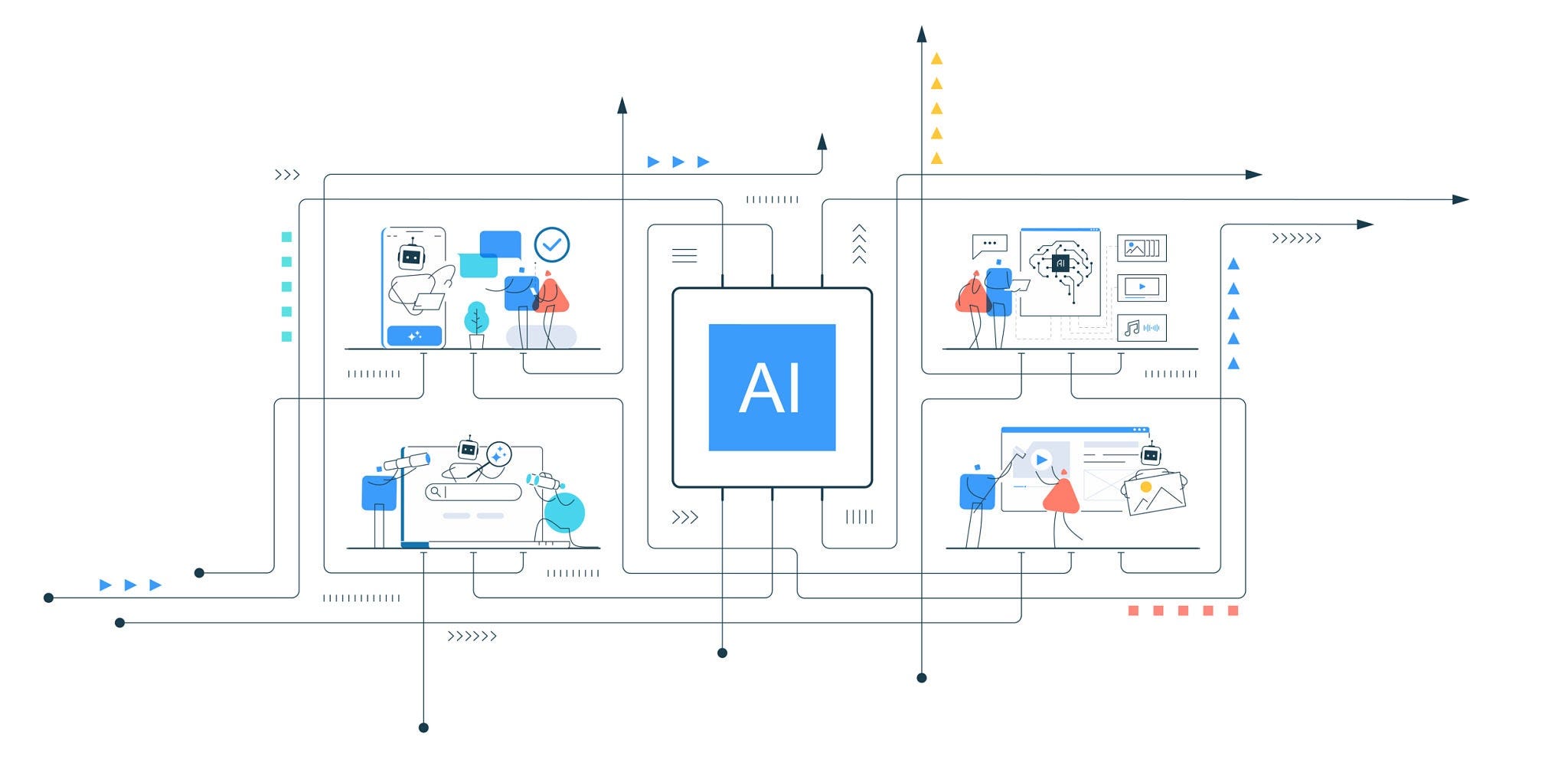
The Telemetry Layer (Data Ingestion): Feeds from SIEM, XDR, cloud providers (AWS CloudTrail, Azure Monitor), IAM systems, and network flows.
The AI Data Lake (Enrichment Engine): Traditional SIEMs parse logs using static regex. The AI-SOC standardizes raw telemetry into a unified schema (like OCSF - Open Cybersecurity Schema Framework) and automatically appends real-time context (threat intel, asset criticality, user behavior history).
The Cognitive Layer (Decision Making): This is where specialized machine learning models and Large Language Models (LLMs) work in tandem to evaluate threats.
The Orchestration Layer (Autonomous Action): Deep integration with SOAR (Security Orchestration, Automation, and Response) platforms to execute code, isolate hosts, and rotate keys without human intervention.
An enterprise AI-SOC relies on a “hybrid AI” approach, combining deterministic Machine Learning with generative LLMs.
Graph-Based Attack Path Modeling: Graphs map out your entire infrastructure. If an attacker compromises a low-level service account, a graph neural network (GNN) calculates the most probable paths the attacker will take to reach the crown jewels (Active Directory, database clusters).
Hyper-Dimensional Behavioral Baselines: Instead of simple thresholds (e.g., “User downloaded >5GB of data”), ML models track hundreds of dimensions per entity (time of day, API calling patterns, velocity of asset switching) to catch subtle data exfiltration.
Automated Case Synthesizers: When a multi-stage alert fires, an LLM reviews the entire log history, raw packets, and timeline, translating it into a highly detailed incident narrative for Tier 2/3 analysts.
Dynamic Playbook Generation: If a novel threat appears that your standard SOAR playbooks don’t cover, the LLM analyzes the threat mechanics and drafts a custom mitigation script on the fly for human approval.
This is how an incident moves through an AI-SOC entirely at machine-speed.
1.Ingestion & Normalization:Milliseconds.
Raw logs hit the pipeline. The streaming ingestion engine converts them to a common schema and checks them against an automated deduplication model to prevent alert storms.
2.Contextual Enrichment:Under 2 Seconds.
The engine fetches external threat intelligence (e.g., active malicious IPs), cross-references internal CMDB (Configuration Management Database) registries to assess the asset’s vulnerability patch history, and assigns an automated “Blast Radius Score.”
3.Autonomous Triage & Risk Scoring:Under 5 Seconds.
The cognitive models analyze the enriched alert. If the confidence score hits a threshold of >95% malicious probability, it escalates to the autonomous response engine. If it is ambiguous, it is grouped into an unified “Incident Story” and flagged for a human analyst.
4.Automated Containment:Sub-minute Execution.
The SOAR framework fires API calls to lock down the threat. For example, it simultaneously revokes the compromised OAuth token via IAM, blocks the malicious IP at the edge firewall, and moves the infected EC2 instance into an isolated quarantine VPC.
Here is the operational breakdown comparing a legacy SOC to an AI-Native SOC:
False Positive Noise Reduction
Legacy SOC: High volumes of alert noise create systemic analyst fatigue. Minor alerts must be manually grouped or filtered using rigid, static regex rules.
AI-Native SOC: Achieves up to an 85% reduction in noise. The triage agent uses semantic context to autonomously deduplicate and close out low-severity, benign-true positives before they ever hit a human queue.
Mean Time to Detect (MTTD)
Legacy SOC: Typically 15 to 30 minutes. Analysts must bounce across multiple security dashboards (EDR, firewall, identity logs) to assemble an attack timeline manually.
AI-Native SOC: Reduced to under 30 seconds. A centralized RAG pipeline automatically pulls and cross-correlates multi-silo signals into a unified data structure the millisecond a telemetry threshold is crossed.
Mean Time to Respond (MTTR)
Legacy SOC: Averages 1 to 4 hours. Mitigating a threat usually requires human escalation, script drafting, or manual coordination with separate network and infrastructure teams.
AI-Native SOC: Executed in under 5 minutes. The mitigation agent generates target-specific containment scripts or API calls, executing low-risk playbooks completely autonomously and routing high-risk actions to an interactive approval window.
Analyst Leverage Ratio
Legacy SOC: Scales linearly, requiring roughly 1 analyst per 500 endpoints to maintain proper coverage. This traps Tier 1 personnel in a continuous cycle of copy-pasting data.
AI-Native SOC: Scales exponentially, allowing 1 analyst to protect over 5,000 endpoints. The machine manages repetitive tier-1 tasks, freeing up human engineering talent to focus entirely on advanced threat hunting and defense architecture.
Building an AI-SOC is an iterative process. Avoid turning on autonomous blocking on day one; instead, follow a structured maturity model.
Deploy an open schema data lake (e.g., Apache Iceberg, Snowflake) to house security logs cleanly.
Implement behavioral anomaly models for high-risk vectors (Identity/IAM, Endpoint EDR).
Run AI in Shadow Mode: let the models score alerts and draft playbooks silently in the background, comparing their accuracy against human decisions.
Connect GenAI engines to your ticketing and SIEM system to auto-summarize incidents.
Deploy human-in-the-loop automation: the AI creates the mitigation plan, but a human must click “Approve” to execute the firewall block or account suspension.
Unleash low-risk autonomous containment playbooks (e.g., auto-isolating a known malware-infected workstation outside business hours).
Establish continuous automated testing via breach and attack simulation (BAS) tools to train and fine-tune your AI models against changing threat landscapes.
A Note on Guardrails: Never let an LLM directly generate or execute system code without a deterministic parser or policy engine (like Open Policy Agent) validating the payload structure first. This prevents the AI from being manipulated via prompt injection or making catastrophic errors on critical infrastructure.
Thanks for reading Seyhun's Substack! This post is public so feel free to share it.
No posts
Comments
Nothing yet. Say the first thing.
Sign in to join the conversation.