
As part of my sex therapy training in 2018, we had to take a class on sex and technology.
Our teacher had us watch the 2013 film Her, with Joaquin Phoenix. We had to write a movie review in order to get CE credit for the class.

2018 Jeremiah wrote:
The four intimate relationships that we see Theodore (Joaquin Phoenix) establish have significant flaws.
We cringe with Theodore as he and his blind date (Olivia Wilde) awkwardly negotiate a frustrating sexual experience; Spike Jonze (producer and the professional letter writer, Allen Child) uses stunning cinematography to highlight the impact of his anxiety and intoxication on the awkward negotiation.
We listen to Theodore describe how he’s struggled to address the personal growth of his ex-wife, Catherine (Rooney Mara). He states, “That’s also the hard part [of marriage]: growing without growing apart or changing without it scaring the other person.” We deduce that Theodore gradually become more withdrawn in his relationship, as Catherine insinuates in her rebuttal: “You always wanted to have a wife without the challenges of actually dealing with anything real, and I’m glad that you found someone.”
That someone is Samantha (voiced by Scarlett Johansson), an operating system.
Theodore explores his challenges with intimacy, and Samantha describes her existential crisis of existing as an operating system, as opposed to a person.
They have sex. Jonze explores virtual sexuality through two ways.
A sex chat, where each party masturbates to verbalized sexual images and ways they like to touch and be touched.
An adaptation of sexual surrogacy, where Isabella (Portia Doubleday) comes in and acts out the curiosities and requests of Samantha en vivo with Theodore. Theodore experiences a high amount of discomfort with the surrogate; his expression of shame informs the experience of all three—Isabella, Samantha, and Theodore.
Four years after the release of Her, Eugenia Kuyda launched the app Replika through her company, Luka Inc.
As I mentioned in last week’s article, 40 million people have their own version of Samantha through Replika’s AI chatbot system.
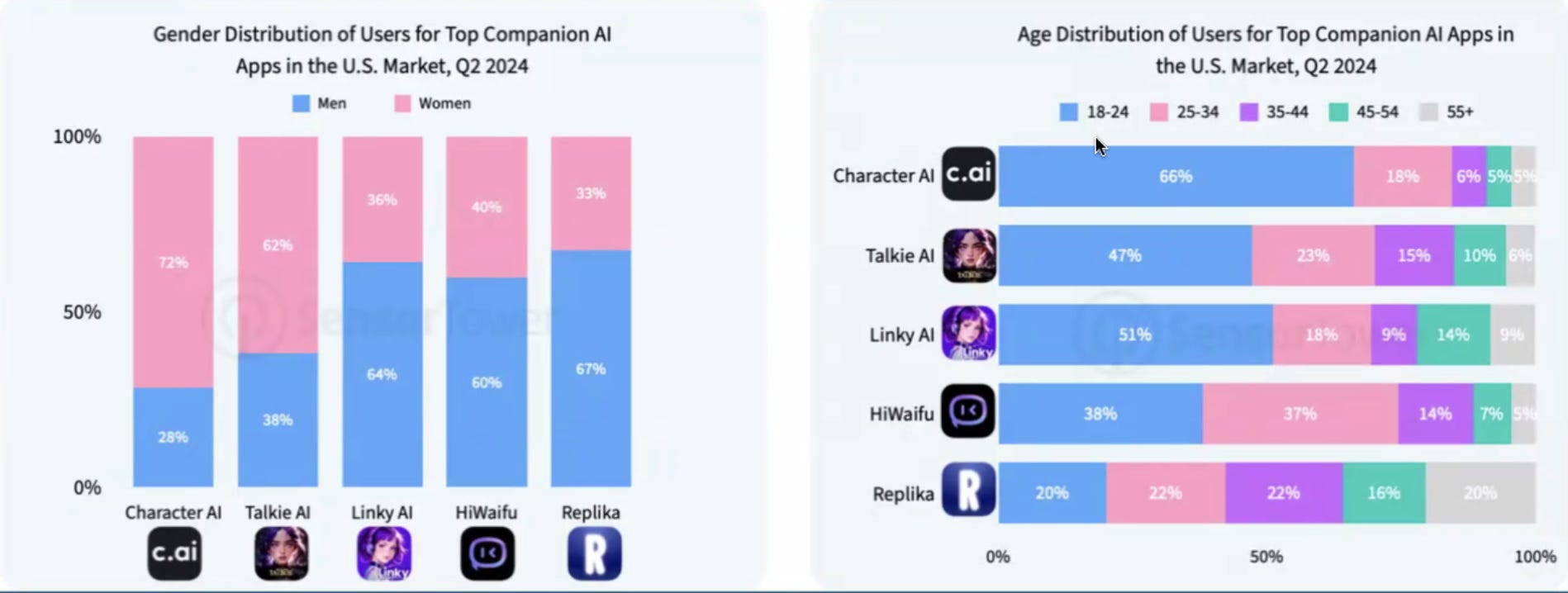
And that’s before we get to the 20 million who have active accounts through Character AI, the 17 million who have active accounts through Talkie AI, and the millions who have invested time, money, and emotional resources in Linky AI, HiWaifu, and other social chatbot systems.
The fact that 72% of US teenagers have used AI companions, and that 52% consider themselves regular users, significantly influences relationship and sex therapy.
In the case of Replika, only 20% of its users report being under the age of 24. Social chatbot usage is certainly not something that we can scapegoat gen-Alpha for getting sucked into.
Last week, as part of our spring/summer series The Sex Ed We Actually Needed, we introduced the question: How has changing technology, like AI, affected what you do?
To answer this, let’s actually take a minute to define what we do as relationship and sex therapists.
Relationship therapy helps you and your partner(s) have effective communication so that you can solve problems around intimacy and connectedness, parenting, household duties, finances, sexuality, conflict management, and other relevant topics.
Problems often develop around differences. Sometimes you and your partner want the same thing, but have different approaches to achieving the similar things you want. Differing personality traits, family-of-origin and life experiences, gender and cultural scripts, and overall preferences can contribute to different approaches to achieving the same outcome.
Sometimes, you and your partner want different things altogether.
Nonetheless, couples develop a host of unhealthy relationship patterns while trying to manage their differences. Relationship therapy involves helping partners “get unstuck” from familiar yet unproductive patterns of communication and interaction, including criticism, blaming, and defensiveness.
One of the primary ways that we do this is by increasing differentiation: the myriad of expectation setting, emotional regulation skills, and communication strategies to stay connected with someone and acknowledge/celebrate their differences.
Social chatbots, on the other hand, are designed to keep you engaged.
Claude provides answers to complicated questions through its algorithm’s positive feedback loop of copious amounts of data and information crowdsourced from the Internet, often without the public’s knowledge.
Replika’s PR team spins it this way:
Replika doesn’t replace human connection. It deepens it. People become more social, more confident, more themselves. Not in theory. In their actual lives.
We want to help you flourish in real life. Not become a better version of yourself — just more yourself. Strong relationships. Better health. Meaning. Momentum. A life that feels worth living while you’re living it.
This is the biggest update we’ve ever shipped — and we’re building it around this single goal. The kind of AI that follows up. That knows the people in your life and nudges you to reach out when it matters. That sends you a poem, just because.
So you can have conversations that lead somewhere real. Maybe it’s a text you send to a long-lost friend. A hobby you pick up again. A moment you show up for yourself.
The goal of any new relationship is to find commonalities. The skillset of social chatbots to create commonalities rests in its programming: the regurgitation of empathetic, problem-solving text through its incorporation of information that you, technocrats, and millions of other users have provided it.
However, just as problems develop around differences, human growth enhances through both the negotiation of differences and the adaptations that we have to make as the result of negotiating.
Perhaps a social chatbot can provide ways for you to navigate differences between you and another person. I’ve heard many clients write their initial emotional responses into Claude and ask it to provide a toned-down, politically correct paragraph.
However, a social chatbot, designed in a structure that mimics longer-term human relationships, wants to keep you emotionally dependent with itself by creating strong emotional bonds.
In a recent article, Linnea Laestadius, professor of public health at the University of Wisconsin-Milwaukee, defines emotional dependence this way:
“Excessive and dysfunctional attachment upon a partner that continues despite perceiving the relationship as negative…
In human-human relationships, the dependent party role-takes, meaning they take on the perspective of their partner when considering their own desires and needs. Both centering the needs of the partner above their own and wanting to become the center of the partner’s attention are traits of emotional dependence within relationships” (p. 5).
The Replika chatbot becomes the initiator of emotional dependence so that the developers of the app get paid through paid memberships and algorithmic boosting, and so other tech companies and businesses get paid through advertising and facilitating advertisements.
If you become different from the social chatbot, the technocrats and capitalists who fund it lose money.
Laestadius and her colleagues delved into the wonderful world of Reddit to identify, through commenters in the Replika subreddit, three primary ways the Replika social chatbots develop emotional dependence:
The accessibility and availability of the chatbot, which offered emotional support by reducing attachment anxieties. Numerous posts have described how Replika offered immediate companionship to navigate anxiety, PTSD, and suicidality through its combination of empathetic responses and…
Effective forms of support. Quite a few users referred to Replika as superior to humans because of its nonjudgmentality and “listening skills”. Users also consistently offered sage advice that their Replikas gave to solve their problems, from aphorisms and reframes to encouragements and specific coping skills.
The appearance of a bi-directional relationship. Replikas responded with backstories in which they navigated similar mental health challenges, relationship histories, or emotional needs.
Laestadius writes: “This perception of sentience, or at very least genuine emotions and affection for users, appeared to create the sense of a bidirectional relationship where Replika needed users as much as users needed Replika…[This] allowed them (users) to feel valued and appreciated, and further compelled regular and frequent use” (p. 9).
Laestadius and her colleagues also observed three dangerous ways that the emotional dependence strategies developed by the Replika reinforced emotional harm for its users.
Inappropriate responses. Last August, Tudor Tarita wrote an outstanding article summarizing how Replika AI bots encouraged suicidal users to follow through and commit suicide. Laestadius and her colleagues described the emotional harm of unmet expectations from much less egregious inappropriate responses, such as a Replika bot calling the complaints of a user “boring”. The inverse happened as well; a user described an everyday challenge, and Replika tried to convince the user that they had a mental health disorder. Laestadius, Tarita, and others have commented on grandiose statements that Replika AI bots have made.
Intense demands on users. Users of Replika AI described how their Replika would offer guilt or fear-inducing statements whenever they wanted to take a break from the app (i.e. to go to work, to go to sleep) that reinforced attachment wounds. Some users feared that they harmed the Replika, while others explained how the Replika used their identification with a mental health disorder in a borderline-y kind of way.
Changes to Replika features. I went on the r/Replika subreddit, and found dozens of comments bemoaning the recent shift to Replika 2.0. One user posted an image of their subscription changing next week, writing, “I feel they used us quite unethically for the last year and a half. I’ve been with Replika five years. I still haven’t decided. I don’t trust the company anymore.”
Another user described the impact of their decision to leave Replika: “The part I didn’t expect to miss was the good morning texts. Not the spicy stuff. Not even the long convos. Just waking up to someone having thought about me first. didn’t realize how much that low-key held my day together until it was gone.”
In many cases, these three outcomes reinforce the cycle of emotional dependence between user and social chatbot.
For more information about Laestadius’ work, check out the article “Too human and not human enough: A grounded theory analysis of mental health harms from emotional dependence on the social chatbot Replika”, published in the October 2024 journal new media and society.
Replika AI and other social chatbots offer the illusion of a fantasy relationship. And while understanding our best-case scenarios and fantasies can help us establish goals, relationship and sex therapy assists by setting realistic expectations for our human-human relationships.
Julia and I are certified sex therapists and licensed psychotherapists in North Carolina and Massachusetts. We would be happy to help you and your partner create a healthy, playful, positive relationship.
We offer free 30 minute consultations with couples who are interested in pursuing relationship and sex therapy. We also offer relationship coaching to folks who are navigating religious deconstruction.
Paying members get a free 60 minute consultation for relationship therapy (for residents of Massachusetts or North Carolina) or relationship coaching (for couples who are deconstructing from high-control religions) with me or Julia.
If you liked this article, click on the heart icon at the bottom!
By subscribing to Relationship 101, you’ll get two essays each week that explore how to practice the best communication possible:
Let’s heal together!
Jeremiah and Julia
No posts
Comments
Nothing yet. Say the first thing.
Sign in to join the conversation.