
Hello friends, and a warm welcome to new subscribers to this newsletter,
Apologies for the missed newsletter last week. I took a few days off to go camping in Tofino with my family. For the third time in my life, I tried unsuccessfully to stand up on a surfboard (my 11-year-old son, on the other hand, managed to get up within minutes, and after two days in Tofino’s frigid waters, I’m told all future holidays must revolve around surfing; we shall see).
While weather conditions here on BC’s west coast have been fairly mild and smoke-free, the same cannot be said for much of the rest of this country, where climate-induced punishing heat, dystopian orange skies and urgent evacuations of mostly northern Indigenous communities are once again elevating the climate emergency in public consciousness. The news from Europe is similarly brutal. The Guardian reports that the May and June heatwaves in England and Wales killed about 2,700 people.
To which our prime minister replies: all in for another oil pipeline!
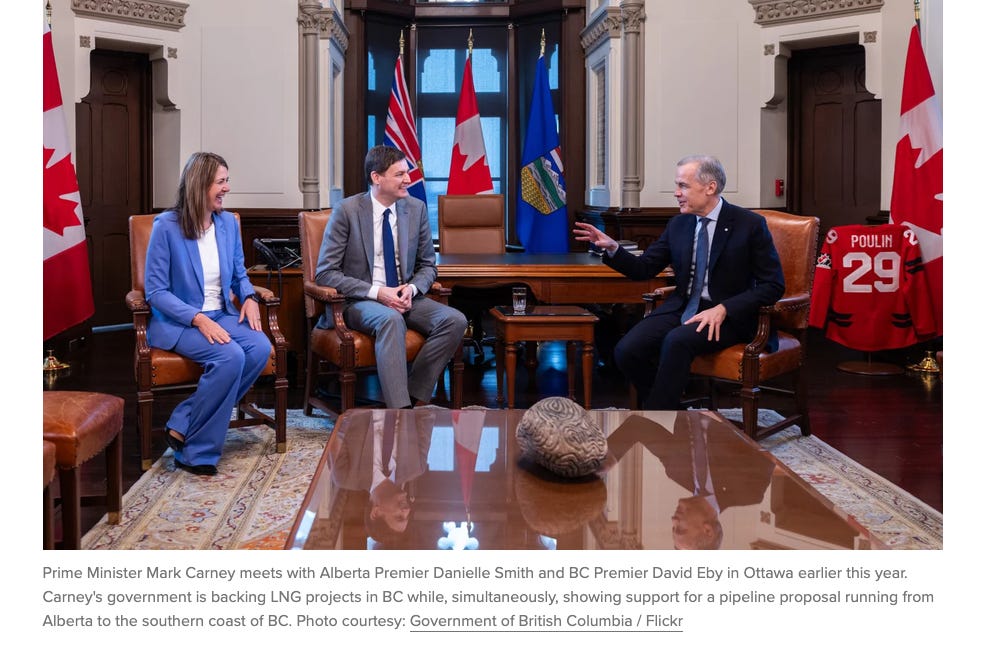
Just before leaving for my trip, Prime Minister Carney came West to sign new partnership agreements with both BC and Alberta. As most readers of this newsletter know well by now, the Alberta deal centers on a new pipeline to carry bitumen from the oilsands to BC’s coast, mostly tracking the same southern route as the TMX pipeline, only now exiting at the Roberts Bank terminal at the mouth of the Fraser River (a highly environmentally-sensitive delta).
Carney’s approach to Alberta’s threats strikes me as little different from his response to Trump: appeasement & acquiescence. To which we can now add a massive taxpayer subsidy.
Carney’s original memorandum of understanding with Alberta last year said a new pipeline would require a private proponent and that all production emissions would be captured by a new Pathways carbon capture and storage (CCS) project. Neither condition has been met. Yet the new pipeline is approved regardless, with the federal government itself now serving as the main proponent via the crown-owed TMX pipeline corporation and committing to pay 90% of the pipeline’s current $44 billion price tag, and the dubious Pathways CCS project now promising to capture a mere fraction of what was previously assured. 😡
In the deal with BC, the provincial government won a federal promise to uphold the north coast tanker ban and secured as much as $20 billion in federal commitments to BC projects. In exchange, the feds won BC’s reluctant acquiescence on the new pipeline. The BC deal has many elements, but a chunk of the federal money is in support of BC’s own fossil fuel expansion efforts, and fully half of the $20 billion is for the expansion of the Roberts Bank terminal where the new oil pipeline is to terminate. Meaning, you can add that $10 billion to the public bill for the pipeline project.
The one element of “social infrastructure” included in the BC deal was, with no hint of irony, more federal money for childcare. That’s always welcome, of course, but there appeared little appreciation for how much of the rest of the deal endangers the alumni of said program.
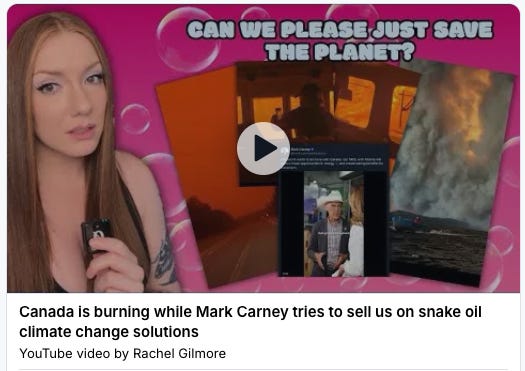
Independent journalist Rachel Gilmore published an excellent article and video earlier this week dismantling Carney’s CCS promises, and I was pleased she drew on some of my analysis. You can see her piece on her Substack here.
Good to see the folks at 350 Canada are hosting a national emergency organizing call next week about how to stop this public subsidy of another new pipeline. Their call: “There can be no pipelines on a burning planet. Not on our dime. Not on our watch. We must make Big Oil pay for climate chaos.”
They are inviting people to join an Emergency Action Call on Tuesday:
When: Tuesday, July 21 at 4pm PT / 5pm MT / 6pm CT / 7pm ET / 8pm AT
Where: Zoom. RSVP now to get the link!
Meanwhile, under the auspices of the BC Climate Emergency Campaign, a group of former BC NDP MPs and MLAs have issued a public letter to Premier Eby, raising the alarm over BC’s support for LNG and urging the province to renew its climate leadership. “B.C.’s climate leadership has been a source of pride,” these 16 prominent BC leaders write. “Now, however, B.C. is backtracking on nearly every metric of progress… We are no longer seeing the climate leadership that we and other British Columbians expect and deserve. If a plan is defined as setting appropriate targets, with a credible path for achieving them, then B.C. no longer has a climate plan.”
You can see the letter and the list of signatories here. And if you want to help amplify their letter, you can do so here:
Canada’s National Observer reports that the country’s largest public pension plans, which historically have avoided investing in Canadian LNG projects, are now being “pressured by aggressive lobbying from a pro-oil federal government” to do just that – big time.
There is something uniquely obscene about pension funds investing in new fossil fuel projects. That because by continuing to hold these fossil fuel companies and projects in their pension portfolios, current and near-term seniors are being made to effectively bet against their own grandkids. If the bet wins, it is only because their offspring lose. It asks today’s pension plan holders to stake their retirement returns on a future in which their own grandchildren reside in a hellscape. Gross.
I know I plug Chris Hatch’s stuff in this newsletter a lot. But that’s because it’s fantastic.
Chris has a great new piece on the brutal math of fossil fuel expansion, which you can find here. He writes: “We pay to subsidize fossil fuel production. We pay for the consequences. Governments spend billions fighting fires, rebuilding communities, compensating disaster victims and treating the growing health burden from climate change. Then those same governments spend billions more expanding the industry making those disasters steadily worse.”
Chris cites Bloomberg’s David Fickling, who writes, “It’s an extraordinary situation for an industry that claims to be governed by capitalist laws of supply and demand… Subsidies for clean energy do exist, to be sure, but they aren’t anywhere close to the numbers the state spends on fossil fuels.”
Chris writes further:
“Canada stands out among the heaviest financiers. New research by Oil Change International found that Canada’s public financing for fossil fuels has been topping $18 billion per year, the highest amount in the G20. The bulk of the financing has been for the Trans Mountain pipeline expansion. By contrast, Canada’s various government banks and financing arms provided $975 million per year for renewable energy — 19 times less than the support given to fossil fuels.”
We need to break free of this hellish arithmetic and the ideological hypocrites shilling for oil and gas.
David Coletto, CEO of the polling firm Abacus Data, had a piece last Monday that is well worth a read. He asks, “Is the Carney government on a wartime-footing” and might this explain why the Canadian public seems prepared to grant Carney so much licence for that would normally be very controversial policies. David’s insights are interesting, but I think he misses the mark in his conclusion.
David notes the interesting historic precedent of the British people rewarding Churchill at the end of WWII by giving the Labour party of Clement Attlee a landslide majority. The British people were grateful to Churchill for “winning the war” (much like they may feel towards Carney today) but they entrusted Attlee to “win the post-war peace.” Coletto wonders if Pierre Poilievre could take a page from this. I think it’s a far more apt lesson for Avi Lewis and the federal NDP. It is Avi who is far more likely to advance the beautiful things and genuine security that people want to see in a “post-war” government. Notably, the Attlee government was arguably the most activist government the UK has ever seen, leaving a legacy of public institutions and programs. Hmm.
Okay, I have one more item to share about my dad, who passed way last month (final one, I promise). A couple weeks ago, the Globe and Mail’s longtime health reporter André Picard published a lovely obit about my father. My gratitude to André, who did a terrific job. You can read the piece – ‘Renegade’ family physician Dr. Michael Klein fought to demedicalize childbirth – here.
**
That’s all for this week.
Let’s break the silence on the climate crisis! Please share these stories on your social media.
No posts
Comments
Nothing yet. Say the first thing.
Sign in to join the conversation.