
Mansour Abbas infuriated Jewish Israelis and provoked condemnation from party leaders, across the political spectrum, with his recent declaration that an “independent Palestinian state” is “a reality1.”
Abbas is trying to steer between his Ra’am party’s newfound commitment (in an appeal to Jewish voters) to Israel’s Jewish democratic character and his Israeli Arab constituents’ affirmation (in keeping with their religious-cultural identity and sympathies) of the Palestinian national cause. This attempt at conciliation backfired on him with many Jews in Israel, who’re in no mood to entertain the concept of Palestinian statehood.
Not only right-wing firebrands here, but soberminded centrists likewise understand the danger Palestinianism objectively poses to our safety. For Jews to survive, they must be aware, 24/7, of their surroundings. This requires realistic assessment of neighbors’ intentions and motives. The “reality” Abbas upholds is (notwithstanding his likely good intentions) lethal fiction: a murderous fantasy. We’d be naive to take it for fact or truth.
Modern nationalism has its fabulists but also its truth-tellers. Those who offer candor about nation-building’s challenges sometimes present it as make-believe - offering incisive, mature reflection in the guise of a fairy tale for children. An example is Carlo Collodi (1826-1890), author of The Adventures of Pinocchio: The Story of a Puppet2.
It’s a satiric parable reflecting Collodi’s involvement with and thinking about Italy’s struggles during its emergence, in the 19th century, as an autonomous and unified nation-state.
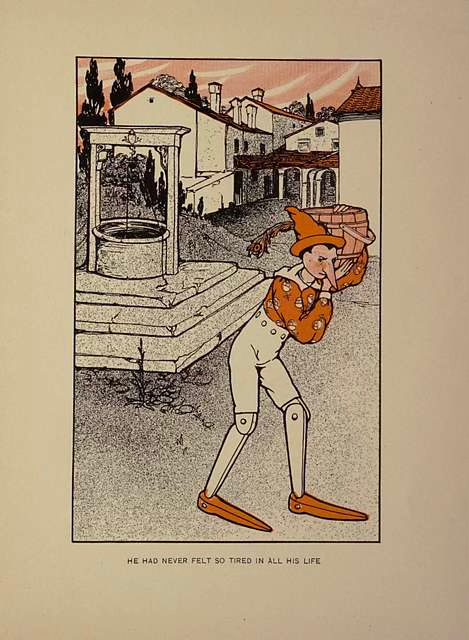
Pinocchio is a wooden puppet who, in order to become a real, flesh-and-blood human, must learn to be honest. His misfortunes and foibles symbolically reflect those of Italy’s formative period - when activists (including Collodi) there were trying to overcome social divisions that hampered unification and thus to establish common ground for a shared national vision.
Over and over, Pinocchio gets in trouble because he refuses to take responsibility for his actions and squanders good opportunities with impulsive, reckless abandon, choosing instead to fall under the influence of unscrupulous, cunning and ruthless rogues who gladly take advantage of his naivety and insensibility.
He allows himself to serve as their puppet. In sabotaging his own prospects, he also creates problems for others.
He murders the cricket who was warning him about self-destructive consequences to which his foolish behavior would surely lead (chapter 4). He torments, physically abuses, his creator, the well-meaning woodcarver Geppeto; the public watching Pinocchio’s maliciously offensive antics concludes Geppeto is to blame for them and - its sympathy completely misplaced - has a soldier drag the poor man to prison (chapter 3).
This scenario should strike a familiar chord with anyone listening in on the piteous Palestinian soap opera! Palestinians who clamor for “liberation” are like unreformed Pinocchio: They, same as he, refuse to take responsibility for their actions, pretending to lack agency while wreaking havoc right and left.
Jerry Seinfeld responded, when a pro-Palestinian (i.e., antizionist) activist asked him to shout out “Free Palestine,” by trenchantly noting: “It doesn’t exist3.”
He’s right: For all the hypocritical hoopla surrounding it, Palestine - a wooden construction, the puppet of interests (notably: jihadists, pseudo-progressives, NGOs, and governments) who exploit Palestinians’ grievances to Palestinians’ detriment - does not exist.
Could it?
That depends on whether the Palestinian body politic decides to follow Pinocchio’s lead.
He ultimately gets the message and grows up, learning how to admit and atone for his mistakes. A benevolent fairy tells him he “cannot grow.” “Why?” Pinocchio wants to know. She explains: “Because puppets never grow. They are born puppets…and die puppets.” “Oh,” he protests, “I am sick of being a puppet!” (chapter 25) He takes a long time to stop being one.
Palestinian politics so far is sunk in quicksand: a study in disunity, dishonesty, malice and violence. Israeli nationalism, by contrast, took a constructive course; proof residing in the Jewish State’s vigorous democracy, cultural blossoming, prosperous economy, and powerful military. These successes have been hampered, as all nation-building scenarios are, by serious flaws and mistakes.
Israelis are struggling with the question of how to sustain national unity in the face of both internal conflicts and external threats; Palestinians are unified only on wanting to destroy Israel. Rage, anger driven by unremitting hatred of Jews as supposed colonialist usurpers, is the driving force of Palestinianism. That’s a lie since am yisrael is indigenous to the Holy Land.
Pinocchio’s nose grows when he lies; his dishonesty sparks bodily reaction. So too for Palestinians as a body politic. In Hebrew, a word for “anger” is af, which in Biblical Hebrew also means “face” and “nose.”
The Torah uses flaring nostrils to signify how God’s retributive “anger will burn” (see, e.g., Exodus 22:23) against agents of indecency and untruthfulness. Researchers coined the phrase “Pinocchio Effect” to describe volatile facial - including nasal - thermal changes that are telltale signs of lying4.
Palestinian culture’s antagonistic and self-defeating dishonesty displays the Pinocchio Effect on a pervasive societal scale. Time is running out for “Palestine,” but like Pinocchio it might still have a chance to learn its lesson and become real.
(https://loc.getarchive.net/media/pinocchio-the-adventures-of-a-little-wooden-boy-a649cb)
https://www.timesofisrael.com/raams-abbas-says-palestinian-state-a-reality-drawing-outrage-from-zionist-parties/
https://www.gutenberg.org/files/16865/16865-h/16865-h.htm
https://www.jta.org/2026/06/11/united-states/seinfeld-declines-to-say-free-palestine-after-knicks-game-it-doesnt-exist
https://gredos.usal.es/bitstream/handle/10366/157705/The Pinocchio effect and the Cold Stress Test Lies.pdf?sequence=1
No posts
Comments
Nothing yet. Say the first thing.
Sign in to join the conversation.