
I didn’t plan to love Salvador. I planned to pass through it.
That’s the thing about this city. It doesn’t wait for your itinerary to catch up. It gets into you through the side door, through the smell of acarajé frying on the corner, through drumbeats you can feel in your sternum before you can locate where they’re coming from. I had four days. I ended up staying nine.
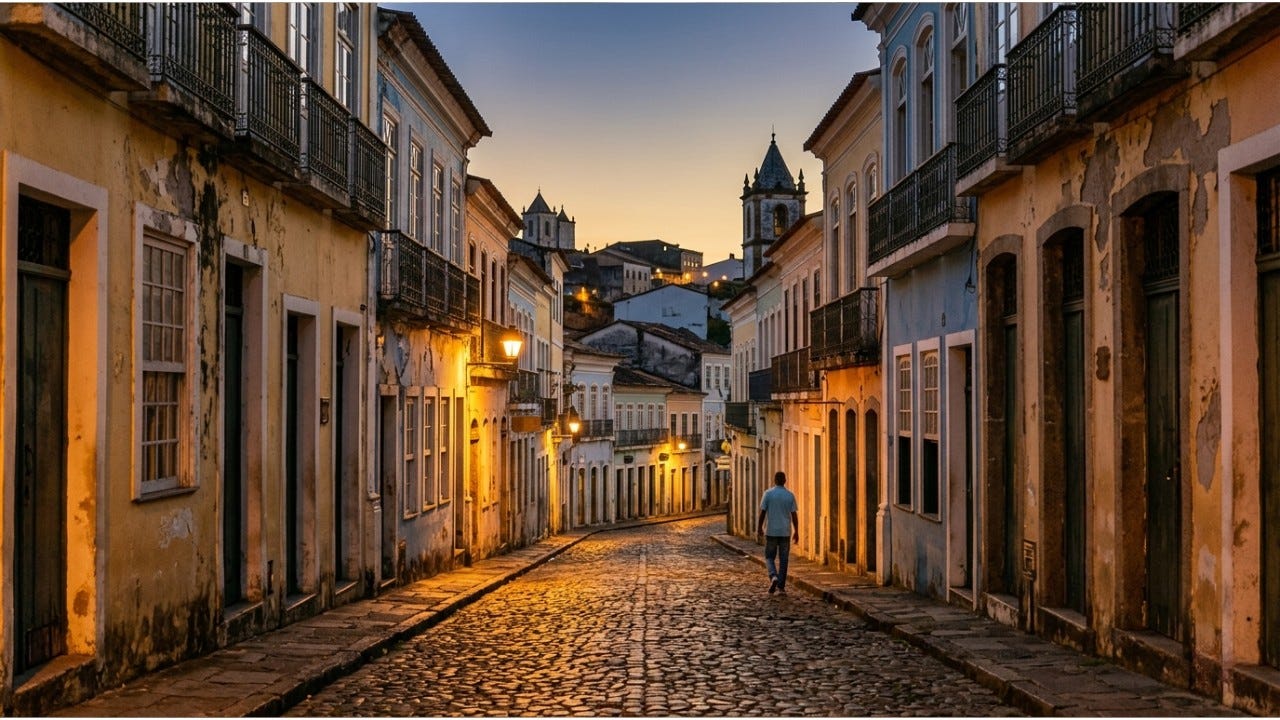
The Pelourinho at dusk is something you don’t forget. I know that sounds like a line from a brochure, but I mean it in the opposite way, the way you don’t forget a conversation that rearranged something in you. The light there in the late afternoon does something specific: it turns the colonial facades into something almost theatrical, all those yellows and pinks and dusty blues catching the last angle of sun while the shadows pool in the cobblestones below. I stood at the top of the main square one evening with a cup of something cold and watched the neighborhood shift from day to night like a slow exhale. Street vendors appeared. A capoeira circle opened up near the church steps. Somebody’s grandmother leaned out a second-floor window and watched the whole thing like she’d seen it ten thousand times and still wasn’t tired of it.
I wasn’t tired of it either, and I’d only been there three days.
Salvador is the kind of city that travel writers tend to over-explain. They reach for the history, the first capital of colonial Brazil, the port that received more enslaved Africans than any other city in the Americas, and yes, that history is everywhere and it matters and you should read about it before you go. But what strikes you on the ground is something more alive than history. It’s the way the African cultural inheritance didn’t just survive here, it became the skeleton of the city. Candomblé, capoeira, the food, the music. None of it feels like preservation. It feels like a living practice, ongoing, unapologetic.
I ate at a place in the Comércio district that had no sign and eight tables and a woman behind the counter who did not take questions about the menu. You ate what she made. What she made was moqueca, and it was the best thing I put in my mouth in six weeks of traveling through Brazil. The dendê oil, the coconut milk, the fresh fish. There’s a richness to Bahian cooking that makes other regional cuisines feel like they’re still drafting their thesis.
I walked a lot. That’s how I prefer to understand a city, on foot, slowly, without a destination firm enough to keep me from turning down a street that looks interesting. Salvador rewards this. The cidade alta and cidade baixa, connected by the Elevador Lacerda, are two completely different textures of city life. The upper city is all plazas and churches and the carefully restored Pelourinho. The lower city is harbor-facing, commercial, louder, grittier, and for my money more honest. I spent a morning down there watching the ferries leave for Ilha de Maré and felt that specific longing you get in port cities, the pull of somewhere you’re not going. If you want to make the crossing, Viator has good options for day trips along the Bahia coast worth looking at before you arrive.
A practical note for anyone planning a trip to Brazil, or anywhere that requires documentation sorted beforehand: if you need apostilles, certified translations, or any official paperwork processed before you travel, Idiomatic handled mine without a single back-and-forth. Worth knowing about before you need it, not after.
For accommodation, Hotels.com Latin America has the best coverage for Salvador and the rest of Bahia. If you’re staying more than a few days, and you should, Vrbo has apartment rentals in the Pelourinho and Barra neighborhoods that put you inside the city rather than next to it.
On my last evening I went back to the Pelourinho, because of course I did. It was a Tuesday, which apparently meant nothing because the square was full anyway. A percussion group set up near the stairs, not a performance exactly, more of an inevitability. People gathered the way people gather around fire, without deciding to. I stood at the edge of it for a long time, not thinking about much, just listening.
Salvador doesn’t let you leave cleanly. It sends you off with something stuck in your chest that you won’t fully identify until you’re somewhere quieter, weeks later, and you realize you’ve been comparing every city since to the one you almost just passed through.
Affiliate link, I may earn a commission at no extra cost to you.
No posts
Comments
Nothing yet. Say the first thing.
Sign in to join the conversation.