
Eleven days before he became acting Russian President on 1 January 2000, Putin made what many of the uninitiated considered to be a joke :
“I would like to announce that the group of FSB agents sent to work undercover in the government has accomplished the first part of its mission.”
He was speaking to his former colleagues at the old KGB headquarters in the Lubyanka, now the headquarters of the Federal Security Service, the FSB, on 20 December 1999.
Ironic, perhaps, but Putin was not joking. During the early 2000s, KGB officers saturated every level of the Russian government. The same became true of the Russian Ministry of Foreign Affairs. There, however, the trend acquired a new meaning and posed an international threat. Putin wanted to conduct diplomacy as another special operation: to corrupt our politicians, subvert democracy and spread disinformation. Russia’s three intelligence services, the SVR, GRU and FSB, took control of the Russian Foreign Ministry.
This change in the nature and objectives of Russian diplomacy really gathered pace during Moscow’s highly successful political interference operations in the years leading up to Brexit in the UK and Donald Trump’s first election in the US. The Russian diplomatic service was effectively and completely co-opted, as two former intelligence officers, Alexander Yakovenko and Sergey Kislyak, took charge as ambassadors in London and Washington respectively.
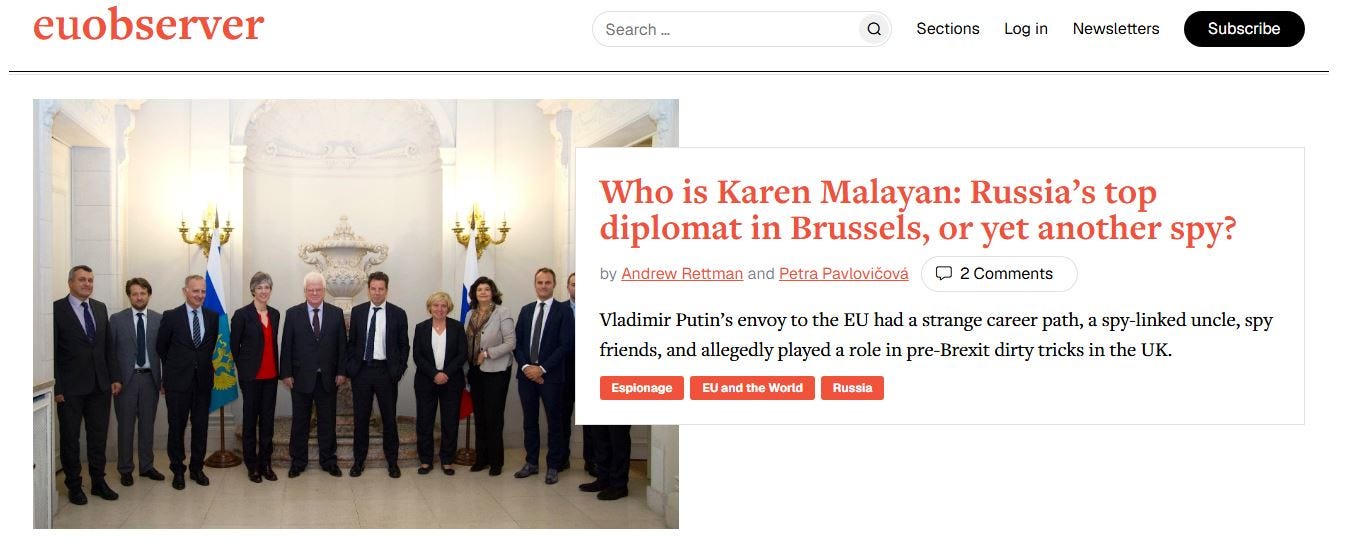
Over the past 15 years, the Russian diplomatic service has been gradually and almost completely hijacked by the Russian intelligence services. The latest example comes from this week’s investigation by Brussels-based journalists at EUobserver, into yet another senior intelligence officer in charge of a major Russian diplomatic mission. This time, it is my contemporary Karen Malayan, whom I met several times during his two postings in London, and knew people close to him. Today, he is in charge of Russia’s mission to the European Union. I was pleased to provide some additional background for the article.
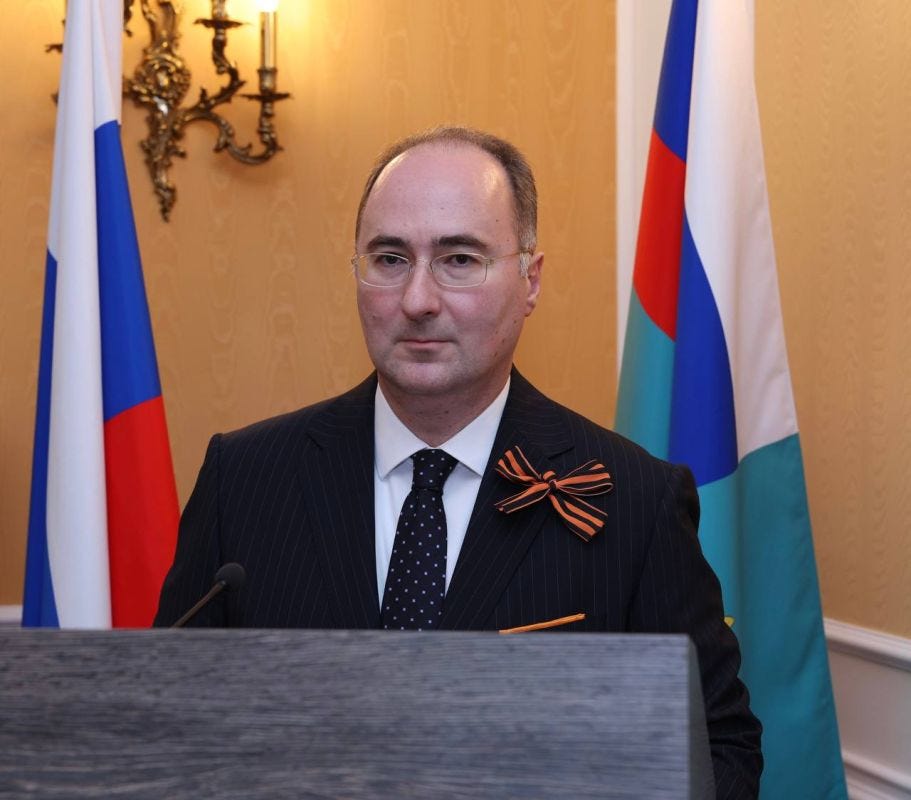
Malayan. Karen Malayan.
Karen Malayan is the 55-year-old career diplomat who has served as acting head of Russia’s mission to the European Union since 27 November 2024. The unusual speed of his career, his family connections, his close relationships with identified or suspected Russian intelligence officers and his activities in London all point to his not being a clean diplomat at all.
Born in Leningrad, now St Petersburg, in 1971 to a university professor and a secondary-school headteacher, Malayan attended an ordinary city school before gaining admission to MGIMO, the elite Moscow diplomatic university from which the Soviet and Russian intelligence services have traditionally recruited officers. He graduated in 1993, immediately joined the Russian Foreign Ministry and, despite being a young graduate without an obvious elite family background, was sent to London as an embassy attaché from 1994 to 1999.
Former Estonian foreign intelligence chief Rainer Saks described both Malayan’s admission to MGIMO and his rapid subsequent advancement as highly unusual, while a former SVR officer said that a young man from a family of teachers would have had virtually no chance of receiving an immediate London posting without the protection of a powerful government patron or the SVR.
Gold Finger
After London, Malayan worked in the Foreign Ministry’s finance department, a well-known cover for Russian intelligence officers, and, at least nominally, in the Presidential Administration until 2005, before returning to the Russian Embassy in London in 2006 as a senior counsellor and head of its economic affairs section, where he remained until 2013.
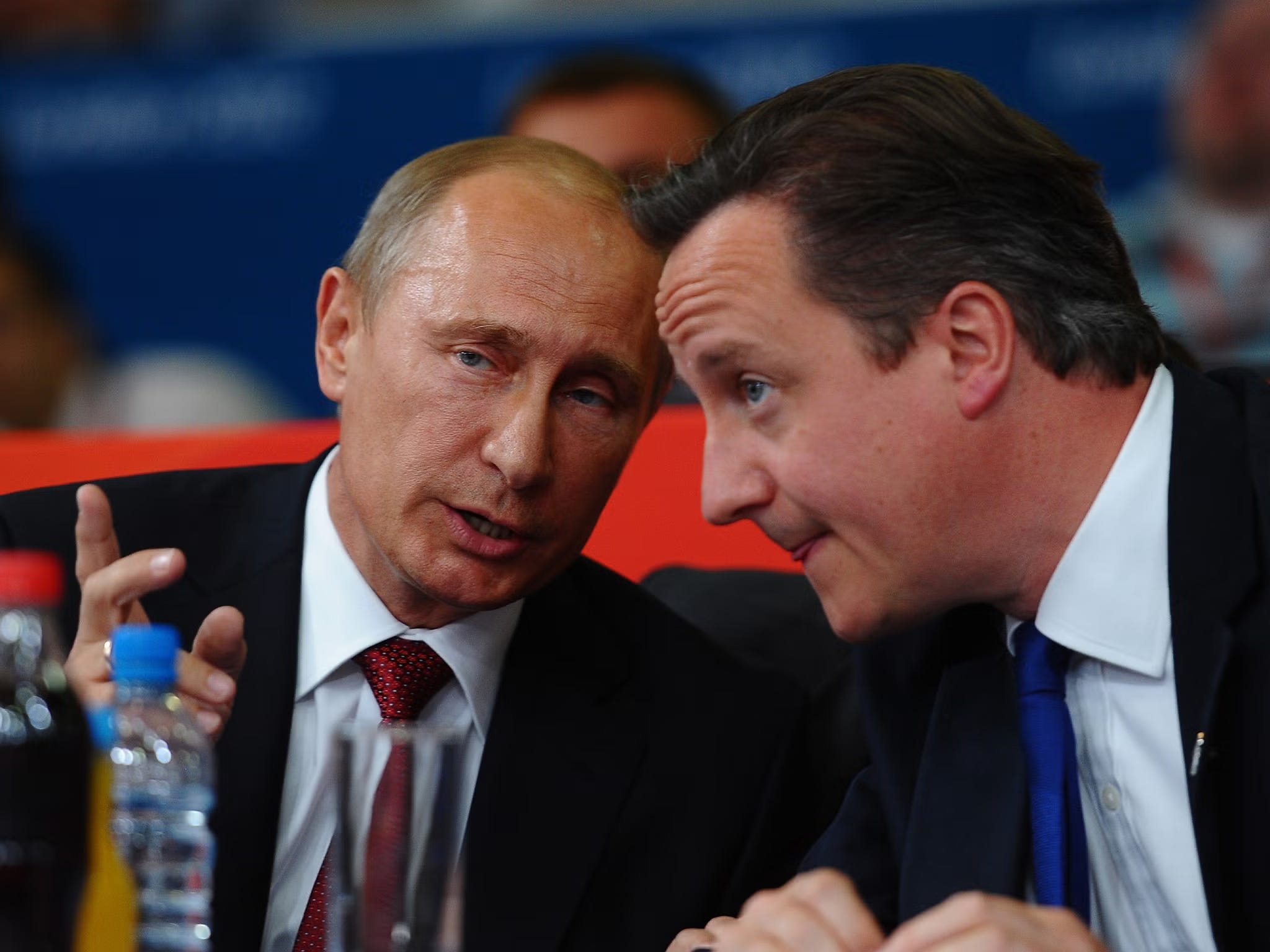
I find it significant that, at the Russian Embassy in London, an intelligence officer was in charge of bilateral economic ties at a time when the British government was desperate to forge a lucrative economic relationship with the Kremlin. Medvedev was, temporarily, President. Putin had, also temporarily, “stepped down” into the Prime Minister’s chair. The European credit crisis was affecting our trade with the Continent, and the lightweight Cameron government had just entered Downing Street.
British diplomats in Moscow were given to understand very clearly that the price of commercial deals would be Britain’s restoration of security cooperation with Moscow, which had been suspended after the 2006 murder of Alexander Litvinenko. Business deals were the carrot, and Malayan was in charge of that carrot in London.
Indeed, in February 2011, the Russian Foreign Minister, Sergei Lavrov, came to London to discuss commercial ties and renewed security cooperation. With one hand, the Kremlin was offering the UK the prospect of future highly profitable joint commercial alliances modelled on the BP-Rosneft venture. In return, the Kremlin wanted to play a bigger role in setting the Western security agenda. Specifically, Lavrov discussed a joint declaration on Afghanistan, commitments to closer counter-narcotics work, an agreement on a new secure hotline between London and Moscow, terrorism, regional instability in the Middle East and Iran (Amos 2011; Bigg 2011).
The following month, Sergei Mironov, chairman of the Federation Council of the Russian Parliament, visited London and Edinburgh, laying the economic foundations that Moscow had wanted all along for the new arrangement: the easing of visa restrictions, joint research centres and investment cooperation (Embassy of the Russian Federation in the UK 2011a; Parlamentskaya Gazeta 2011).
Following on from New Labour’s cozy relationship with the Kremlin in early 2000s, ground was already waiting ready for the building what had become the world’s biggest laundromat of dirty Russian money: Londongrad.
Over the previous decade, the City of London and its spiderweb of offshore jurisdictions had become Whitehall’s darlings. A major revenue earner for the country, they were thriving on a cocktail of financial liberalisation, inventive non-dom tax status arrangements and “light-touch” regulation. This was an irresistible, highly fertile ground for dirty, stolen, dodgy or laundered money - what financiers politely called “mobile capital” (Morgan 2024; Shaxson 2011). And Russian crooks and kleptocrats have been its top clientele since the 1990s.
At the same time, Britain’s offshore system - the Crown Dependencies and Overseas Territories - made it easier and cheaper than ever to create anonymous shell companies, which could then be used to channel laundered assets into the UK with minimal transparency. Between 2001 and 2010, this offshore route was crucial to global illicit financial flows, a huge chunk of which came from Russia (GFI 2012, cited in Morgan 2024).
Russian oligarchs and kleptocrats had already been enjoying Labour’s “golden visa” investor-residency route for two years. Just for £1 million, wealthy foreigners could effectively buy residency in Britain. Home Office data showed that by the mid-2010s the scheme had brought at least £3.15 billion into the UK, big money in those days, in just a few years. Russians accounted for about a quarter of that, with about £729 million invested. (Transparency International UK 2015).
Meanwhile, London itself was enthusiastically marketing itself to Russia’s elite. “Red Ken” Livingstone, the then Mayor of London, told the Russian Economic Forum in 2006 that he wanted the British capital to be the “natural base in Europe” for Russian companies. Around that time, the London Stock Exchange welcomed companies such as Evraz, Sistema and Novatek. In 2006, the very year Alexander Litvinenko was murdered in London, Rosneft’s enormous IPO proceeded despite allegations in the High Court that it involved assets effectively stolen from Yukos.
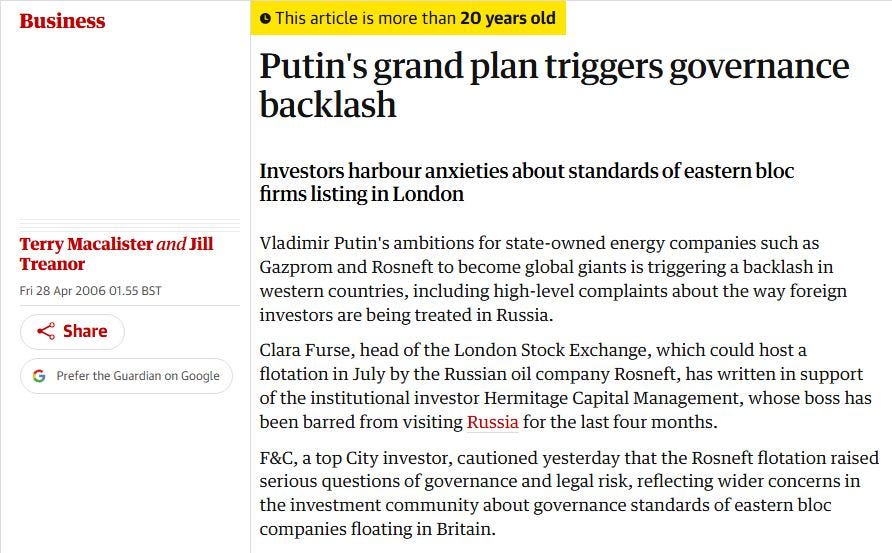
The only strong caution about the Rosneft IPO from any investors was from F&C Asset Management, and only because I worked there at the time, and wrote our press release expressing concern about the flotation.
And it was not just the City of London: estate agents and lawyers were busy happily building Londongrad. Livingstone’s City Hall created a dedicated unit charged with attracting Russian investment. In a couple of years after Mironov’s visit, about £1.5 billion worth of UK property would be owned by corrupt Russians with links to the Kremlin (Hollingsworth and Lansley 2010; Transparency International UK 2015; Morgan 2024). Money laundering estimates for the UK during those years ran into tens of billions of pounds annually. The scale was staggering: £19 billion to £48 billion in 2005, and £23 billion to £57 billion in 2007, accounting for about 2% - 5% of the UK’s GDP (Alkaabi et al. 2010; Talani 2011; Morgan 2024).
Money Penny
Those years also saw the first signs of the emerging covert political interference operation. The Conservative Party had taken its first political donation a couple of years earlier.
Boris Johnson grew closer to the Lebedev circle. David Burnside, the former Conservative MP, took Sergei Nalobin to Conservative fundraising events, while his company, New Century Media, launched “Positive Russia” to improve Moscow’s image. Burnside employed Alex Nekrassov, the son of a hardline Kremlin propagandist. Lubov Chernukhin, the wife of a former minister in Putin’s government and a Carlton Club member since 2008, became a prominent donor to the Conservative Party. Putin’s friend Vasily Shestakov was brought to a Tory fundraising dinner, where he spoke to Cameron.
During that time, Malayan worked closely in London with Sergei Nalobin, the Russian diplomat accused of trying to channel Russian money towards Conservative and pro-Brexit political networks. Nalobin was gently pushed out of the UK by the Foreign Office in 2015 and expelled from Estonia in 2022 for activities undermining Estonian security. He was also identified as an SVR officer in a leaked Russian intelligence database. Malayan, with his extensive contacts among British businesses that depended on Russia and Russian businesses channelling money into the UK, would have been essential to this operation.
As some of you who have listened to “Sergei and the Westminster Spy Ring” will know, I have tried to expose this shameful period in British history, when the authorities pointedly ignored my reports that the Kremlin was looking to bankroll the country’s governing political party. Produced on a shoestring budget and presented by the journalists Carole Cadwalladr and Peter Jukes, our podcast took Gold in the Best UK News and Politics category at the 2025 APAs Awards, followed by Bloomberg with Silver and The Times with Bronze. It is the true story of how Moscow instigated the most successful covert “active measures” operation in British history, and how successive British governments tried to cover it up for their own party-political reasons.
Spies ‘R’ Us
Karen Malayan briefly became a deputy director in the Foreign Ministry in Moscow in 2014, an exceptionally senior position, before moving to Brussels in 2015 as deputy permanent representative responsible for economic affairs and eventually taking command of the EU mission. Suspicion was strengthened by Malayan’s family background: his uncle, Eduard Malayan, was formally a diplomat but lived at Moscow residential blocks known to house officers of the Russian Foreign Intelligence Service (SVR) and, after leaving seizing to be a “diplomat”, worked for a defence company.
Apart from Nalobin, Malayan was also personally close to other several Russian intelligence officers. His predecessor in Brussels, Kirill Logvinov, was identified by Belgian intelligence as an SVR officer and left Belgium after his identity was exposed.
From his social media interactions linked him to Alexander Rogov, Russia’s consul general on the strategically important Åland Islands, who reportedly came to the attention of Finnish intelligence after attempting to cultivate a local politician and who maintained relationships with other SVR officers and a Russian linked to an assassination conspiracy in Georgia. Their relationships extended beyond professional contact: Malayan continued interacting socially with Nalobin and Rogov online, while Rogov was also connected to Logvinov.
My own experience provided a further indication. During Malayan’s first London posting at in the late 1990s, a Russian embassy diplomat jokingly warned me at a reception that the KGB was watching me and then immediately pointed Malayan out as someone I should approach, leaving me with the clear understanding that Malayan belonged to Russian intelligence.
During his second London posting, he occupied a central economic role at precisely the moment when Moscow was seeking to rebuild influence in Britain through business relationships, oligarchs, intermediaries and political proxies, developments that later became important to understanding Russian activity around Brexit.
What Malayan’s professional biography tells us is that Russian diplomacy has long ceased to exist in the traditional sense, increasingly stepping into the operational shoes of what used to be known as the KGB. Supercharged by oligarchs’ money, old KGB mindset and mafia tactics, it was not a quick process, but nevertheless, I believe, our security services missed that trick. They also missed the important role that co-opted oligarchs and commercial interests played in Moscow’s political interference operations around the world. MI5 and the FBI became stuck in the past, chasing the old ghosts of Cold War espionage, while the Kremlin quickly learnt how to weaponise money and offshore finance successfully to corrupt our politics.
BIBLIOGRAPHY
Amos, H. (2011). ‘Lavrov in London: Russia–UK relations after BP–Rosneft deal’. Financial Times, February 2011.
Bigg, C. (2011). ‘Lavrov meets Hague and Cameron: Joint declaration on Afghanistan and security issues’. The Guardian, February 2011.
Embassy of the Russian Federation in the UK. (2011a). Press-release: Visit of Chairman of the Federation Council Sergei Mironov to the UK, March 20–22, 2011. London: Russian Embassy.
Parlamentskaya Gazeta. (2011). ‘Speech of Chairman of the Federation Council Sergei Mironov in Edinburgh on Russian–British cooperation and trade’. Parlamentskaya Gazeta, March 2011.
Alkaabi, A., Mohamad, M., Nazeer, A. & Manasrah, A. (2010). Estimating the Magnitude of Money Laundering Activities in the United Kingdom. Journal of Money Laundering Control, 13(4), pp. 346–356.
Evraz Group. (2005). Evraz Group S.A. Announces Pricing of its Initial Public Offering of Global Depositary Receipts. Company announcement, London, November 2005.
Global Financial Integrity (GFI). (2012). Illicit Financial Flows from Developing Countries: 2001–2010. Washington, DC.
Hollingsworth, M. & Lansley, S. (2010). Londongrad: From Russia with Cash; The Inside Story of the Oligarchs. London: Fourth Estate.
Morgan, J. (2024). Dark Finance: How Britain Became the Laundromat of the World. London: Allen Lane.
Moscow Times. (2012). Novatek and Sistema Expand London Presence through GDR Offerings. Moscow, 2012.
Radio Free Europe/Radio Liberty (RFE/RL). (2006). High Court Challenge to Rosneft IPO Over Alleged “Stolen Assets”. London/Moscow, July 2006.
Shaxson, N. (2011). Treasure Islands: Tax Havens and the Men Who Stole the World. London: Bodley Head.
Talani, L. S. (2011). The City of London as a Centre for Money Laundering. In: Talani, L. S. & Casey, A. (eds.), Europe in Crisis: The Global Recession and the EU. Basingstoke: Palgrave Macmillan, pp. 170–188.
Transparency International UK. (2015). Gold Rush: Investment Visas and Corrupt Capital Flows into the UK. London: TI-UK.
No posts
Comments
Nothing yet. Say the first thing.
Sign in to join the conversation.