
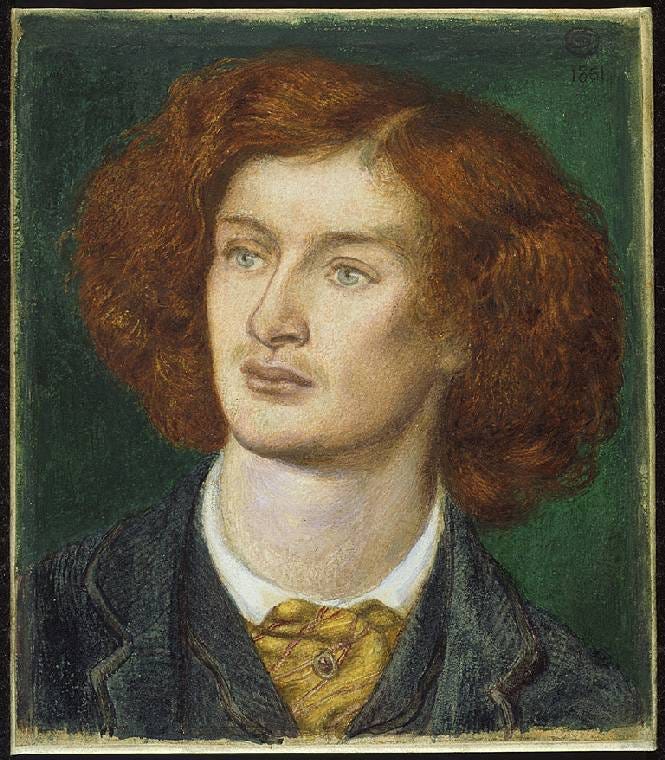
In the Sunday Times this week was an article that caught my eye: a handwritten musical manuscript was discovered at Morley College in London, signed by Ralph Vaughan Williams. The work was hitherto unknown, and, excitingly, it is a song setting for the words of Algernon Charles Swinburne’s poem ‘Before the Mirror’. If you’re not familiar with Swinburne, he was a red-haired Pre-Raphaelite poet with a tendency towards flagellation and sliding naked down bannisters (allegedly). Putting levity aside, Swinburne was an extraordinary poet who intentionally flouted Victorian taste, morality and convention, writing poems which are technically dynamic and complex, often drawing on classical mythology and history.
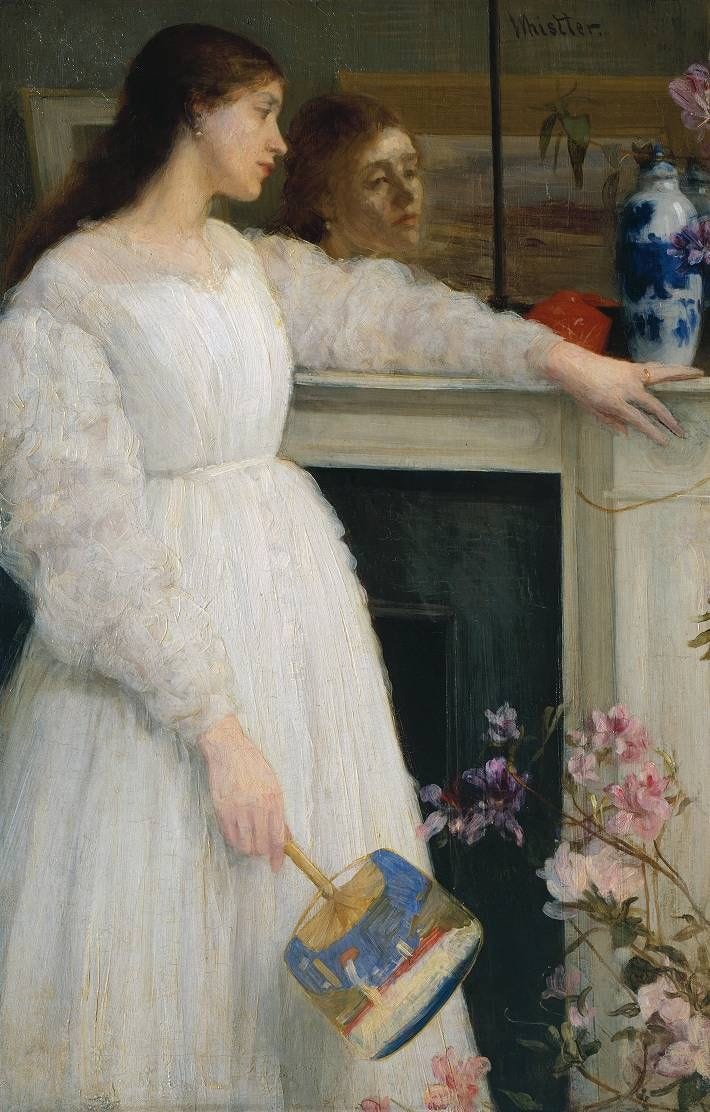
This poem is different from many of his others, however, partly because of its reflective, melancholy nature, and partly because it is an ekphrastic poem, written as a response to James McNeill Whistler’s painting Symphony in White, No. 2 (1864). Whistler often used musical terminology for his paintings, suggesting that we should move away from the visual and figurative to simply absorb and experience, perhaps. (Later this month you can experience more of Whistler at the Tate’s exhibition). Whistler knew Swinburne well (though they disagreed and fell out later in life), and was influenced by Dante Gabriel Rossetti (though he and Ruskin famously had a mutual antipathy). In his ‘Ten O’Clock Lectures’ on art, Whistler said,
Nature contains the elements, in colour and form, of all pictures, as the keyboard contains the notes of all music. But the artist is born to pick, and choose, and group with science, these elements, that the result may be beautiful – as the musician gathers his notes, and forms his chords, until he bring forth from chaos glorious harmony. To say to the painter, that Nature is to be taken as she is, is to say to the player, that he may sit on the piano.
It is clear from this that Ruskin’s call to artists to represent nature directly is anathema to Whistler!
Various research projects have caused me to think a lot about art and poetry together, and so the added musical element makes this even more interesting. Walter Pater suggested that ‘all art aspires to the condition of music’, and poetry is in itself a musical art, expressing itself through sound when read aloud (as it should be!) Swinburne’s poem, which in form itself seems musical, with rhymes, alliteration and assonance, also offers a veiled sadness which reflects but does not describe the painting. Only two stanzas were exhibited with the painting; 4 and 6:
“Come snow, come wind or thunder
High up in air,
I watch my face, and wonder
At my bright hair;
Nought else exalts or grieves
The rose at heart, that heaves
With love of her own leaves and lips that pair.
“I cannot see what pleasures
Or what pains were;
What pale new loves and treasures
New years will bear;
What beam will fall, what shower,
What grief or joy for dower;
But one thing knows the flower; the flower is fair.”
These two stanzas focus on looking (‘watch’, ‘see’): the figure of the girl (Joanna Hiffernan, model, muse and lover of Whistler) looks away from both the viewer and the mirror, negating the traditional concept of the mirror as a symbol of vanity. The final line suggests that beauty exists only for the sake of beauty (art for art’s sake and all that), and yet time is short, the ‘rose’ will die, love will pass: is this not so much a vanitas as a memento mori?
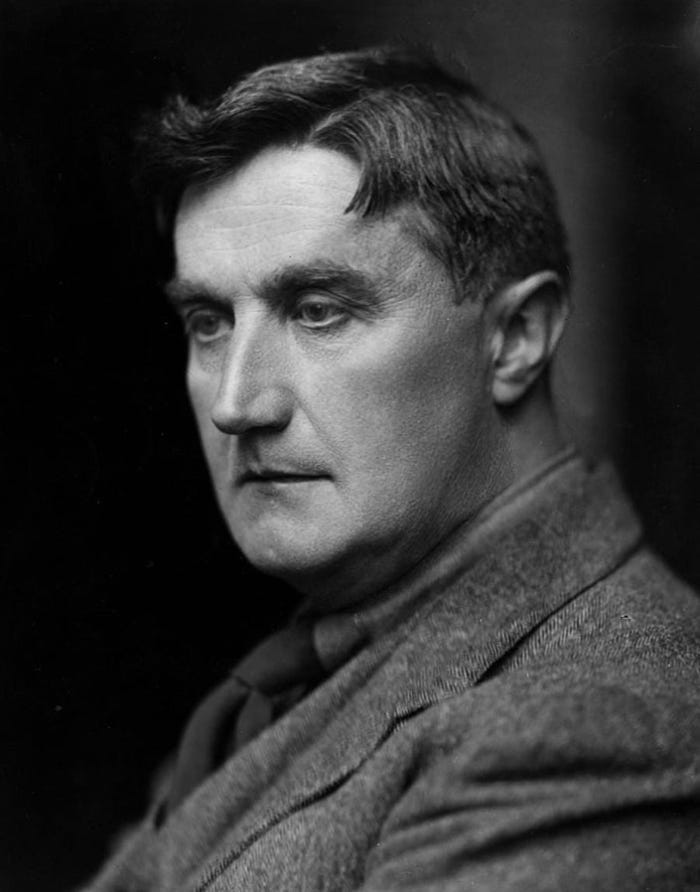
In 1902 Whistler wrote that the poem was ‘a rare and graceful tribute from a poet to a painter – a noble recognition of work by the production of a nobler one’. I wonder what he would have thought of Vaughan Williams’ work? Morley College plan to record it soon, and I can’t wait to hear it! And of course Vaughan Williams is well-known for his settings not only of folk songs but of other poems, most famously of George Meredith’s ‘The Lark Ascending’, and A. E. Housman’s ‘On Wenlock Edge’.
Below is Swinburne’s poem in full.
‘Before the Mirror’
I.
White rose in red rose-garden
Is not so white;
Snowdrops that plead for pardon
And pine for fright
Because the hard East blows
Over their maiden rows
Grow not as this face grows from pale to bright.
Behind the veil, forbidden,
Shut up from sight,
Love, is there sorrow hidden,
Is there delight?
Is joy thy dower or grief,
White rose of weary leaf,
Late rose whose life is brief, whose loves are light?
Soft snows that hard winds harden
Till each flake bite
Fill all the flowerless garden
Whose flowers took flight
Long since when summer ceased,
And men rose up from feast,
And warm west wind grew east, and warm day night.
II.
“Come snow, come wind or thunder
High up in air,
I watch my face, and wonder
At my bright hair;
Nought else exalts or grieves
The rose at heart, that heaves
With love of her own leaves and lips that pair.
“She knows not loves that kissed her
She knows not where.
Art thou the ghost, my sister,
White sister there,
Am I the ghost, who knows?
My hand, a fallen rose,
Lies snow-white on white snows, and takes no care.
“I cannot see what pleasures
Or what pains were;
What pale new loves and treasures
New years will bear;
What beam will fall, what shower,
What grief or joy for dower;
But one thing knows the flower; the flower is fair.”
III.
Glad, but not flushed with gladness,
Since joys go by;
Sad, but not bent with sadness,
Since sorrows die;
Deep in the gleaming glass
She sees all past things pass,
And all sweet life that was lie down and lie.
There glowing ghosts of flowers
Draw down, draw nigh;
And wings of swift spent hours
Take flight and fly;
She sees by formless gleams,
She hears across cold streams,
Dead mouths of many dreams that sing and sigh.
Face fallen and white throat lifted,
With sleepless eye
She sees old loves that drifted,
She knew not why,
Old loves and faded fears
Float down a stream that hears
The flowing of all men’s tears beneath the sky.
Comments
Nothing yet. Say the first thing.
Sign in to join the conversation.