
Hi! Welcome to Science with Serena.
I’m Serena.
I write about concepts in quantum computing the way I would like to read about them. Today, I’m finishing up my three-part series on superconductivity with the final exploration of how superconducting qubits are made. Whew! It’s been a journey. To start from the top, check out my previous articles here: Superconductors: The Start of Something Cool and Superconductors: Lattice Discuss
If you’re ready to go: let’s get into it.
To start, we need to clarify what a qubit is and how we can make one.
A qubit is a basic unit of information (like a regular bit for a regular computer), but instead of having just a value of 0 or 1, it can be in a superposition of both. Qubits just need two states and the ability to exhibit quantum behaviors like superposition and coherence, so they come in a variety of forms—atoms, photons, trapped ions, or electrical circuits.

Superconducting qubits are just one kind of qubit; they use superconductors (shocker) in electrical circuits to create and control quantum states. To find out how, let’s review some electrical engineering.
Superconducting qubits are built on modifications of a basic electrical circuit called an LC circuit.
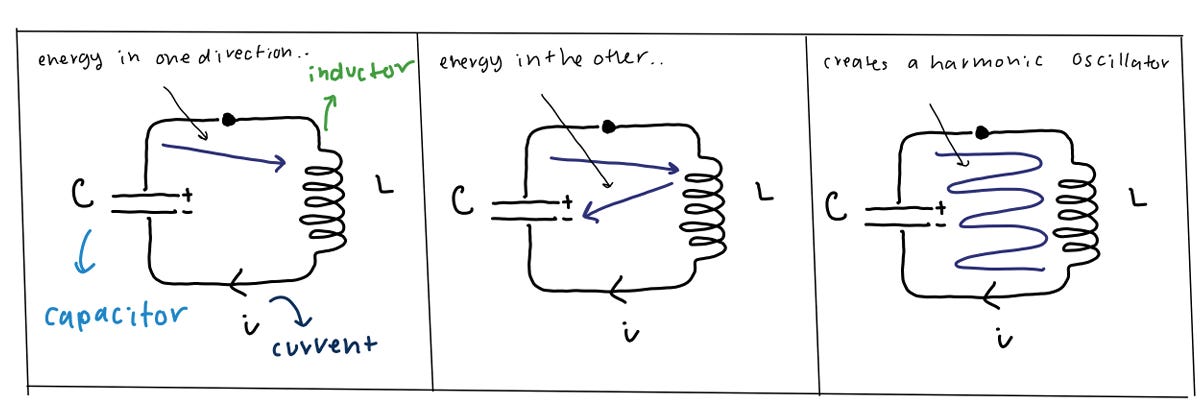
An LC circuit stores and exchanges energy between an inductor (L) and a capacitor (C), where the inductor is a coil of wire that stores energy in a magnetic field, and the capacitor is a set of two metal plates that store energy in the electric field created by separated charges. When a current is applied, the capacitor charges and discharges, and the inductor builds and collapses its magnetic field.

The way energy moves in this system forms a pattern called a harmonic oscillator.
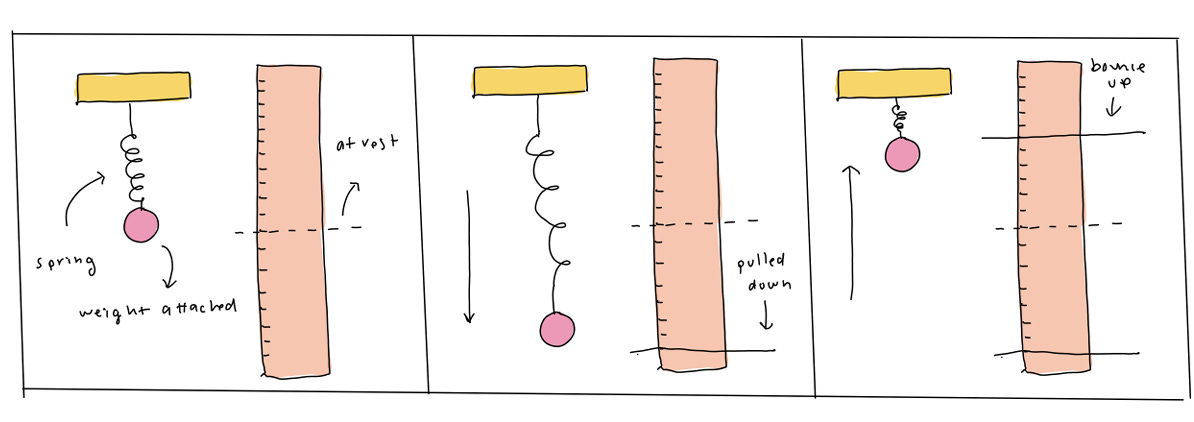
You might remember (or have repressed) this concept from general physics: a harmonic oscillator is the pattern of potential energy created when a spring bounces up and down. The motion of a spring over time traces a sine wave, and if you graph its potential energy versus position, you get a parabola.

An LC circuit is an electrical version of a harmonic oscillator. If we wanted to use one to make a qubit, we’d have to use superconducting materials and cool it down to near absolute zero temperatures.
Then it starts to behave like a quantum harmonic oscillator, where, instead of flowing smoothly across all energies, the system’s energy becomes quantized, meaning it can only occupy discrete energy levels.
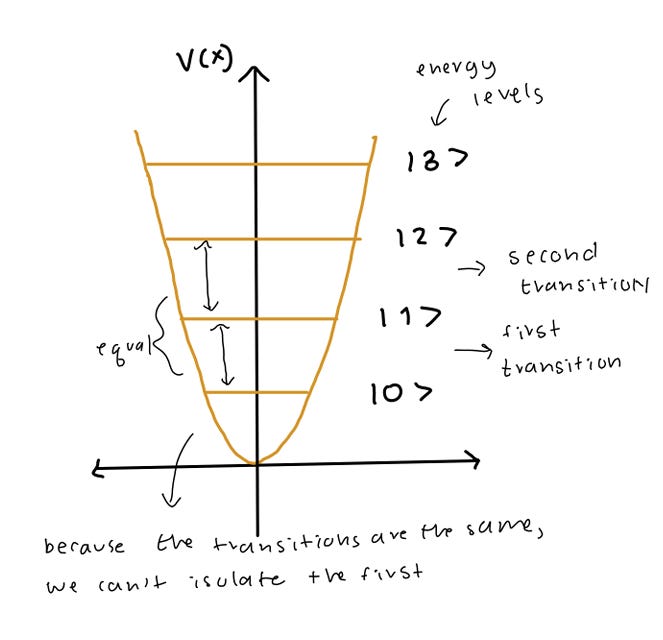
In our quantum harmonic oscillator, the energy levels are evenly spaced: the jump from the ground state to the first excited state is the same as the jump from the first to the second, and so on.
While this quantum harmonic oscillator is fine for regular circuits, it’s terrible for building qubits.

That’s because to make a qubit, we need a system with exactly two energy levels. We could potentially use the first two energy levels of our LC circuit as a qubit, but because all the levels in the quantum harmonic oscillator are evenly spaced, it is difficult to excite only the first transition without accidentally exciting all the other transitions too. We couldn’t isolate just the first transition, so our qubit would start leaking information into higher-transition states.
So our LC Circuit won’t work as a qubit. So, what do we do?
Enter Brian Josephson.
Brian Josephson was a 22-year-old PhD student at the University of Cambridge when he published “Possible new effects in superconductive tunnelling” in 1962. The theoretical paper proposed that a current could flow without resistance between two superconductors over a thin insulating barrier thanks to quantum tunnelling. His theory, called the Josephson effect, eventually led to the creation of the Josephson junction, a type of junction that makes superconducting qubits possible.

It works like this: Josephson junctions act as a nonlinear inductor, so the cycle of potential energy stops the harmonic oscillation. Instead, it turns the circuit into an anharmonic oscillator. Now, instead of evenly spaced energy levels, the energy levels are unevenly spaced and different amounts of energy are required for each transition.

This means we can isolate the lowest two energy levels (0 and 1). Once we have those two isolated, we have our qubit. The transmon qubit—the type you might be seeing everywhere—is built from a Josephson junction inside a specific circuit design.
Thanks Josephson!
Enjoyed this article??? Interested in supporting more fun science content?? Buy me a coffee here!
No posts
Comments
Nothing yet. Say the first thing.
Sign in to join the conversation.