
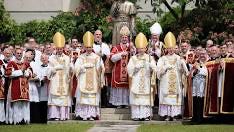
Commentary will be forthcoming.
For now, we simply present the documents:
-The Decree of Excommunication
-The accompanying Explanatory Note
-Translation of the little-known 1996 note of the Pontifical Council for Legislative Texts, “Sculla Communica” (“On Excommunication”) referenced in the Explanatory Note below.
Decree of the Dicastery for the Doctrine of the Faith, 02.07.u2026
Prot. N. 99/2009
DECREE
Despite the warnings addressed to the Superior General of the Priestly Society of Saint Pius X, Bishop Alfonso de Galarreta, having committed an act of a schismatic nature through the episcopal consecration of four priests, without a pontifical mandate and against the will of the Supreme Pontiff, has ipso facto incurred the penalties provided for by canon 1387 and canon 1364 § 1 CIC 2021.
I therefore declare for all legal purposes that both the aforementioned Bishop Alfonso de Galarreta and Pascal Schreiber, Michael Goldade, Michel Poinsinet de Sivry and Marc Hanappier have incurred ipso facto the latae sententiae excommunication reserved to the Apostolic See.
I further declare that Bishop Bernard Fellay, having directly participated in the liturgical celebration as a co-consecrator, thus publicly adhering to the schismatic act, has incurred the latae sententiae excommunication provided for by canon 1364 § 1 CIC2021.
Clerics and lay faithful are warned not to adhere to the schism of the Priestly Society of Saint Pius X, because they would ipso facto incur the penalty of latae sententiae excommunication .
From the Dicastery Building, 2 July 2026
Víctor M. Card. Fernández
Prefect
John J. Kennedy
Titular Archbishop of Ossero
Secretary for the Disciplinary Section
Monsignor Armando Matteo
Secretary for the Doctrinal Section
Prot. N. 99/2009
EXPLANATORY NOTE
From the time of Saint Paul VI until the most recent discussions held at this Dicastery, multiple attempts to bring the members of the movement initiated by Archbishop Marcel Lefebvre back into full communion with the Catholic Church have proven futile. This situation has been further aggravated by recent episcopal consecrations celebrated without papal mandate, against the will of the Holy Father, in open violation of canon law. Therefore, this Dicastery, in the faithful exercise of the functions entrusted to it, deems it necessary to note that this act constituted the crime of schism, with canonical consequences for the sacred ministers and lay faithful involved. Indeed, as already declared in 1988, “such disobedience—which entails a practical rejection of the Roman Primacy—constitutes a schismatic act” (cf. John Paul II, Apostolic Letter Ecclesia De i , 3).
In this regard, from now on:
1. The sacred ministers belonging to the Priestly Fraternity of Saint Pius X are in schism and must therefore be considered schismatic (cf. Ecclesia De , 5 c; Pontifical Council for Legislative Texts, Explanatory Note on the excommunication for schism incurred by the adherents of the movement of Bishop Marcel Lefebvre , 24.08.1996, 5-6), resulting in them being subject to the excommunication provided for by law (can. 1364 § 1 CJC).
2. As regards the lay faithful, those who formally adhere to the Priestly Fraternity of Saint Pius X under the conditions established in the Explanatory Note of the Pontifical Council for Legislative Texts of 1996 (cf. ibid ., 7), still in force, which this Dicastery adopts, are to be considered schismatic and excommunicated.
3. Finally, the holy People of God are warned that the sacred ministers of the Priestly Fraternity of Saint Pius X administer the sacraments illicitly and that the sacrament of penance administered by them and the marriage assisted by them are invalid.
The Church, as a caring mother, will welcome with sincere affection and deep concern all those who wish to return to full communion. The Apostolic Nuncios will have access to the procedures that Ordinaries may use in various cases.
Finally, all the faithful are exhorted to remain firm in communion with the Roman Pontiff, with the Bishops in communion with him and with the whole Church (cf. Lumen Gentium , 22; can. 751 CIC ), and to abstain from participating in the celebrations and activities promoted by the aforementioned Priestly Fraternity of Saint Pius X.
From the Dicastery Building, 2 July 2026
Víctor M. Card. Fernández
Prefect
Monsignor Armando Matteo
Secretary for the Doctrinal Section
John J. Kennedy
Titular Archbishop of Ossero
Secretary for the Disciplinary Section
________________________________________________
[Translation of the little-known 1996 Explanatory Note referenced above]
PONTIFICAL COUNCIL FOR LEGISLATIVE TEXTS
EXPLANATORY NOTE
V. On the excommunication for schism incurred by adherents of Bishop Marcel Lefebvre’s movement
(Communicationes, 29 [1997] 239–243)
Following recent reports in certain media outlets, this Pontifical Council deemed it appropriate to make public an Explanatory Note that it had sent to the Congregation for Bishops.
Your Most Reverend Eminence,
By letter dated July 26 of this year, Ref. No. XXX, Your Most Reverend Eminence forwarded to this Pontifical Council a letter from His Excellency Bishop Norbert Brunner of Sion, Switzerland, in which the Bishop—in light of certain confusing press reports—sought an authoritative interpretation of the Motu Proprio “Ecclesia Dei” and the subsequent Decree of this Congregation concerning the excommunication imposed on Bishop Marcel Lefebvre, the four bishops ordained by him, and Bishop Emeritus Antonio de Castro. At the same time, Your Eminence requested the opinion of this Dicastery regarding the wording of the reply to be given to the aforementioned prelate.
In this regard, I have the honor to inform you that the issue raised by the Ordinary of Sion does not appear to require an authentic interpretation of either the Motu Proprio “Ecclesia Dei” of July 2, 1988, or the Decree of this Congregation for Bishops of July 1, 1988, or the relevant canons of the Code of Canon Law: 1364, § 1, and 1382.
In fact, the Bishop bases his request on pastoral considerations, seeking to put an end to erroneous interpretations, but he offers no evidence suggesting the existence or well-founded likelihood of an authentic “dubium iuris” in the provisions of the aforementioned documents—a condition indispensable for an “authentic interpretation.”
Nevertheless, in order to accommodate the request of this Dicastery, the attached Note offers some considerations and suggestions in the hope that they may be of use for the clarifying response that this Congregation intends to give to the Bishop of Sion.
If, on the other hand, the confusion mentioned by the Prelate in his letter were significant from a pastoral standpoint—not least because it extends to other dioceses and nations where the Lefebvrian movement is active—one might envisage a general declaration by the Holy See, to be prepared in collaboration with the Congregation for the Doctrine of the Faith (cf. Note, n. 5).
I take this opportunity to reaffirm, with profound veneration,
to Your Most Reverend Eminence
most devotedly
Julián Herranz,
Titular Archbishop of Vertara
President
Marino Maccarelli
Under–Secretary
* * *
NOTE
1. From the Motu proprio “Ecclesia Dei” of July 2, 1988, and from the Decree “Dominus Marcellus Lefebvre” of the Congregation for Bishops, dated July 1, 1988, it appears first and foremost that Archbishop Lefebvre’s schism was declared to be directly related to the episcopal ordinations performed on June 30, 1988, without a papal mandate (cf. CIC, can. 1382). However, it also clearly appears from the aforementioned documents that this most grave act of disobedience constituted the culmination of a progressive, overall situation of a schismatic nature.
2. In fact, no. 4 of the Motu proprio explains what was the “doctrinal root of this schismatic act,” and no. 5 c) warns that “formal adherence to the schism ” (meaning “the movement of Archbishop Lefebvre”) would entail the excommunication established by the universal law of the Church (CIC, can. 1364, § 1). The decree of the Congregation for Bishops also makes explicit reference to the “schismatic nature” of the aforementioned episcopal ordinations and recalls the most grave penalty of excommunication that would result from adherence “to the schism of Archbishop Lefebvre.”
3. Unfortunately, the schismatic act that gave rise to the Motu proprio and the Decree has done nothing but bring to completion, in a particularly visible and unequivocal manner—through a most grave formal act of disobedience to the Roman Pontiff—a process of separation from the communio hierarchica. Until there are changes leading to the restoration of this necessary communio, the entire Lefebvrian movement is to be considered schismatic, as there is a formal declaration by the Supreme Authority on this matter.
4. No judgment can be made on the arguments of Murray’s controversial thesis because it is unknown, and the two articles that mention it appear confusing. In any case, the validity of the excommunications of the bishops declared in the Motu proprio and the Decree cannot reasonably be called into question. In particular, it does not appear that any exculpatory or mitigating circumstances can be found regarding the imputability of the penalty (cf. CIC, canons 1323–1324). As for the state of necessity in which Archbishop Lefebvre believed himself to be, it must be borne in mind that such a state must exist objectively, and that there is never a necessity to ordain bishops against the will of the Roman Pontiff, Head of the College of Bishops. This would, in fact, imply the possibility of “serving” the Church by attacking its unity in a matter connected with the very foundations of that unity.
5. As stated in Motu proprio no. 5 c), the latae sententiae excommunication for schism applies to those who “formally adhere” to said schismatic movement. Although the question of the exact scope of the notion of “formal adherence to schism” should be referred to the competent Congregation for the Doctrine of the Faith, it seems to this Pontifical Council that such adherence must involve two complementary elements:
a) one of an internal nature, consisting in freely and consciously sharing the substance of the schism—that is, in opting in such a way for the followers of Lefebvre that this choice is placed above obedience to the Pope (at the root of this attitude there will usually be positions contrary to the Magisterium of the Church);
b) another of an external nature, consisting in the outward expression of that choice, the most manifest sign of which will be exclusive participation in Lefebvrian “ecclesial” acts, without taking part in the acts of the Catholic Church (this is, however, not an unambiguous sign, since it is possible for some faithful to take part in the liturgical services of Lefebvre’s followers without, however, sharing their schismatic spirit).
6. In the case of Lefebvrian deacons and priests, it seems beyond doubt that their ministerial activity within the schismatic movement is a more than evident sign that the two requirements mentioned above (no. 5) are met and that there is therefore formal adherence.
7. In the case of other members of the faithful, however, it is obvious that occasional participation in liturgical acts or activities of the Lefebvrian movement—without adopting the movement’s attitude of doctrinal and disciplinary disunity—is not sufficient to constitute formal adherence to the movement. In pastoral practice, it may prove more difficult to assess their situation. Above all, one must take into account the person’s intention and the translation of that inner disposition into action. The various situations must therefore be judged on a case-by-case basis by the competent authorities of both external and internal jurisdiction.
8. In any case, it will always be necessary to distinguish the moral question regarding the existence or absence of the sin of schism from the legal-penal question regarding the existence of the crime of schism and its consequent sanction. To the latter, the provisions of Book VI of the CIC (including canons 1323–1324) must be applied.
9. It does not seem advisable to further formalize (though the competent Dicastery should be consulted on this matter: cf. Apostolic Constitution “Pastor Bonus,” art. 52) the requirements for the crime of schism. There is a risk that stricter penal regulations might create more problems by failing to adequately cover all cases: either by excluding cases of substantial schism or by including external behaviors that are not always subjectively schismatic.
10. Again from a pastoral perspective, it would also seem appropriate to further recommend to the sacred Pastors all the norms of the Motu proprio “Ecclesia Dei,” through which the Vicar of Christ urged dialogue and the implementation of the necessary supernatural and human means to facilitate the return of the Lefebvrians to full ecclesial communion.
Vatican City, August 24, 1996
Comments
Nothing yet. Say the first thing.
Sign in to join the conversation.