
Happy Halloween Book Friends,
I grew up loving old-fashioned ghost stories, the kind that are more wistful than frightening. The Ghost and Mrs. Muir was one of my favorites and sparked the idea for this short story.
But heads up! It’s a complete short story coming in at about 7,000 words, so Substack will ask you to click through to read it on the web. And while you’re there, don’t miss the giveaway at the end!
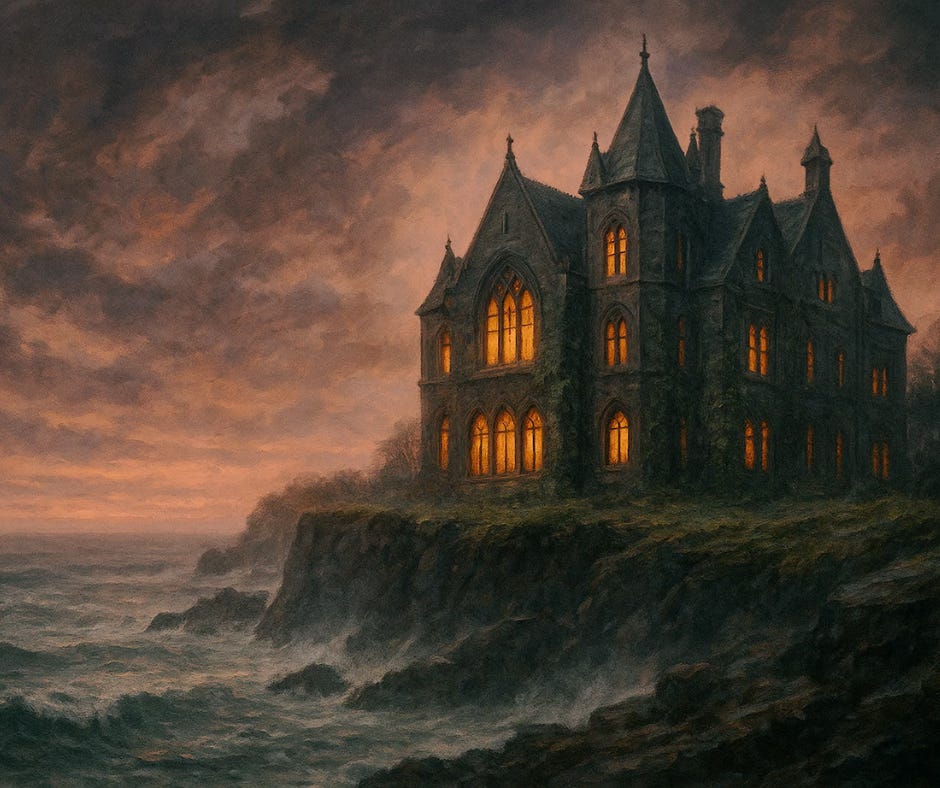
The Ghost of Greycliff
A Gothic Romance
Nora Prescott hadn’t expected to be chosen.
The Greycliff Historical Trust selected one lucky librarian to assist in restoring the private collection of Greycliff Manor—a sprawling seaside estate built in the 1800s by Cornelius Ashford, art collector and rumored eccentric.
Nora had applied on a whim, filling out the online form late one night after her boyfriend Connor broke up with her. He said he needed a break, yet a week later, he was tagged in photos with his CrossFit instructor. After that night nearly six months ago, she vowed to stop believing in love, romance, and marriage. It just wasn’t meant to be. For her, anyway.
She would stick with what she knew best. History, research, and lately, the lost masterpiece of Harrison Ashford, a gilded age painter who’d died at twenty-five, leaving behind a haunting collection of seascapes and one unfinished work that had never been found.
When the acceptance letter arrived, embossed with the Trust’s seal and signed in elegant script, she almost didn’t believe it. Three days on the Rhode Island coast, working in a forgotten library with views of the Atlantic—how could she say no?
“You know that place is haunted, right?” Maya, her best friend and co-worker had said the night before Nora left. “They say the ghost of Harrison Ashford still roams the halls, looking for his lost painting.”
Nora had rolled her eyes, tossing another sweater into her suitcase. “Then maybe I can help him look for it.”
“Imagine if you did meet him? It would be like falling into a Gothic romance,” Maya said.
Now, standing at the end of the long, gravel drive, Nora tipped her chin toward the mansion that rose before her. Turrets caught the October sunlight like sentinels. Ivy curled over stone arches and beyond it all, the sea murmured against the cliffs below. The air smelled faintly of salt. Gothic romance, indeed.
The tour had been fascinating. Built in 1887 by the industrialist Cornelius Ashford, Greycliff had been home to three generations of New England aristocracy. The docent, an elderly woman named Mrs. Chen, had lingered particularly long in the third-floor studio.
“This was where Harrison Ashford worked,” she’d said, gesturing to the north-facing windows that flooded the room with cool light, making the space seem almost peaceful. Too peaceful, perhaps, for a place so full of loss. “He was the family’s youngest son—a painter and a poet of some renown. Tragic, really, that he died so young.”
Nora had studied the reproduction paintings on the walls—seascapes mostly, moody and romantic. She’d seen them before in catalogs and digital archives, had practically memorized every brushstroke. But seeing them here, in the space where Harrison had actually worked, made her chest tight. A small placard noted that Harrison Ashford (1869-1894) had died at twenty-five, cause of death unrecorded, most of his work lost to time.
“Such a waste,” Mrs. Chen had sighed. “They say he was working on his masterpiece when he died. A storm scene, from what the family records suggest. But no one ever found it. It’s become something of a legend among art historians.”
Nora had nodded, not trusting herself to speak. She’d read every article, every mention of that lost painting. It had consumed her research for months, this mystery of a work that should have been Harrison Ashford’s crowning achievement but had simply vanished.
Now, hours later, Nora sat in the second-floor bedroom that had been prepared for her stay. The museum had provided period-appropriate linens (she’d checked—authentic reproduction, not actual antiques, thank goodness) and a basket of modern amenities that felt jarringly out of place on the Victorian washstand.
She’d changed into her pajamas—practical flannel, because it was late October and the mansion was drafty—and was scrolling through her phone when she heard it.
Footsteps in the hallway.
Nora froze. Mrs. Chen had been very clear that she was alone in the mansion. Security would check in at midnight and again at six a.m., but otherwise, she had the place to herself.
She removed her glasses to place them on the nightstand when footsteps paused outside her door. Quickly, she put them back on.
“Hello?” Nora called, her librarian voice firm despite her racing heart. “The museum is closed. You need to leave.”
The door swung open, rather slowly, revealing a man in the doorway.
Nora glanced around for something, anything to throw at the man and make her escape. She tried to swallow, but her mouth had gone bone dry from fright. Neither one of them moved and as Nora kept her eyes on him, she couldn’t help but notice the man looked just as scared as she was.
Was he a docent? Because if he was, he was the most attractive one she’d ever seen. Tall and lean, with dark hair that fell across his forehead and eyes the color of a winter sea. Although, he wore strange clothes—a white shirt with no collar, dark trousers, and a silk waistcoat. But the thing that make it look genuinely Victorian was he wore a… cravat?
“You… can see me?” he asked, his deep voice carrying a note of surprise.
“Of course I can see you.” Nora lifted a questioning eyebrow. “Are you insinuating that you’re a ghost?” She scoffed as Maya’s words came flooding back. You know that place is haunted right?
She still didn’t believe that.
“Indeed, I am madam, and you shouldn’t be here. This bedchamber… it belongs to me.”
“Pretty sure the Greycliff Historical Trust disagrees,” Nora muttered.
He relaxed a little, smiled faintly, and now sounded wistful rather than threatening. “Bold words for a trespasser.”
“Bold words for a dead guy.”
That startled a laugh out of him—a sound rich and unexpected, like sunlight breaking through fog. “I see the centuries haven’t improved manners.”
“I see they haven’t improved your outfit,” she shot back, before she could stop herself. She just wanted to sleep, not be annoyed by her unannounced guest.
He tilted his head, amusement flickering in eyes that glowed faintly silver in the dark. “Don’t be frightened. I’ll not harm you.”
“Much appreciated,” she murmured. Her heart pounded and her hands shook. “The tour ended hours ago,” Nora said, clutching her phone like a lifeline. “Maybe I should call security.”
“Security?” His brow creased. “Madam, as I’ve said—this is my home. I rather think I should be asking why you’re here.”
“Look, I’ve played along, but you’re really starting to freak me out.” Nora rose from the bed, pulse thrumming and phone in hand. “This is a museum. It’s been a museum since 1952.”
She moved toward the door, intending to brush past him and run downstairs—only to collide with a wave of cold. It washed through her, sharp and sudden, like diving headfirst into the autumn surf. She gasped, stumbling back as the air itself seemed to hum. Her skin prickled, while her heart slammed against her ribs.
He looked as startled as she did. “Forgive me,” he said softly, anguish flickering across his face. “I didn’t mean to—”
“What the hell—” She pressed a trembling hand to her chest. “You—You walked through me.”
His eyes, impossibly blue and sorrowful, met hers. “It seems I’m out of practice at giving people space.”
The absurdity of it cracked through her panic. “Out of practice? Were you ever good at it?”
“Clearly not. And honestly, it’s not like I haven’t had one hundred and thirty-five years to reflect on that. My deepest apologies, Madam.”
“You’re...” She swallowed, trying to make sense of what her senses refused to deny. “No… it’s not possible.”
He stepped forward, this time with care, and a faint shimmer of light followed his movement. He paused before her, gaze steady and reverent, as if he were seeing sunlight for the first time in a century. Then he bowed, graceful and formal, every inch the gentleman he must have been in life.
“Harrison Ashford,” he said quietly. “At your service. And you are...?”
“Hallucinating,” Nora said firmly. “Too much excitement. Not enough dinner. Low blood sugar.”
“You’re not hallucinating.” He moved toward her, and she instinctively stepped back. He stopped, holding up his hands. “I mean you no harm, I promise. I’m simply... surprised. You’re the first person who’s stayed overnight in decades who could actually see me.”
“See you.” Nora’s mind was racing. “Because you’re a ghost.”
“Yes.”
“You’re Harrison Ashford.” The words came out as barely a whisper. “I’ve been researching you. Your paintings. Your lost masterpiece. I’ve spent three months trying to find any trace of what happened to it.”
Harrison’s expression shifted from shock, then to something that looked almost like wonder. “You were looking for my painting?”
“Yes. I work in special collections at the university. Art history is part of my research and I…” She stopped, realizing how absurd this was. “And I’m explaining my job to a ghost.”
“Someone remembers,” Harrison said softly, and there was such naked emotion in his voice that Nora’s throat tightened. “After all this time, someone still cares about my work.”
Nora sat down on the bed with a thump. Her hands still shook. “This isn’t happening.”
“I did just walk through you, and this chair, although you weren’t looking when I did that.” He sounded amused. “I suppose I could move an object, though I’ll warn you, that takes considerable concentration.”
Nora slowly shook her head. “No, just... give me a moment.”
She pressed her palms to her eyes. This was fine. She was fine. She was a rational person with a master’s degree in library science and a minor in history. Ghosts were not real. There was no empirical evidence. No peer-reviewed studies. No—
“I can hear you thinking,” Harrison said gently. “Quite loudly, in fact.”
Nora looked up at him. He’d settled into the chair by the window—the one she assumed he’d walked through moments ago—and was regarding her with what looked like genuine concern.
“If you’re a ghost,” she said quietly, “why are you still here?”
“Ah.” His expression grew distant. “The eternal question. Unfinished business, I suppose. I was working on a painting when I died. My masterpiece, or so I thought. I never completed it.”
“And you can’t... move on? Without finishing it?”
“As you know, I’ve rather lost track of my unfinished painting.” He smiled wryly. “A hundred and thirty years is a long time to search a house, even when one can walk through walls. But yes, I believe that’s what keeps me here. That, and...” He paused. “Other regrets.”
Nora found herself leaning forward despite her better judgment. “What kind of regrets?”
“The usual kind.” Harrison’s gaze drifted to the window, to the moonlight on the water beyond. He reached into his waistcoat pocket and pulled out something small—a piece of sea glass, worn smooth by the ocean, a deep blue-green that caught the light. He turned it over in his fingers absently. “I found this the day before my first gallery showing. I was terrified, convinced I’d fail. But I found this on the beach that morning, and somehow it steadied me.” He smiled sadly. “Silly superstition, but I kept it with me always. Even now.”
“It’s beautiful,” Nora said softly.
“I was so focused on my art, on making my mark, that I forgot to live.” He tucked the sea glass back into his pocket. “I was engaged once, did you know that? To a wonderful woman named Catherine. But I kept putting off the wedding. ‘After I finish this painting,’ I’d say. ‘After I complete this series.’ After, after, after.” His voice grew soft. “She married someone else eventually. I can’t say I blame her.”
She hated to admit it, but the idea of him being a ghost had vanished, and his words caused something inside her to shift. Ghost or not, emotion overcame her at his words. “I’m very sorry.”
“Ancient history now. Quite literally.” He turned back to her, and his smile was startling in its warmth. “But what about you, Miss...?”
“Prescott. Eleanor, but my friends call me, Nora.”
“It is a pleasure to meet you, Miss Prescott. Why are you spending this night alone in a haunted mansion?”
“I’m not just spending the night. I’ll be here for two nights and three days,” Nora said. “And to be fair, they didn’t advertise that it was haunted.”
He smiled. “Three days? Won’t Mr. Prescott miss you being away from home for that long?”
The question was gentle, but Nora looked away.
“I am not in a relationship at the moment,” she found herself saying. “I was six months ago. Thought it was serious. He didn’t. And I just,” she sighed,
”I’m tired of it. Of hoping and being disappointed. It’s easier to just focus on work.”
“Books don’t break your heart,” Harrison said quietly.
“Exactly.”
They sat in silence for a moment. Outside, the wind rattled the windows, and somewhere in the house, a clock chimed eleven.
“So, what do we do now?” Nora asked finally. “Do I pretend you’re not here? Do you float through walls, and moan dramatically?”
Harrison laughed—an actual laugh, warm and surprised. “I don’t moan, thank you very much. I’m a ghost, not a cliché.” He stood, moving to the window. “We could talk, I suppose. It’s been rather a long time since I’ve had anyone to talk to.”
“How long?”
“The last overnight guest who could see me was in 1987. A teenager who got left behind on a school trip. She saw me, screamed and ran outside until they came back for her.” He glanced back at her. “You’re taking this remarkably well.”
“Honestly, I was frightened at first, but it was your words about forgetting to live and losing your Catherine that moved me to the point of overlooking the ghost part and see you as just a man. It doesn’t hurt that I’m a historian, I suppose,” Nora said. “I’m trained to adapt to new information.”
“Even when that information includes the existence of the supernatural?”
“Even then.”
And so, they talked.
Harrison was nothing like she’d expected a Victorian ghost to be. Yes, he was formal and occasionally used words like “whilst” and referred to her as “Miss Prescott” despite her protests. But he was also funny, self-deprecating, and surprisingly well-informed about the modern world.
“I do pay attention,” he explained when she expressed surprise that he knew what the internet was. “People come through on tours. They have those remarkable glowing devices.”
“Phones.”
“Phones, yes. And they talk about all sorts of things. I’ve picked up quite a bit over the years.” He paused. “Though I confess, I still don’t understand what ‘going viral’ means, and at this point I’m afraid to ask.”
Nora laughed—really laughed—for the first time in months.
As midnight approached, she found herself telling him things she hadn’t told anyone. About her work in the university’s special collections, about her love of old letters and manuscripts, about how sometimes she felt more comfortable with the past than the present.
“You’re not alone in that,” Harrison said softly. “Though in my case, I quite literally live in the past.”
“Do you mind it? Being stuck here?”
“I did at first. I raged against it. But after a while...” He shrugged. “One adapts. Though I’ll confess, it’s been lonely. Watching the world change around you, unable to be part of it.”
“Don’t you have any ghost friends?” Nora asked, then immediately felt silly. “Sorry, that’s probably not how it works.”
“I’ve never met another ghost, if that’s what you’re asking. Perhaps I’m the only one foolish enough to get stuck.” He smiled, but there was sadness in it. “Or perhaps the others were smart enough to let go.”
Nora wanted to say something comforting, but what could you say to a ghost? That everything would be okay? That he’d move on some day?
Instead, she said, “Tell me about your painting. The one you never finished.”
Harrison’s whole face changed. For the next hour, he described it—a seascape, but not like his others. This one had captured a storm rolling in over the bay, with a small boat fighting against the waves. “It was about struggle,” he explained. “About fighting against impossible odds. About refusing to give up even when all seems lost.”
“It sounds beautiful,” Nora said.
“It would have been.” He looked at her, and something in his expression made her breath catch. “If I’d had the courage to finish it.”
“Why do you think you didn’t?”
“I was afraid,” Harrison admitted. “Afraid it wouldn’t be good enough. That I wouldn’t be good enough. So, I kept tinkering, kept changing things, never quite finishing. And then I died, and...” He gestured helplessly. “Here I am.”
Nora understood that feeling more than she wanted to admit. How many times had she held herself back, afraid to try, afraid to fail? How many opportunities had she let slip by because it was safer to stay where she was?
The clock struck two, and Nora yawned despite herself.
“You should sleep,” Harrison said gently. “I’ve kept you up far too late with my rambling.”
“I don’t mind,” Nora said, and realized she meant it. “Will you... will you be here in the morning?”
“I’m always here.” He smiled. “Though I don’t usually reveal myself. But yes, if you’d like, I’ll be here when you wake.”
Nora settled back into the bed, pulling the covers up. Harrison moved to the chair by the window, sitting like a gentleman keeping vigil.
“Harrison?” Nora said drowsily.
“Yes?”
“Thank you. For tonight. For talking to me.”
“Thank you, Miss Prescott,” he said softly. “For seeing me.”
When Nora woke, pale autumn sunlight streamed in through the windows, and Harrison was still there by the window, watching the morning light on the water. She went through her morning ablutions, half-convinced she’d dreamed the entire encounter. But when she emerged from the bathroom, he was waiting with that gentle smile.
Mrs. Chen arrived promptly at nine with a breakfast tray—fresh fruit, warm muffins that smelled of cinnamon, and blessedly strong coffee.
“The archives are set up in the library,” Mrs. Chen said, setting the tray on the small table. “Take all the time you need. I’ll return at eleven for the first tour, but feel free to investigate the mansion all afternoon if you’d like.”
After she left, Nora turned to find Harrison watching her with barely contained anticipation.
“You mentioned that you came here to research my unfinished painting,” he said.
“Yes.” Nora poured herself coffee with slightly shaking hands. “I’ve been trying to trace what happened to it. There are mentions of it in a few contemporary sources—other artists who’d seen your studio, a critic who wrote about your ‘ambitious work in progress.’ But after you died, it just... vanished.”
“I hid it,” Harrison said quietly. “The night I died—or thought I was dying. I knew it wasn’t finished, wasn’t perfect. I couldn’t bear the thought of anyone seeing it incomplete, judging it, judging me.” He pressed his palm against the window. “I hid it somewhere in this house. And then I died, and when I woke as... this... I couldn’t remember where.”
Nora’s heart ached for him. “You’ve been looking for it all this time?”
“On and off. I tore through every room I could, though I can’t actually move much.” He gave a rueful smile. “Being a ghost is rather limiting in that regard. Eventually I gave up. Assumed it had been found and destroyed or lost in some renovation.” He looked at her. “But you—you have access to the family papers. Perhaps there’s something there. Some record of what happened to it.”
“Then let’s find it,” Nora said.
They spent the morning in the library, Nora carefully going through boxes of documents while Harrison hovered nearby, commenting on handwriting, correcting dates, explaining contexts she couldn’t have known. It was the strangest research session she’d ever conducted—and somehow the most wonderful.
“That’s my mother’s hand,” he said, watching her read a letter. “She always made her capital G’s with that extra flourish.”
“She’s writing to your aunt about clearing out your studio after...” Nora trailed off delicately.
“After I died. Yes, go on.”
Nora read aloud. “’I cannot bear to enter Harrison’s studio. His father has agreed to leave it untouched for now. Perhaps in time, when the grief is less fresh, we might see about cataloging his works. The unfinished piece troubles me most—he was so secretive about it in those final weeks.’”
Harrison made a soft sound. “I wouldn’t let anyone see it. Kept the studio door locked.”
Nora continued through the boxes, through inventories and household accounts and letters. Finally, in a ledger dated 1895, she found it.
“Harrison.” Her voice was barely a whisper. “Listen to this. ‘Moved to attic storage: 1 canvas, large format, unframed. From H.A.’s studio. Per Mrs. A’s instruction, wrapped and sealed. Not to be disturbed.’”
Harrison went very still. “The attic.”
“Can you... do you remember what’s in the attic now?”
“I haven’t been up there in decades. It’s been closed off, used for museum storage.” He was already moving toward the door. “Come on.”
The attic was reached by a narrow servants’ staircase that Mrs. Chen had pointed out but said was off-limits during regular tours. Nora climbed carefully, Harrison floating effortlessly beside her, his translucent form growing more agitated with each step.
The attic was long and low-ceilinged, filled with the accumulated detritus of a century. Old furniture shrouded in dustcovers, steamer trunks, rolled carpets, boxes of archived records. Weak light filtered through small dormer windows.
“Where would they have put it?” Nora asked, slightly overwhelmed.
Harrison moved through the space, his form flickering as he passed through boxes and furniture. “There,” he said finally, pointing to the far corner. “Behind those trunks. Yes,” he became excited, “there is a panel. I remember! A small alcove. Let’s try it.”
It took Nora twenty minutes to carefully move the trunks—heavy, awkward things that scraped across the floor. Harrison paced anxiously, unable to help, offering directions and apologies in equal measure.
Finally, she could see where the wall was uneven. She pushed on it once. Then twice with more force and it opened. She used her cell phone flashlight to peer inside, her heart in her throat. “Yes! I see something.”
A large rectangular shape wrapped in canvas that had gone brown with age, tied with twine that crumbled at her touch. Written across the paper were the words, ‘Damaged. No value.’
“Do you think?” she asked, looking at Harrison. “Could this be it?”
His face was a mixture of hope and terror. “Yes. Please, Nora, bring it out here.”
Nora’s hands shook as she carefully unwrapped the canvas. The fabric fell away, and there it was.
A seascape. A storm rolling in across dark water, clouds roiling in shades of grey and purple and deep blue. In the foreground, barely sketched in, a small boat fought against impossible waves. The painting was perhaps three-quarters finished—the sky was complete, masterfully done, but the boat was only suggested, the water in the foreground still rough and unresolved.
“Oh, Harrison,” Nora breathed. “It’s beautiful.”
Harrison had gone completely still, staring at his lost work. When he finally spoke, his voice grew thick with emotion. “I was so afraid it wouldn’t be good enough. That I wasn’t good enough.” He moved closer, studying it as though seeing it for the first time. “I kept telling myself I’d finish it tomorrow. After I’d studied the waves more. After I’d gotten the light just right. After, after, after.”
“It’s extraordinary even unfinished,” Nora said. “Harrison, this is museum quality. This could be your masterpiece, exactly as it is.”
“Unfinished,” he said softly.
“Honest.” Nora corrected. “It’s honest, Harrison. You can see your process, your struggle, your vision. That boat fighting against the storm—that’s you. That’s everyone who’s ever tried to create something despite fear, despite doubt.” She looked at him. “This painting has been hidden for a hundred and thirty years. Let me bring it into the light. Let me show the world what you created.”
Harrison was silent for a long moment, his eyes never leaving the canvas. Finally, he looked at her, and tears glimmered on his translucent cheeks.
“I think,” he said slowly, “that’s what I’ve been waiting for. Not to finish it. But for someone to find it and see value in what I’d begun. For someone to care.”
Nora carefully rewrapped the painting, her mind already racing. “I need to document this. Write up the provenance, the discovery, the context.” She looked at Harrison. “Will you help me? Tell me what you were thinking when you painted it?”
They spent the next hour in the library, Nora writing furiously while Harrison spoke. He told her about the day he’d started the painting—how he’d watched a fishing boat struggle against a sudden squall, how the captain had refused to give up, had fought his way back to shore. How it had struck him as the perfect metaphor for the artist’s struggle, for life itself.
“I wanted to capture that moment of decision,” Harrison said, pacing as he spoke. “When you’re in the middle of the storm and you have to choose… either give up or keep fighting. The boat’s not winning, but it’s not surrendering either. It’s just... persisting.”
Nora wrote it all down, her historian’s training taking over. She documented the discovery location, the 1895 ledger entry, every detail that would help authenticate and contextualize the work. And then she wrote something more—a personal note, an interpretation.
“This unfinished work may be Harrison Ashford’s most honest and profound statement. Rather than a failure to complete, the painting’s unresolved state speaks to the ongoing nature of struggle itself. We are all, like the small boat in his canvas, fighting against forces larger than ourselves. What matters is not that we triumph, but that we persist. That we refuse to surrender to the storm.
Ashford did not finish this painting, but perhaps that was never the point. The painting is not about arrival—it is about the journey. About courage in the face of uncertainty. About continuing even when the outcome is unknown.
This work deserves to be seen not despite its incomplete state, but because of it. It is a testament to the artistic process, to vulnerability, and to the very human act of trying.”
She read it aloud to Harrison when she finished. He was silent for a long moment.
“You understand,” he said finally, his voice breaking. “After all this time, someone finally understands what I was trying to say.”
“Will they listen to me?” Nora asked. “I’m not family, not officially connected to the museum. This is just—”
“Leave it with the painting,” Harrison said. “Dated, signed. Mrs. Chen will find it when she comes to check on you. And your note, combined with the painting itself...” He smiled. “Hopefully, the art world won’t ignore it.”
Nora carefully tucked her documentation—the ledger photocopy, her handwritten notes, her interpretation—into a folder and placed it on top of the wrapped canvas. She turned to him and something changed in the air between them.
Harrison reached out, and his hand moved toward her face.
She closed her eyes and expected his fingers to pass through her, insubstantial as mist.
But they didn’t.
His palm cupped her cheek, solid and warm and real. Nora gasped, and Harrison’s eyes went wide with wonder and shock.
“I can feel you,” he whispered. “Nora, I can actually—”
The moment his skin touched hers, the air in the attic charged with an energy that made Nora’s hair stand on end. Harrison’s form flickered, and for just an instant, he seemed to glow with an inner light.
“No,” he said suddenly, his voice tight with panic. He pulled his hand back, but the damage was done. His form was already beginning to fade, becoming more translucent. “No, not yet. Please, not yet.”
“Harrison?” Nora reached for him, but her hand passed through his arm now. The solidness was gone.
“The painting,” he said, his voice strained as though he were fighting against something pulling at him. “Finding it, your understanding, and now... touching you. It completed something. I can feel it… the pull. It wants to take me.”
“Then go,” Nora said through sudden tears. “You’re free, Harrison. You should go.”
“I don’t want to.” His form solidified slightly, as though sheer will could hold him in place. “I’m not ready. Not after finally...” He looked at her with such longing it made her chest ache. “One more night. I just want one more night.”
Nora nodded, unable to speak past the lump in her throat.
Harrison closed his eyes, and she could see the effort it took for him to remain visible. His jaw clenched, his hands fisted at his sides, and his entire form shimmered with the strain of staying tethered to the world.
“One more night,” he said again, as if convincing himself. “I will try my hardest to hold on for one more night.”
They spent the rest of that day and into the evening exploring more of the mansion, but Harrison’s condition deteriorated. He flickered in and out of visibility, sometimes fading so much that Nora could barely see him. His voice grew fainter, and she had to strain to hear him.
Mrs. Chen brought her takeout from a local eatery. She listened intently to everything Nora said about the painting, but Nora found it hard to concentrate. She kept glancing at Harrison, who stood by the window, his form wavering like a candle flame in the wind.
That night, before dawn on the last morning of her stay, Nora settled back into the bed, the quilt tucked up to her chin. Harrison lingered near the window, the moonlight shining through him more than illuminating him. He looked exhausted—could ghosts be exhausted?—and she could see the toll that staying was taking on him.
“Harrison?” she whispered.
“Yes?” His voice was barely audible, like wind through leaves.
“When you touched me earlier in the attic, you were warmer than the first time we met. When you walked through me. I’m so glad I could feel your touch this time. Did you feel that way, too?”
His expression faltered. “More than anything.” He paused, then added quietly, “Especially now that I know what I’m missing.”
He reached into his waistcoat pocket—the movement slow and labored—and pulled out the small piece of sea glass. It took him three tries; twice his fingers passed through it before he could grasp it. He turned it over in his hand, and Nora noticed his fingers were trembling.
He looked at the sea glass, then at Nora. “I want you to have it.”
“You can barely hold it,” Nora said, her voice unsteady. “How could you give it to me?”
“I know.” He smiled sadly. “But perhaps... tomorrow. Before I...” He couldn’t finish the sentence.
Harrison moved closer to the bed, and for a heartbeat, his hand hovered near hers, just above the blanket. The air shimmered faintly. He was trying so hard to touch her again, to recreate their moment in the attic, but he couldn’t hold onto his form. His hand flickered, and she saw the anguish in his face.
“It’s alright, Harrison,” Nora whispered, tears spilling freely now. “It’s hurting you to keep trying. I’ll always remember the warmth of your touch.”
“For one perfect moment, I felt you,” he said, his voice breaking. “That’s more than I could have ever hoped for.”
He withdrew his hand, retreating to the window as the first light of morning began to pale the sky. A lone seagull wheeled over the bay, its cry cutting through the salty air.
“Sleep now,” he said gently, though she could hear the exhaustion in every word. “Before the day steals what’s left of the night.”
But Nora wasn’t sure he’d still be there when she woke.
When she opened her eyes, pale sunlight streamed through the windows. For a heartbeat, she thought she was alone—then she saw him.
Harrison stood by the window, barely visible now—more suggestion than substance, a watercolor painting left too long in the rain. He flickered rapidly, like a light about to burn out, and even from across the room she could see the strain on his face.
“Harrison.” She sat up quickly. “How long have you been like this?”
“Since… just after you fell asleep.” His voice was so faint she had to hold her breath to hear it. “I almost left then. Almost couldn’t… hold on.”
Nora scrambled out of bed but stopped a few feet away. She was afraid that getting too close might somehow make it worse, might pull him away faster.
“Why didn’t you wake me?” she asked.
“I wanted to see you one more time. In the morning light.” He managed a weak smile. “You’re beautiful when you sleep. Did you know that?”
She could see it now—the way his form spasmed and sputtered, the way he seemed to fight invisible chains. “Staying is hurting you.”
“I don’t care.” But even as he said it, his form wavered—then disappeared entirely.
The air rippled.
“Harrison!” she gasped, reaching into empty air.
And then he was back, fainter, trembling, his edges fading like mist.
“I’m sorry, Nora,” he whispered.
Nora’s heart broke. He’d been waiting 130 years for someone to see him, and up until that moment, she hadn’t realized how much she’d needed to be seen, too. Yet Harrison had.
She hated that he fought his own peace, his own rest—because of her. She couldn’t let him suffer for her sake.
“Harrison,” she said softly. “Look at me.”
He did, those winter-blue eyes finding hers even as his form flickered like candlelight.
“I know you’re trying so hard to hold on, but you don’t have to stay anymore,” she said, her voice steady despite the tears streaming down her face. “You don’t have to worry about me. I promise, I’ll be fine.”
“I don’t want to leave you, Nora,” he said, his voice cracking.
“You’re not leaving me,” she said. “After 130 years of waiting, you’ve earned your rest, Harrison.”
He was silent for a long moment. She saw the war play out across his face—the desire to stay versus the relief of finally letting go.
“Do you think… will you remember me?” he asked at last.
She pressed her hand to her heart. “How could I forget you? You reminded me what it means to truly see someone—and to be seen. You taught me how to love again. For that, I’ll always be grateful.”
Harrison’s form steadied, as though her words had given him permission to stop fighting.
He reached into his waistcoat pocket one last time and pulled out the sea glass. It glowed faintly in his translucent hand, the blue-green catching what little light he had left.
“My talisman,” he said softly, turning it over. “For bravery. For taking chances.” He looked at her, and his smile was bittersweet. “I think I’ll need it for whatever comes next.”
For a moment, she thought he might leave it behind so she could remember him—but he needed it more than she did.
“It belongs to you, Harrison,” Nora said through the tightness in her throat.
“It’s been with me since the beginning,” he said. “Seems only right it should be with me at the end.”
Nora released the sob she’d been holding back.
“Goodbye, Harrison,” she said, her voice breaking. “Find your peace, my love.”
Harrison looked at her one last time, and his smile was radiant despite his fading form.
“Sail into the storm, my brave Nora,” he whispered.
And then, like morning mist burned away by the sun, he was gone. The sea glass went with him, dissolving into particles of light that sparkled once before disappearing completely.
The room suddenly felt different. Lighter. Warmer. The dust motes danced in the sunbeams like they were celebrating.
Nora stood there for a long time, her hand pressed to her heart where she’d felt his presence. Crying and smiling at once. Her heart ached with loss, but beneath it was something else—gratitude. Joy, even.
She was lucky enough to get to know him. For two perfect days and nights.
And in knowing him, she’d found herself again.
She gathered her things slowly, reluctant to leave the room where she’d spent those extraordinary days. As she carried her bag down the grand staircase, Mrs. Chen met her in the foyer.
“We can’t thank you enough, dear. When the people from the trust come next week, I can’t wait to show them Harrison’s missing painting,” the elderly woman said.
Nora thought of the painting in the attic, waiting to be authenticated and displayed. She thought of Harrison’s words, his laughter, the impossible moment when his hand had touched her cheek.
“I’m just thrilled it will finally see the light of day and be hung where it deserves to be seen,” she said, smiling through her tears. “I have a feeling that Harrison Ashford himself would be happy and proud to know it’s been found.”
Three weeks later, Nora found herself driving back to Newport on a grey November afternoon. She told herself it was just to visit the other mansions, to make a proper tourist weekend of it.
She lied.
Greycliff wasn’t open on Mondays, but she parked in front anyway, staring up at the grey stone walls. She wondered if Harrison was pacing in his studio or sitting by the window watching the sea.
She’d thought about him constantly. About his kindness, his humor, his loneliness. About the way he’d looked at her like she was someone worth seeing.
And the more she thought about it, the more she realized how ridiculous all of it had been.
But she’d needed to come back. To see the place again. To remember how special he’d made her feel.
With a sigh, Nora started the car. There was a small bookshop in town she’d noticed on her last visit. Maybe she’d stop there before the long drive home.
The shop was quaint, the kind of place where books were stacked in precarious towers and the smell of old paper hung in the air. Nora browsed the local history section when her cell buzzed. As she retrieved it from her back pocket, it clattered to the floor.
She crouched down to get it and a hand reached down at the same moment. Their fingers touched and suddenly, something small rolled between them across the wooden floor.
A piece of sea glass, deep blue-green.
Nora’s breath caught.
She looked up at the man who’d bent to help her, her heart thundering. He was nothing like Harrison—sandy blond hair where Harrison’s had been dark. He had light blue eyes instead of the dark winter sea color of Harrison’s, and a smattering of freckles across his nose. Maybe a little older than Harrison, he wore a canvas jacket and a smile that crinkled the corners of his eyes.
But there was something in that smile. A familiar kindness that made her chest ache.
“Where did that come from?” he asked, picking up the sea glass and holding it out to her with a puzzled expression.
Nora took it with shaking hands. It was warm—impossibly warm—and in that moment she knew.
Harrison had moved on and this was his gift. His blessing. His way of saying: Try again. Don’t be afraid.
“Are you alright?” the man asked, concerned. “You look like you’ve seen a—”
“If you say ‘ghost,’ I will absolutely lose it,” Nora said, laughing and crying at the same time.
He raised his hands in mock surrender, grinning. “Duly noted.” He pretended to pull out a notebook, pantomiming writing with his finger. “Clichés make pretty girl at the bookstore cry.”
Nora wiped the tears from her cheeks, still smiling. “Not all of them. Just the ghostly ones that hit close to home.”
He drew his eyebrows together, looking very concerned now. “Seriously, let me get you a bottle of water or something.”
She shook her head, clutching the sea glass like a lifeline. “No, I’m—I’m okay. Better than okay.” She looked at him, really looked at him, and something stirred inside her. The heaviness that had been there for the past three weeks was gone. Her heart felt lighter. “I’m Nora.”
“Dash,” he said, still looking worried but offering his hand. “Nice to meet you, Nora.”
She slipped the sea glass into her pocket and felt its warmth settle against her hip. “This might sound strange, but... would you like to get a coffee with me?”
Dash’s smile widened and a wave of warmth rolled through her. “I’d like that very much,” he said.
As they walked toward the exit together, Dash reached the door first and held it open for her. A slight breeze ruffled her hair, gentle as a sigh.
Somewhere on the cliffs overlooking the sea, Greycliff stood a little lighter in the afternoon sun.
A little less haunted. And a lot more at peace.
The End
Copyright © 2025 Sera Cassell. All rights reserved.
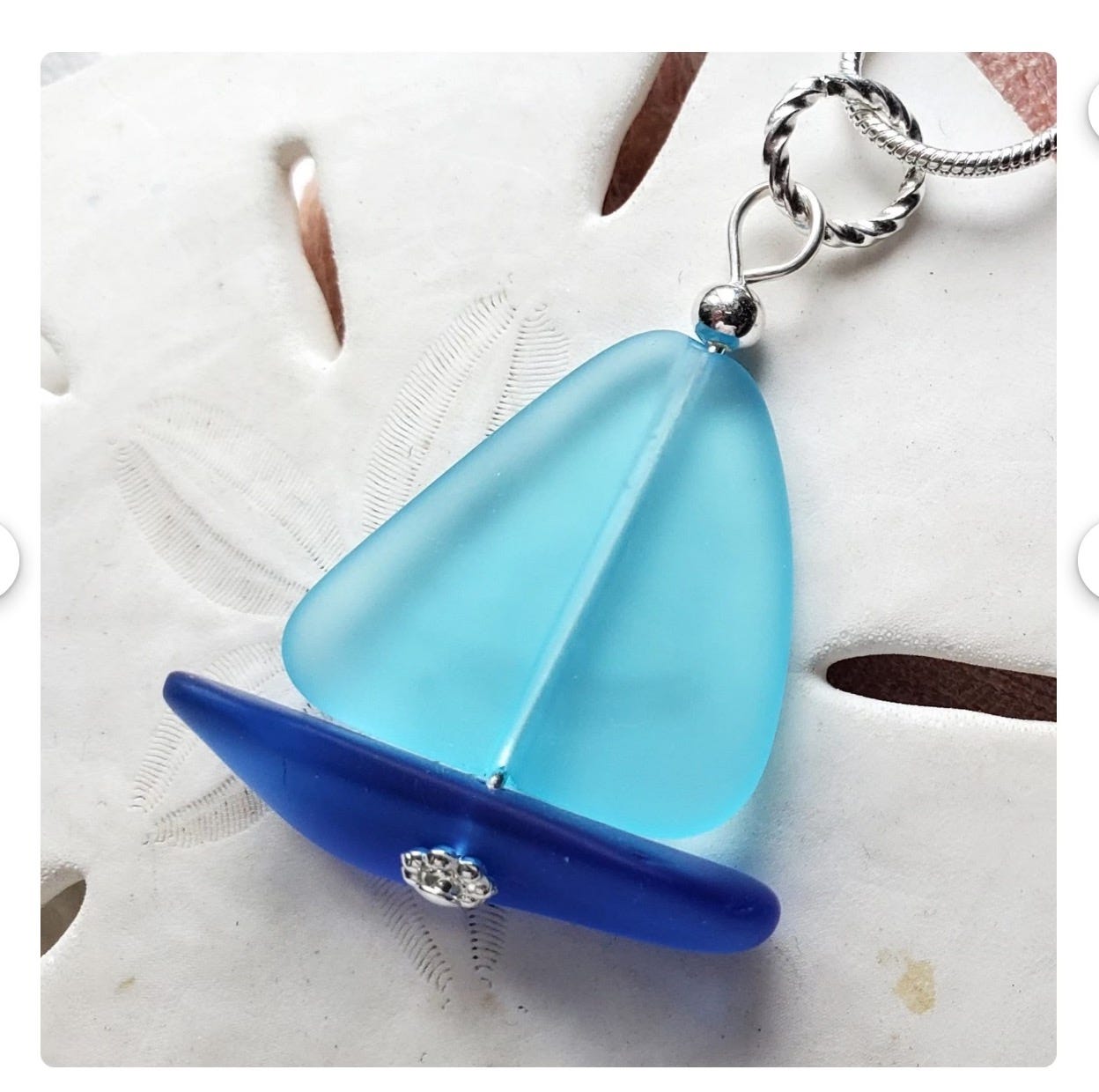
I’m giving away a sea-glass boat necklace — a tiny echo of the magic that inspired Nora and Harrison’s tale.
Click below to enter the giveaway (it’s easy — just your name and email):
👉 Enter to Win the Sea-Glass Necklace
Until next time,


No posts
Comments
Nothing yet. Say the first thing.
Sign in to join the conversation.