
So I’ve been talking a lot about tax-aware investing, using leverage deductions to offset capital gains, and in general how the wealthy accrue wealth using the tax code that most people either don’t have access to (you have to have wealth to actually borrow against first) or simply don’t know about or haven’t actually taken the time to implement this in spite of how ridiculous the value proposition is here.
I was doing a presentation the other day about how Elon Musk borrowed $44 billion against his Tesla shares to purchase Twitter which allowed him to keep his Tesla shares (and the future appreciation) while also receiving a government subsidized tax deduction for doing so and it was a massive hit that people were shocked by.
So while I’ve talked about this in the past in a more analytical way, I thought I might as well share it here too because it’s a great story that has a practical real life application you can tie to. And if I’ve learned anything in my transition from mathematical-behind-the-scenes actuary to business/sales professional wannabe, is that the math is completely forgettable. But the story is what sticks with people long after they forget about the numbers. So if I truly want people to walk away understanding the gravity of the math, I have to embed it within an even greater story. And “the guy who bought Twitter with a loan he’ll probably never pay back — and got a tax break for it” is one heck of a story.
The Problem: Wealth That Only Helps You After You’re Gone
If you’ve read this substack before, you know the basic move: invest for the long term, and your kids can inherit your assets tax-free thanks to a rule called step-up in basis.
Great for your kids. Not as much benefit for you.
If all that tax-free wealth only kicks in when you die, how do you get to enjoy any of it while you’re still around?
The answer: borrow against it.
Borrowing tax-free against your own wealth, and you get three things at once — tax-free cash, a tax deduction, and you still own the underlying asset, appreciation and all. Compare that to selling which means paying the taxes now and giving up the future upside.
Let’s make this concrete with Elon’s Twitter purchase.
Elon’s $44 Billion Decision
In October 2022, Elon Musk needed $44 billion to buy Twitter.
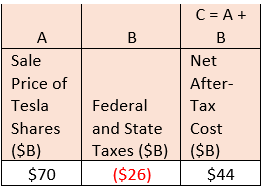
He could have sold Tesla stock to raise the cash. But selling $70 billion of Tesla shares would have triggered roughly $26 billion in taxes — leaving him with $44 billion after tax.
Instead, he borrowed the $44 billion against his Tesla shares.
That single decision meant he was able to do all of the following:
1) Keep his Tesla stock;
2) skip the $26 billion tax bill and;
3) most importantly, still have the cash he needed to purchase Twitter.
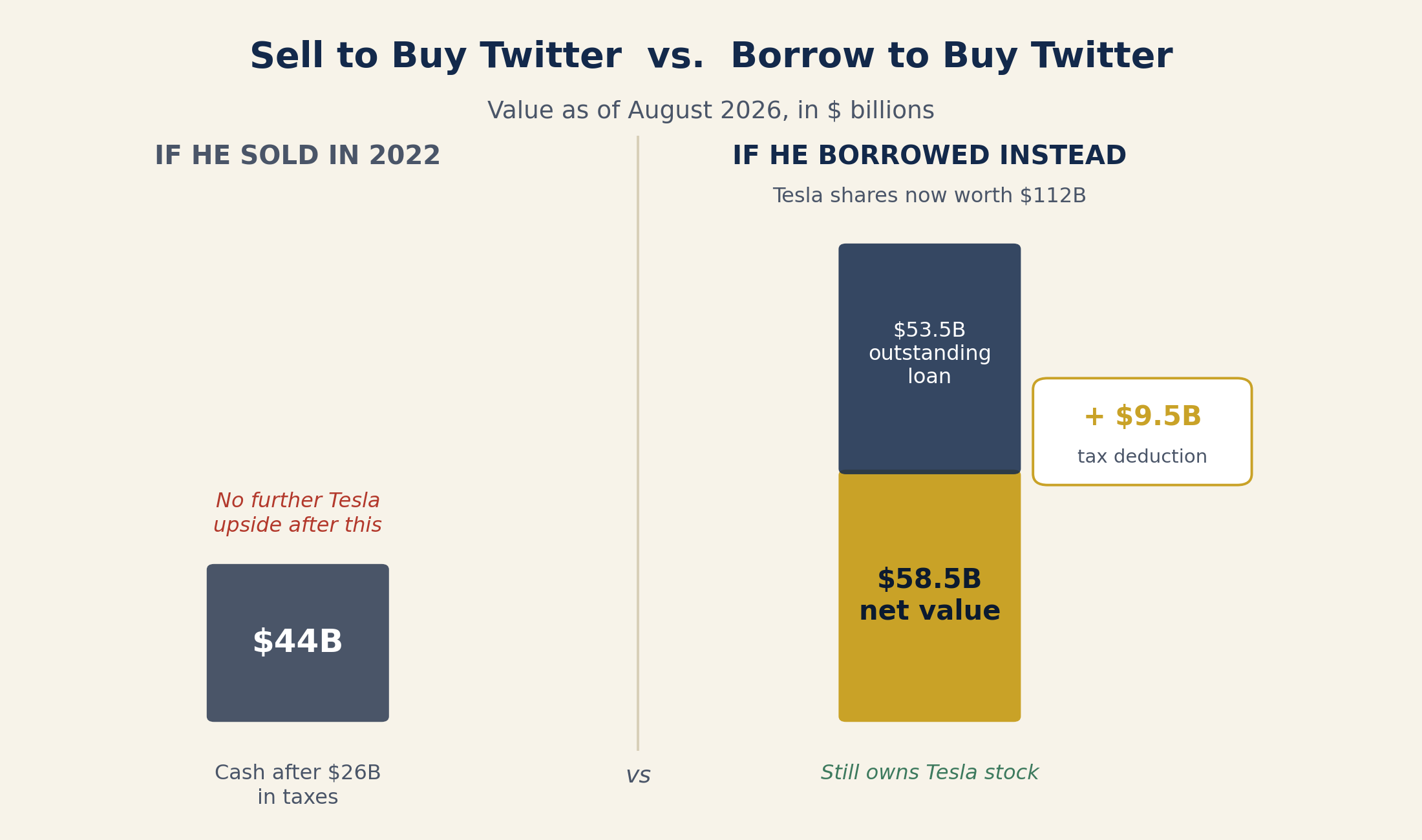
Fast forward to today (August 2026): those $70 billion worth of Tesla shares he would have sold are now worth $112 billion. Had he sold in 2022, none of that growth would belong to him.
Instead, because he borrowed, he still owns those shares. Yes, the loan has grown too — to about $53.5 billion, including interest. But subtract the loan from today’s share value, and he’s still sitting on $58.5 billion in net value. That’s on top of $9.5 billion in interest he can deduct against future capital gains.
Why Elon (Probably) Never Has to Pay This Loan Back
Here’s the part most people don’t know.
Elon borrowed $44 billion against $200 billion of Tesla stock — a 22% loan-to-value (LTV) ratio.
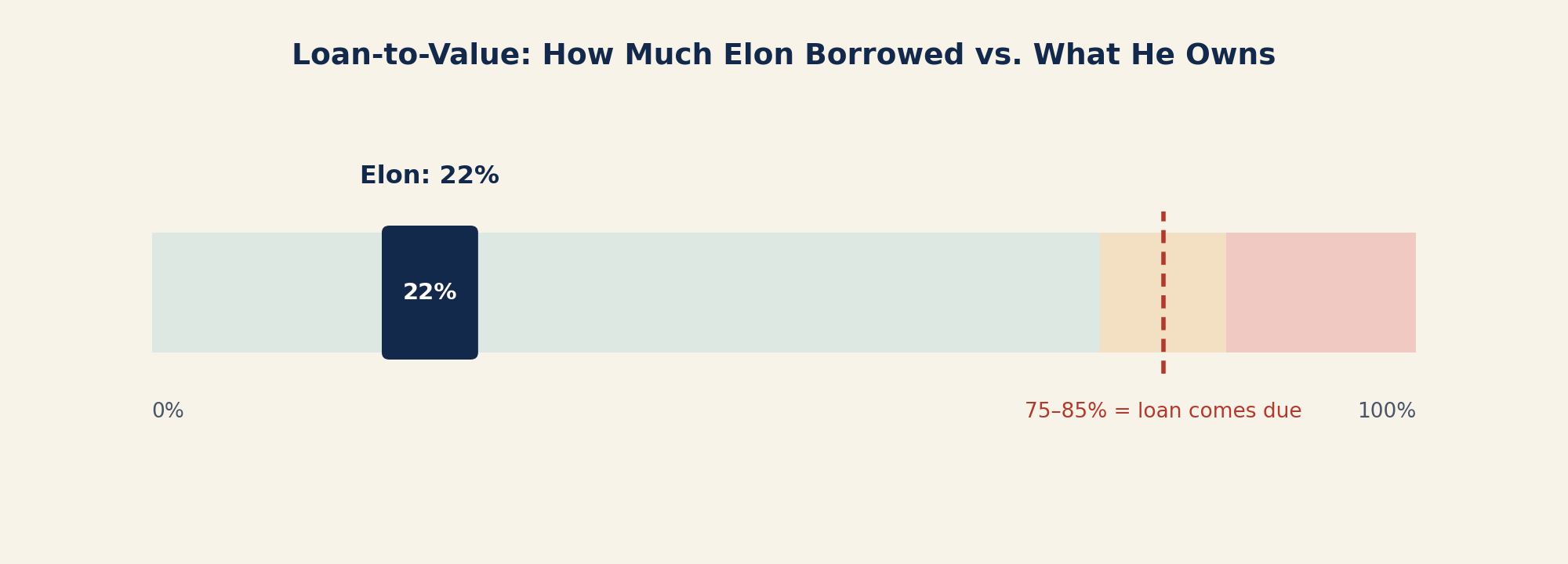
As long as that ratio stays under roughly 75–85%, he never has to make a payment. Not on the interest. Not on the principal.
This isn’t like a mortgage loan. It’s a securities-based loan, and the rules are completely different:
● Mortgage: pay principal and interest every month, or risk foreclosure.
● Securities-based loan: pay nothing as long as your LTV stays under the limit.
The loan only comes due if the value of his portfolio drops too dramatically or he sells enough stock to push the LTV over that limit — or when he dies.
Since Elon borrowed so far under that limit, it’s likely this loan never gets paid off in his lifetime. In fact, Elon’s Tesla shares would have to drop by more than 70% before Elon would be required to start paying the loan off (or investing more cash into the stock market).
The Tax Deduction From Leverage That You Don’t Pay Back However, what’s key to all of these financing arrangements is that in order to claim the tax deduction you have to actually pay back the interest in cash. You typically do this every month or every year depending on the loan arrangement.
The use of leverage in most financing operations is tax-deductible. This isn’t new to anyone who has had a mortgage or who has borrowed to invest in their business operations.
But if Elon used a box-spread loan — a specific type of securities-based loan structured as a Section 1256 contract — he gets to deduct the interest every year, even though he isn’t actually paying the interest back.
That’s because Section 1256 contracts are “mark to market.” The IRS treats the accrued (but unpaid) interest as a deductible loss, every single year.
Compare that to a mortgage:
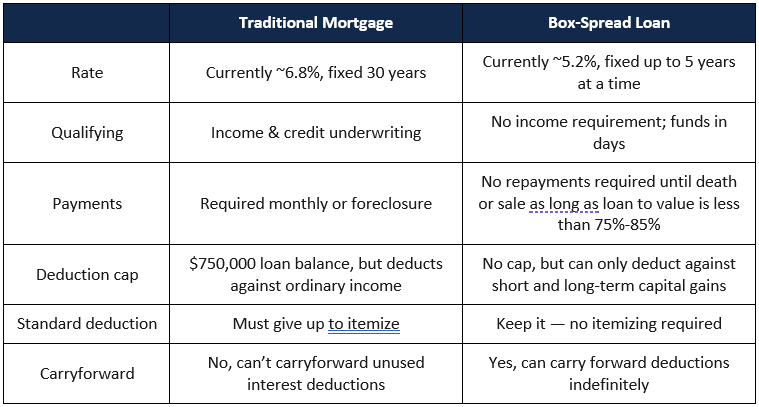
● You only get the deduction if you actually pay the interest in cash.
● The deduction is capped — only the first $750,000 of loan balance counts.
● You have to itemize to claim it, which means giving up the standard deduction ($32,200 for a married couple in 2026).
A box-spread loan has none of these limits. No $750,000 cap. No giving up your standard deduction. And the deduction carries forward indefinitely to offset future capital gains.
Box-spread rates are also currently lower than mortgage rates — about 5.2% versus 6.8% 30 year mortgage — though you can only lock the rate for 5 years at a time, similar to a 5-year Adjustable Rate Mortgage (ARM).
Putting the Deduction to Work
Elon’s accrued interest gave him $9.5 billion in deductions.
Say he’s a little nervous about having so much wealth tied up in one stock, and decides to sell $9.5 billion of taxable Tesla shares to diversify.
Normally, that sale would trigger a large capital gains tax bill. But because he already has $9.5 billion in deductions banked up, the sale is tax-free — the deduction cancels out the gain, dollar for dollar.
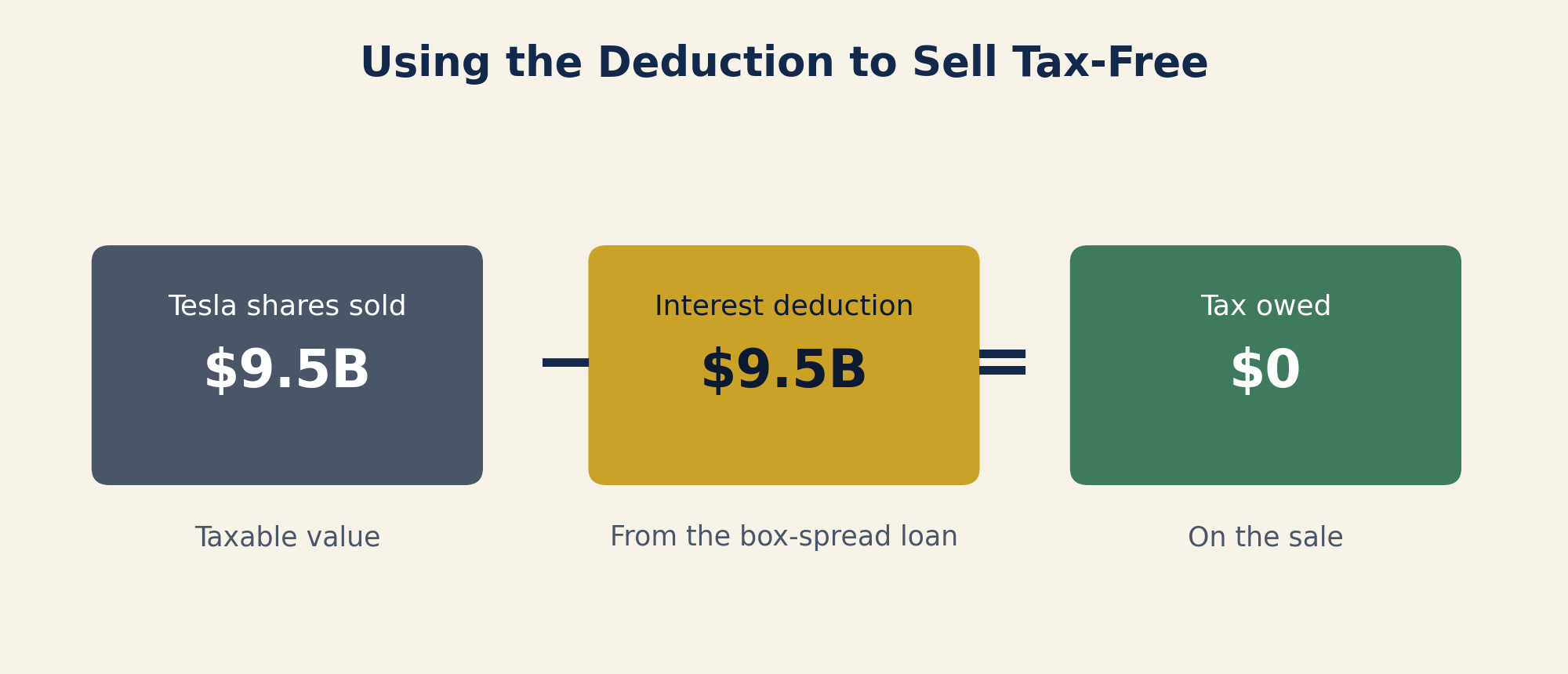
The use of leverage allows Elon to slowly sell out of the position over time.
Clearly $9.5 billion is a small fraction of the $200 billion of Tesla shares. It would take him decades to fully diversify his position this way.
He can speed this process up to a couple of years by using a combination of tax-aware investing (which heavily increases the use of leverage as opposed to what I’ve described here and pairs it with tax-loss harvesting) as well as exchange funds.
But the overarching point here is how the use of leverage allowed Elon to buy an asset without selling his existing portfolio and receive a tax-deduction for doing so.
How Can I Use Leverage to Take Out Tax-Free Gains or Diversify?
The use of prudent leverage allows the wealthy the ability to truly minimize the taxes they pay on their increasing wealth in ways that are difficult for the average person to do so.
But to the extent that you have a portfolio and the amount you need to borrow is significantly less than that portfolio, here are a number of things you can use that leverage for.
A downpayment on a home that doesn’t require you to sell part of your portfolio
Buying a home or rental property outright using portfolio-backed borrowing instead of a mortgage
Creating tax-free retirement income — and lower IRMAA charges—all while getting a tax-deduction
Diversifying and selling out of a concentrated stock position tax-free
Offsetting capital gains when you sell a business or a home
About the Author
Rajiv Rebello helps HNW clients implement better after-tax, risk-adjusted wealth and estate solutions through strategic financial planning and life insurance and annuity vehicles. He can be reached at rajiv.rebello@colvacapital.com.
No posts
Comments
Nothing yet. Say the first thing.
Sign in to join the conversation.