
States like California and New York offer people a wide range of opposing lifestyle choices that make people more than willing to pay the exorbitant cost of housing in either place.
If you want exciting nightlife options, a vibrant social scene, and to be in the middle of cultural/career relativism, then New York City is the place to be.
If you want more work-life balance, amazing weather, a slower pace of life and the ability to check your emails from the beach, then the California coast line is where you want to reside.
But as different as these locales and their cultures might be, the one thing they both have in common is that residents who choose to live their will be subject to some of the highest income tax-rates in the country.
High income residents in California will pay ~50% ordinary income taxes on their wages/profits, ~40% capital gains from the sale of their investments and after they’ve paid all that they can end up paying ~40% on all the wealth left over at death.
If that sounds like a lot, that’s because it is.
But that’s only a lot if you actually pay it.
The irony of the tax code is that it assesses extremely high tax rates on one hand and then with its other hand offers you a myriad of ways to limit this taxation dramatically—but of course only if you’re wealthy.

Regular W2 owners are forced to just pay their taxes with little recourse.
I often wonder why the tax code was designed like this.
And I think the answer has everything to do with the same behavioral finance elements I talk about here in this Substack.
Many wealthy people will actually pay these taxes because they either don’t know what their financial planning options are, or the effort/money saved isn’t worth it to them.
I once had a client who sold his business for over a $100 million dollars. In looking at his options and life expectancy I told him that with the growth of his portfolio over the next 30 years he was looking at paying a couple $100 million in estate taxes so I went through a couple planning options to minimize this.
At which point he told me:
“But my kids are still going to be left with a couple hundred million dollars afterwards right? How much more do they need?”
It was an excellent question.
After all, how much more money does anyone really need when they have that much?
I have a whole future post that I want to devote to this topic on the value of educating future generations on how to use tools at their disposal for their own benefit so that the ingenuity and perseverance of the first generation of wealth doesn’t die with the second, but that’s outside the scope of this post.
So to stay on topic it’s suffice to say that for him, the marginal value of the couple extra hundred million dollars or so wasn’t worth the mental energy of having to think about saving it.
Other clients will come to me living in states with low tax rates like Florida or Texas and have business deductions/losses that have reduced to their effective tax rates to the teens or low 20% range and are still interested in tax-free wrappers and growth.
For them it wasn’t about the tax-savings, the return on investment, or the effort involved.
They just didn’t want the government to have their money. So the mental and emotional energy was well worth fighting for the principle of it.
And this is why the tax code is the way it is.
The value we receive from our efforts is subjective and what’s worth it to one might not be worth it to the other.
But as long as one person is willing to pay the full price there’s always another party on the opposite side eager to get a discount.
The blissfully ignorant amongst us eagerly sign up for trial subscription after trial subscription and forget to cancel it once the free trial period ends and we end up getting charged. And those fees are either subsidizing the costs for the users who actually use the service or making someone on the opposite side of the table very rich.
It’s a behavioral finance trade as much as it is an economic one.
And the redistribution of benefits are being paid by one so that another can benefit—consciously or subconsciously.
A lot of what I write about here is about numbers and structures and logic—but more importantly how these structures are build around human behavior and feelings.
So much of what people bring to me are feelings and bias looking for an actuarial or economic stamp of approval.
The numbers will always be what the numbers are.
I can help tell you what those numbers are.
What those numbers mean to you, on the other hand, is an entirely different story.
People will use numbers and create a story to justify how they feel regardless of which position they’re on.
What’s an extra ten or hundred million dollars really worth to you?
Not for me to say.
What is for me to show is what can be done to protect or grow that.
And perhaps more importantly the opportunity cost of not doing anything.
Which is what this post is about.
Let’s take a dive into a case example.
A married couple in California has a business that is generating $5M in yearly profits that is currently worth $30M. They expect to sell it in 5 years for $60M at which point they will invest in a portfolio earning 9.4% gross rate of return before taxes.
If their life expectancy is 30 years and their beneficiaries sell all the assets at the time of death, how much is left when their kids inherit it?
In other words, how much did they lose as a result of income and estate taxes?
Well for starters, the $5M in profits are being taxed at ~50%.
And as the profits are increasing each year so are the taxes being paid on their profits.
Text within this block will maintain its original spacing when published
Increasing Profits Vs Increasing Tax-Liability
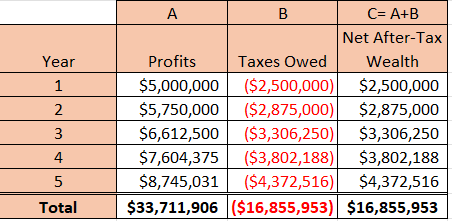
This is a point that’s often missed when doing planning.
Sure the profits are growing.
But so is their tax-liability.
The more your wealth grows, the more the tax-liability grows as well.
A similar story can be applied to the capital gains tax liability on sale of the business and the estate tax liability on death of the client.
The more the value of the company grows the more the client’s tax-liability on the sale of that business will as well.
Text within this block will maintain its original spacing when published
How Capital Gains Tax-Liability Increases with Value of the Business
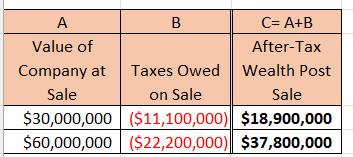
Same with the value of the estate. The more it grows, the more the estate tax liability does as well.
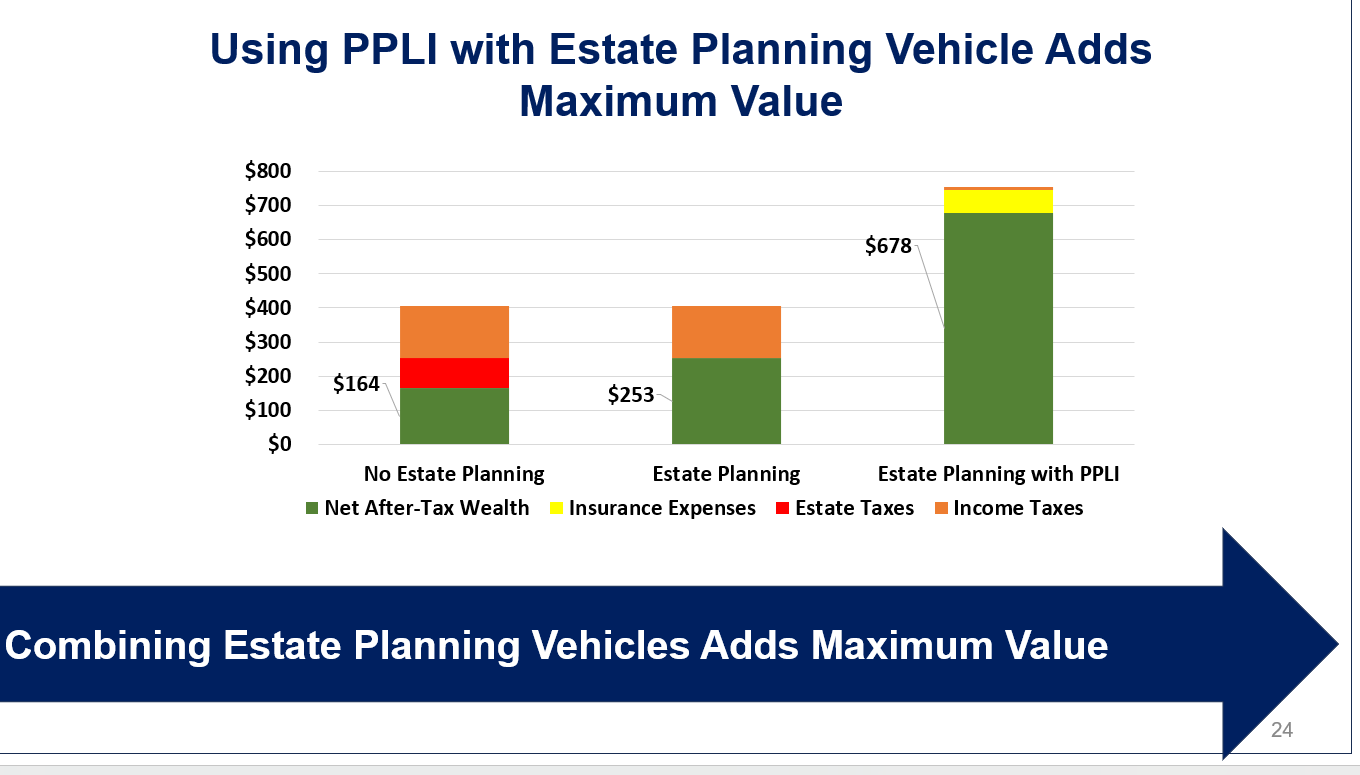
In the case example above, the couple would have accumulated nearly $700 million in wealth at the time of their death if it wasn’t for taxes.
However, of that $700M their beneficiaries are only inheriting $164M.
But it’s not income taxes or estate taxes that is the biggest drag on wealth here.
It is the lack of compounding those taxes create in their aftermath.
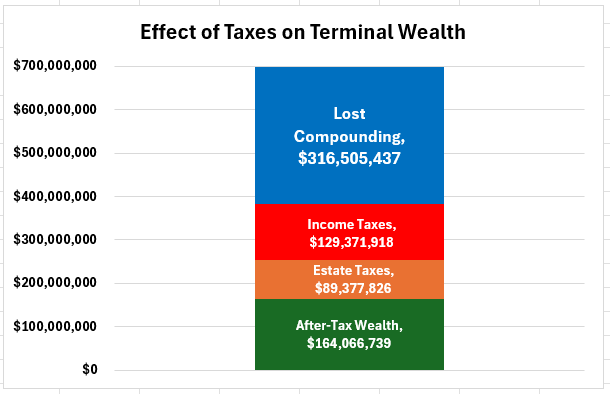
This lack of compounding costs the clients and their beneficiaries $317M whereas income and estate taxes ate up only $129M and $89M respectively.
So instead of $700M the clients and beneficiaries are only left with $164M.
So the lack of planning here costs the clients in both higher income taxes, higher estate taxes, and worst of all lack of compounded growth over the 30 years of their remaining lifetime.
“Freezing” the Income Tax and Estate Tax Liability
In previous posts we talked about the idea of “freezing” the income and estate tax liability by moving assets outside the estate and into a Private Placement Life Insurance Policy (PPLI).
What this does is it moves both the profits outside the estate and into a tax-free vehicle and freezes the income tax liability at today’s current $30M valuation instead of having it accrue as the company increases in value.
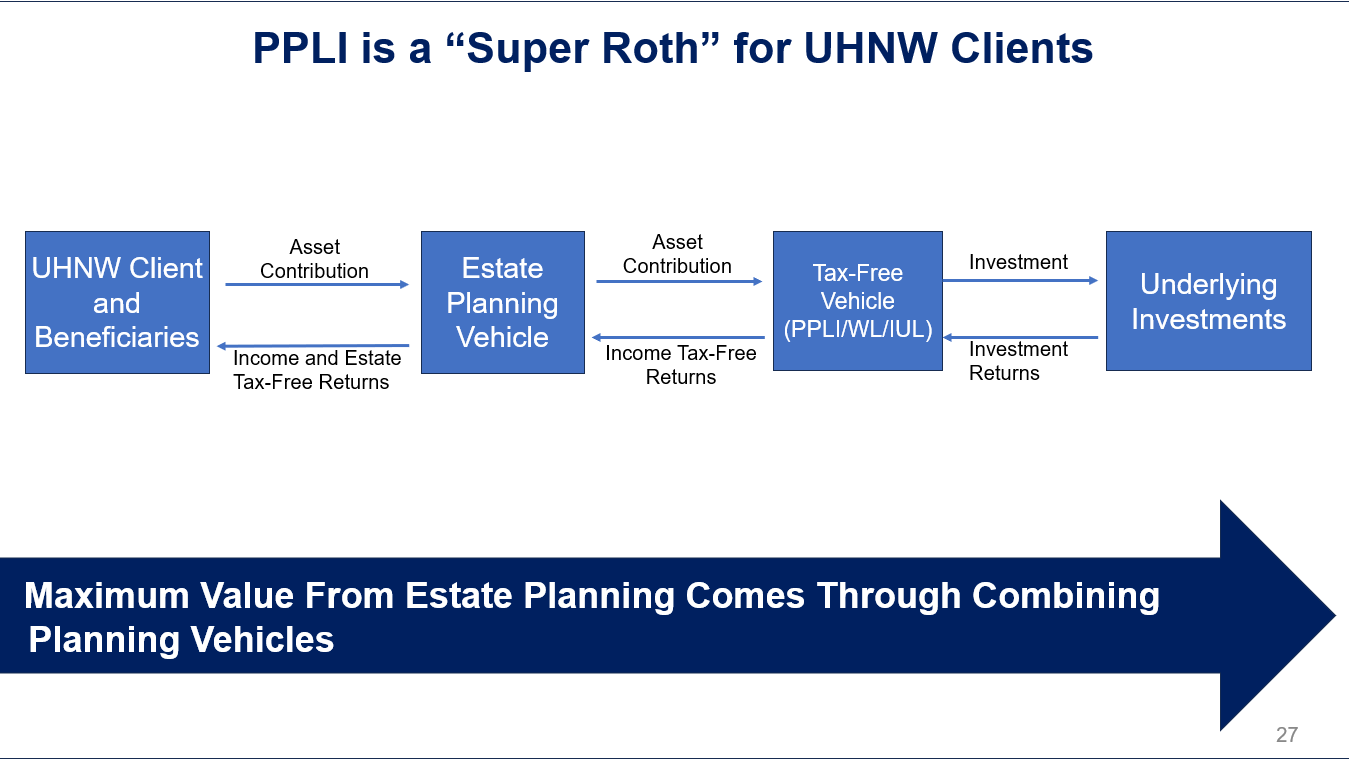
This way the client is paying taxes on $30M of gain based on today’s valuation instead of on the $60M sales price when they actually sell (and if they’re super crafty, they’re using discounted valuation practices to reduce this taxable gain further and interest only installment sales to defer actual payment of the tax-liability for 20 to 30 years).
And all this future growth is outside of the estate.
By combining an estate planning vehicle with PPLI the client has all the future growth be income and estate tax-free.
And the bulk of the value comes from the tax-free compounding vehicle for the next 30 years of their life.
Net of the insurance costs, the client and their families are walking away with $678M instead of the $164M.
I get a lot of shock when I tell clients you can move assets outside of their estate and have the future growth be both estate tax AND income tax-free.
If it sounds too good to be true, that’s because as I pointed out at the beginning of this article the tax-code is more or less a play ground for the wealthy to find the loopholes in.
And the irony here is that it’s not just really smart estate attorneys who have pointed out these loopholes.
Our own government has as well.
Every year the White House Administration generally publishes a list of proposals of parts of the tax code they wish to change and the reasons for it—namely for the purpose of increasing tax revenue.
This is colloquially referred to as “The Green Book” for reasons unknown to me.
In it they point out current tax law, how the tax law allows individuals (namely the wealthy) to bypass paying taxes, and proposals that would prevent this from happening going forward.
In 2024 the Biden administration released its Green Book for Fiscal Year 2025 that addressed a lot of income and estate tax loopholes that the wealthy use to minimize their income tax liabilities and how they would recommend closing it as well as quantifying the impact.
Here are just some of the tax benefits for the wealthy that were addressed:
· Limiting step-up in basis for the wealthy at death
· Limiting deducting business losses against ordinary income
· Increasing cap gains tax-rates for those making $1 million+
· Limiting the ability to contribute appreciating assets outside the estate to vehicles like grantor trusts
· Limiting 1031 exchanges without taxation (i.e. “like-kind” exchanges)
· Contributing in-kind private interests to PPLI policies
The one most pertinent to this article had to do with using in-kind contributions to fund Private Placement Life Insurance (PPLI).
For those not familiar with the term “in-kind contributions” it essentially means contributing an asset without having to sell it and then contribute the cash.
For example, if I want to move my NVIDIA stock positions from Vanguard to Schwab, I don’t have to sell my NVIDIA position at Vanguard and then take the cash from that and invest it in a Schwab account.
I can just do an in-kind transfer of my NVIDIA stock from Vanguard to Schwab without having to sell it.
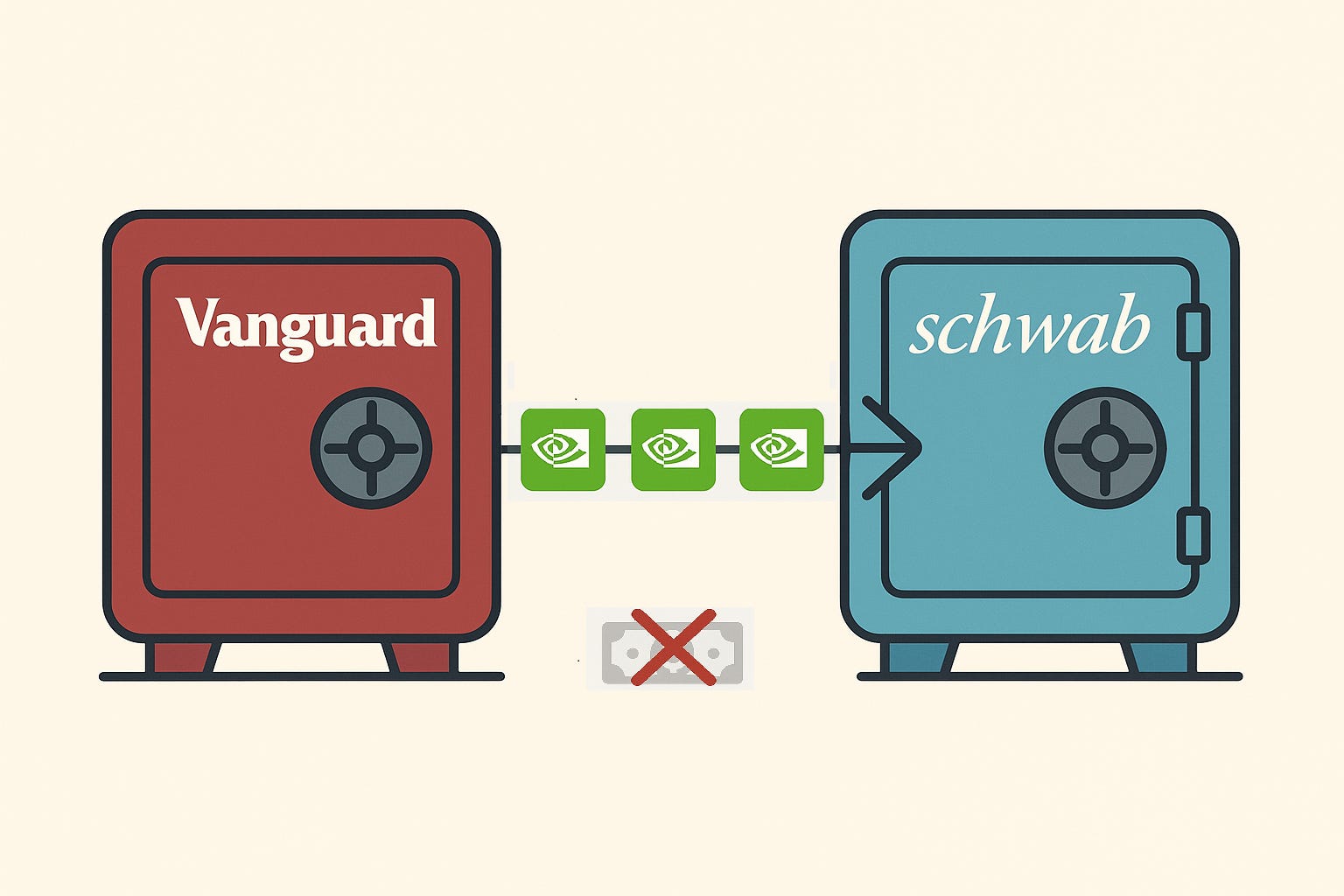
Now the reason I would do this is because if I have a lot of unrealized gains in my NVIDIA position I don’t want to have to sell it, pay taxes, and then contribute the net cash (which would be a smaller amount) to my Schwab account and rebuy the NVIDIA position from within the Schwab account.
By transferring the asset in-kind to my Schwab account I’m deferring the tax-liability until I sell the position at a later date (or eliminate it completely if I hold it until death and my beneficiaries inherit it tax-free through step-up in basis).
The reason I would do an in-kind transfer to my PPLI policy is similar; I want the future income and capital gains generated by the private interests to be tax-free.
If I own interests in a business that is growing by 20% a year, transferring those private interests to a PPLI policy allows me the ability to get the future appreciation both outside the estate and income tax-free.
Which of course prevents the government from collecting on that tax-revenue.
Which is exactly what the Biden administration wanted to prevent wealthy individuals from doing and why they included it in their list of proposals to eliminate.
Obviously none of their proposals went through and with a Republican administration now in office its highly unlikely that any proposals will even be suggested that involve limiting the ability of wealthy individuals to invest in PPLI.
But it’s important to understand that the government is acknowledging that wealthy people are legally doing this and are pointing out direct parts of the tax code that need to be changed in order to prevent it from continuing to happen.
And while laws may be changed in the future that prevent this ability to grow wealth income and estate tax-free, as with most tax-law changes they will most likely be focused on preventing future individuals from being able to do it and not on preventing people who enacted their estate plans when it was fully legal to do so. This is commonly referred to as a “grandfather clause” that is accounted for in order to not unfairly penalize individuals who would not have engaged in the planning if they knew it would one day no longer be legal to do so.
So the question really stops being about whether this has quantifiably objective monetary value (it does) or is legal to do (it is) and entirely about one question:
What’s an extra 10 million or 100 million really worth to you?
And that is a question for another post.
About the Author
Rajiv Rebello is the Principal and Chief Actuary of Colva Insurance Services and Guaranteed Annuity Experts. He helps HNW clients implement better after-tax, risk-adjusted wealth and estate solutions through the use of strategic planning and life insurance and annuity vehicles. He can be reached at rajiv.rebello@colvaservices.com.
You can also book a call directly with him here:
No posts
Comments
Nothing yet. Say the first thing.
Sign in to join the conversation.