
Welcome back to Sensus Capital Research. This weekend, we are initiating coverage on Dynatrace Inc ($DT), a name we have been watching closely and building a position in as the broader software sector got and keeps on getting obliterated.
The “SaaSpocalypse”, as it has been named by other fellow Substackers, is real.
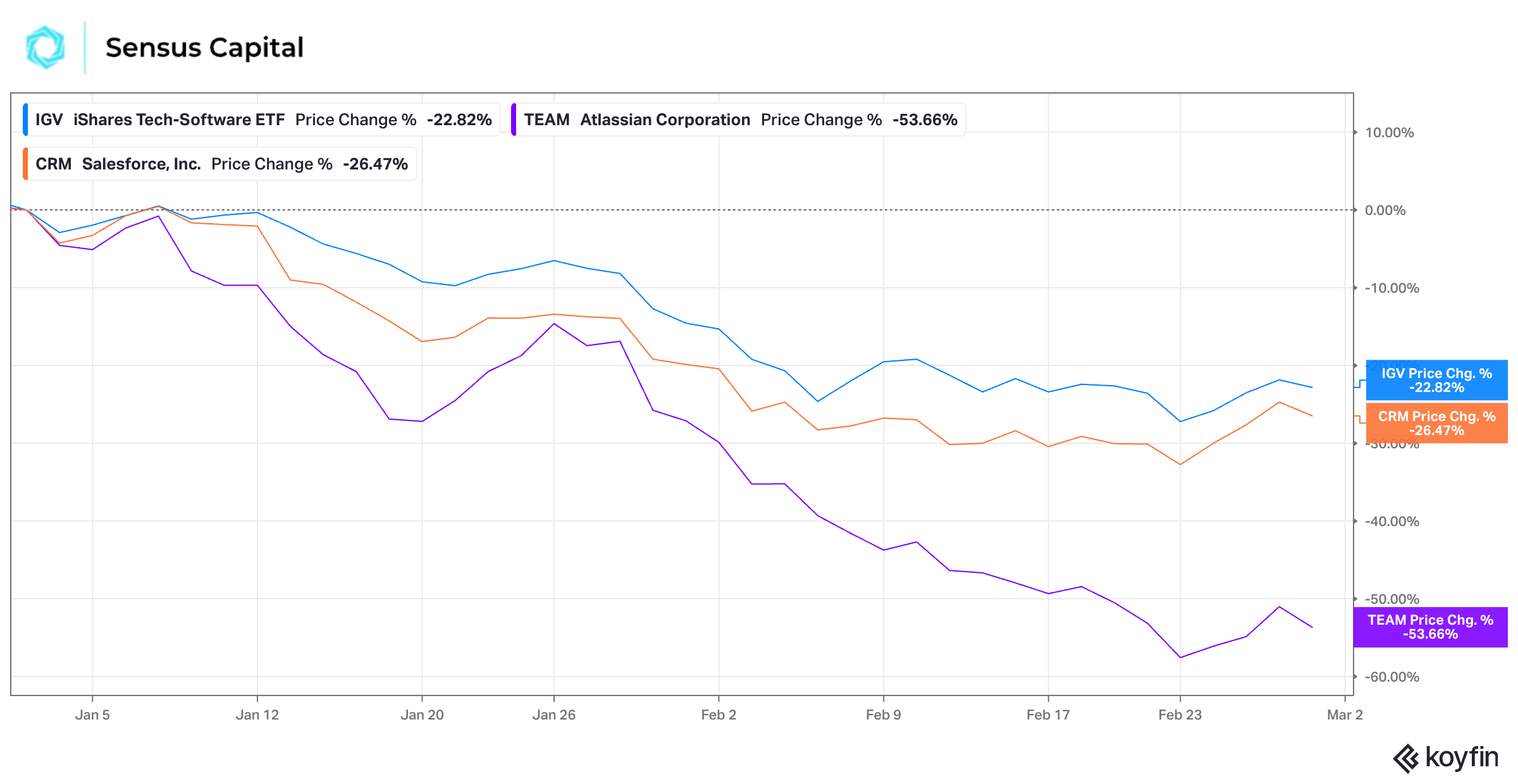
Since the start of 2026, nearly 300 billion market cap has been wiped from the software sector. Software ETF (IGV) is down over 20% YTD. Names like Atlassian and Salesforce have been sold off in panic. The fear is two-fold, yet simple and, in many cases, justified:
If AI agents can perform the work of ten employees, you no longer need ten software seats.
If you see a massive renewal bill from your software vendor, higher productivity of your internal engineers leads to you raising the question of “why not build instead of buy?”
The “per-seat” model and pricing leverage that powered two decades of SaaS economics is breaking in real time, and the market is repricing the entire sector accordingly.
We wrote about this structural risk in our Klaviyo report earlier this year. The companies that will survive are not the ones selling commodity software. They are the ones sitting on top of proprietary data or providing infrastructure that becomes more critical as AI adoption scales.
Dynatrace falls into the second category.
Here is the core logic: every enterprise that is deploying agents, automating cloud workflows, or scaling agentic infrastructure needs to know what is happening inside that infrastructure. Which agent is hallucinating? Which workflow is burning through cloud spend at 3x the budget? Where is the latency bottleneck killing UX?
That is what Dynatrace does. It is the “control tower” for increasingly complex cloud environments that AI is creating.
The more AI agents enterprises deploy, the more they need someone watching the infrastructure. Dynatrace’s demand is a direct function of the complexity AI creates.
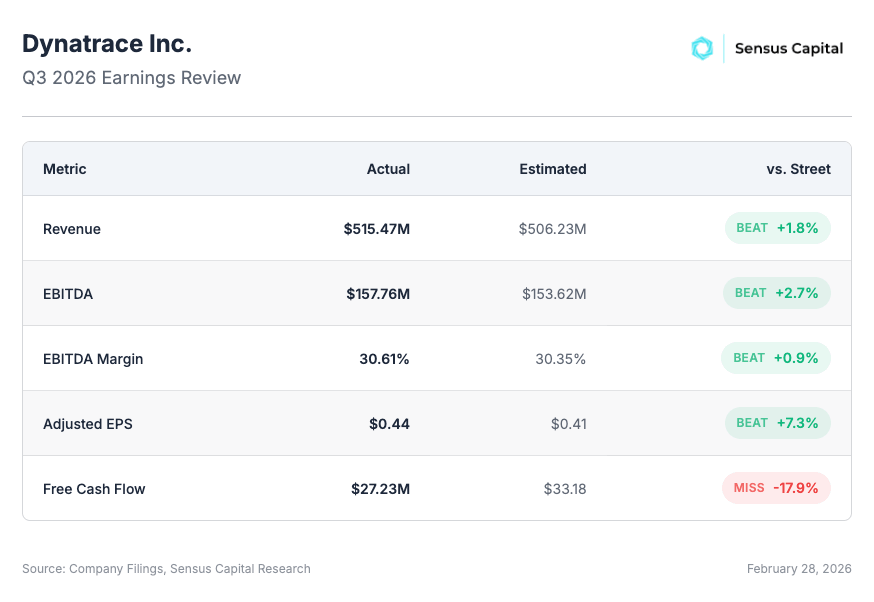
At sub $36 per share, the stock is trading near its 52-week lows. This is for a company that just beat guidance across every metric (except FCF due to timing), raised its full-year outlook, and is on track to surpass $2bln in ARR.
Something does not add up. Let’s dig in.
Already subscribed? Pledge your support before April 1 to lock in Founding Member pricing for life. New here? Subscribe to receive the future reports right into your inbox.
Before getting into the details, let’s make the product a bit more understandable and tangible with a quick exercise.
Imagine you are a CTO at a mid-sized insurance company. Your team has just deployed a dozen AI agents across customer service, claims processing, and fraud detection. These agents are running on AWS and Azure simultaneously, calling multiple third-party APIs, and handling thousands of interactions per hour.
On Tuesday morning, one of the AI agents starts hallucinating policy details, another is routing claims to the wrong department, and your cloud bill for the month has all of a sudden doubled.
You have 300 microservices, four different cloud environments, and a CEO who wants to know why the customer portal is suddenly so slow.
How do you even begin to diagnose what went wrong? Where in the chain of hundreds of interconnected services is the root cause?
This is the problem that Dynatrace solves.
At its core, Dynatrace is an AI-powered observability platform. It ingests, correlates, and analyses the massive volume of data generated by the modern cloud infrastructure, from server logs and application traces to user behaviour and AI agent performance, and it turns it into actionable insights.
Think of it as the central nervous system of an enterprise’s digital operations. It does not just alert you to a problem. Its AI engine (Davis AI) automatically identifies the root cause, maps every dependency in the environment and can take autonomous action to fix the issue before it impacts the end user (the ability of Davis will improve with improvements in AI).
The key word here is “automatically”. In the legacy world, an engineer would spend hours going through dashboards and logs to find a needle in a haystack and debugging. Dynatrace’s approach is to deploy a single agent (One Agent) that auto-discovers every component across the entire technology stack, maps the dependencies in real time (via Smartscape), stores it all in a unified data lakehouse (Grail), and lets its AI engine surface the answers.
A lot of technical jargon, but to keep it simple, Dynatrace’s USP for enterprises is: less manual work, faster resolution, fewer outages, and lower cloud costs.
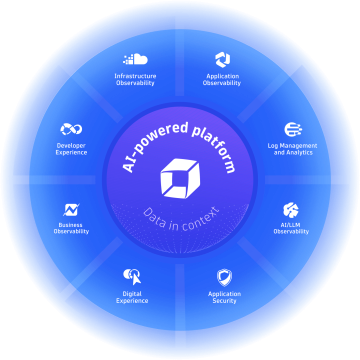
Dynatrace’s platform is structured around five key product pillars, all running on the same underlying data engine.
Infrastructure Observability: End-to-end monitoring of multi-cloud and hybrid environments across AWS, Azure, and Google Cloud.
Application Performance Monitoring (APM): Distributed tracing, code-level analysis, and performance analytics for cloud-native and enterprise application stacks.
AI Observability: Purpose-built monitoring for generative AI applications, LLMs, and autonomous agents. This is the newest and arguably the most strategic module. It provides visibility into response quality, token costs, and security risks of AI workloads.
Application Security: Runtime vulnerability detection, threat analytics, and Cloud Security Posture Management (CSPM).
Log Management & Analytics: Unified log ingestion and analysis (which recently surpassed $100mm in annual consumption, a key milestone) and customisable business analytics dashboards that connect technical metrics to business KPIs.
Tying all of this together is Dynatrace Intelligence, which was unveiled at the company’s Perform 2026 conference in January. This is the agentic layer of the platform: domain-specific AI agents for SRE, security, DevOps, and development workflows that can reason over live system data, investigate incidents, and execute remediation steps within defined guardrails.
Basically, an autonomous 24/7 on-call engineering team of agents.
Dynatrace is primarily focused on the up-market enterprises with large annual revenue. It is a core difference of GTM for Dynatrace, as it follows a top-down approach (target enterprises first) rather than a bottom-up (target developers first).
The average ARR per customer is now nearly $500,000, with management stating that the long-term opportunity per enterprise customer could reach $1mm or more. In Q3 2026, the average new logo landed at over $160,000 in ARR.
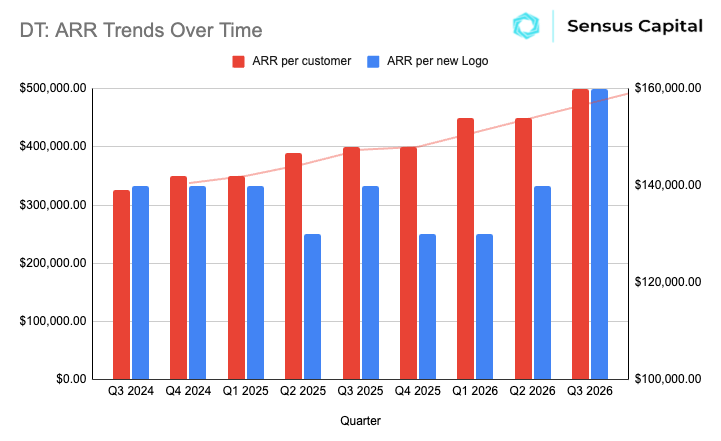
Why does it matter? Because large enterprises are the customer segment is more insulated from AI disruption risk. A Fortune 500 bank is not going to “vibe code” an internal observability platform to replace Dynatrace. These organisations have enormous, multi-cloud environments with thousands of services, strict compliance requirements, and zero tolerance for downtime.
The switching cost is immense, the platform is deeply embedded into the daily operations, and the cost of getting it wrong is existential.
A significant and under-appreciated element of Dynatrace’s GTM (go-to-market) is its deep partnerships with the three major cloud providers.
Dynatrace has crossed $1bln in lifetime AWS Marketplace sales, with triple-digit marketplace growth still accelerating. A multi-year Strategic Collaboration Agreement with AWS commits both companies to joint GTM activities, aligned roadmaps, and coordinated sales efforts.
Similar partnerships exist with Azure and Google Cloud. At Perform 2026, all three hyperscalers were featured in joint sessions alongside Dynatrace.
By 2025, partner-influenced revenue had grown to 70-80% of the total revenue, up from approximately 50% in 2021. In Q3 2026, 11 of 12 deals greater than $1mm ARR involved partner collaboration. Partners also report achieving 7x services revenue for every $1 of Dynatrace software sold, which creates a powerful incentive for the ecosystem to keep recommending the platform.
Three trends stand out to us from the recent quarters that are worth monitoring closely:
New Logo ARR Is Growing and Getting Larger
In Q3 2026, Dynatrace added 164 new logos, with the average ARR per new logo exceeding $160,000 for the first time. Dynatrace is adding more customers, who are larger, higher-quality and more likely to expand over time.
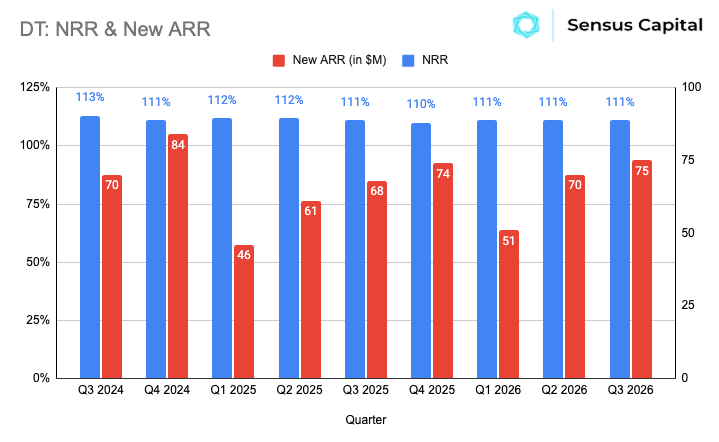
NRR Has Stabilised at 111%
NRR held steady at above 111% for three consecutive quarters (there were concerns about a downtrend). Sure, it is not the 120%+ that high-growth SaaS investors used to dream about, but given that Dynatrace is enterprise-focused, 11% growth with the existing customers represents more durable long-term revenue.
Log Management Has Hit Escape Velocity
Logs have been the breakout product category. Annualised log consumption has now surpassed $100m, a milestone the company set for itself. Management has noted that nearly all seven-figure observability deals now include logs. This is becoming a new “land and expand” lever the company can pull on: once a customer consolidates their log management into Dynatrace (replacing legacy tools like Splunk), the platform becomes even more embedded and the cross-sell into APM, security, and observability is more natural.
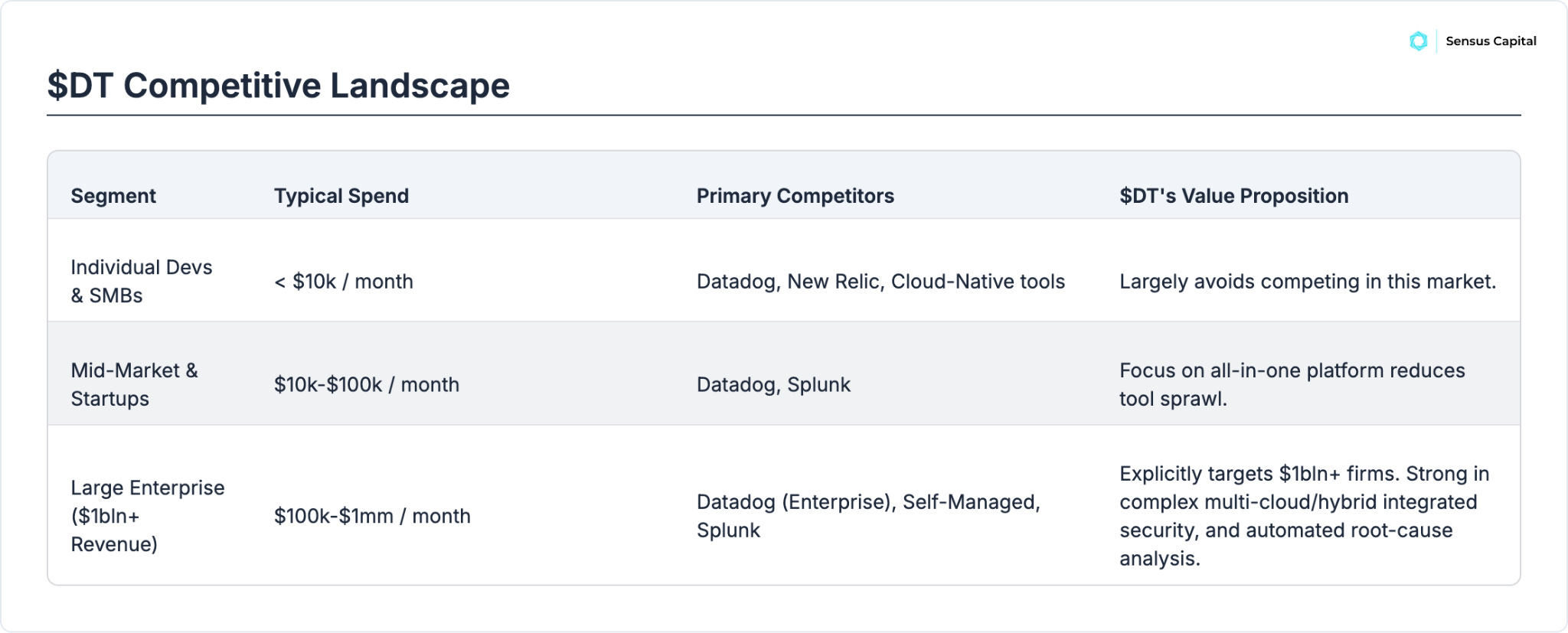
The observability market is estimated at $51bln (with an additional $14 billion for security, bringing Dynatrace's addressable TAM to $65 billion). Within this large and growing market, the competitive dynamics can be simplified into three tiers.
Tier 1: Datadog ($DDOG)
Datadog is the most direct public competitor and the name that Dynatrace is most frequently compared to. However, the two companies are pursuing meaningfully different strategies within the same market.
Datadog's approach is bottom-up and breadth-first. It appeals strongly to developers and DevOps teams with a wide product catalogue (24+ products), a large integration library, and a land-and-expand model that starts small and grows with usage. It has a much larger customer base (over 116,000 in some estimates vs. Dynatrace's around 4,000 enterprise customers) but a lower average contract value.
Dynatrace's approach is top-down and depth-first. It targets the CIO and VP of Infrastructure at large enterprises, offering a unified, AI-powered platform where a single agent auto-discovers and maps the full environment. Where Datadog gives developers flexibility and customisation, Dynatrace gives enterprises automation and answers.
Tier 2: Legacy and Adjacent Players
Splunk (now Cisco) was a major competitor in the log analytics space but has been absorbed into Cisco's broader portfolio, creating uncertainty and integration challenges. New Relic pivoted to consumption-based pricing early but has struggled with execution. Elastic offers open-source-based observability but lacks the enterprise automation layer.
Tier 3: Hyperscalers Themselves
AWS CloudWatch, Azure Monitor, and Google Cloud Operations are native tools that come bundled with the respective cloud platforms. They are "good enough" for basic monitoring, but they only see their own cloud. For enterprises running multi-cloud and hybrid environments, a vendor-neutral platform like Dynatrace that provides a unified view across all environments is a fundamentally different value proposition.
Already subscribed? Pledge your support before April 1 to lock in Founding Member pricing for life. New here? Subscribe to receive the future reports right into your inbox.
Dynatrace is growing at a high-teens rate, profitable and generating significant free cash flow, maintaining improving margins, and actively returning capital to shareholders. It is a rare combination, and the market is currently ignoring it.
Revenue: Dynatrace has compounded revenue from $930mm in FY2022 to $1.7bln in FY2025, representing a 3-year CAGR of approximately 22%. In Q3 2026, revenue came in at $515mm, up 18% YoY, beating consensus estimates of $506mm. For FY2026, management has raised guidance to $2.01-$2.02bln in revenue, implying 16% YoY growth.
ARR: The trajectory here is clear. Total ARR was $1.97bln at the end of Q3 2026, up 20% YoY, with the company on track to surpass $2bln in ARR by end of this year. For context, Dynatrace crossed the $1bln mark just over three years ago.
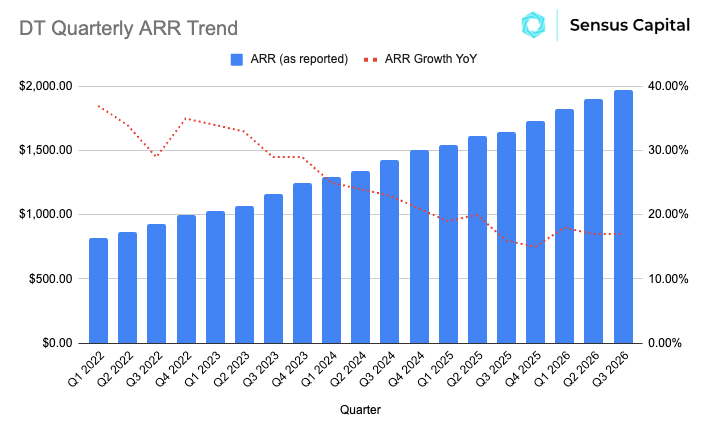
Net New ARR: $75mm added in Q3 2026 alone, 11% YoY in CC and third consecutive quarter of double-digit net new ARR growth.
Subscription Mix: 96% of revenue is subscription-based.
NRR: 111% and stabilised. The number has been compressed during the DPS pricing transition. Management has flagged that the first full three-year DPS cohort classes will mature in FY2027, which should provide a natural uplift to NRR as consumption patterns fully kick in.
Non-GAAP Operating Margin: 29-30%. Operating margin has expanded steadily from approximately 26% in FY2023 to 28% in FY2024 to 29% in FY2025, and is guided at 29% for FY2026. This is being achieved while the company continues to invest meaningfully in R&D (16% of revenue), sales and marketing (31%), and G&A (8%). In other words, this is not a company cutting its way to profitability. It is investing for growth and generating expanding margins simultaneously.
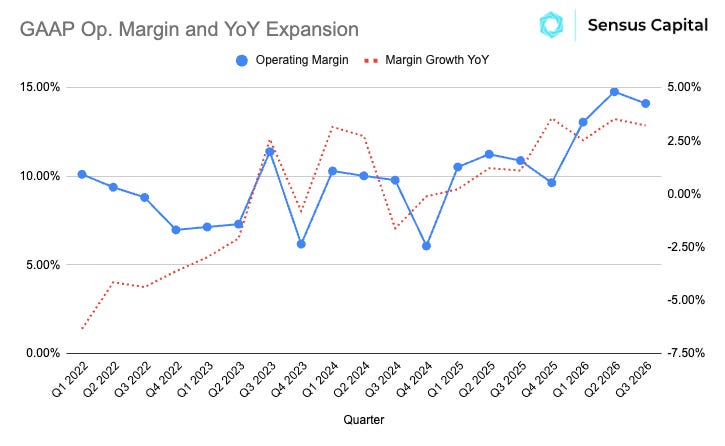
The company spent over $200mm in the last four months of 2025 to buy back stock as the stock sold off. In February 2026, the Board authorised a new $1bln buyback programme.
CFO Jim Benson was direct about it on the Q3 earnings call, stating that the new authorisation reflects their conviction in the underlying strength of the business and their commitment to driving shareholder value. Since inception of the buyback programme, Dynatrace has repurchased shares at an average price of approximately $50, well above the current market price of ~$36.
That tells you something about where insiders see the intrinsic value.
The top-line growth rate has been decelerating, which is mathematically inevitable when you go from $700mm to $2bln in five years. However, Dynatrace has continued adding roughly $270-300mm in incremental annual revenue in each of the last three years, with the guide for FY2026 implying similar growth rate.
The business is growing.
Looking forward, revenue consensus for FY2027 (ending March 2027) sits around $2.3-2.4bln, implying approximately 15-17% growth. Our internal forecast is largely aligned. We do not see a catalyst for a dramatic reacceleration back to 20%+ top-line growth in the near term, but we also do not see evidence that growth is about to fall off a cliff.
The secular tailwinds around cloud migration, AI agent deployment, and tool consolidation are durable and accelerating.
The TAM: $65 Billion and Expanding
Dynatrace's total addressable market is estimated at $65bln, comprising $51bln for observability and $14bln for application security. Against FY2026 guided revenue of approximately $2bln, the company currently penetrates roughly 3% of its addressable market.
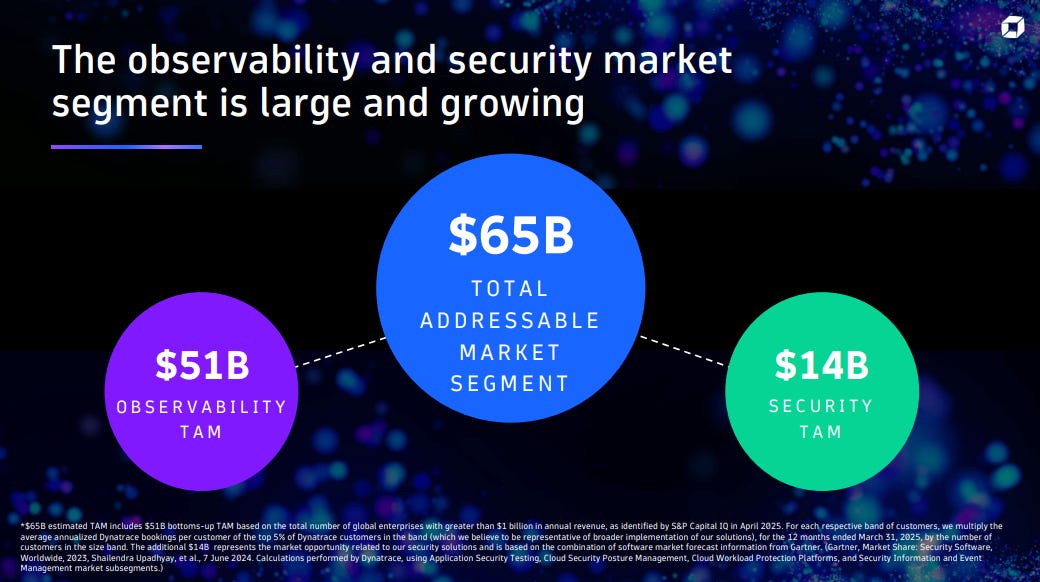
However, what makes the TAM discussion particularly interesting is that it is actively expanding.
AI Observability, the monitoring of LLMs, AI agents, and generative AI applications in production, was not a meaningful market category two years ago. Today, it is one of the fastest-growing product segments on the platform (recall: logs already surpassed $100mm annualised consumption, and nearly all large deals include AI-related workloads). As enterprises scale their AI deployments, the observability TAM grows in lockstep. Every new AI agent deployed in production is a new workload that needs monitoring, performance management, cost tracking, and security governance.
This is the reasoning behind us believing that AI is a demand driver for Dynatrace. More AI workloads mean more infrastructure, which means more things to observe, which means more Dynatrace consumption. The TAM is not shrinking. It is expanding precisely because of the same technology that is destroying other software business models.
The Pricing Model Shift: DPS as a Tailwind
One final critical point on the financial outlook. The ongoing migration to Dynatrace Platform Subscription (DPS) pricing, now representing 70% of ARR, is a structural tailwind that the market is ignoring.
Under the old SKU-based model, customers bought specific modules at fixed prices. Under DPS, customers commit to a platform-wide consumption pool and spend it across any Dynatrace offering. The result has two key impacts:
It removes the friction of upselling new modules (customers can simply start consuming a new capability without a new procurement cycle).
It ties revenue growth directly to infrastructure usage rather than headcount or seat count growth.
Management has consistently noted that DPS customers’ consumption growth is running at 2x the rate of SKU-based customers. As the remaining 30% of ARR migrates to DPS within the next year, this consumption uplift should flow through to accelerating ARR per customer and higher NRR.
A strong thesis means nothing without the right people in charge to execute on it. Dynatrace has an unusual leadership structure that, in our view, gives it a significant edge: a professional “scaling CEO” brought in to commercialise the business, a CFO who has done the exact same job at the same scale before, and the original founder still running the technology as CTO.
Similar to our reports on LYTS 0.00%↑ and LYB 0.00%↑, let’s grade the trio.

McConnell is a career enterprise technology executive with over 30 years of experience. He holds a BA in Quantitative Economics and an MBA, both from Stanford. His first job out of college was programming IBM mainframes in FORTRAN at an investment bank (having some tech understanding to run a company like Dynatrace is key).
He held the following notable roles:
CEO of Latitude Communications (1998-2004, acquired by Cisco)
VP/GM and VP of Sales at Cisco Systems (part of the team building a multi-billion dollar Communications and Collaboration business)
President and GM at Akamai Technologies (scaling the security business from a few million dollars to over $1.3bln in revenue)
Since December 2021, CEO at Dynatrace
The Key Observation: What stands out across McConnell’s career is a clear pattern of taking an enterprise technology platform at the inflection point between “promising” and “scaled business” and pushes them through the growth curve.
At Cisco, he helped build a division from early stage to multi-billion dollar scale. At Akamai, he took a small security business and turned it into the company's largest and fastest-growing segment at $1.3 billion+. Now at Dynatrace, he took over a business at approximately $929mm in revenue (FY2022) and has already pushed it past $1.7 billion.
Grading:
Execution: A. He hits the numbers he guides to, and then raises them. The DPS pricing transition, which could have been a messy multi-year disruption, has been managed smoothly and with minimal impact on growth rates.
Guidance & Anticipation: A-. McConnell guides conservatively and delivers upside. He anticipated the shift to consumption-based pricing before it became a sector-wide trend, positioned the company for the AI observability wave before it was a consensus theme, and has been disciplined about not over-promising on the speed of new product adoption. The only reason for not a full A grade, is the stock performance, which could suggest the market narrative could have been better sold by the management, since the business itself is positioned really well.
Compensation & Alignment:
Total Pay (FY2025): about $19mm ($675K in Salary; $672k Bonus, $18mm Stock Awards)
The pay structure is around 96% equity-based and performance-driven targets. His stock ownership guideline is 5x base salary. Compensation is high in absolute terms for a company of this size, but the structure is heavily tilted toward at-risk, performance-based equity, which is exactly what shareholders should want to see.

Benson is a 30-year veteran of the enterprise technology finance. He spent 20 years at Hewlett-Packard in various senior finance positions, followed by a 7 year stay as CFO at Akamai Technologies.
Notice the Akamai Technologies connection. McConnell recruited Benson directly (Benson started in 2022).
Grading:
Execution: A. Cash flow management has been excellent. The DPS pricing transition has been navigated without a hick-up. Share dilution is being actively managed through the aggressive buyback. The balance sheet is clean (nearly $1.2bln in cash and investments as of March 2025). There is no debt drama, no working capital issues, no accounting concerns.
Guidance & Anticipation: A. Benson is a conservative guide who consistently sets realistic expectations and outperforms them. Every quarter of FY2026 has seen guidance raised. He provides clear visibility into the DPS migration timeline, the NRR trajectory, and the margin expansion path.
Compensation & Alignment:
Total Pay (FY2025): Around $7mm ($490K salary, $400K Bonus, $6mm Stock Awards).
Similar structure as for CEO, with being equity-weighted and tied to performance goals.

Greifeneder is the soul of Dynatrace. He co-founded the original company, dynaTrace Software GmbH, in 2005 in Linz, Austria. Dynatrace is his third successful technology venture
Having the founder still actively running R&D after nearly two decades is an underrated structural advantage. Greifeneder is the architect of the three proprietary technologies that form Dynatrace's competitive moat: Grail (the data lakehouse), Smartscape (the real-time dependency graph), and Davis AI (the causal AI engine).
In the context of the current SaaSpocalypse, where the market is questioning whether SaaS platforms have durable technical moats or are just wrappers around commoditised functionality, having a founder-CTO who built the core IP from scratch and is still the named inventor on 20 patents is a tangible differentiator. It is one thing to claim you have a proprietary data engine. It is another thing entirely to have the person who invented it still running the shop.
Compensation & Alignment:
Total Pay (FY2025): $5.75mm ($445K Salary, $310K Bonus, $5mm Stock Awards).
The management configuration at Dynatrace is a key positive in our thesis. It combines three archetypes that are individually valuable and rarely found together:
1. The Scaling CEO: McConnell knows how to take a $1bln enterprise technology business and push it to multi-billion dollar scale. He has done it before, twice, at companies with similar profiles (Cisco, Akamai).
2. The Disciplined CFO: Benson is a capital allocation specialist who has managed the exact same financial transition at the same scale before, at the same company where the CEO was also working.
3. The Founder-CTO: Greifeneder provides the technical continuity and product vision that keeps the platform ahead of competitors. His 20-year patent portfolio and deep institutional knowledge of the codebase is an asset that cannot be hired or acquired.
There is no management drama. There is no CEO who is focused on self-promotion over execution. There are no unusual insider sales to flag. The compensation is equity-heavy, performance-driven, and aligned with shareholders. The 94% say-on-pay vote confirms that institutional investors agree with this assessment.
We have gone through the business, the financials, and the management. Now let’s take a look at four key insights that define our conviction in the thesis, and two risks that worry us the most.
AI is a demand driver, not a threat.
This is the most important point in this entire report. The market is selling Dynatrace alongside every other software company because of “AI disruption risk”. We believe this is fundamentally wrong for this specific name
Every AI agent that an enterprise deploys in production is a new workload that needs to be monitored.
We have made a similar argument in our Klaviyo coverage: AI is not the enemy for companies whose product sits on top of proprietary, contextual data. In Klaviyo’s case, it is behavioural purchase data. In Dynatrace’s case, it is the real-time dependency graph across entire enterprise cloud stack.
The insight boils down to a simple relationship: as enterprises increase AI adoption, their cloud infrastructure complexity grows non-linearly. More complexity means more things to observe. More things to observe means more Dynatrace consumption.
DPS Pricing proves the management sees around the corners.
The SaaSpocalypse is punishing SaaS companies that are still clinging to per-seat pricing models, because AI directly compresses headcount and, by extension, seat count. Dynatrace saw this shift coming and moved early.
The performance data validates the decision. DPS customers' consumption growth outpaces SKU-based customers by 2x. In Q3 FY2025, on-demand consumption revenue contributed 150 bps to subscription revenue growth. Customers on DPS can start using a new capability (logs, security, AI observability) without a new procurement cycle, which removes the friction that historically slowed cross-sell in enterprise software.
Instead of waiting for the market to force the transition, the way many peers are now scrambling to do, Dynatrace pivoted proactively. This is one of the clearest signals we have seen that this management team understands structural industry shifts and positions ahead of them, not in response to them.
The financial model is proven and still has catalysts.
Dynatrace is a proven, profitable, cash-generating business that still has multiple levers to pull on to sustain high-teens revenue growth:
Large ACV deals are still ramping
New product adoption is still early
DPS consumption is turning into a flywheel
Taken together, these catalysts give us confidence that mid-to-high teens revenue growth is sustainable for the next 2-3 years, with the potential for re-acceleration if AI observability demand inflects faster than expected.
Two key risks are on our radar.
Datadog
It is a formidable competitor with a broader product catalogue, a larger customer base, and strong developer mindshare. It is aggressively pushing upmarket into the enterprise segment, and if they successfully combine their developer distribution with enterprise-grade capabilities, the competitive pressure on Dynatrace increases meaningfully.
Hyperscaler Dependency
As outlined earlier, Dynatrace’s GTM heavily depends on the partnership programs with the hyperscalers. When it works, it is a great distribution engine. It can also become a threat if any hyperscaler decides to build out its own observability offering to a level that competes directly with Dynatrace (rather than partnering), or if the terms of the partnerships (economics) change into the negative for Dynatrace direction.
How We Deviate From Consensus Analytically:
AI observability demand is being mispriced at zero. Consensus models largely treat Dynatrace’s AI-related revenue as immaterial or speculative. We believe AI observability is already contributing to the growth rate (logs at $100mm+ annualised, nearly all 7-figure deals include AI workloads) and will become a primary growth driver over the next 2-3 years.
NRR has a path to re-acceleration. Consensus treats 111% as a ceiling. We believe it is instead temporarily compressed by the DPS pricing transition. A return to the 113-115% range is realistic and would materially improve the revenue growth rate.
How We Deviate From Consensus Behaviourally:
The SaaSpocalypse discount is a temporary panic, the business quality is a permanent fact. The market is treating all software companies as structurally impaired by AI. We believe the sell-off is indiscriminate and that the inevitable sorting process (separating truly disrupted SaaS from AI-beneficiary platforms) will favour Dynatrace.
We are willing to hold through volatility: The stock can go lower from here if the broader software sell-off continues. We are comfortable holding and scaling opportunistically, because our thesis is based on the business fundamentals, and not on the stock finding a near-term catalyst.
As usual, we arrive at our price target using a blended valuation methodology and our internal forecasts for the company.
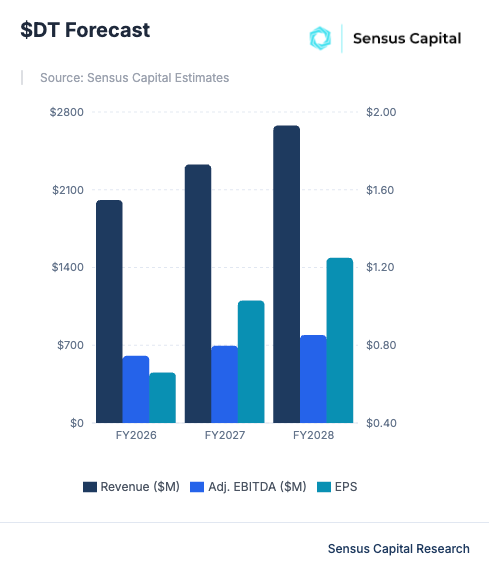
Using our internal models, assumptions, and analysis, we arrive at the following conclusion regarding our outlook for Dynatrace DT 0.00%↑.
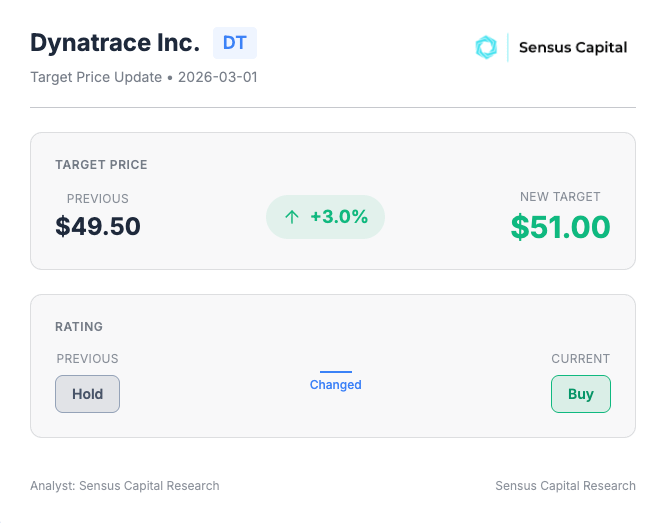
The combination of a proven financial model, a management team with a track record of enterprise scaling, AI as a structural demand tailwind, and a valuation that has been compressed by indiscriminate sector selling creates an attractive risk-reward at current levels.
We are actively building a position at the $35-37 range and would add aggressively below $32.
Key Watching Points:
We will be monitoring three specific metrics to confirm the thesis is playing out:
Enterprise adoption through ARR per new logo and ACV deals count
DPS adoption and NRR trajectory
Profitability expansion
Disclaimer: We may hold or trade $DT equity or $DT-related derivatives at any time. The comments and information presented in this post are not investment advice, but opinions. Please do your own research.
Thank you for reading! As all content of Sensus Capital Research is available for now for free, subscribe to not miss out on any of it in the future and pledge your support to secure your exclusive perks for even more analysis and reports!
Best returns,
Sensus Capital Research
No posts
Comments
Nothing yet. Say the first thing.
Sign in to join the conversation.