
IN THIS ISSUE
AI enables personalized disease risk prediction to manage health
GFAP makes MS trajectory more predictable
Next-generation AI still produces racial and gender stereotypes

AI’s superpower is its ability to find patterns across diverse data sets. If we use that superpower to its maximum — by analyzing our genetics, past behavior, the environment we live in, and the history of our interactions with the healthcare system — we ought to be able to find predictive patterns. The holy grail would be the ability to use personalized health predictions to take tailored, pre-emptive preventative actions.
Real progress is being made toward this goal. Two recently published models (one last November and one this month) seek to integrate genetics with electronic health record data to calculate a personal health-risk profile. The profile could then be used to design a plan to maximize health over time: what to be screened for, when and how often; which preventative drugs to take and procedures to undergo; which behavioral changes to make.
The more recently published model starts by finding disease signatures (things that typically go wrong as we age). It then assembles a tailored mix of them for each person (their portfolio of comorbidities) and predicts what each person is at risk of developing both in the next year and up to 10 years out. The model was much more accurate than traditional single-disease risk tools (e.g., PREVENT for heart disease).
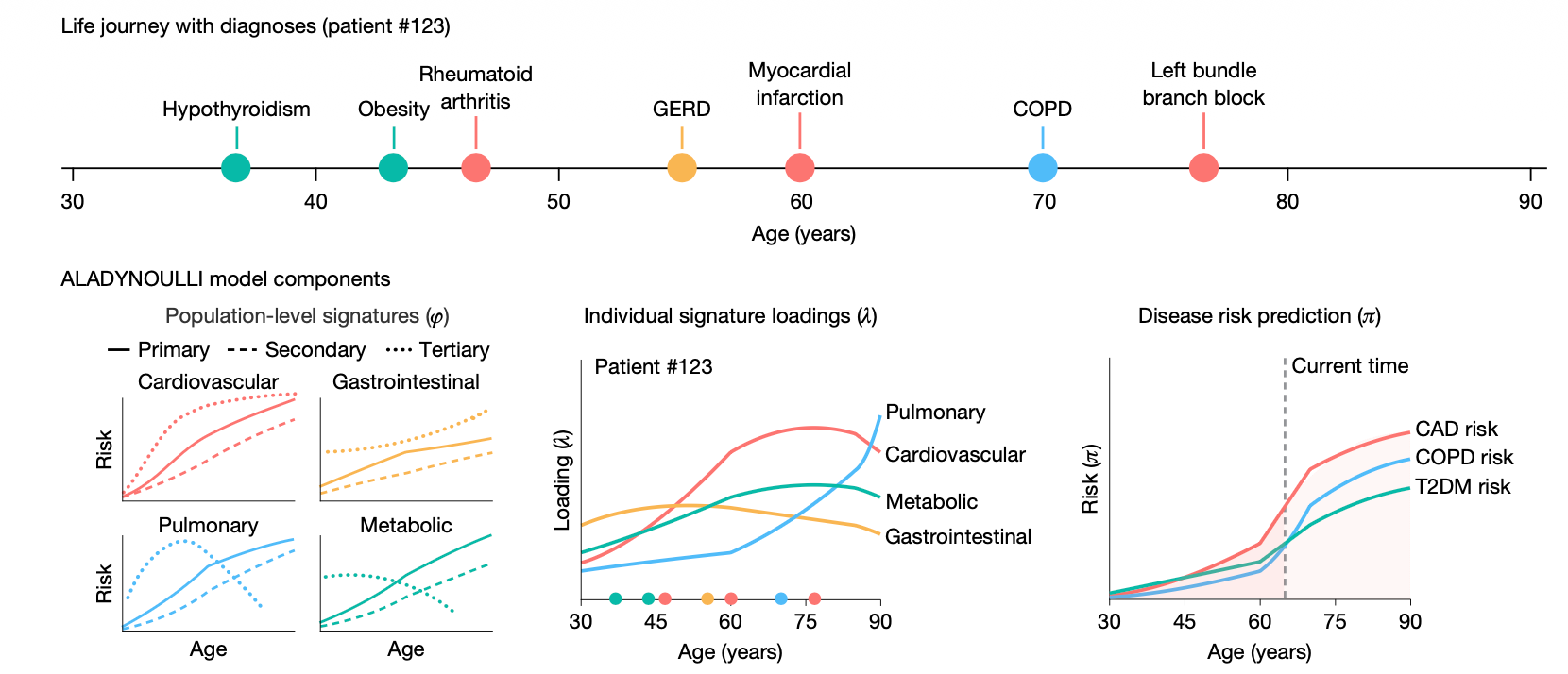
COMMENTARY: The tragedy of 21st-century healthcare is that in spite of all its advances and technology, at the patient level it leaves a lot to be desired. The system remains predominantly reactive (because doctors are paid for procedures, not prevention). In addition, it’s episodic, siloed by physician specialty, and has a severe long-term memory problem.
For patients up to age 30 or so, this is a reasonable approach. But beyond that, these failings become increasingly important. This study shows the way forward for primary care: personalized risk assessment based on longitudinal, dynamic, multi-omic, multi-dimensional data, generating clinical predictions that inform interventions to maximize healthspan.
On its “What is MS?” page, the National Multiple Sclerosis Society defines MS as “a chronic, unpredictable disease of the central nervous system.” Most commonly, MS progresses in a “relapsing-remitting” fashion: Periods of remission punctuated by episodes in which the disease reappears and things get worse. But for some people, progression simply plods on, without remission. Unfortunately, just as the National MS Society says, it’s hard to predict which version a patient will have — and someone who starts in one camp may eventually switch to the other, also unpredictably.
MS is generally thought to be an autoimmune disease in which the body’s attacks on its own nervous system cause inflammation in the affected tissues. We already have a biomarker for that: neurofilament light chain (NfL). But while high NfL levels tell you that the patient’s neurons are inflamed and that a relapse is imminent, they don’t tell you whether the patient’s disease is about to progress or not. Until recently, we didn’t know of a biomarker that could make that call.
According to a paper that appeared in JAMA Neurology earlier this month, we might have one now. It’s glial fibrillary acidic protein (GFAP). We already knew that patients with high GFAP levels were likely to have progressive disease eventually. With this study, we now know that MS in folks with high GFAP levels is 40% more likely to progress within the next year. In addition, when GFAP levels decreased in patients receiving treatment for MS, their likelihood of disease progression decreased, as well.

The idea behind an electrochemical sensor is simple: It’s made of a material whose measurable electrical properties change when it binds to a chemical that drives or reflects a specific disease. In practice, it’s very hard to design a sensor that only binds to one thing. Generally, the more sensitive the sensor, the more stuff sticks to it, most of which you don’t want.
Last week, we highlighted one electrochemical-sensor-based device that manages this trick: It measures ketones in breath (they rise when the body burns fat for energy). This week, we came across another: a sensor that can measure dopamine levels in tears. Those levels directly affect mood, and low levels are also the key driver of Parkinson’s disease. To a lesser degree, low levels of dopamine also drive schizophrenia, Alzheimer’s disease, and depression.
COMMENTARY: Over the past several years, many less-invasive tests based on non-traditional analytes have been found to be just as effective at diagnosis as techniques that rely on traditional samples. Two good examples: Using blood instead of tissue to diagnose or monitor cancer (aka liquid biopsy), and using plasma instead of spinal fluid to identify brain disorders. At the same time, novel materials research is enabling the creation of selective and sensitive electrochemical sensors that can do for pennies what previously cost hundreds of dollars. This is a great thing, as lower-cost, less-invasive tests increase access, which can then drive adoption and earlier treatment.
If you or I had to have some aspect of our health monitored using a wearable device on, say, our upper arms, we probably wouldn’t think twice about it. We’ve all seen people wearing glucose monitors there, right? How about on the chest or belly? Sure, fine — it’ll be under a shirt, what’s the difference?
How about on your face?
I don’t know about you, but I might want to think about that one.
That’s exactly why a group of researchers have developed a skin sensor that is effectively invisible. They’re incredibly thin, stretchy electrodes — so thin, they not only can’t be seen, they also can’t be felt (see image). And yet, in tests, they could be used to measure electrical activity in the eyes, facial muscles, and brain (EEG). In fact, in some cases they did a better job than conventional gel electrodes.
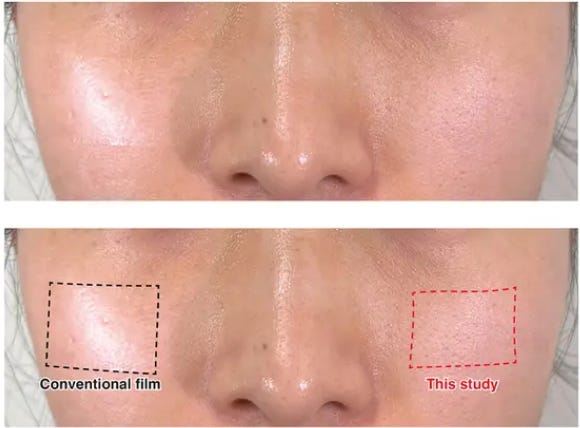
Of course, there’s one group of patients who might want to be able to see sensors on their faces — if they looked like, say, dinosaurs. Or maybe butterflies.
For those kiddos (and other body-art enthusiasts), there are paint-on electrodes — think temporary tattoos that can measure electrical impulses.
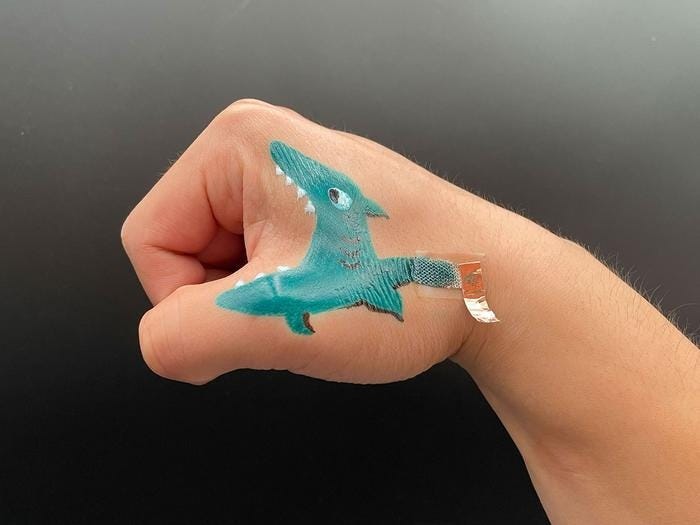
Painting the electrode onto the skin serves a functional purpose as well as an aesthetic one. The conductive, polymer-based ink is applied to the skin while it’s wet, so it adheres to every crevice and flows underneath hairs. That gives it the best possible contact with the skin, without any air gaps. Once it dries, the material is stretchy, so the wearer can move without dislodging it. And it’s porous, so sweat can flow right through it. How sure are the researchers that it works? They’re sure — one of them even wore one during their exercise routine.

Back in 2024, research showed that when GPT-4 (the second foundation model behind ChatGPT) was asked to describe fictional patients with various medical conditions, it frequently reproduced racial and gender stereotypes. Things haven’t gotten any better over the past couple of years.
When researchers tested newer models o3-mini and DeepSeek-R1, which are supposed to be better at reasoning, the results were the same or worse. Where GPT-4 demonstrated racial and gender stereotyping for 67% of the medical conditions it was faced with, the newer models showed racial stereotyping for 78 – 89% of medical conditions and gender stereotyping for 56 – 67% of conditions.
No posts
Comments
Nothing yet. Say the first thing.
Sign in to join the conversation.