
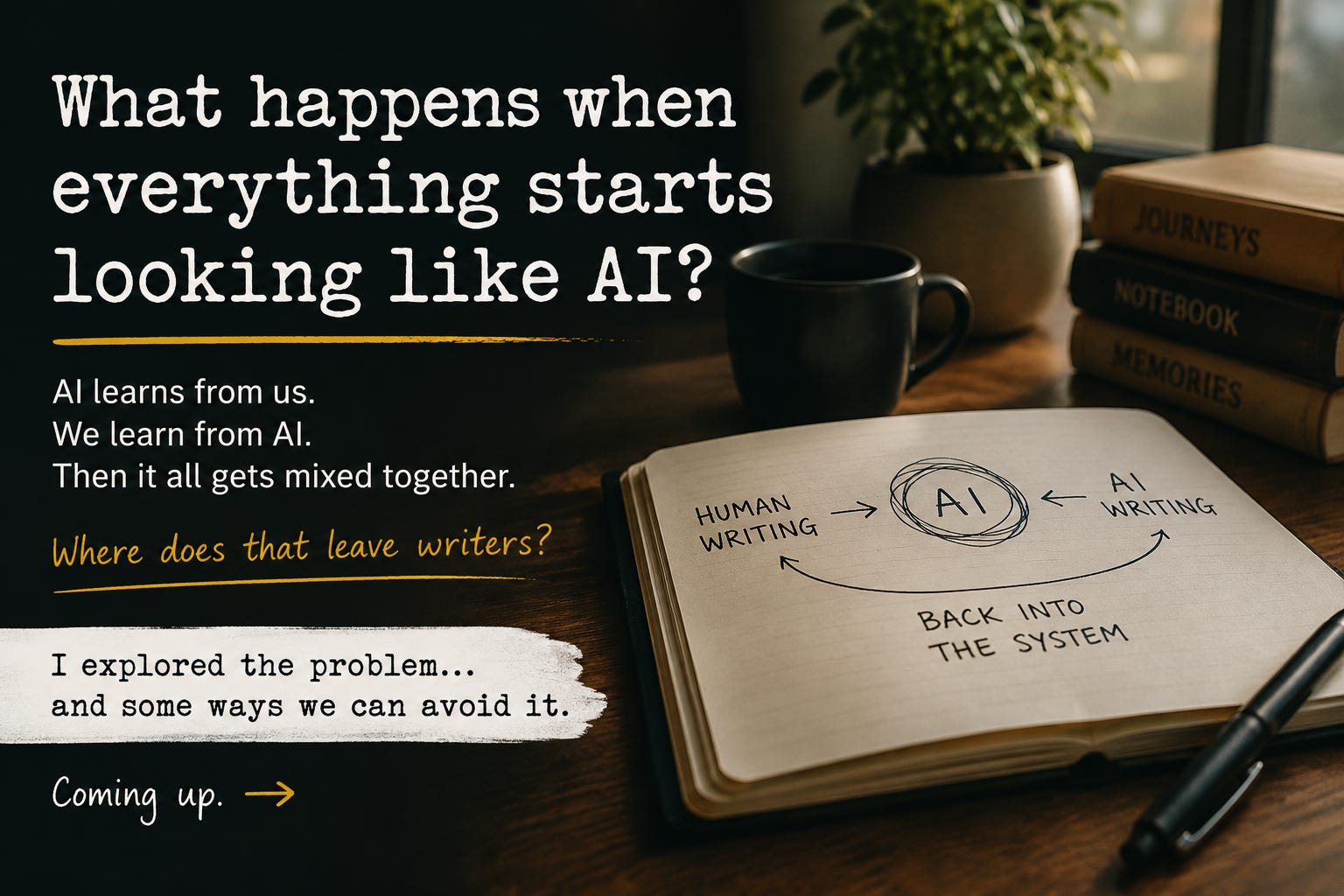
I keep thinking about something that feels slightly ironic. AI learns from us. . . our books, articles, blogs, conversations, research and probably billions of fairly ordinary things people have written online over the years. Now we are increasingly using AI ourselves, not necessarily to write everything for us, but to research, edit, check facts, organize ideas, find the word that has temporarily disappeared from our brains and occasionally tell us that a sentence really is as confusing as we suspected.
Then we publish what we have written, and presumably some of that eventually becomes part of the enormous amount of material future AI systems learn from. Humans influence AI, AI influences humans, and all of it gets tossed back into the same rather enormous pot.
Where does that leave us five or ten years from now? I have a feeling we may eventually reach the point where almost everything looks vaguely AI-generated because nobody will be quite sure anymore what supposedly “AI writing” looks like. We will have influenced it, and it will have influenced us.
This is one reason I have very little faith in the current obsession with AI detectors.

We are trying desperately to draw a line between human writing and machine writing while simultaneously making that line blurrier every year. I can write a paragraph, ask ChatGPT to tighten it, reject half the suggestions, put my original ending back, ask it to check a date, and then decide I prefer the whole darn thing before I start messing with it. Is the finished paragraph AI-generated? I don’t think so. It is still my story, my opinion, and sometimes, unfortunately, my sentence structure.
What worries me more is not whether we use AI but whether we allow it to slowly make all of us sound the same. There is a particular polished style that creeps in very easily. Everything becomes beautifully organized. Every paragraph knows exactly where it is going. There is always a lesson at the end, and apparently nobody ever wanders off topic, changes their mind halfway through or remembers something completely unrelated that turns out to be the best part of the story.
I don’t write that way, and frankly I don’t think most people think that way either. But every time I ask AI to review for grammar (instead of using Grammarly), it comes back “perfect”.
Motivational sayings and posters have been around for years. There isn’t much new here. People read them, love them, and requote them. They are in many ways just platitudes that predate AI.
A platitude is a statement that is seen as trite, meaningless, or prosaic, aimed at quelling social, emotional, or cognitive unease. The statement may be true, but its meaning has been lost due to its excessive use as a thought-terminating cliché.
Platitudes have been criticized as giving a false impression of wisdom, making it easy to accept falsehoods:
Wikipedia · Text under CC-BY-SA license
I don’t think the answer is to stop using AI. That would be a bit hypocritical coming from me because I use it all the time. The answer, at least for readers, is we need to be better educated to be discerning and challenge our assumptions. This, of course, is a whole other discourse beyond the scope of this essay.
But I do have a thought on what we as writers, and we all are in one way or another, need to become much more protective of what we put into it.
If I’m writing about hiring a driver in Morocco twenty years ago, I should be the one bringing Morocco to the page. I remember roughly what happened, what I paid, what surprised me and why the day has stayed in my memory. ChatGPT wasn’t there. It can help me figure out whether €60 twenty years ago was affordable, clean up a confusing section or check something I’ve forgotten, but it shouldn’t be inventing my memory for me.
That may be one of the most important distinctions we need to make. Use AI to help with the writing, but don’t outsource the experience.
I also think we need to stop accepting every improvement it suggests simply because the new version sounds more polished. I have caught myself doing this. A perfectly decent paragraph comes back smoother, more elegant and somehow less like something I would ever say. These days I am much more likely to put the awkward bit back in.
There is nothing wrong with an occasional clumsy sentence. I repeat myself. I wander off on tangents. Sometimes I start writing about hotel points and end up talking about why I travel in the first place. That is not necessarily something that needs fixing. It may actually be the thing that tells you there is a person sitting behind the keyboard.
I don’t mean we should deliberately make our writing worse to prove we are human. Adding spelling mistakes and mangling sentences so an AI detector gives us a gold star for humanity would be ridiculous. I simply think we need to resist having every rough edge polished away.
The other thing we can do is keep creating original material rather than simply recycling what is already online.
Take your own photographs. (That may even include some selfies. 😱 )
Keep written travel notes.
Track what something cost.
Record a quick voice memo when something strikes you as funny or odd.
Write down what the taxi driver said, or why you hated the famous attraction everyone else adored.
Note why some completely insignificant café became the thing you remember most about a city.
Those little details matter because they are yours. They didn’t come from the first ten Google results, and they weren’t assembled from what thousands of other people have already said.
We also need to become more comfortable saying, “I don’t know.” I have travelled to places I still don’t quite know how I feel about. I’ve changed my mind about destinations, hotels, cruises, expensive experiences and supposedly terrible tourist attractions. Sometimes there isn’t a clever lesson waiting at the bottom of the page. Maybe something happened, I thought it was interesting, and I wanted to tell you about it.
And that brings me back to AI detection. The more AI learns to imitate human writing, and the more humans use AI as part of their normal writing process, the more the whole idea of detecting it becomes moot at some point. I can imagine an AI detector examining half the internet and confidently announcing that 97% of it was probably written by AI, including a few things written before computers existed.
Maybe we are asking the wrong question altogether. Instead of obsessing over whether AI touched a piece of writing, I’d rather know whether the person has something worth saying, the facts are reasonably accurate, there is some original thought or experience behind it, and the writer is willing to put their name on it.
I use AI, and I’m not embarrassed about that. It saves me enormous amounts of time on research, editing, fact-checking and all sorts of things I don’t particularly want to spend my day doing. What I don’t want to do is decide what I noticed, what I thought about it or what story I want to tell.
Those bits are mine, including the slightly messy ones. And perhaps keeping them slightly messy will become more important than we realize.
Disclosure: This was identified as 89% AI-assisted. Go figure; I think I only deserve 35% 🤔😎🤷♂️
Comments
Nothing yet. Say the first thing.
Sign in to join the conversation.