
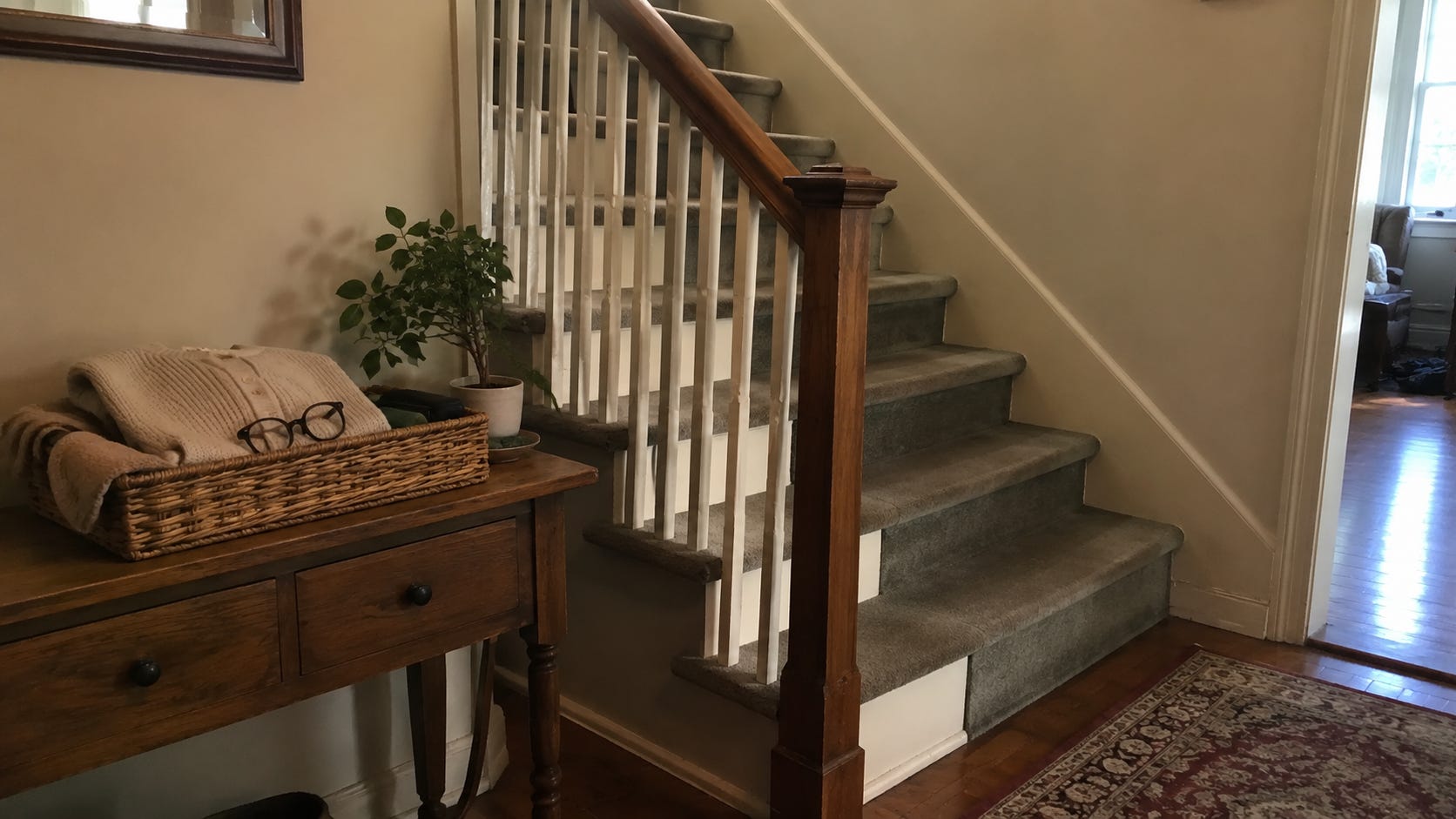
Nobody decides one morning to stop using stairs.
First you hold the handrail. Then you pause halfway up. Then, when there’s an elevator, you take it. Not because you can’t do the stairs. Just because today you’d rather not.
One day, without really noticing, you’ve organized your life around avoiding them.
When I published the first stair article, I could only focus on one question because the test itself already needed careful explanation. Turning one study into useful advice can be a challenge here, but nowadays, any number that sounds simple will become a rule, warning, or diagnosis. The researchers were more cautious about the result, but someone has to turn a limited study into a universal test, I guess, so why not make it ninety seconds?
During article follow-ups, such as this one months after the four-flight test, I’m usually back inside the research and find myself surrounded by possible explanations, and have to resist treating all of them as the same problem. But alas, I can only follow one thread at a time, and this one is the moment people start avoiding stairs.
I was not only interested in the 16,102 views and the reach of the article, but noticed what the stopwatch left out, which is often the point where convenience starts blending into avoidance.
As I looked more closely at the change, some of the reasons people might give themselves contained at least one explanation that sounded perfectly reasonable, and would be easy to accept. The elevator that was already waiting called for no extra effort. The bags in your hands made the stairs feel unnecessary for that day (which is understandable).
The next time I went back to the paper, I realized the participants were not healthy volunteers taking a home test. Important! They had already been referred for heart testing.
What stayed with me was the number, of course because 60 seconds and 90 seconds are easy to remember. But the paper was not really saying that, in effect, one time means healthy and the other means disease. It was showing that a staircase can expose something a resting appointment may never ask your body to do.
There’s more to stair decline that we’ll consider in the future, but the reason why it’s important is this. If someone is avoiding stairs because of breathlessness, weaker legs or poor balance, then the advice to ‘take the stairs more often’ is horribly incomplete. Instead, we need to identify what changed and deal with it in an appropriate manner, eg. cardiovascular assessment, strength training, balance work. What we need less of, is the casual reassurance that says ‘It’s just age. Use the elevator. Be careful’.
Stair avoidance is a relatively neglected area of discussion. Certain changes are easy to notice: a fall, chest pain, severe breathlessness for example. A gradual loss of stair ability is characterized by repeatedly choosing another route despite the person knowing they could probably still manage the climb. The person knows full well that stairs were easier a few years ago. Despite this, they continue to avoid them. It is an adjustment, not necessarily laziness. Certain changes have this characteristic, while others don’t. We may notice a sudden injury, but not the slow disappearance of an ordinary movement.
Stairs can also become intimidating. This may not be recognized until someone begins planning the day around them, when the choice of parking space, restaurant or hotel starts to depend on whether steps are involved. Ordinary walking almost never exposes the whole problem. We are almost never concerned while walking across a flat supermarket floor. However, think about how many people might say “I’m fine walking” or “I still walk every day” or “my legs are strong enough”. Until there is a staircase.
Again, we’ll cover this more in the future. Why is this important? Because different causes of stair decline must be handled differently. Think how utterly useless the advice to ‘Take the stairs more’ is to somebody with chest pain. Or ‘push through the dizziness’. Or ‘just hold the rail’. When people avoid stairs because of a medical problem, the reason must be assessed first, not just give some casual advice to ‘use it or lose it’. Stair avoidance is closely related to our next area of consideration.
Routine avoidance is a pattern not generally thought of as a health issue. The problem with repeated avoidance is that it short circuits around our regular exposure to the movement. If you take the elevator, for example, even when one flight would be manageable, you might easily go weeks without climbing stairs and not notice the loss of practice in the least. This is because the easier route is built into modern life.
Why is this important? Because if your problem is that you’re using stairs less and less, then you need to restore safe exposure, not ‘wait until they become impossible’. Finding the root cause of the problem leads to lasting solutions.
Many people never actually decide to stop using stairs. They avoid them because they have been trained to avoid them. Think about modern buildings. Sometimes it is very hard to find the stairs at all. As adults, we always assume that choosing the elevator saves effort, even in our current environment where movement is already being removed from daily life. When stairs feel inconvenient, we remove them from the routine. “Take the elevator!” “Park on the ground floor” “Don’t tire yourself out.” No, instead, remove the exact movement you are trying to preserve so that it becomes harder the next time. Great idea, Sherlock.
I remember thinking about this after the first stair article. The test asked people to climb four flights, and many readers focused on the time. I looked back at the argument. The stopwatch was useful. But it started after the choice had already been made. Why, I wondered, do we wait until someone tests the stairs before asking whether they have stopped using them?
We often avoid stairs as part of a routine. Elevator, ground floor and closer parking. People tell you that you should save your knees, even if the stairs are still manageable. People tell you that you should never, ever make yourself breathless or you’ll hurt yourself. You should never climb if an elevator is available or you’ll wear yourself out. In a surprisingly common conversation, even family members may suggest that taking the stairs is unnecessary at your age.
Once we get stuck in a routine or habit, we’ll often choose the elevator just because we expect to use it. Avoiding stairs when you are still able to climb them is not a particularly good strategy for preserving stair ability. Your body doesn’t receive the demand. You don’t give your balance or legs any reason to adapt. Yet, you still expect the ability to remain there? Why? What will preserve it if the movement disappears?
The solution is to understand that stair use is linked to your habit and to Choose Deliberately. This takes some attention but it’s worth it. Learn to notice the choice before the stairs become impossible. Once again, this is vitally important because if you are avoiding stairs due to routine, then you need to change that routine, not get the casual advice “just use the elevator”.
For some older adults, this eventually becomes part of a nursing home assessment. Not because one flight of stairs caused the problem, obviously, but because the question “can you manage the stairs in your own home?” is one of those ordinary questions that can decide whether going home is considered safe. I’m not saying this to frighten anyone, because the important part is the time between those two moments. “I just take the elevator now” can happen years before that assessment. Years in which somebody might still notice the change and ask what is causing it.
What to do next depends on why the stairs have become harder. If the problem is chest pain, dizziness or unusual breathlessness, the answer is obviously not to force another flight. But if the change is ordinary loss of fitness, leg power or confidence, then one safe flight with the handrail is more useful than avoiding every staircase. I know that sounds obvious, but this is exactly where the advice usually becomes muddled.
If stairs have become harder because your legs feel weaker or you have lost some of the power you once had, avoiding them will not rebuild that capacity.
The Complete Power Training Protocol gives you an eight-week structure for training leg power at home, with five exercises, modifications for knees, balance and arthritis, and a weekly tracking sheet.
Already a paid subscriber? Access the members-only protocol here
Prefer a one-time purchase? Get the complete protocol here.
Sources: Peteiro et al., four-flight stair test and exercise capacity (Revista Española de Cardiología, 2021); Reid and Fielding, muscle power and physical functioning in older adults (Exercise and Sport Sciences Reviews, 2012).
Stay independent. Stay capable.
Comments
Nothing yet. Say the first thing.
Sign in to join the conversation.