
So I got a new job a month ago. I feel like the new rule for me with new jobs is that I have to write something about why I’m 100% sure this one is going to the moon. And I’m going to admit that ClickHouse feels like the most rocketshippy of the rocketships I’ve had the opportunity to be involved with. That said, ClickHouse is a bit of a different flavor for me. This is actually the latest stage I’ve ever joined a company (though they still let me have natty@, which would have otherwise been a dealbreaker), and historically, I’ve been very valuation-sensitive. I have made some terrible financial career decisions by getting too wrapped around the axle around perceived upside. ClickHouse raised their most recent round at an eye-popping $15B valuation, and me from 10 years ago would have said “hard pass, I can’t make any money on that.” Fortunately, today Natty is a little more willing to look past a big valuation, and the more I dug in, the more convinced I became that ClickHouse is going to be the best career bet I’ve ever made. Let me show you why.
If you haven’t subscribed yet, you can get thoughts and musings about personal finance and whatever else I find interesting straight to your inbox by clicking here:
First things first: What the heck is ClickHouse?
At its core ClickHouse is an analytical database. For the people who don’t really know what a database is, it’s kind of like an Excel spreadsheet. There are tables and rows and columns. If you want more of a foundation than that, I offer you ChatGPT (though if ChatGPT’s explanation involves the phrase ‘in the ever-evolving landscape of data management,’ close the tab immediately). Beyond that, there’s basically two primary types of databases: transactional and analytical. Transactional typically means you’re keeping stateful information that changes a lot. ATM networks are like a canonical example of these, because you’ve got many customers with many accounts, and they can do things like check their balances, or withdraw money or deposit money, which basically just updates the current balance in their account. Lots of changes to individual accounts. Analytical means you’re crunching a shitload of historical data to answer questions. Sticking with the ATM analogy: it’s not “what’s my balance?” but “how much money moved through every ATM in the country today?” Different question, wildly different scale. ClickHouse is the latter of these two. It’s really good at processing large amounts of data, and in particular, it’s really good at processing large amounts of data really fricking fast.
Why is ClickHouse so fast, you may ask? Well, when you get down to brass tacks, database performance really comes down to one key factor: how fast you can move data from where it’s stored to where it can be processed. Think of it like a warehouse with a single loading dock – no matter how many trucks you have, only one can pull up and load at a time, and each truck can only carry so much. The speed of that loading dock is basically fixed. This is what database engineers mean when they say a system is “disk-bound” — the bottleneck isn’t the processing, it’s the loading dock.
So with that knowledge in hand, you may ask: well how does ClickHouse make the loading dock faster? Do you have magical powers that defy the laws of physics, or do you spend outrageous amounts of money on attaching petabytes of SSDs to your servers? The answer is neither. Instead, we pack the same amount of stuff into smaller boxes – we compress the data.

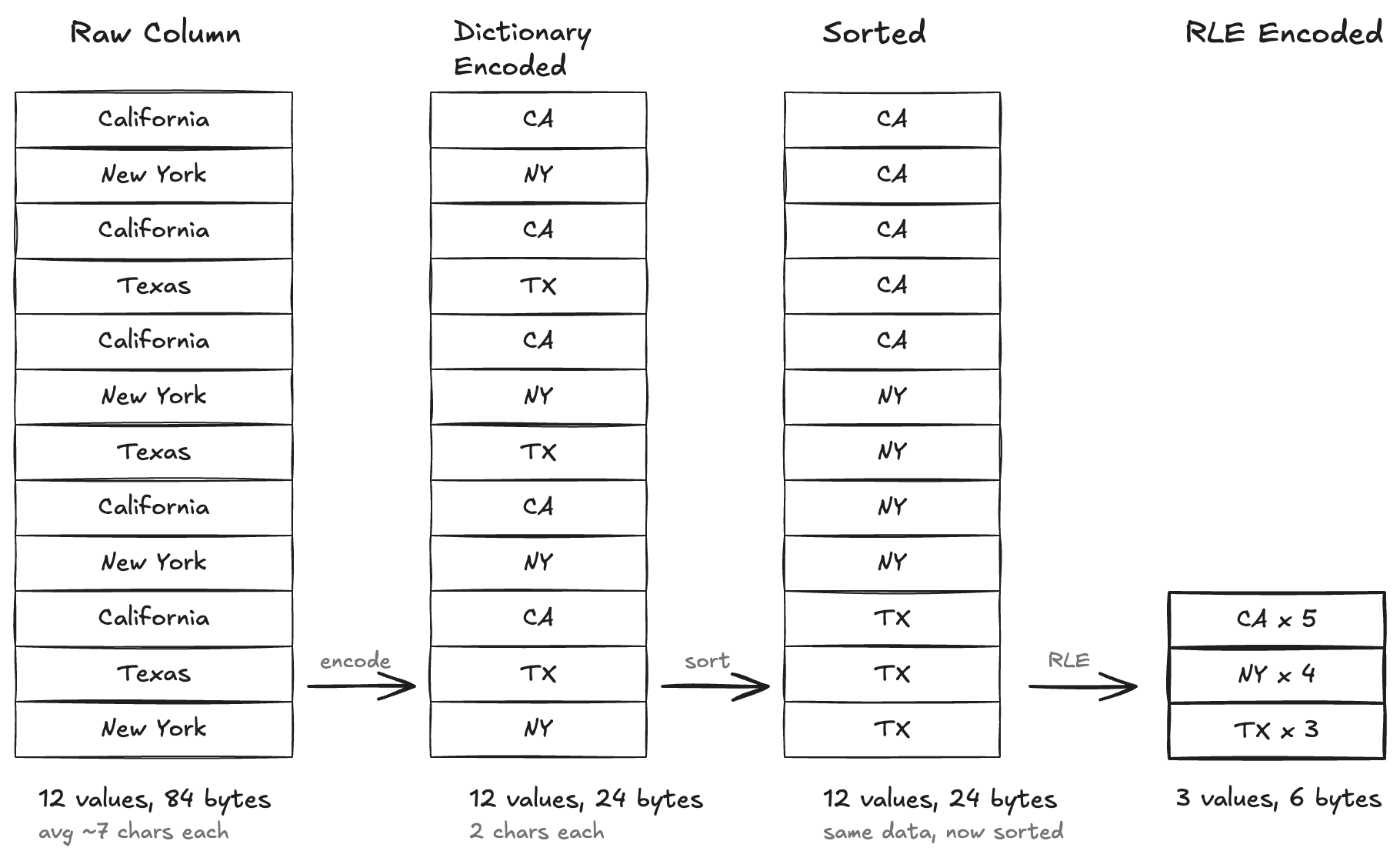
An important thing to call out about ClickHouse is that it’s a columnar database, which means it stores column data as individual files (the alternative, which is what a lot of transactional databases are, is a row-oriented database that stores data for rows all together – they’re good at their jobs for different reasons). To illustrate why columnar data is heavily compressible, let’s talk about a column containing US states – there’s 50 of them. Even if you have 1B rows in your database, there are only 50 possible values for what can be in that column (you may have a 51st value – no, not Canada – which is essentially a blank entry, called a null value). Basic compression algorithms work by taking a set of characters and representing them as something smaller. So instead of Alabama, I might encode Alabama as the number 1, and Wyoming as the number 50. Then I can represent a column with numbers that take up fewer characters on disk than if I had the full text for every column value.
You can also stack different encoding and compression techniques to go even further. There’s a popular encoding technique called Run-Length Encoding, which essentially stores a value, and then the number of times that the value appears in a row. If you sort your column data first, you can essentially store a huge amount of data in a teeny, tiny file. The more you compress the data down, the faster you can read it back off of disk to answer questions, and sometimes, you can actually use the encodings to speed up the data processing, as well.
So now you’re probably thinking – this is a damn good idea. How come nobody ever thought of this before? Well, they did. There’s actually a lot of columnar databases out there, including Redshift, BigQuery, Snowflake, Vertica and a whole host of others. So ClickHouse is not the first columnar database. It’s not even the only fast one. What makes it different is that ClickHouse treats speed as a near-religious conviction rather than a feature on a marketing page. Most databases are fast enough. ClickHouse looked at “fast enough” and took it as a personal insult.
ClickHouse’s Open Source Model
One of the key elements in ClickHouse’s future success is its open-source business model. Building a robust open-source business is extremely non-trivial. There’s very few companies that have successfully transitioned from private to public companies with an open-source model. The majority of them have managed to do it by leaning heavily on selling support for their open-source software (Confluent, Redis, MongoDB all great examples), and often later moved to selling a PaaS offering to drive more cloud-native revenue. However, many of the companies that have managed to make it onto the public markets have also struggled once they got there. Cloudera limped along before being taken private, Confluent and HashiCorp are both currently being sucked into the big blue hole of IBM.
You can often see the signals that the business is experiencing challenges early on. The playbook goes like this: you build a popular open-source project, and you use a license like Apache 2.0, which lets anybody build on top of your software (this is helpful for building popularity). People find your project and get excited. Lots of people start using it. You start monetizing it through support and a managed cloud service. AWS notices. AWS builds a managed version of your thing (which they can do because your Apache software license legally allows them to do so), undercuts you on price because they own the infrastructure, and now you’re competing with a trillion-dollar company selling your own technology back to your customers. So you change your license to something that doesn’t allow competitors to build their own version of your product, which protects your IP but also signals to the market that you couldn’t figure out how to build a business that was differentiated enough to survive the hyperscaler onslaught. At this point, “we’re changing our open-source license” is basically the startup equivalent of “we need to talk.” Nothing good follows.
The core problem is that many of these companies have an open-source offering that has limited differentiation between their open-source offering and their Enterprise, managed offering, or they can’t beat the scale economics that hyperscalers like AWS and GCP can bring to bear when they go hard into a space, so they struggle to compete.
Databricks is a good example of a company where I think they’ve done a much better job of traversing the OSS minefield. Databricks started as a Spark company, but most practitioners probably don’t think of them as a Spark company anymore. They’re a data company, and they’ve built a massive amount of proprietary IP around the original kernel of Apache Spark. They’d also probably argue that they have a strong commitment to open-source, which I don’t disagree with, but they kind of treat open-source as a fallback option once there’s a competitive reason to open-source. As a couple examples, their Delta Lake file format started proprietary, and then open-sourced it when Iceberg became a serious competitor (and then they bought the Iceberg project when it became clear that Delta Lake was losing the battle). Similarly, Unity Catalog started proprietary, and they more recently open-sourced it. Notably, Spark is still Apache 2.0-licensed (although their more expensive, faster version of Spark, called Photon, remains proprietary), Databricks is clocking $6.5B in annualized revenue, and growing at >50%. That’s an accomplishment.
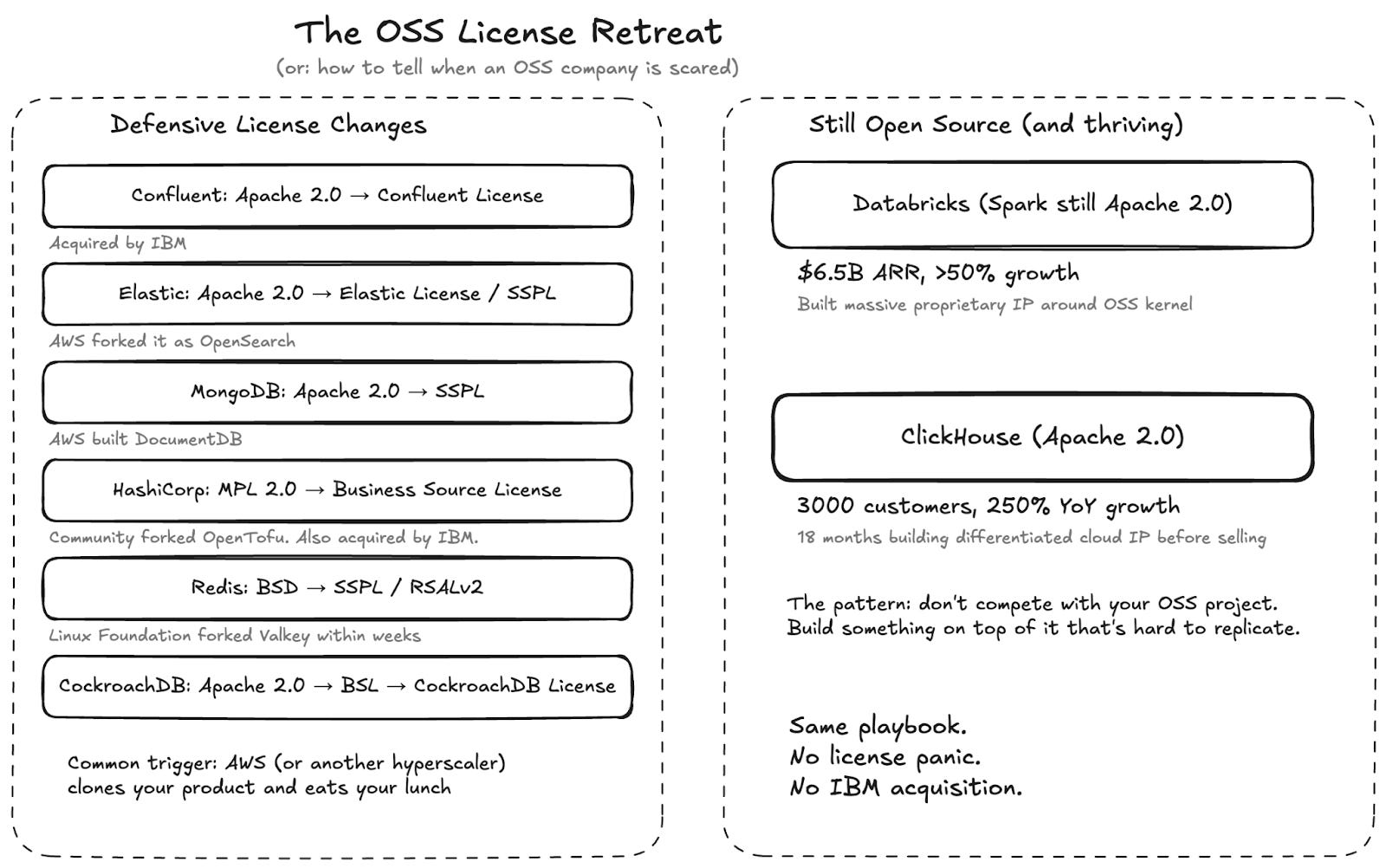
How this all ties back to ClickHouse is that ClickHouse’s approach to open-source is much closer to Databricks’ than, say, Confluent’s. When ClickHouse was incorporated as a commercial entity, they didn’t go to market with open-source ClickHouse. They put their heads down, and for 18 months, developed differentiated IP that took the open-source ClickHouse from a product that was extremely capable, but also extremely difficult to scale into a commercial product that has the open-source as a core, extended with difficult-to-replicate foundational IP that made ClickHouse into an inherently-cloud-native database technology. As a result, ClickHouse is able to truly benefit from the open-source funnel of wide distribution that actually converts to durable, paid customers.
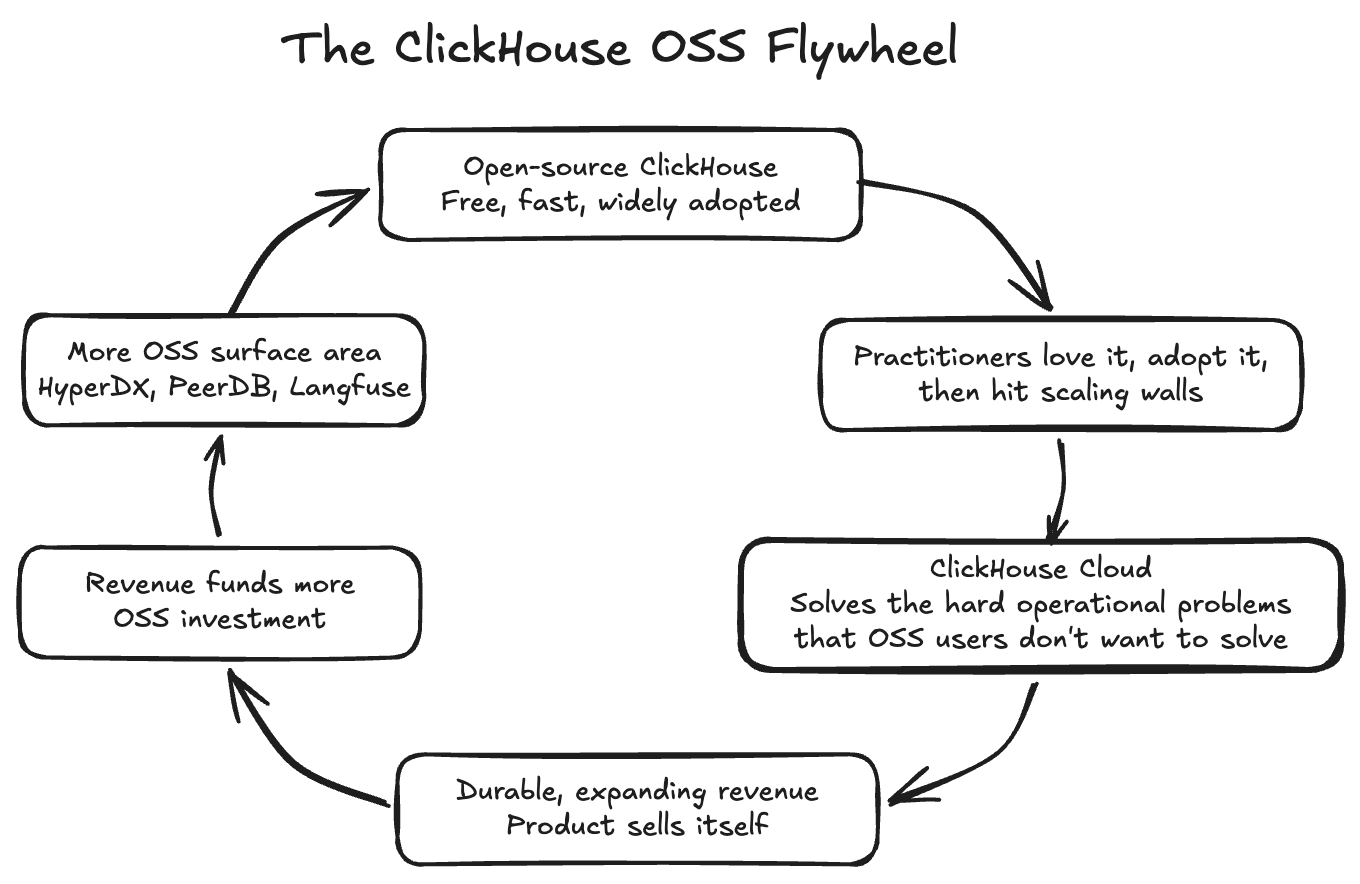
One thing that is a little bit different from Databricks is that, where Databricks has remained loyal to Spark’s open-source roots, the vast majority of their product portfolio is proprietary and closed-source at this stage. ClickHouse has made very intentional investments via acquisition, such as LibreChat (a chatbot front-end), HyperDX (a visualization tool for observability, competitive with Grafana), PeerDB (Postgres replication tool), and most recently Langfuse (LLM observability), and, notably, all of those are, and remain, open-source projects.
Extreme PMF in an enormous market
The bet on this open-source, but differentiated strategy has paid off in spades. As far as I can tell from early customer conversations, customers love ClickHouse’s product (which makes my job a lot easier, thankfully), and the logo list is incredible. ClickHouse is experiencing extreme product-market fit, and you can see it in the metrics they publish.
There are no published revenue numbers, so I’m going to stay away from those. That said, the company has been selling ClickHouse Cloud since December 2022, and by June 2024 (about 18 months later), they estimated to have crested 1000 customers. In May 2025, a year later, ClickHouse announced its Series C, and claimed 2000 customers and 300% revenue growth. The Series D was announced in January 2026, about 8 months later with 250% YoY revenue growth, and the company had grown to 3000 customers.
The pace is accelerating dramatically. And here’s the part that broke my brain a little: the company has zero SDRs. Not a lean team. Not an “efficient” outbound motion. Zero. Three thousand customers, 250% revenue growth, and nobody is cold-calling anyone. The entire pipeline is inbound.

That is the open-source distribution, and the defensible, differentiated Cloud IP doing exactly what it’s supposed to do.
But the inbound pipeline alone doesn’t explain why the revenue sticks. It sticks because of what customers are actually buying. This isn’t BI tooling that sits under a CIO’s cost center budget – the kind where procurement spends six weeks negotiating a 3% discount on a dashboard nobody opens. ClickHouse’s customers are building real-time analytics into their actual products – the P&L sits under a CTO, it’s part of a profit center, and the willingness to pay is categorically different. That distinction matters when you’re trying to build durable, expanding revenue. On the observability front, ClickHouse sees heavy adoption because the workload is a natural fit — when your production environment is on fire at 3am and your observability tool takes 45 seconds to return a query, you’re not debugging, you’re refreshing a loading spinner and contemplating a career change. ClickHouse is designed to turn that panic back into debugging.
Beyond real-time analytics and observability, ClickHouse is starting to see serious traction in traditional data warehousing and with AI-native companies building agentic infrastructure – both of which are stories I want to unpack properly in a follow-up post because the market theses there deserve more space than a paragraph each.
That market fit is great, but market fit only matters if your market is large enough to support a massive outcome. Conveniently, ClickHouse’s market is something that I would measure in the hundreds of billions of dollars.
ClickHouse competes in a number of arenas – real-time analytics, AI/ML, observability and security, and increasingly, traditional data warehousing. These markets are all massive on their own, but ClickHouse has shown major market fit across all of them. There’s a lot of big existing players that ClickHouse is starting to eat into.
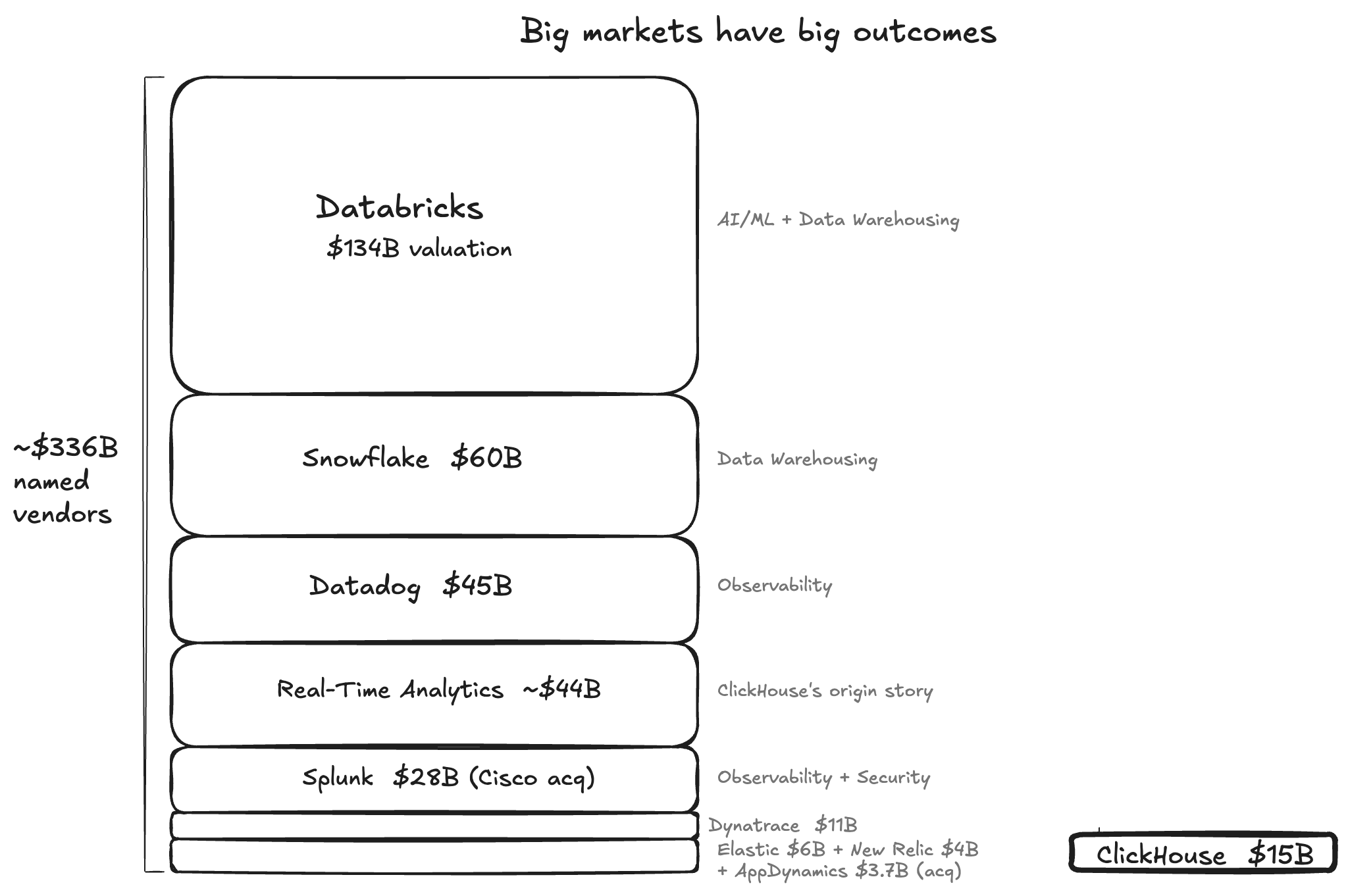
Even before we start to opine on how big the AI/ML infrastructure landscape could be, we’re already somewhere in the neighborhood of $350B in addressable market. Even if my math is off by half, that is a big ass market. And not pictured are things like Redshift and BigQuery, which are massive businesses in their own rights, buried in the AWS and GCP P&Ls. You don’t have to win a big market to have a massive outcome. You just have to show up with a better product and take a piece of it. ClickHouse is showing up.
The executive team is world-class. CEO who took Elastic public as CRO. President who brought Netflix into the cloud era. CRO who led some of the largest PLG/sales-assist motions in the world at Atlassian, Slack, and Dropbox. CFO from Snowflake’s leadership bench. CTO who built the open-source project from scratch. VP Product who led Elastic’s core product lines. I’ve joined startups where the most experienced person in the room was me, and for the sake of the business, that should probably never be the case.

I want to be transparent about something before I wrap up: I work at ClickHouse. I have equity. I have a bias you could see from orbit. Everything in this post was written by someone with enormous financial incentive for this company to succeed. Take it with the appropriate amount of salt. Me from 10 years ago would have looked at a $15B valuation and walked. He would have optimized for entry price, chased a lower-stage company with more “upside on paper,” and spent three years learning the hard way that cap table math is worthless if the business doesn’t grow into its valuation. I’ve done that. More than once. It turns out that joining a rocketship at a high valuation is a significantly better financial outcome than joining a bottle rocket at a low one.
ClickHouse is the bet that the business grows into its valuation. And honestly? After a month inside the building, I think the valuation might be the cheap part. A database that’s genuinely best-in-class fast, an open-source model that’s actually working, extreme product-market fit in a market measured in the hundreds of billions, and an executive team that’s taken companies public before. That’s Part 1. There’s a whole separate conversation to have about why observability is being disaggregated, what the Langfuse acquisition signals about ClickHouse’s AI thesis, and whether a high-performance analytical database can eat traditional data warehousing. I’ll get into all of it. Subscribe if you want to catch it.
I could be wrong. The late-stage bet is inherently riskier in some ways – there’s less room for the valuation to multiply, the expectations are higher, and the margin for execution error is thinner. I know that. But I also know what I’ve seen in the first month, and what I’ve seen is a company that is moving faster and executing harder than anything I’ve been a part of.
And if you’re staring at your LinkedIn profile, mulling your own career bet right now – whether to join the rocketship or the bottle rocket – I’d love to hear from you. My inbox is open. It’s natty@.
No posts
Comments
Nothing yet. Say the first thing.
Sign in to join the conversation.