
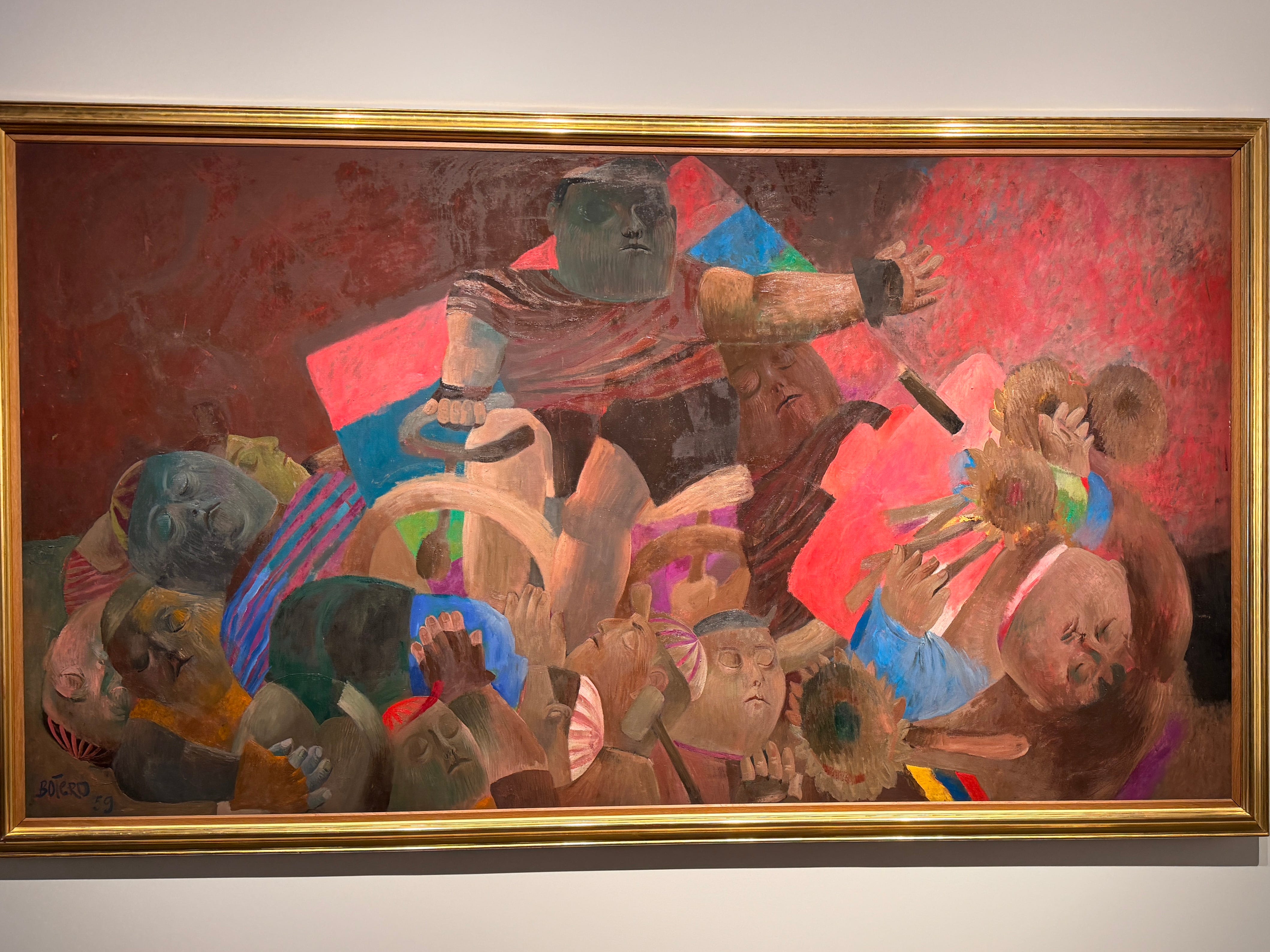
Last weekend, my friend Lilia and I (Claire) went to the Botero show at Sotheby’s, where we planted ourselves in front of The Apotheosis of Ramón Hoyos (1959), a larger-than-life artwork featuring a pileup of cyclists, spectators, and wheels that seems to be more or less taking a piss at physics. Naturally, we tried committing the indignity of trying to reduce the whole thing to a 4:3 aspect ratio but alas, Botero notoriously does not shrink well. Perhaps he’s taking a piss at us.
Lilia stepped back, tried again, squinted at the result, then lowered her phone like a flag at half-mast but make it 0.5x zoom. With no particular buildup, she exhaled: “Do you think photo dumps are dead?” I buffered. “Wait. Bruh I literally JUST posted one.” She laughed.
Surely it wasn’t the first time I’d thought about the slow and painful death of the medium, but it got me thinking…how did we lose the plot? If the whole point of a dump began as quite literally that — a spontaneous download of the visual bits and bobs of life, invented somewhat in revolt against feeds so lacquered you could practically see your reflection in them #poetic — how did it become this much work?
For most of photography’s history, the limitations were obvious: film cost money, development took time, and cameras weren’t always in your hand. A photograph meant some small expenditure of attention and intention.
A “casual” dump now requires combing through hundreds (if not thousands) of photos, agonizing over opener and closer, promoting pic 6, demoting 2, dialing up and down until the final product looks perfectly unconsidered while remaining, from every angle, imperfectly considered. I used to rationalize it as a creative exercise, no different than a mixologist at a Top 50 bar obsessing just as much over the first smell, first sip, and last note of a drink. But then, why are we all making the same cocktail, with every standard pour tasting something like:
A 0.5 selfie (cheeky!)
Recent clothing acquisition(s) (pics or did i really buy anything??)
A dirty martini, or a funky cocktail with something unnameable pickled in it (i’m niche like that!)
Half-eaten plate of steak frites (i have appetite! joie de vivre!)
Three blurry friends in quasi-flash (i have friends! i stay out late! i let my hair down sometimes!)
A bowl of fruit (i’m summoning my inner cézanne! i have an #eye)
Nature, filmed vertically (channeling ansel here! and I don’t mean the baby driver)
A window looking out into unclear landscape (ah the eternal human pursuit of clarity but finding none)
A street sign or license plate with subtle innuendo (broadcasting to all but intended for 1)
One suspiciously good photo, buried under enough visual debris to ward off potential thirst trap allegations (i accept all of me!)
Etc. etc.
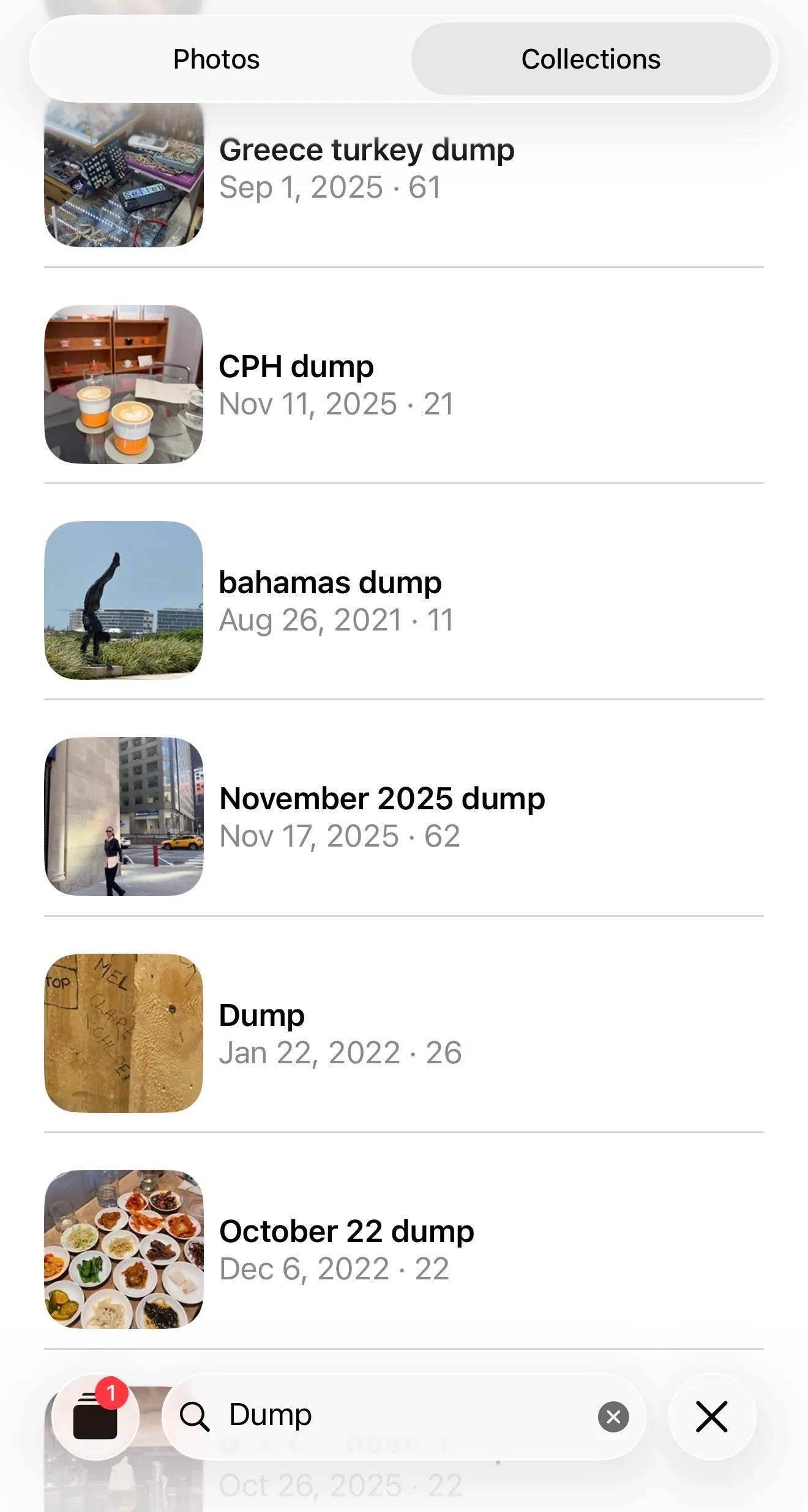
Cultural theorists call the photo dump calibrated amateurism; internet pundits call it performative nonchalance. Whatever the term, we’ve reached the point where trying hard and trying hard not to look try-hard require about the same amount of work. Are we surprised?
I used to rationalize it as a creative exercise, no different than a mixologist at a Top 50 bar obsessing just as much over the first smell, first sip, and last note of a drink.
In the past, the candid shot was more often than not, actually candid, which is exactly what made it special (and therefore credible, or credible therefore special?). And then distribution did what distribution does: it distributed. To everyone. We all learned the grammar of the candid: the flash, the friend caught mid-bite, the finger over the lens, the post-dessert plates, the laissez-faire outtakes of life that were anything but laissez-faire or outtake. Instead, the outtakes became a bona fide, studied shot list.
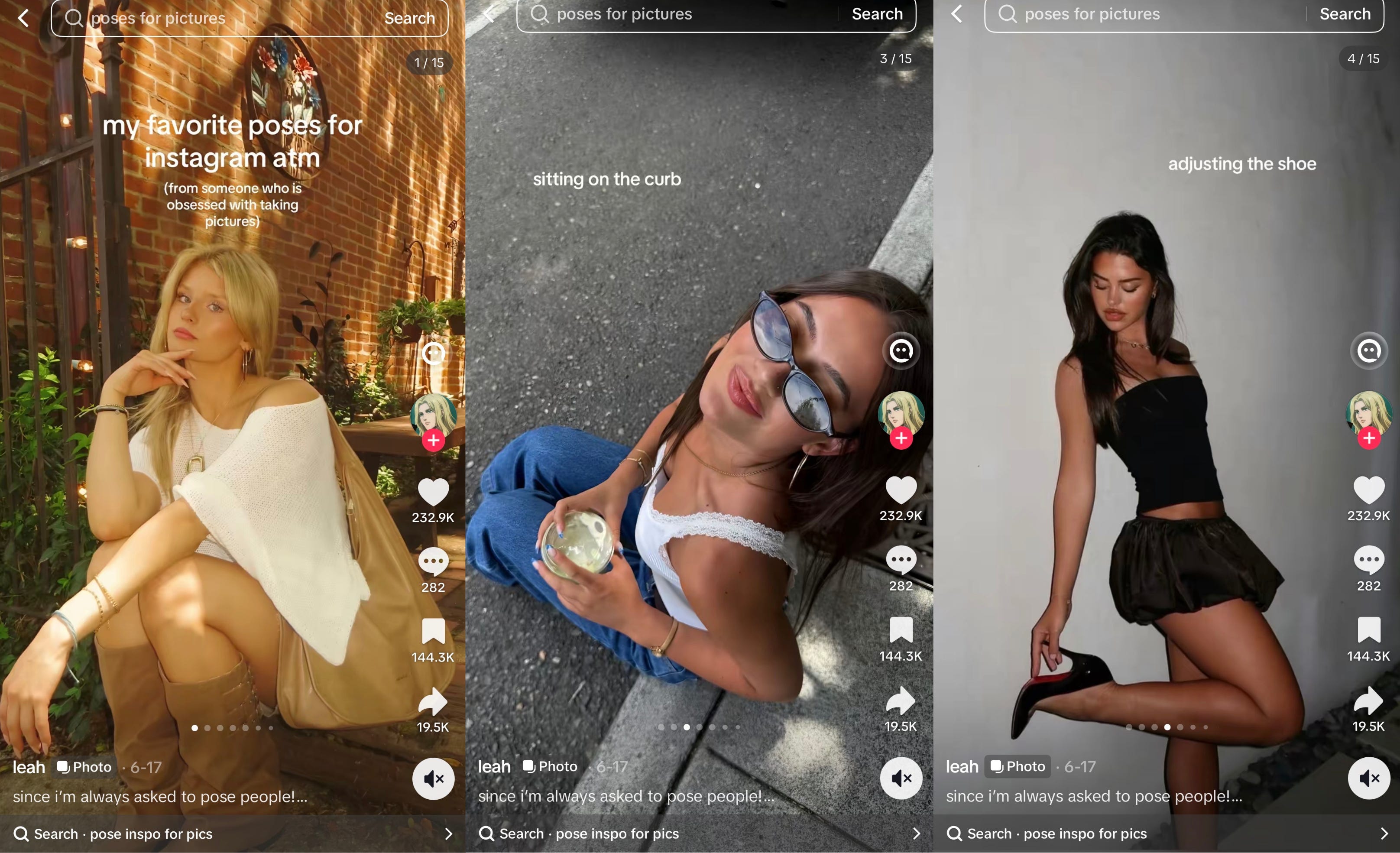
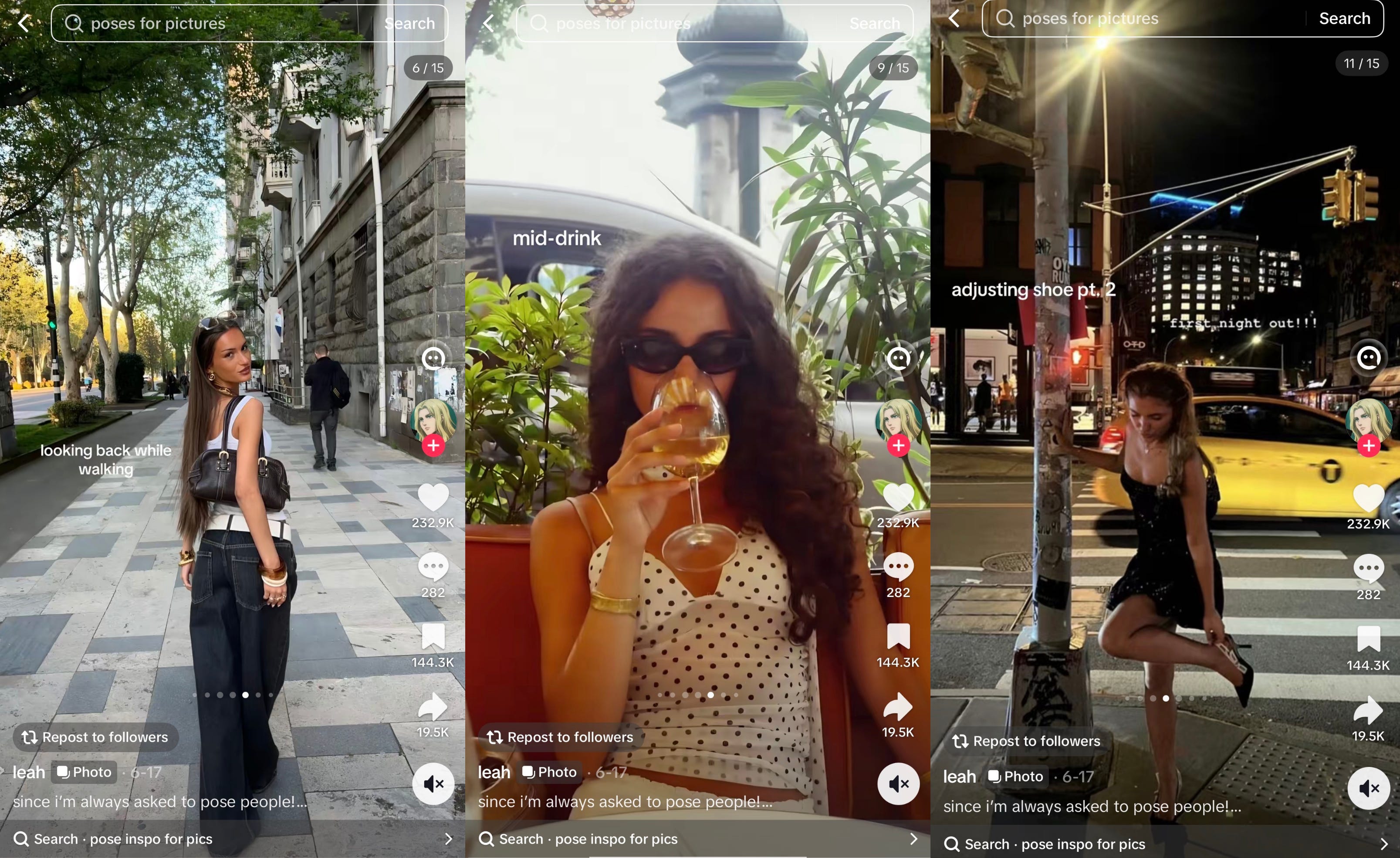
That is the photo dump’s actual problem: Everyone is doing the same thing. Authenticity only works when it’s hard to name and difficult to counterfeit. Once a clear playbook is established with recurring visual cues and recognizable production choices, it no longer feels authentic, and the culture begs for a counter-trend. (Make no mistake: one is already in incubation)
Authenticity only works when it’s hard to name and difficult to counterfeit.
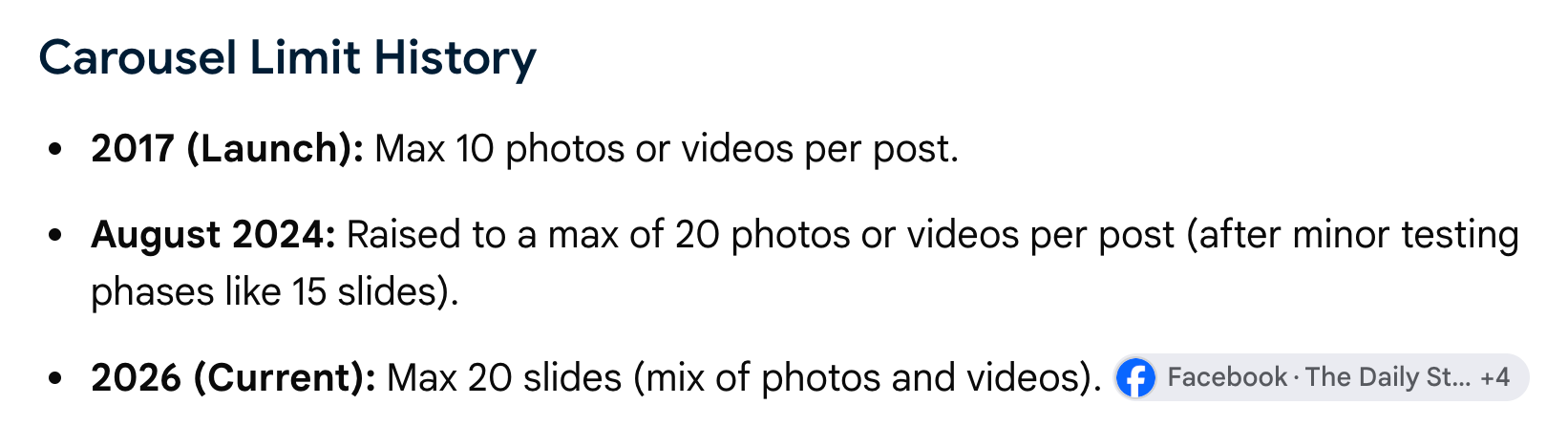
But it wasn’t a total waste. The dump took care of the small problem of, well, vanity (there I said it). It gave you plausible deniability about caring too much about your image! One beautiful photo asks you to stand wholeheartedly behind your own judgment, whereas 20 photos surround the claim with disclaimers, which is presumably why Instagram kept raising the ceiling: 10 slides, then 20. What’s the minimum sample size of deniability??
But curation itself cannot reasonably be the villain. A diary is curated too, as is a scrapbook or photobook. Heck, memory itself is an editor with fairly aggressive cuts. Nostalgia = memory - pain. Documenting anything already has a built-in this, not that; worth keeping, not worth keeping. We all do it consciously or subconsciously, and to say otherwise would be a fool’s errand.
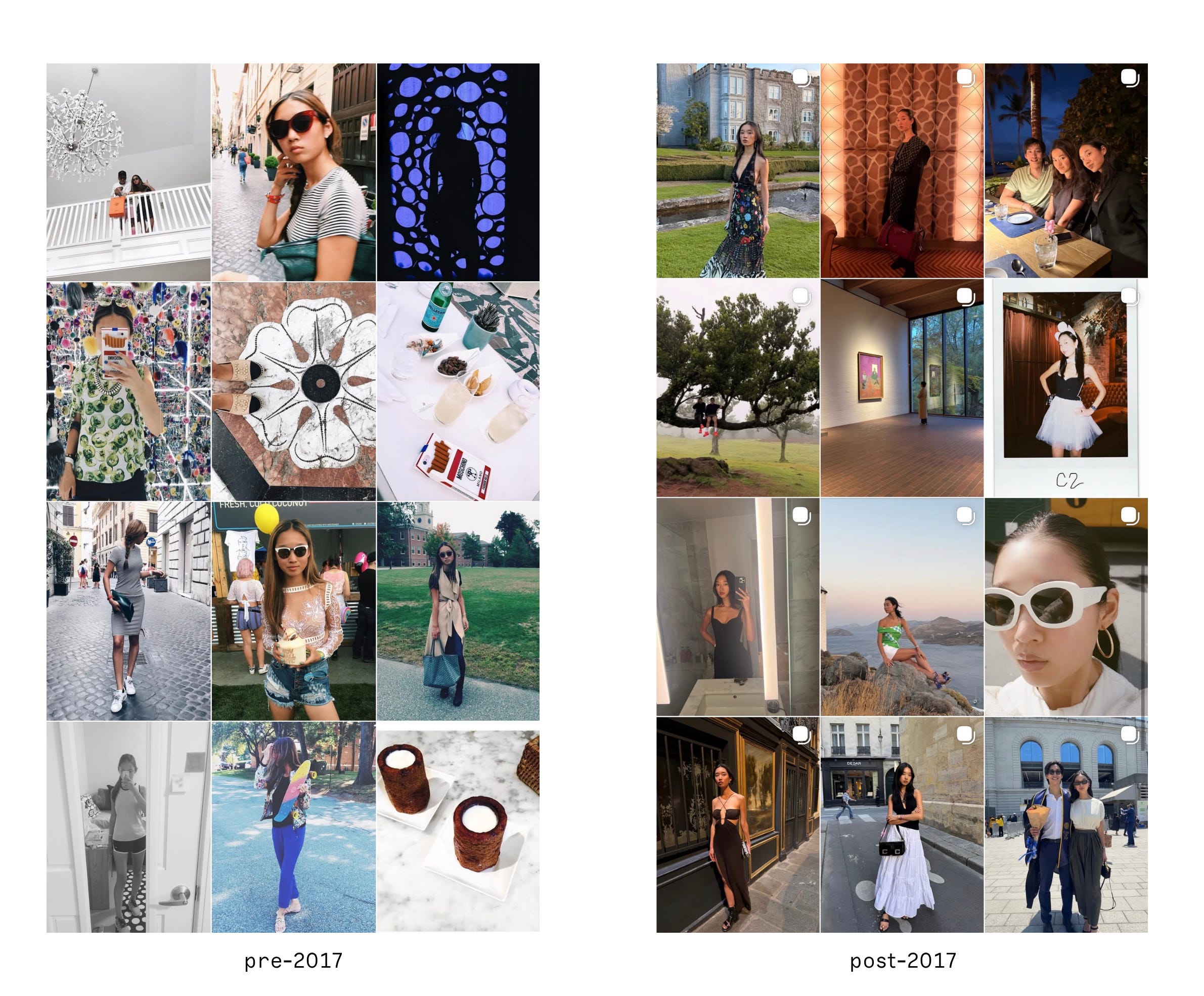
For most of photography’s history, the limitations were obvious: film cost money, development took time, and cameras weren’t always in your hand. A photograph meant some small expenditure of attention and intention. Then digital photography swooped in and solved the problem of scarcity lock, stock, and barrel, and yet: we barely noticed the inversion. A single dinner can produce more photographs than my grandparents might have taken in a year.
If the old problem was a game of addition (how to capture more), the new paradigm seems to point towards subtraction (capturing less, capturing better).
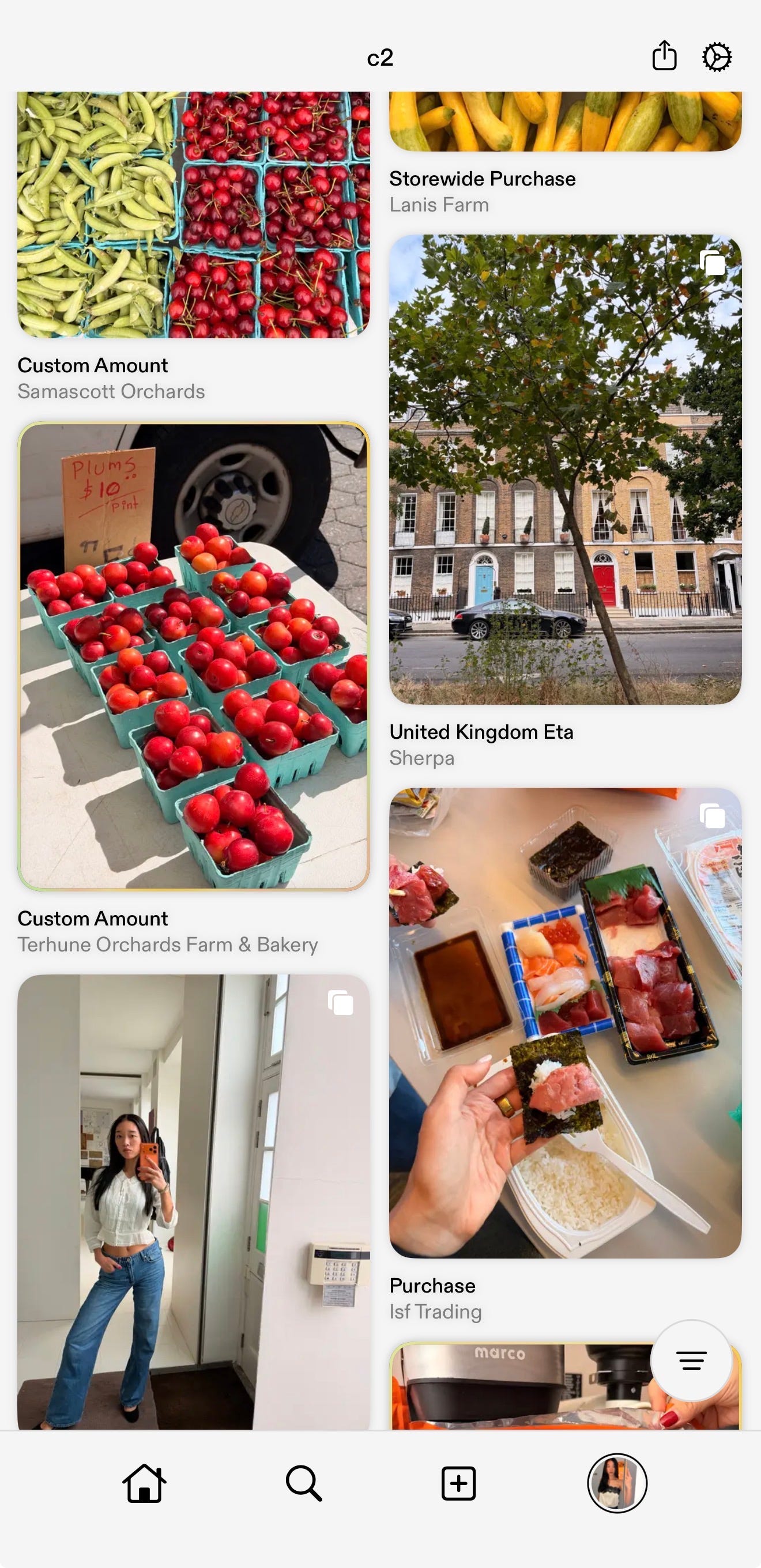
The idea of “capturing better” powers Selleb, the app I co-founded with my sister to document our lives through receipts.
Most social platforms ask you to start with a blank page. Make something, say something from nothing! That’s a lot of pressure. And exactly why even the greatest of authors freak out and suffer writer’s block when confronted with a white page/screen….And also why so many of us defer to the playbook…
Selleb gives you a starting point, an anchor, a topic: a single receipt sitting in your inbox or crumpled at the bottom of your purse or pocket! It may be the most honest document of your life produced anyway, because 1) it’s raw material that already exists (easy participation!) and better yet, 2) it is irrefutable, post-facto evidence of a life already lived (REAL #proofoflife).
From there, you can personalize it: add the photograph, the story, the review, the regret, the return, the person you were with, the reason a completely ordinary line item still brings an entire night rushing back. At the end of the day, humans are incorrigible archivists; we save ticket stubs, restaurant matchboxes, post-it notes, receipts, postcards, mementos, EVERYTHING. Don’t get me wrong: I LOVE MY MEMORY BOXES. The instinct to document was never the problem. The starting point is…
The future of authenticity isn't about looking less staged or documenting for its sake, but starting with the most honest variables from your day-to-day: the stuff (small or big) you actually bought. START THERE. Tell us what you bought, where, and maybe even why, and your authentic story will write itself.
How’s that for a cocktail ingredient?


Join us on Selleb,
Claire, co-founder of Selleb
Comments
Nothing yet. Say the first thing.
Sign in to join the conversation.