
As someone who was raised by well-intentioned and loving parents who had a lot of plans and aspirations for me, but didn’t always understand or accept who I was as a person…I’ve always been interested in “personality tests” and any other tools that could help me see myself more clearly. (Note that I did not say, “to find out who I am.”)
Once I had kids - I always wanted to make sure I gave them the autonomy and safety to Be Themselves, whatever that looked like. As they got older, I encouraged them to experiment with their identity, from clothing choices, hair color, music, who and what they liked, etc.
My oldest son had hot pink hair for about 5 years when he was a teen - and by the time my youngest Reflector child was born, I was much more grounded, more “unflappable” as a parent, and I think his sensitive nature benefitted from that ease in me.
When I discovered Human Design - it wasn’t long before I was learning all I could about the different Types as yet another lens I could use to learn who and how to honor my children’s uniqueness!
There are very broad strokes that we can paint on the canvas of Type in Human Design, that translate to how we might have wished we experienced being loved, seen, heard, honored and respected as a child.
We can use that lens in parenting our own children, without getting too bogged down in the details of either their charts, or ours.
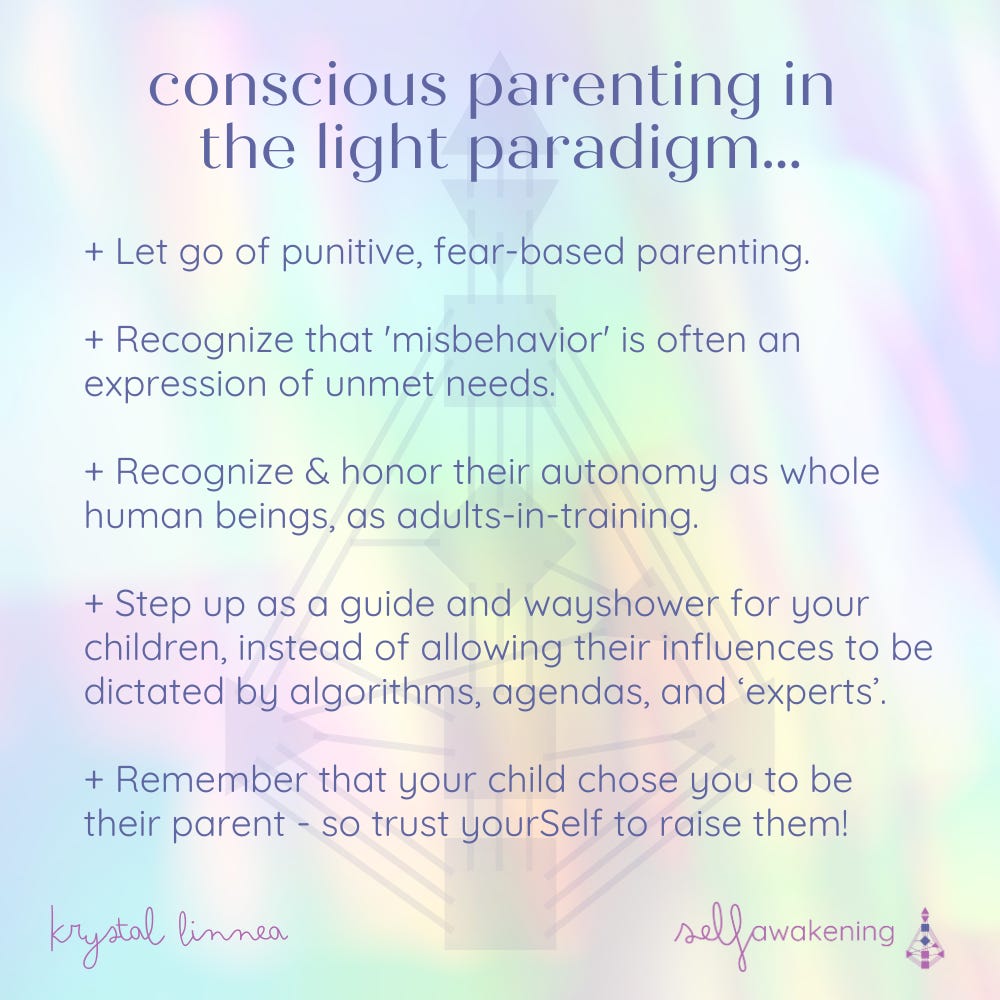
If you’re busy parenting “light paradigm kids” - please enjoy my list of recommendations for how to love your child of any age, according to their Human Design Type:
(but then keep reading for the real answer to “Does my child’s chart actually matter?”)
(and nurture your inner Projector)
Recognize their talents & focused, sensitive nature, and be aware that they notice a lot!
Model healthy boundaries with others, so they’ll learn about loving themSelves by watching you.
Honor their need to rest and recharge after busy social days, or intense experiences.
Be mindful that they may feel pressure to behave like a little adult. Invite them to do more of what they love, and assure them that it’s okay to play!
Acknowledge them, and invite them to share their deep insights and perspective with you.
(and nurture your inner Manifestor)
Create space for their creative intensity and innovative nature - and respect their unique cycles of boredom/busyness as a normal part of life, not a problem to fix.
Honor the power of their voice, and as they get older, help them to recognize the impact they have on others just by being themselves, and doing their own thing.
Let them take charge (when appropriate!), and become a key facilitator in helping them make their ideas happen.
If a Manifestor hears ‘no’ too often, they may react by doing things alone, without asking for permission - or by doing nothing at all (apathy).
Respond to this by finding ways to say yes more often, and give them freedom within clearly-defined limits.
Don’t see their matter-of-fact nature as a challenge to your authority, but teach them how to respectfully negotiate - instead of making demands!
(and nurture your inner Generator)
Understand that their energy is a slow-and-steady burn - they may not move fast (especially if their Emotional Solar Plexus is defined), but they will keep going!
Give them things to respond to (“do you want eggs or toast?” instead of “what do you want for breakfast?”) and this vs. that options, instead of asking open-ended questions.
Help them recognize their embodied responses to life in the moment, instead of relying on what they “think” they’re supposed to do.
Encourage them to hone their skills over time, stick with things, and trust their process, especially when they hit a plateau and feel like giving up.
Make sure they’re using plenty of energy during the day, doing things they find stimulating, so they’re tired by bedtime!
(and nurture your inner ManiGen)
Give them opportunities to explore their ever-changing interests, and also, let them feel ‘bored’ when nothing seems to spark joy.
Honor their need to move fast (or sometimes, slow), take shortcuts, and do things in their own way, which is often non-linear.
Give them permission to change their minds often, and reassure them that this is not a flaw, but a feature!
Help them connect with their Authority (Emotional or Sacral) and be aware of how impatience may show up for them.
Encourage them to honor their own voice, and to trust their responses to life.
(and nurture your inner Reflector)
Honor their curious, finely-attuned nature by giving them plenty of time to be curious (or, let them be slow to warm to new things/places/people).
Don’t pressure them to be consistent or decisive, and give them plenty of time to make choices.
Be conscious of their ‘quiet needs’, and give them space, without letting them feel forgotten.
Make a habit of doing things that surprise them, and delight in the things they notice about the world that others don’t...
Ask them to share their insights, and be mindful of how environments and people impact them!
Okay, but does Human Design really apply to your toddler?
However, it’s usually worth looking at your own chart as a parent, alongside your child’s.
A child’s energy is felt, sometimes quite strongly, even before they are born.
Parents pick up on the energy mechanics of a new being interacting with them on a subtle level, and how they - the adults - are able and willing to respond to those mechanics can make a huge difference in their child’s first 7 years of life.
Ideally, all kids would arrive into an environment that feels supportive, loving, and also aware of the potentially wide gap between how the parents are {have been conditioned to be}, and how their child naturally, innately is.
Generally speaking, how your child “grows into” their chart depends on how well you are able to support and nurture them without getting triggered, without seeing their muchness as some sort of challenge or threat to your priorities.
It’s kind of a running joke that children come in knowing how to push all of mom and dad’s buttons.
This makes even more sense when you discover that we inherit aspects of our charts from our grandparents.
Not always, and not every grandparent, obviously…but it’s very common that your child will come in with some uncannily similar characteristics to your mom’s chart - or your partner’s dad’s chart.
It seems that some energetic aspects or “flavours” are so compelling to us on our soul’s journey that we wish to experience them from two different perspectives - first as the child, and then as the parent.
For example, one of my daughters has almost the exact same hanging Gates in her undefined Throat Center, as my mom did - and even though my daughter was only 9 when my mom passed on…I notice that even as an adult, she seems to share many of my mom’s mannerisms, and there’s just something indefinable in her expressions that reminds me of her…
Charming - but the thing is, I noticed this resonance between my daughter and my mama long before I ever heard of Human Design.
So does your child’s chart really matter?
Well - it can be a fun and validating way to confirm things you already suspect…and it can also become an interesting reality check, when maybe you’re viewing your child thru your own limiting beliefs - but don’t realize it yet.
For example, you may think your child is “so emotional”. Maybe they cry easily, are loud and demanding, etc.
Okay, time to look at the parents’ charts! If mom and dad are both emotionally defined (if you both have defined Emotional Solar Plexus Centers), and your little one has an open or undefined Emotional Solar Plexus…what’s likely happening is that he’s mirroring and amplifying the emotions he perceives around him - yours!
If you’re having relationship challenges with your child of any age, it can be worth looking at the broad basics of their chart (Type, Authority, Profile, , as well as their chart in combination with your own.
conscious + connected parenting for the light paradigm:
+ Recognize & honor their autonomy as whole human beings, as adults-in-training, not inferior beings.
+ Recognize that ‘misbehavior’ is often an expression of unmet needs.
+ Let go of punitive, fear-based parenting. It simply has no place here anymore.
+ Step up as a guide and way-shower for your children, instead of allowing their influences to be mainly dictated by algorithms, agendas, and ‘experts’.
+ Your child chose you to be their parent - so trust yourSelf to raise them.
» One more thing - I will be releasing my Parenting by {Human} Design workshop here for my paid subscribers. Upgrade your subscription if you want to watch it!
Comments
Nothing yet. Say the first thing.
Sign in to join the conversation.