
You probably know this already, but thoughts are things. They exist in the physical world, even if they’re too subtle to touch our senses.
Our beliefs and ideas influence our lives and experiences. Not slightly, not just a little bit - our beliefs are actively and profoundly shaping our perception of reality from moment to moment.
Emotional wellbeing is a huge component of our physical, body-based health.
This might seem “woo,” but indigenous wisdom has held this knowledge since time immemorial - and medical science is finally catching up. Even the CIA has been documenting this kind of knowledge for over 100 years.
That’s why the Bach flower remedies are a game-changer.
I’ve worked with the Bach flowers for over twenty years - through five pregnancies, through the postpartum haze, and through the long, unglamorous work of healing depression, trauma, and C-PTSD that I’d carried for lots of my adult life. Flower essences were a crucial component of that healing, especially when I needed something that worked fast, but was gentle enough to not cause problems during pregnancy - or potentially set off another healing crisis.
The Bach Flowers are a collection of 38 remedies that help to correct emotional imbalances.
They look a bit like herbal tincture bottles - but chemically, they’re “all the same”. I like to call them homeopathy for the soul. Often, once our emotions are addressed, our body’s innate energetic passageways become less burdened, which allows for flow rather than stagnation (this is both a metaphor, and a concrete observation). This impacts our body on subtle levels, as well as our fascia, and even the expression of our DNA.
While I wouldn’t say that Bach flowers address our physical health directly…I would absolutely assert that processing repressed or hidden feelings and beliefs can be a catalyst for physical healing.
This may sound like a stretch, but it’s not a new idea. It’s the same premise at the heart of German New Medicine, which maps out emotional conflicts to specific biological responses. Dr. Edward Bach understood this intuitively long before the research to support it existed: Disease (literally, dis-ease, lack of ease) begins in the emotional body long before it appears in our physical state.
The Bach Flowers are similar to homeopathic medicine in that they are very safe, with no substance interactions.
Unlike homeopathy, you can add these to your coffee, and they won’t be rendered ineffective. They are gentle enough to use with babies, teens, the elderly - and even our pets.
Homeopathy works on the principle of “like cures like”, where we match symptoms to remedies, and this can be done without the input of the person in need of healing.
The Bach system works through “choosing the desired state” - where the vibrational signature of a flower correlates to a person’s emotions - or more accurately, their opposites.
While homeopathy is supportive even if someone taking them doesn’t understand anything about them…the Bach flowers (and all flower essences) are more of a co-creative tool. Ideally, the person in need of healing is actively involved in selecting their own remedy combination, because our own conscious choice is part of the healing.
All flower remedies are prepared with a small amount of natural preservative (like brandy, vodka, or glycerin) and spring water - living, structured water. The more I’ve worked with this system, the more I have come to respect that this is not a minor detail.
The work of Masaru Emoto and Veda Austin has quantified and made visible what energy healers and indigenous healers have long known: water, as a crystalline structure, holds information. Water responds to our intention, and we can interact with it as a living consciousness. Living water - and the minerals in it - is what carries a flower’s energetic signature throughout the body.
The Bach flower remedies have been made the same way since the 1930s, according to the methodology of Dr. Edward Bach, who personally developed each of the remedies. Through his work as a physician, he came to believe that illness is the end result of disharmony between body and mind. He sought to treat people holistically, by turning to nature to balance their emotions.
Many of Dr. Bach’s early realizations came from strolling through his garden in the early morning, as he contemplated mystery cases presented by his various patients (solvitur ambulando = “it is solved by walking”).
He would find himself repeatedly drawn to certain plants and flowers, and had the inspiration to touch the glistening morning dew - and then taste it - after which, he would frequently arrive at a breakthrough pertaining to the patient he was contemplating.
Dr. Bach’s life story is fascinating, and his home and gardens are still open to the public. An early Projector Type, he was deeply immersed in astrology, herbs, science and mysticism - but he destroyed nearly all of his research before his death, because he wanted the Bach flowers to remain as they were - a simple and direct system, easy to use, without complication.
The Bach flower remedies are excellent for emotionally-based issues throughout life - and flowers hold a special affinity for women and babies.
They’re particularly well-suited to the childbearing year, because pregnancy and early motherhood are threshold experiences - times when our emotional body is more open and receptive. Buried emotions tend to surface during pregnancy, and whatever’s been restrained tends to start feeling like a pressure cooker…or a leaky faucet!
This is not pathology - it’s our body’s intelligent response, readying us for the emotional depth and breadth of motherhood. Our hearts are expanding as we take in all we need to nurture and grow new life - it’s intense!
Some of the remedies I reach for most often in the perinatal window:
Rescue Remedy for acute stress, fear, or shock - this is a combination of five single remedies, and a great “emergency” go-to. You can add a few drops of this to your water bottle, and voila! Every sip becomes a dose of healing.
Star of Bethlehem for shock or sudden change, given to both mother and baby directly after birth, especially after a hard or fast labor.
Walnut for smoothing transitions and coping with change - in labor, in the weeks postpartum, and for older siblings adjusting to a new baby.
Crab Apple for the complicated feelings that can arise around our changing bodies.
White Chestnut for the racing, monkey-mind of late pregnancy or early postpartum.
In addition to the perinatal year, I’ve used the Bach flowers with my children through stress around moving, night terrors, and warts, to name a few things. I also use Rescue Remedy for my cats every time we moved.
As a complete and simple system, the Bach flowers offer steady + grounded support for folks navigating grief, burnout, depression, and relationship challenges.
Selecting the right remedies may seem overwhelming at first, but it’s a straightforward process - and it’s wonderful because no harm comes from choosing a remedy that isn’t quite right. If a remedy isn’t the right match, you simply won’t notice much - and that itself offers useful information.
Choosing your remedies is ideally meant to be a co-creative act.
While there’s a proper intake and process I take you through in choosing remedies - it’s also true that you may resonate with particular name, or recognize yourself immediately in the keywords on the bottle. You might even dream of a certain flower, or find it popping up repeatedly in your environment.
Sometimes, the medicine of place is how our local ecosystem participates in our healing - if we’re able to notice.
Flower remedies can help within moments…but their deeper effects are felt over time, as a gradual unfolding, in layers.
The first remedy or series of remedies often addresses what’s most pressing - and after this, your feelings may shift, which can bring up new things to look at!
This layered process might seem strange or slow to “work”, but these remedies are meant to find balance, not to be a magic bullet. Uncovering hidden patterns or noticing new feelings is actually a great sign that the remedies are working - because healing isn’t linear.
Working with the Bach flower remedies helps you process your emotions so that you are free to live in clarity, without the overlays of unhelpful conditioning running the show.
Once you don’t need a remedy anymore, you will know - because your focus shifts. It’s a subtle but discernible change…and discernment of our own emotions is an incredibly powerful tool for building the kind of life we actually want to live..instead of allowing inertia to decide for us.
The goal is to restore your own clarity and capacity to navigate life, with clear eyes - instead of operating from past conditioning, programming, or “have-to”s.
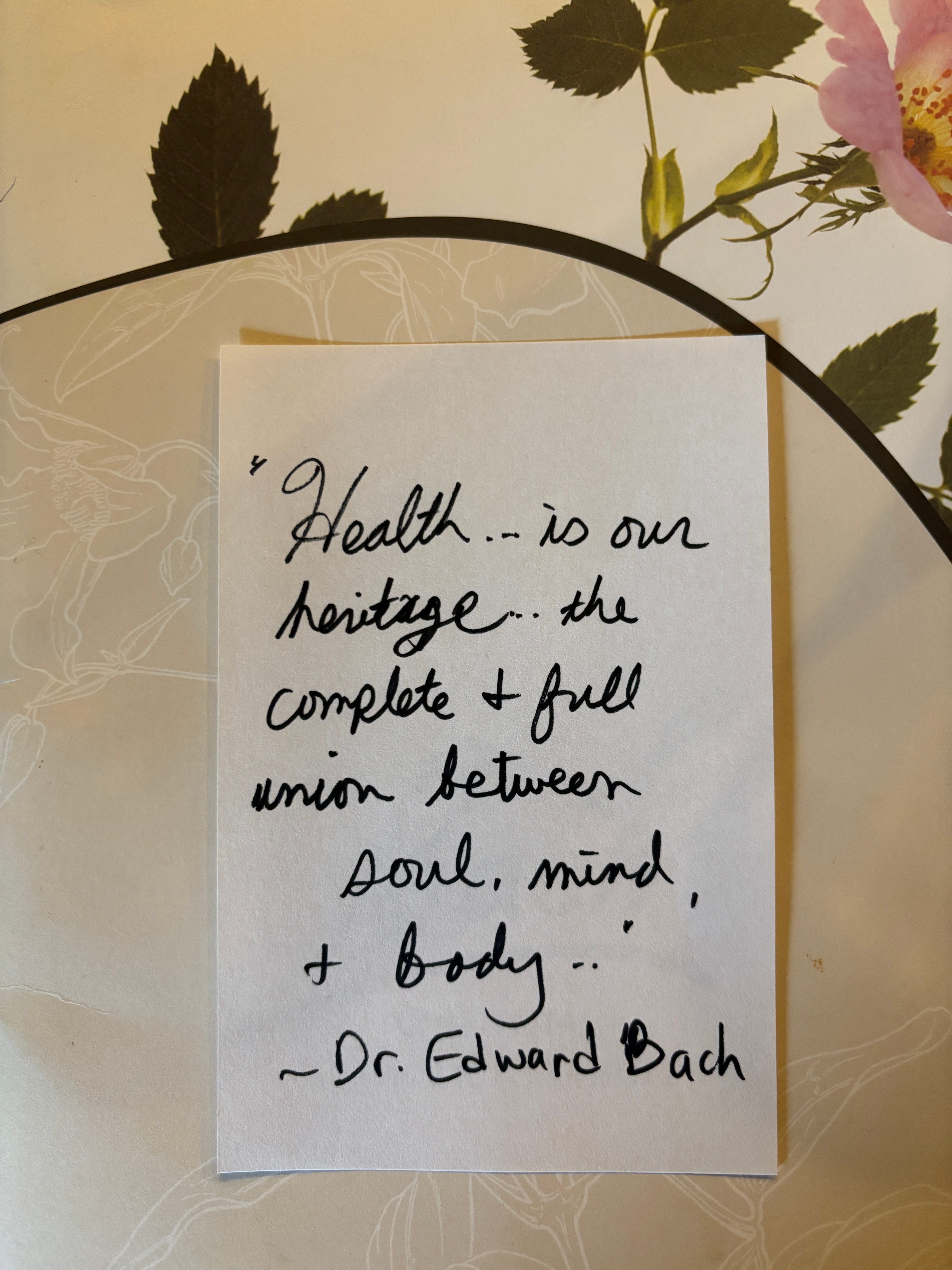
Dr. Bach believed that health is our birthright. He also said,
“If we follow our own instincts, our own wishes, our own thoughts, our own desires, we should never know anything but joy and health.”
This quote has always resonated with me, because it seems that he’s talking about the highest expression of a quantum human, with a fully integrated body/mind/soul and higher-self in charge.
In Human Design, the Not-Self has been collectively running the show for a long time, and the Bach flowers are a phenomenal tool to clear away unhelpful conditioning of the Not-Self.
Any of our white Centers (undefined or open) can be susceptible to conditioning, but certain people’s lived experiences and unique Design may predispose them to really struggle in certain areas. We can use the Bach flowers to address this in a beautiful and subtle way.
For example, someone with an undefined/open Spleen might have a tendency to hold onto things - or relationships - for longer than they should. Maybe that looks like nostalgia for the past (Honeysuckle), or trouble adjusting to a new situation at work or school (Walnut). We can use the lens of Human Design to help discover what remedies might be especially helpful for us, given the underlying tendencies in our chart and how they express, as well as our lived experiences and unique situation.
If you’ve looked into the Bach flowers before, you might see yourSelf in many of the remedies - but you don’t need the entire set of 38 to make a difference, and overlapping our Human Design can give us greater insight on where to begin.
How the Bach flowers found me…
During my fifth pregnancy, I realized that the emotional struggles I’d experienced across each of my pregnancies weren’t just passing emotional weather. I was suffering from depression.
At that time in my life, the Bach flower remedies made the difference between a day that was a struggle and a day that felt more hopeful and lighthearted.
When pregnancy and nursing left me with limited options, these gentle + holistic drops made the difference between non-functional, stay-in-bed-and-cry days, and days where I could actually be present for my family. Even missing a single morning’s dose made a noticeable difference by afternoon.
That’s why, after twenty years of working with this system personally and with clients, I’m finally teaching it.
I am trained in Levels I and II of the Bach Flower Registered Practitioner program, through the Bach Centre in England - which is the only official certifying body for Dr. Bach’s system. I’ve been using these remedies regularly in my own life and with clients for over 15 years, and they’re a beautiful way to bridge practical tools with energy medicine.
On May 16th and 17th, I’m offering an immersion workshop in the Bach flower system for healers, wellness pros, and birthworkers - and I’d love for you to join.
The booking link will go live this week - and in the meantime, I invite you to become a paid subscriber here on Substack.
» I recently changed my prices to make things more sustainable!
To be the first to know when registration opens, please subscribe - or send me a message here:
Comments
Nothing yet. Say the first thing.
Sign in to join the conversation.