
I’ve been getting some lovely DM’s from readers experimenting with bibliomancy on the heels of the last post here. With their permission, I may share some of those accounts berore long. In any case, I’m glad folks are having fun with the practice and finding it useful.
Today, something a little different: a foray into the fictional universe of Phillip Pullman’s brilliant His Dark Materials trilogy, for a look at an unusual divination tool, the novel’s fabled “golden compass” a.k.a. aletheiometer. While the instrument in question may not exist in physical reality, its author and his creations have a lot to teach us about how to divine well. Enjoy.
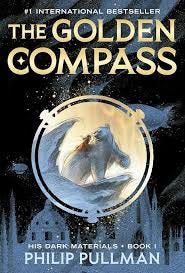
The Truth Meter
In Philip Pullman’s novel, The Golden Compass, the protagonist, an orphaned girl named Lyra, finds herself in possession of a divination device called an “aletheiometer” (Greek for truth meter). This extraordinary fictional instrument furnishes us with as good a description of divining with images as we’re likely to find.
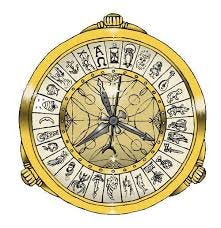
What is this mysterious device? The aletheiometer looks something like a golden pocket watch, with
hands pointing to places around the dial, but instead of the hours or the points of the compass there were several little pictures, each of them painted with extraordinary precision, as if on ivory with the finest and slenderest sable brush...There was an anchor; an hourglass surmounted by a skull; a chameleon, a bull, a beehive...Thirty-six altogether, and she couldn’t even guess what they meant.
Young Lyra may not be able to guess at first. But she soon becomes an adept user of the golden compass thanks to her own intuition and some guidance from the kind Farder Coram.
With Coram’s help, she comes to understand that the nature of the extraordinary tool that’s found its way to her. She learns she can pose a question by adjusting three of the clock-hands to point at different symbols: the first challenge is finding a way of phrasing her question in the language of the device. Then the answer comes by way of the fourth hand moving as if of its own accord to point at a further sequence of symbols, which must then be decoded.
As Lyra learns from Farder Coram, crucially, each of the symbols stands not just for one thing, but
“for a whole series of things. Take the anchor, there. The first meaning of that is hope, because hope holds you fast like an anchor so you don’t give way. The second meaning is steadfastness. The third meaning is snag, or prevention. The fourth meaning is the sea. And so on, down to ten, twelve, maybe a never-ending series of meanings...you got to be able to hold [the meanings] in your mind without fretting at it or pushing for an answer, and just watch while the needle wanders. When it’s gone round its full range, you’ll know what the answer is.”
Easier said than done, of course. In the novel’s world, few people can interpret the device’s answers, and most of those are hoary old scholars who rely on dusty tomes on the subject. But Lyra turns out to be naturally gifted in this realm. In the following conversation she’s telling Coram about her first aletheiometer reading.
“I just put three pictures together because...I was thinking about Mr. de Ruyter, see...And I put together the serpent and the crucible and the beehive, to ask how he’s a getting on with his spying, and--”
“Why them three symbols?”
“Because I thought the serpent was cunning, like a spy ought to be, and the crucible could mean like knowledge, what you kind of distill, and the beehive was hard work, like bees are always working hard; so out of the hard work and the cunning comes the knowledge, see, and that’s the spy’s job; and I pointed to them and I thought the question in my mind, and the needle stopped at death...D’you think that could be really working, Farder Coram?”
It’s working, all right, for just that moment a messenger arrives bearing news: the very same de Ruyter has been killed. It’s Lyra’s first spine-tingling experience with these mysteries, but not her last.
As the novel progresses, we grow with her in our understanding of the device and the mental strategies that help one access its wisdom. For although Lyra may be a natural, she also takes to practicing with the device regularly.
The one thing that drew her out of her boredom and irritation was the aletheiometer. She read it every day, sometimes with Farder Coram and sometimes on her own, and she found that she could sink more and more readily into the calm state in which the symbol meanings clarified themselves, and those great mountain ranges touched by sunlight emerged into vision.
She struggled to explain to Farder Coram what it felt like.
“It’s almost like talking to someone, only you can’t quite hear them, and you feel kind of stupid because they’re cleverer than you, only they don’t get cross or anything...And they know such a lot, Farder Coram! As if they knew everything, almost!”
Coram has Lyra practice on questions of real import, then asks her how she arrives at the answer: “how do you know where these meanings are?”
“I kind of see ‘em. Or feel ‘em rather, like climbing down a ladder at night, you put your foot down and there’s another rung. Well, I put my mind down and there’s another meaning, and I kind of sense what it is. Then I put ‘em together. There’s a trick in it like focusing your eyes.”
Lyra is discovering her gift for divination.
It was a sensation of such grace and power that Lyra, sharing it, felt like a young bird learning to fly. Farder Coram, watching from across the table, noted the places where the needle stopped, and watched the little girl holding her hair back from her face and biting her lower lip just a little, her eyes following the needle at first but then, when its path was settled, looking elsewhere on the dial. Not randomly, though. Farder Coram was a chess player, and he knew how chess players looked at a game in play. An expert player seemed to see lines of force and influence on the board, and looked along the important lines and ignored the weak ones; and Lyra’s eyes moved the same way, according to some similar magnetic field that she could see and he couldn’t.
Truth-reading indeed becomes a kind of game for Lyra as she grows in confidence, mixing intuition and experience. But it’s a game with high stakes. So it goes in life as well, for those using oracles to thread their way through treacherous passages of their own or to help others navigate them.
Though the aletheiometer may be fictional, it offers very real lessons for students of divination. Many forms of the mantic art combine knowledge of symbols with imaginative fluency and the trick of holding multiple images in mind as you locate their resonance.
I don’t mean to suggest your mind will work quite like Lyra’s, even if you were using the same instrument. (How I’d love to get my hands on an aletheiometer.) But what’s key here is Lyra’s ability to have a direct relationship with the images she’s working with. Where the stuffy scholars of the aletheiometer depend on their manuscripts for interpretation, Lyra speaks lets the images themselves speak to her. Such immediate (as in un-mediated) connection is what all diviners strive for. Books can be good guides, but ultimately they’re crutches that must be kicked away in favor of direct experience or gnosis.
Intuition and scholarship aren’t actually at odds with each other: book knowledge can serve as a scaffold for intuition, while intuition can guide our study. But most Westerners have a bias toward the knowledge that comes from books, and an underdeveloped intuitive faculty. Therefore the growth usually lies in learning to trust our intuition again and to lean less on written authority. I’ve found that a direct relationship with the symbols and images of the divination system you’re using is key. That’s where the juice is. Books and teachers can help tremendously, but they’re ultimately fingers pointing at the moon. We have to trust our own gaze to bridge the distance, otherwise we remain stubbornly earthbound and blind to the living magic that requires no translation or footnotes.
Comments
Nothing yet. Say the first thing.
Sign in to join the conversation.