
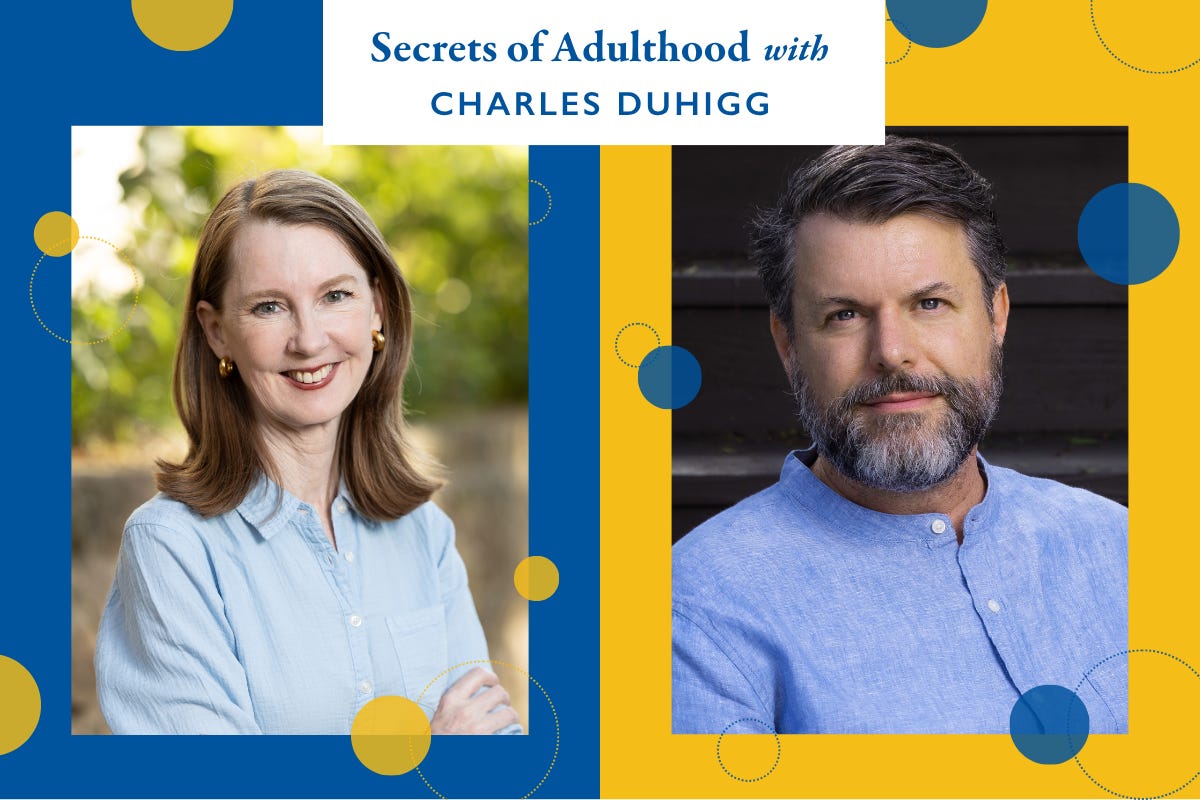
My longtime friend Charles Duhigg and I had a great time discussing his favorite Secrets of Adulthood, the power of thank-you notes, and the questions that can set you on the right career path.
Charles is a Pulitzer prize-winning journalist and author of many terrific books, including The Power of Habit, which spent over three years on bestseller lists and has been translated into 40 languages. He now writes for The New Yorker magazine. I couldn’t wait to ask him about the lessons he’s learned through time and experience.
You can watch the replay of our conversation and read some of my favorite moments below.
Charles’ first Secret of Adulthood is to always send thank-you notes.
“Any time we get a chance to tell someone thank you—and more explicitly, when we get to tell them why we’re saying thank you—what we’re doing is saying, I honor your time and your attention.”
His tips for sending meaningful thank-you notes:
Handwritten is great, but it’s not the only way to express gratitude. (Charles sends a bottle of wine in thanks to everyone who blurbs his books.)
Calibrate tone and formality so that it’s appropriate to the recipient.
Most importantly, make the sentiment authentic and heartfelt. As Charles puts it, saying something that’s true and honest always feels good.
It’s especially nice to be thanked for something we don’t expect to be thanked for! I told Charles the story of thanking a friend for something he didn’t even remember: welcoming me into a social setting where I felt out of place.
When his kids or other young people ask for life advice, Charles tells them to make two assumptions:
First: “Assume you will be as successful as you want to be.” If you want to be a writer, assume your books will be bestsellers. Assume if you’re going into politics, you will end up a U.S. Senator.
And second: “Assume it will take longer than you want it to take.”
If you’re doing something you enjoy and are committed to, you probably will be successful—but it’s going to take much longer than you think. Because of this, Charles says it’s important to do something you really want to do. “The only way you get good at something is by thinking about it all the time and loving thinking about it.”
Charles chose a career in journalism when he realized he loved thinking about stories. For my part, I left a career in law when I realized I didn’t love thinking about the law as much as my colleagues did.
When considering a career path, ask yourself: Will I enjoy spending the time it takes to get to the success?
Charles says: “Ignore the trappings of success. Be honest with yourself about what you actually enjoy doing, because you’re only going to be successful at things you enjoy doing on a regular basis.”
Speaking about careers reminded me of one of my own Secrets of Adulthood: “The person who works the hardest isn’t necessarily the person doing the best work.”
We discussed a (possibly apocryphal) anecdote about actor Dustin Hoffman that illustrates this idea:
Dustin Hoffman was working on the 1976 film Marathon Man with legendary British actor and director Laurence Olivier, known for his Shakespearean roles and considered by many one of the greatest actors of his time.
Hoffman had a grueling scene coming up, where his character hadn’t slept in three days. He told Olivier that to prepare for the scene, he too hadn’t slept for 72 hours.
“My dear boy,” replied Olivier, “why don’t you try acting?”
In other words, the hardest work isn’t necessarily the best work.
Or, as Charles put it: “Oftentimes we do our best work not because we’re working hardest at that moment, but because we’ve spent years working hard to learn our craft.”
Thanks so much to Charles Duhigg for this conversation! If you want more from Charles, check out his Substack: The Science of Better. Each newsletter tackles a different topic, from negotiation to sleep to the science behind a great vacation. The Science of Better is entertaining, rooted in evidence, and full of practical insights to apply in your own life.
And if you enjoyed our conversation, subscribe below so you’ll be alerted when I go live with other writers and thinkers to discuss their Secrets of Adulthood.
No posts
Comments
Nothing yet. Say the first thing.
Sign in to join the conversation.