
This post was originally published in The Secret CFO’s newsletter in February 2023
Growth is an art and a science. The art is in building something people want, and discovering the right way to find those people. The science is in finding an efficient way of delivering it to them.
We can call the latter ‘growth management.’
And great growth management is built on knowing how your costs behave as your volumes shift.
Let’s dive into how you do that… starting with some fundamental.
From first principles there are two types of costs
Variable Costs - Costs that vary directly with sales volumes. (E.g. materials, direct labor)
Fixed Costs - Costs that are fixed regardless of sales volumes. (E.g. rent, salaries)
Whilst in practice, no costs actually behave in this purist way, this is important theory.
The mix of costs between variable and fixed costs describes its ‘operating leverage’:
High operating leverage: Fixed costs are the dominant part of the cost structure
Low operating leverage: Variable costs are the dominant part of the cost structure
To illustrate the difference, we’ll use an example.
Imagine there are two new e-commerce businesses. Both set up to sell dumbbells online through a Shopify storefront.
Both single product businesses, both charging the same price.
The front end of their business is very similar, and they are even using the same supplier.
But, their distribution models are world’s apart:
Debbie Dropship - Is using a 3rd party dropship service paying a fixed cost per unit shipped. Low operating leverage.
Ian Insource. Insourcing distribution; has rented a warehouse and employed staff on fixed salaries. High operating leverage
Let’s bring that to life:
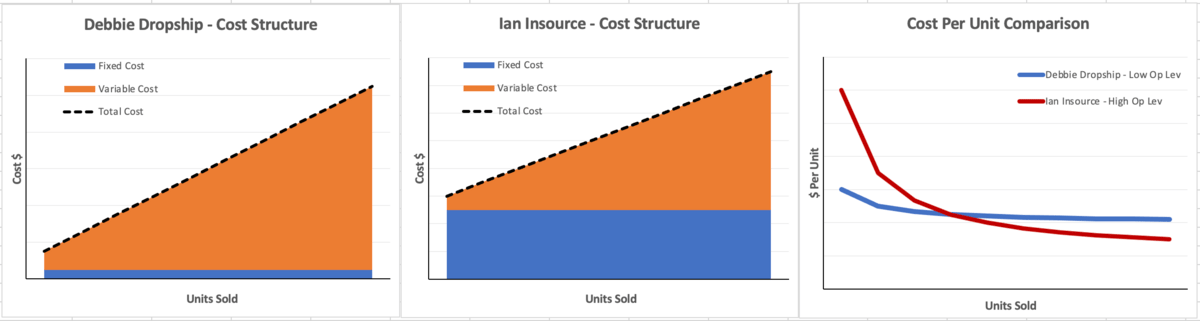
High vs low operating leverage
On the right hand side you can see, at lower volumes, Debbie Dropship’s model is more efficient (lower cost per unit). And at higher volumes Ian Insource’s model is more efficient.
More operating leverage = more sensitivity in the Income Statement to changes in volume.
So who is right?
The correct answer would be to have the best of both worlds.
At start up volumes, keep it scrappy, and minimize fixed costs whilst volumes are low. Ensure each unit sold is profitable, even if marginal. Low operating leverage.
Then once volumes are growing, convert some of that variable cost into fixed cost, reducing cost overall. I.e. increase operating leverage.
By using your scale to reduce cost per unit, you build a moat (cost advantage) that is hard for a new entrant to replicate.
Once the crossover point is reached, insource the distribution. I.e. remove the margin of the 3rd party dropshipper. Variable cost per unit comes down, at the expense of more fixed cost.
In that case, the optimal cost curve would look like this:
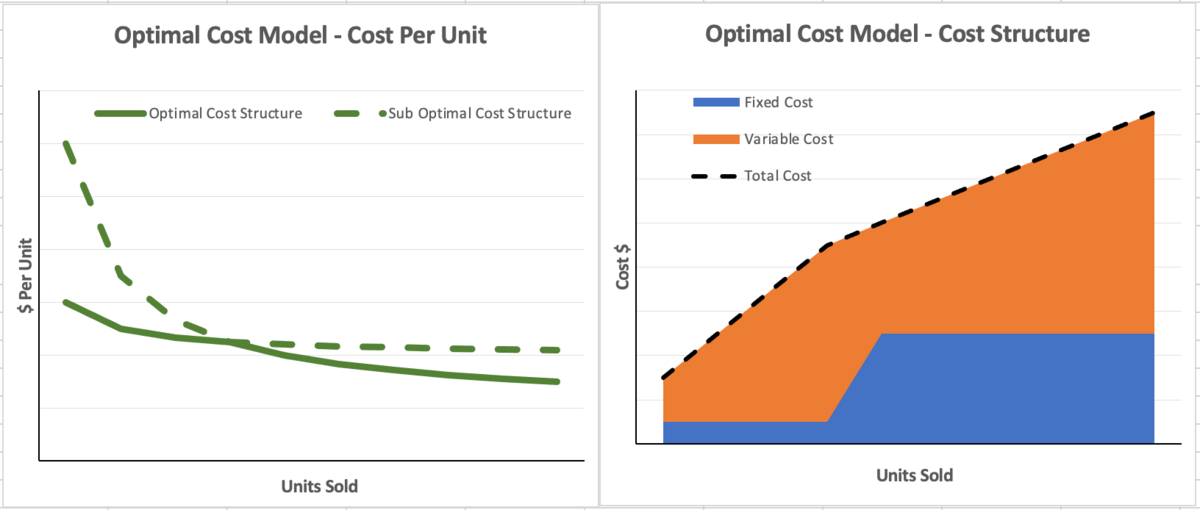
Changes in operating leverage and the impact on cost structure
Whilst the theory talks to fixed and variable costs, it is just that… a theory.
This doesn’t work in practice.
There is a third type of costs…
A mixed cost is a cost that has both a fixed and variable component. I.e. any cost that has an impure relationship with volume.
It’s neither directly variable, nor totally fixed.
In practice, all costs have, at some level, both a fixed and variable component. Said another way, if you look hard enough all costs are mixed costs.
There are several sub-definitions of mixed costs, but we won’t get lost in those. The terminology isn’t important.
We’ll dive back into the example of the scaling e-commerce business.
Things have gone well since insourcing the distribution. They’ve outgrown their first warehouse.
They now need a second warehouse to service increased volume.
And that means more fixed cost (rent, insurance, utilities, salaries, etc)
Wait, didn’t we say that fixed costs shouldn’t vary with volume?
Yes we did. And therefore our ‘fixed costs’ are in fact mixed costs. There is a non-linear relationship with volume
The chart below plots the development of fixed costs at different volume points:
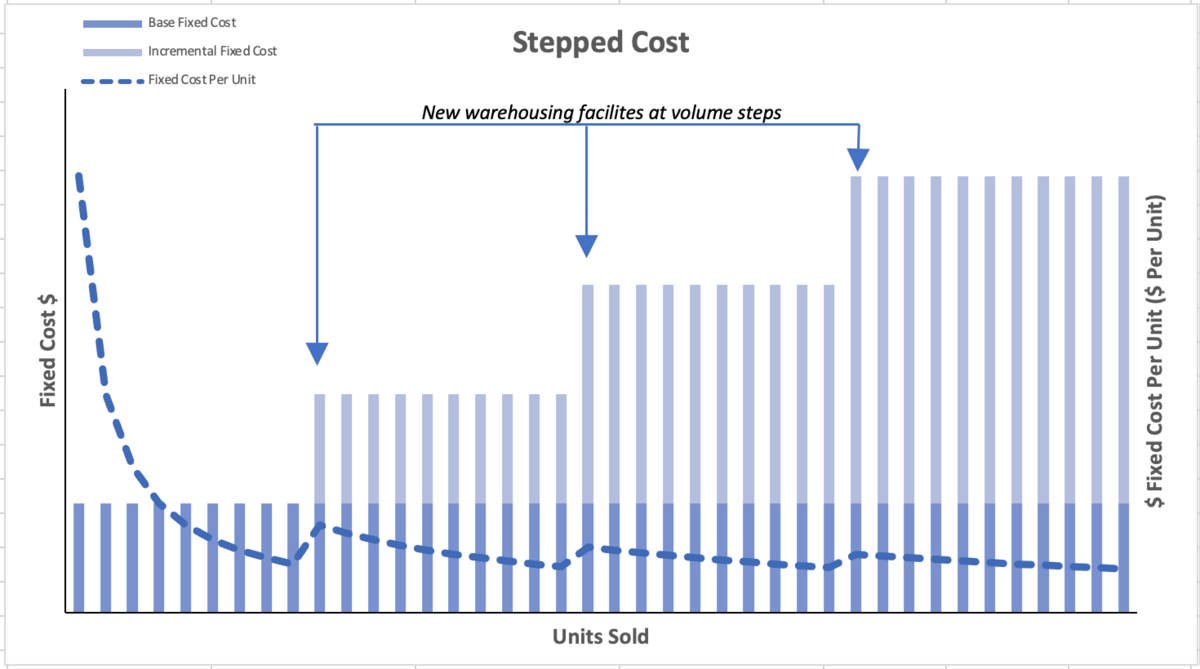
Stepped costs
Each step reflects the opening of a new warehouse to cope with the extra volume.
Here we’ve illustrated the impact of a 2nd, 3rd and 4th warehouse. You can see the impact of the new cost ‘stepping in’ at each capacity point.
On the secondary y axis, you can see Fixed Cost Per Unit at different levels of volume.
There are points at which extra volume makes the business less efficient. i.e. increases fixed per unit.
Initially, the costs of each new warehouse warehouse is not counter balanced by the extra volume. This changes as those warehouses become better utilized.
This tells you one thing. Getting the decision right of how and when to step in new fixed cost is important.
Too late and you could impinge growth. Too early and you are inefficient.
Another term for this is ‘stranded cost’. Any fixed cost in a business that isn’t rational for the current volume.
Back to our dumbbell e-commerce business.
Things went well, and the business grew to 4 distribution warehouses. But then… disaster struck.
The supplier’s factory that manufacturers the dumbbells caught fire. It’s out of commission for the next 24 months. Supply will be constrained by 80%.
Now we have the worst of both worlds.
The fixed cost base for a 4 site business, but only the volumes to fill one of those sites.
That leaves a truckload of stranded fixed cost:
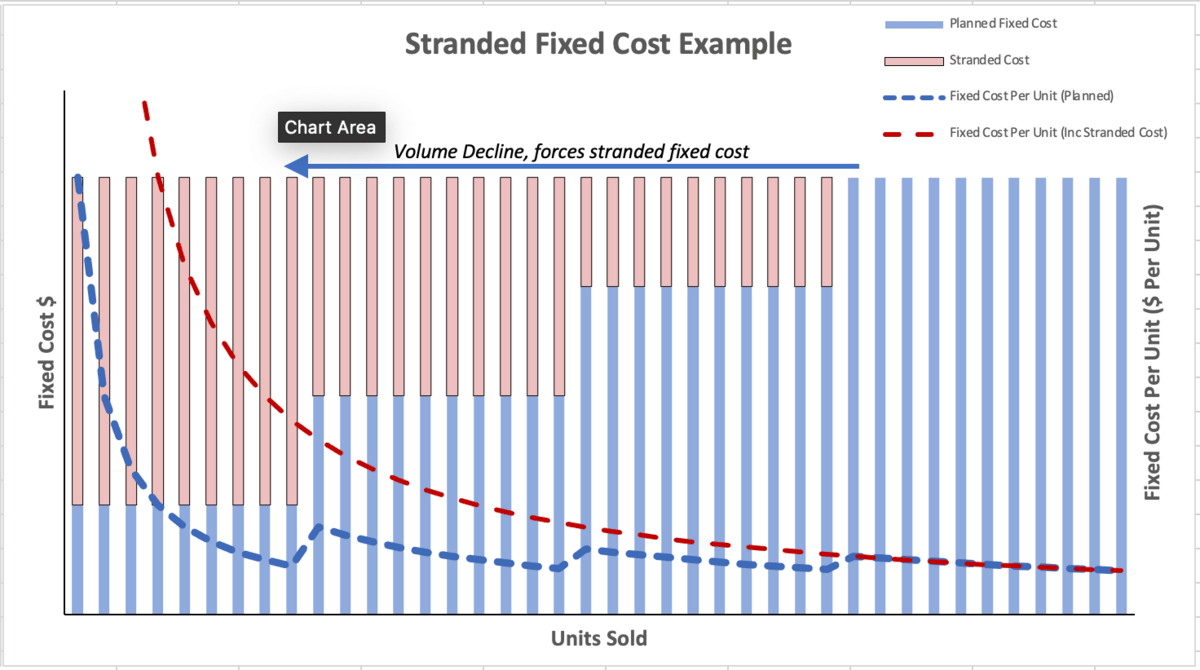
How fixed costs get stranded
The efficient cost curve is shown by the blue dashed line. The red-dash line shows the actual cost curve for a 4 warehouse operation. The difference between those two lines is the in-built inefficiency at sub-scale volumes.
The same applies for investments in fixed cost ahead of growth that never materializes. A cardinal sin.
There are too many exec teams now running businesses who don’t understand how to manage costs sensitively.
Or even if they do, don’t have the first clue how to axe cost out of a business.
It’s hard yards.
There are many different volume impacts on fixed costs. Too many for one post, but the above examples illustrate the key concepts.
We said earlier that a variable cost is one where the cost varies directly in line with volume. I.e. the cost per unit is fixed.
But do we expect the supplier to quote the same unit cost for an order of 50 dumbbell sets, versus 1,000,000?
Of course not.
Put yourselves in the shoes of the supplier for a moment.
Running a dumbbell manufacturer (high operating leverage), you want to incentivize large orders. Larger volume orders brings an opportunity to exploit your own fixed cost dilution.
How do you incentivize larger orders? You reduce prices (often via volume rebates).
You are taking a share of that fixed cost efficiency and sharing it with the customer through lower net prices. Incentivizing bigger orders, which drives more fixed cost efficiency. And so on.
A cost leadership flywheel.
Now back to the ecommerce operator.
Your dumbbell supplier has reduced their unit price to you for higher orders. Your most directly variable cost line is now reducing per unit, as volumes increase.
I.e. it is no longer a purely variable cost:
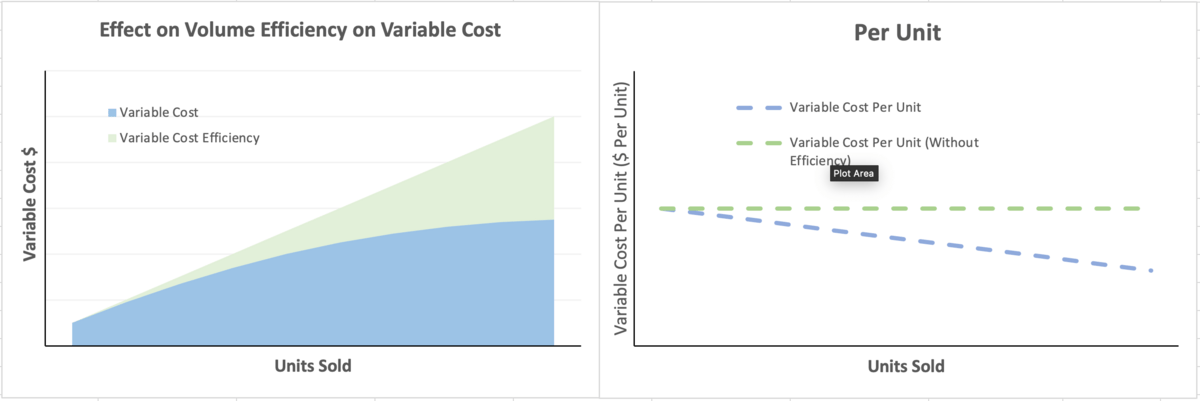
Impacts of volume rebates on variable costs
The blue area is the variable cost relationship with volume. The line is now curved and no longer straight (as it was the first chart). The green area represents the value of the efficiency saving. Growing as volumes grow.
This is how to build cost leadership moats.
Understand the behavior of each cost line in your business in detail. We’ll cover this in more detail next week.
All costs have some relationship with volume (some more than others). But volume isn’t the only thing that drives costs; £ revenue, employees, sales mix, etc
If in doubt, use low operating leverage; low fixed costs (at expense of higher variable costs). This will limit your profitability. But more importantly, will prevent huge losses whilst you prove your model.
Capitalize on opportunities to increase operating leverage once you are confident volatility in volumes won’t leave you with stranded fixed cost
However, increases in fixed costs are easier to implement than they are to reverse. Use caution, and time carefully.
Cost behavior dynamics apply for your suppliers, competitors and customers too. Think about how you can exploit them to create cost leadership moats in your business / supply chain.
No posts
Comments
Nothing yet. Say the first thing.
Sign in to join the conversation.