
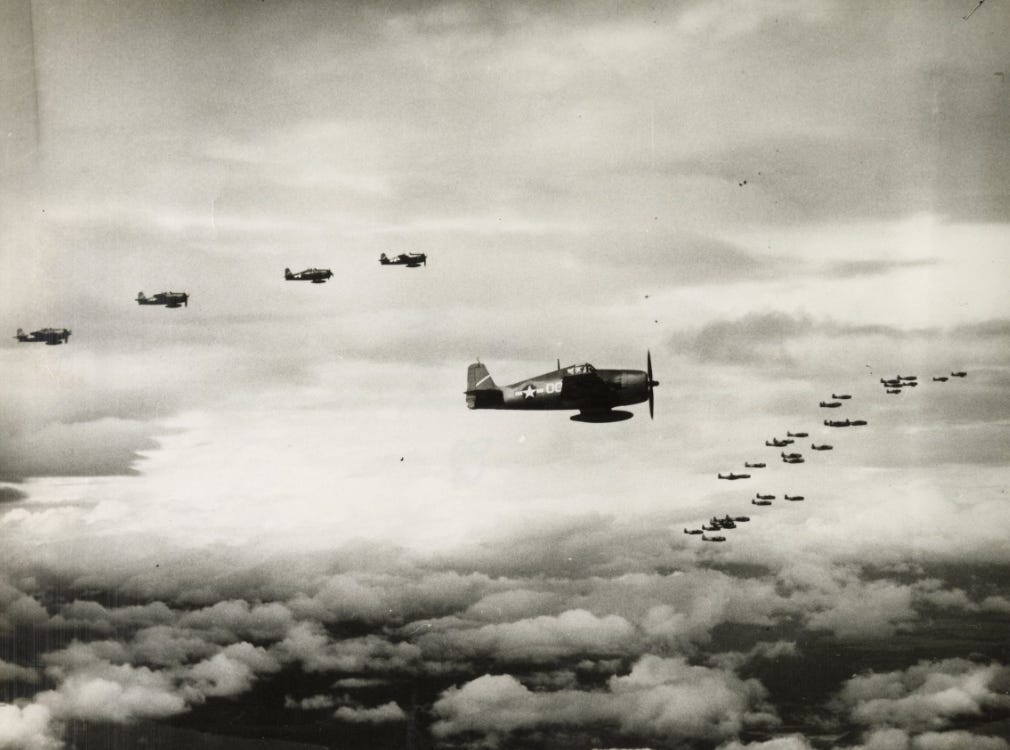
Writing a book has always been on my bucket list, and I'm happy to say I'm getting the opportunity to do so with a great publisher! Without getting too far into the weeds just yet, it's going to be a history of American naval aviation in the Pacific during World War II from 1943 to 1945, told through the pilots and squadrons who flew off the carriers. I hope to touch more on why I chose this particular time period at some point, but I’ll say this is a topic that has always been of keen interest to me. More details to come as things take shape.
I will preface this by reiterating that this has always been a free newsletter. I never felt comfortable asking people for money for what I considered to be my hobby outside my day-to-day job. Now that I am embarking on this adventure, I have decided to open up paid subscriptions if you would like to help me. With paid subscriptions, I’m hoping to cover some of the research costs associated with this endeavor. Luckily, the vast majority of the material has been digitized and is available, so I will not have to slave away in the National Archives in College Park too much (I hope). However, some of it is not; for example, a number of pilot papers, including those of Jimmy Flatley (the legendary commander of Fighting Squadron 10) and Robert Duncan (the first pilot to shoot down a Zero in a Hellcat), are at the Patriots Point Naval & Maritime Museum in Charleston, South Carolina. None of those papers is available online, so I would have to take a trip out there at some point. The Naval History and Heritage Command at the Washington Navy Yard also has a large archive, and many of those papers have not been digitized.
I’m also hoping to cover the costs of a variety of different research tools. For example, I’ve used Adobe to create PDFs of all of the documents I used on the recent pieces on Rabaul. Unfortunately, the National Archives only provides digitized images, so I download each one individually and then aggregate them into a single document. This then allows me to read and search a document as a whole rather than individually. I plan to make those available as I make them. I also use Zotero, OneDrive, and JSTOR, just to name a few other useful tools that will cost money, given the size and scope of this project. Having various access to memberships for associations such as the U.S. Naval Institute and the Yorktown Association will be extremely helpful.
As for this newsletter, because I’m writing this book outside my day-to-day job, unfortunately, I won’t be able to do the sorts of articles I’ve been doing for the last two years. The long, deeply researched pieces that this newsletter has become known for take quite a bit of time to put together, and for the foreseeable future, most of that time and energy needs to go toward the manuscript itself. I don’t say this lightly. Every one of those articles has been a labor of love, and I know a lot of you found your way here because of them.
So what does that actually look like?
For one, you’ll probably see the end of standalone semi-academic style deep-dive pieces in the near term, at least in the format you’re used to. Instead, I want to open up more of the process itself. A lot of what makes this kind of history interesting isn’t just the finished narrative, it’s the digging that gets you there: chasing down a squadron war diary that turns out to be misfiled, cross-checking an American loss claim against a Japanese record and watching the story change, or realizing a name of a pilot in a footnote or report leads somewhere nobody’s really followed before. I’d like to start sharing more of that in a regular “research update,” either every week or every other week, walking through primary and secondary sources as I work through them, possibly as a paid-subscriber feature to start. Nothing is locked in yet, but that’s the direction I’m leaning. This way, I can keep you’ll posting and not let this newsletter slowly die off.
I also want to make some of the source material itself available where I reasonably can, like those aggregated PDFs I mentioned. Even if you never crack open an archive yourself, there’s something worthwhile about being able to look at the same documents I’m working from and draw your own conclusions.
As for how you can help, a few things come to mind. Paid subscriptions are obviously the most direct way, and every one of them goes straight back into the research: archive trips, document costs, software, all of it. But even if that’s not something you’re able or willing to do, sharing this newsletter with people who might be interested helps more than you’d think. And if any of you happen to have connections to naval aviation veterans, their families, or unpublished papers and collections I might not know about yet, I would genuinely love to hear from you. A lot of the best material I’ve found so far has come from exactly those kinds of tips.
I know asking for money is a little awkward, especially after two years of this being free, and I don’t take lightly that some of you are on fixed budgets or just don’t do paid newsletters as a rule, no hard feelings either way. But if you’ve gotten something out of the work here, a paid subscription is genuinely the most direct way to keep it going and to make the book better than it would otherwise be. This isn’t funding a vacation or my coffee habit; it’s funding a research trip to Charleston to sit with papers that exist nowhere else, or a JSTOR subscription that unlocks a journal article that changes how a chapter gets written, or the software that turns a folder of scanned archive images into something actually usable. Every subscriber makes the finished book a little more thorough, a little better sourced, and a little closer to the kind of history I think this subject deserves. If that’s something you want to be part of, now’s a good time to jump in, and if not, sharing this post with someone who might care is worth just as much to me.
I’m genuinely excited about this project, and a little terrified, in the way I think anyone should be when they’re taking on something this size. Thank you for reading this far, and for being part of this newsletter’s journey and story. More soon!
Comments
Nothing yet. Say the first thing.
Sign in to join the conversation.