
June 2026.
The turboprop from Montréal to Québec City shudders, drops, and catches itself. I grip both armrests. Gray clouds hang over the St. Lawrence. Rain streaks sideways across the window.
We land in Québec City for a quick passenger exchange. The pilot turns around from the cockpit.
“Everybody needs to get off the plane.”
We were supposed to stop for a few minutes, then take off for Baie Comeau, on the north shore of the St. Lawrence, roughly nine hours from Montréal by car. My ticket cost about $150, a price heavily subsidized by the Québec government.
I’m on a tight schedule. My 18-year-old son, Charlie, and my nephew have already driven to Baie Comeau. They’re waiting for me. From there, we’ll drive another three hours into the northern Québec wilderness to meet my father and uncle at a remote fishing camp.
The airline’s terminal is a small room attached to a hangar. There is no security checkpoint. A few rows of plastic chairs face a large window. One vending machine hums against the wall.
I walk to the counter. The employee looks about seventeen.
“How long are we going to be here?”
“Probably fifteen minutes,” she says.
It’s obvious she has no clue.
Then I see something through the window.
Our pilot climbs into a white pickup truck with two maintenance workers. They drive away.
Wait, what?
I catch another maintenance worker as he heads upstairs.
“What’s going on with our flight?”
“Something with the wheel.”
“We just landed on those wheels.”
I look through the window. The wheels appear perfectly normal, an assessment supported by zero aviation expertise.
“Why did the pilot leave?”
“They’re looking for a replacement piece,” he says. “It’s the weekend.”
I pride myself on reading people. I decide he’s lying.
An hour passes.
The airline transfers almost everyone to another flight. A couple remains behind with me. Only three of us. I’m convinced they’re going to cancel the flight.
The husband approaches the teenager at the counter.
“She’s flown with you about ten times,” he says, pointing toward his wife. “You’ve left her stranded here nine of them. This is unacceptable.”
I pull out my phone and look up the airline. Its average rating is one and a half stars. Review after review describes delays, cancellations, and stranded passengers.
I buy a Kit Kat from the vending machine. Then another. I’m stress-eating.
I email Charlie and my father. Charlie replies that he’s fine and will wait.
My father responds philosophically, his favorite style of communication.
“That’s the beauty of these fishing trips. Nothing ever goes as planned. We learn to enjoy the adventure.”
That calms me down for about five seconds.
I return to the counter.
“When are we leaving?”
“I don’t know,” the teenager says.
At least she’s telling the truth now.
Should I rent a car and drive? The main terminal is about a twenty-minute walk away. I head outside, dragging my roller bag into the rain, confident that the flight isn’t leaving anytime soon.
The wind pushes drizzle into my face. Cars spray water across the access road. By the time I reach the rental counters, my shoes are wet.
A car is available. Now I have a choice. I can rent it and drive roughly nine or ten hours to the fishing camp. Or I can place another bet on Flaky Air (not the airline’s real name).
I’m furious and laser-focused on solving a situation I barely control.
Then I ask myself, why?
From any reasonable perspective, this is a small problem. I’ll reach the camp one way or another. I’ve taken time off. I’m about to fish for trout with my family on quiet, uninhabited lakes. My reaction isn’t proportional to the situation.
Why does waiting in a tiny airport feel like such a high-stakes situation? Why am I so impatient and irritable?
Several psychological factors are at play. First, when we get closer to the end of a wait, our frustration increases. Researchers have found this pattern in people waiting for a bus, waiting to receive a COVID vaccine, and waiting for election results. In the bus study, “Participants felt more impatient as the bus arrival time approached.” Counterintuitively, the wait feels worse when it’s almost over. I’m just a short flight away from connecting with my son and nephew.
Second, research shows that when you put a “high achieving” or perfectionistic kind of brain in a passive state of waiting, with nothing useful to do and little control, agitation follows.
Also, no one has unlimited capacity to handle stress. We all have a stress bucket, if you will. When mine is already 95 percent full from my day job, it doesn’t take much to make it spill over.
Emotional regulation and self-control draw on a limited pool of mental resources. High-stress jobs require a massive amount of both—maintaining composure during tense meetings, measuring every word, and projecting calm leadership. By the time we encounter a small annoyance outside work, that reservoir may be empty, leaving little buffer for additional friction.
Back at the rental counter, I need to make a decision.
I decide to check the flight one last time. I walk back to the small terminal.
A different plane is sitting outside the hangar.
Miracle.
“We found another aircraft,” the teenager says. “You’re going.”
The airline will fly the three remaining passengers to Baie Comeau. A few crew members are coming with us. I suspect their desire to get home has improved our odds of our flight not getting cancelled.
Charlie and my nephew are waiting when I arrive. We load my bag and start driving north.
The roads narrow. Cell reception fades.
By the time we reach camp, the air smells of spruce, wet earth, and wood smoke. The only sounds are wind in the trees and birds.
My father is smiling. He’s been coming here for decades, sometimes for weeks at a time. This is his favorite place in the world. He looks completely at home.
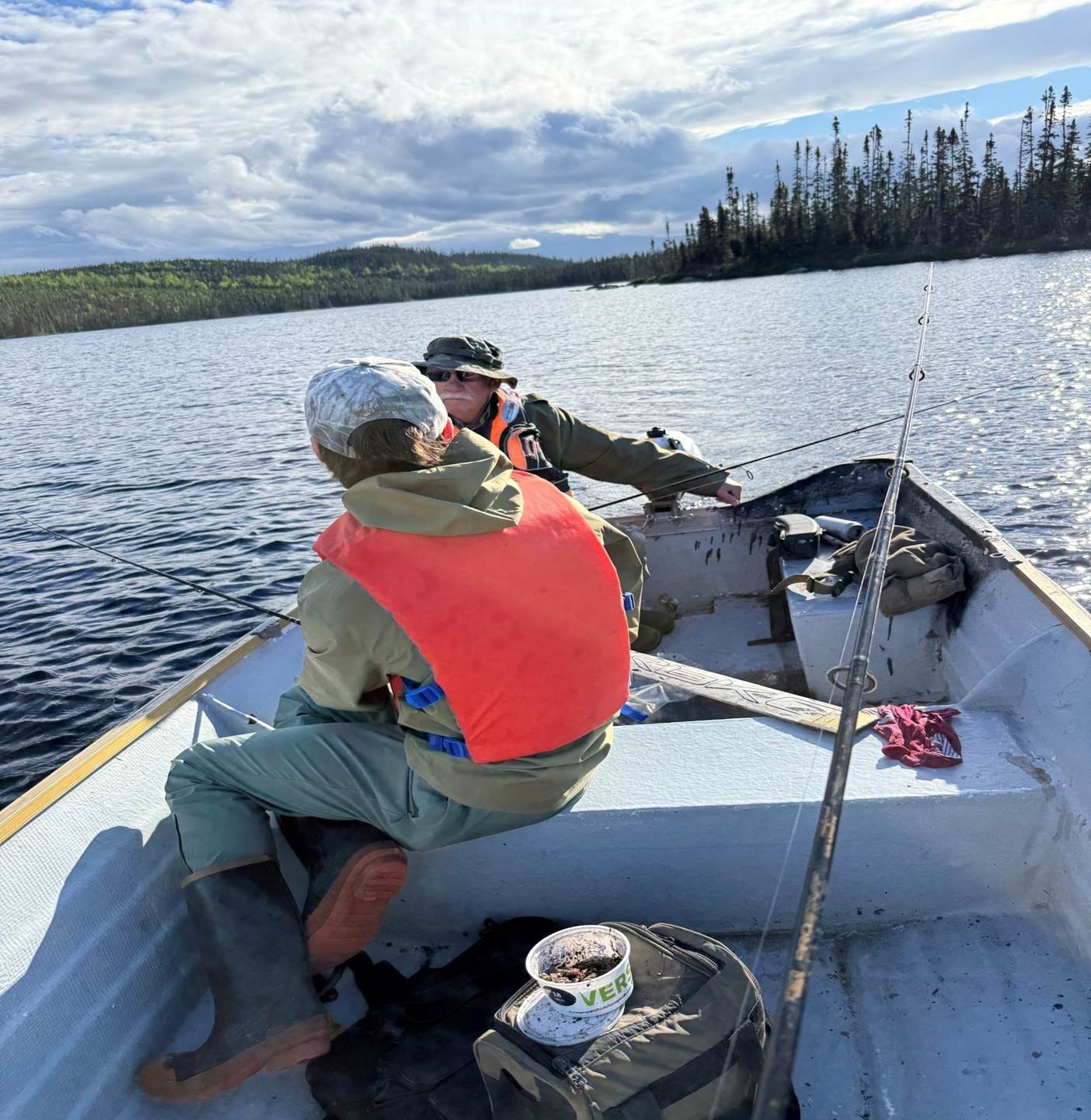
The next morning, my father, Charlie, and I climb into a small boat.
Three generations on the water.
The lake is flat and mist hangs over the far shoreline. My father starts the small motor and begins his seminar. He was a professor for 40 years—old habits die hard.
Some of his key minimalist lessons:
“Everyone does what they want here. There’s no rush. No schedule.”
“People buy expensive fishing gear. All useless. You need a high-quality hook.”
“Eighty-five percent of the lake is empty water. Spend your time finding the fifteen percent where the fish actually are.”
“Give a man a fish and he eats for a day. Teach him to fish and he’ll sit in a boat and drink beer all day.”
My father has built a philosophy out of fishing. Protect your time. Ignore expensive distractions. Find the small part of the lake that deserves your attention.
At camp, the lost hours at the airport shrink into irrelevance.
Time away lowers the waterline in my stress bucket. Nature helps. Distance from work helps. Family helps most.
Late the next afternoon, my father, Charlie, and I sit quietly in the boat. The sun is low. The water reflects the trees. No one checks the time. We each grab an ice-cold beer from the cooler.
“There’s no rush here,” my father says.
This time, I listen.
(Buy my book here.)
Share Sebastien Page's The Psychology of Leadership
Endnotes
Roberts, A. R., & Fishbach, A. (2025). “Impatience Over Time.” Social Psychological and Personality Science, 16 (2), 173–181. Across real-world waits lasting minutes, days, and months, impatience increased as people approached the end. The authors found that a heightened desire for closure helped explain the effect.
Weaver, R. C., & Rodnick, J. E. (1986). “Type A Behavior: Clinical Significance, Evaluation, and Management.” Journal of Family Practice, 23 (3), 255–261. The authors describe the historical Type A pattern as time urgency, competitiveness, impatience, and a persistent drive toward goals. Their examples include irritability while waiting and a compulsive need to remain active.
Dunkley, D. M., Zuroff, D. C., & Blankstein, K. R. (2003). “Self-Critical Perfectionism and Daily Affect: Dispositional and Situational Influences on Stress and Coping.” Journal of Personality and Social Psychology, 84(1), 234–252. In a seven-day diary study, people high in self-critical perfectionism showed stronger emotional reactions to everyday stressors involving possible failure, loss of control, or criticism. This supports the link between perfectionism and heightened stress when plans fall apart.
McEwen, B. S., & Stellar, E. (1993). “Stress and the Individual: Mechanisms Leading to Disease.” Archives of Internal Medicine, 153 (18), 2093–2101. McEwen and Stellar define allostatic load as the accumulated cost of repeated or chronic stress responses. This provides the scientific foundation for the stress-bucket metaphor.
Baumeister, R. F., Bratslavsky, E., Muraven, M., & Tice, D. M. (1998). “Ego Depletion: Is the Active Self a Limited Resource?” Journal of Personality and Social Psychology, 74*(5), 1252–1265.
Hagger, M. S., et al. (2016). “A Multilab Preregistered Replication of the Ego-Depletion Effect.” Perspectives on Psychological Science, 11*(4), 546–573.
Baumeister and his colleagues proposed that different forms of self-control draw on a shared resource.
No posts
Comments
Nothing yet. Say the first thing.
Sign in to join the conversation.