
But various voices – as Clyde entered the first door to cross to the chair room, calling “Good-by, Clyde.” And Clyde, with enough earthly thought and strength to reply: “Good-by, all.” But his voice sounding so strange and weak, even to himself, so far distant as though it emanated from another being walking alongside of him, and not from himself. And his feet were walking, but automatically, it seemed. And he was conscious of that familiar shuffle – shuffle – as they pushed him on and on towards the door. Now it was here; now it was being opened. There it was – at last – the chair he had so often seen in his dreams – that he so dreaded – to which he was now compelled to go. He was being pushed towards that – into that – on – on – through the door which was now open – to receive him – but which was as quickly closed again on all the earthly life he had ever known.
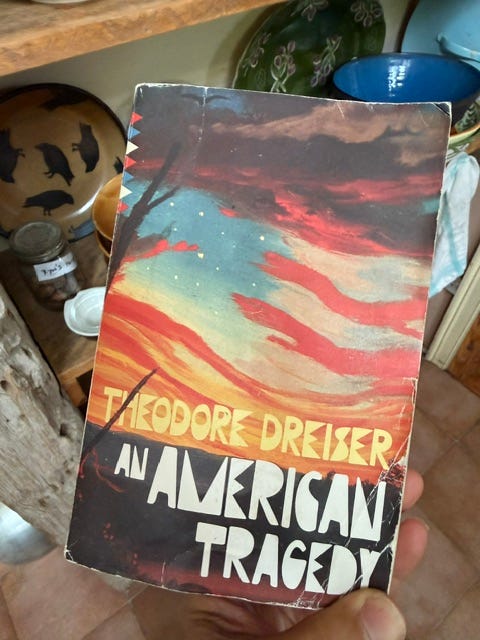
In Theodore Dreiser’s unforgivable novel, An American Tragedy, these are the last moments of the main character of the book. Clyde Griffiths is a young man of humble – even embarrassing – origins who, through a combination of luck and determination, has placed himself within the social circles of a manufacturing family in a one-factory town. He is given a supervisor’s job at the factory and quickly violates company policy by starting an affair with a young woman named Roberta who works the floor under his authority. Meanwhile, Cyde also manages to make the beautiful and high-born Sondra fall in love with him, which promises a lifetime of inherited ease if he can only manage to marry her. Unfortunately, Roberta gets pregnant, and when she insists on having the baby - which will ruin his chances with Sondra - he kills her in a fake drowning. Clyde is arrested, tried and put to death in the electric chair.
I say the novel is unforgivable because it starts slowly – very slowly – and lulls you into complacency through the sheer banality of the world it describes until - step by step, small decision by small decision - monstrous things are contemplated. And then planned. And then carried out. The anguish I felt sensing that all this was coming was almost unbearable. Clyde destroys three human lives - his own, his lover’s, and his child’s - and the only people who escape harm are the affluent who float above it all. Through the careful accretion of detail, Dreiser creates a world that at first you can’t resist and finally you can’t escape.
Dreiser was the ninth of ten children (two others did not survive childhood) born to poor, religious parents in Terre Haut, Indiana in 1871. As a young journalist, Dreiser’s primary concern was social justice in all forms: Racial, economic, political. He was unrelenting in his pursuit of fairness and quickly drew his bead on the desperate measures young people would take to grab the coattails of the wealthy. American Tragedy came out in 1925, four years before the start of the Great Depression and after several decades of unbridled economic domination by corporate titans. The book won no major awards but enjoys the double honor of being banned by the City of Boston and by the Nazis. A clever friend once told me that the way you can tell that New York won the competition with Boston is that New York doesn’t realize there’s a competition with Boston. The other way you can tell, of course, is that only Boston and the Nazis banned Dreiser’s book.
The paragraph, above, is among the last of an 869-page book. Clyde has spent a year trying to exonerate himself and then, finally, accepting his death. He has spent a year trying to imagine this moment and failed to because it was simply too horrifying. But he’d heard other men go to their deaths in the small hours of the morning - shuffling and bidding farewell, as he was - and in a sense, he learned how to do it from them. And now it’s his turn. What strikes me is the fractured grammar, the incomplete sentences. The first sentence of the paragraph begins with, “But,” and then falls off a syntactic cliff to just hang, unresolved. The next sentence ignores any requirement to use a verb. The result is a profoundly unsettling experience for the reader, who expects sentences to unfurl in minimally predictable ways. The third sentence also starts with “But” and continues to a gerund that leads nowhere. Except we realize that Clyde is having an out-of-body experience - psychologists call it “de-personalization” and “de-realization” - where his voice seems to come from someone else. This is a classic stress reaction that we all recognize even if we’re not psychologists. Reading it produced a feeling of absolute dread in my stomach.
And now we are at the end. And now we are at the confused and halting repetition that surely must be what the mind does in such a moment. He sees the door - the door! - the last one he will ever pass through. The chair - the chair! - the one he has spent a year trying to imagine. In one’s final moments, apparently, the mundane attains a kind of surreal glow as if all of reality is sacred - every single thing. We know this because the Russian writer, Fyodor Dostoevsky, was stood before a firing squad when he was young (for speaking on behalf of the country’s serfs.) Orders were shouted, rifles were leveled, and at the last moment, a horseman galloped up with a pardon from the Tsar. “There was a church not far off, its gilt roof shining in the bright sunshine,” Dostoevsky wrote in his novel, The Idiot, about a character widely thought to be a stand-in for himself. “He remembered staring with awful intensity at that roof and the sunbeams flashing from it; he could not tear his eyes off those rays of light: those rays seemed to him to be his new nature, and he felt that in three minutes he would somehow merge with them.”
The repetition and halting pace of the final sentence is worth appreciating: towards that – into that – on – on – through the door which was now open – to receive him. Ordinarily, one wouldn’t want to write in such a way except that this is no ordinary moment; a young man is about to cross from existence to non-existence at the flip of a circuit-breaker. And then the final words: quickly closed again on all the earthly life he had ever known. We are all in that final room, of course, whether we die surrounded by loved ones in our bedroom or by state officials in a death chamber. The ultimate point of this brilliant and unforgivable book is that a brutal economic systems cause otherwise decent people to make absolutely brutal decisions.
It really is as simply as that.
No posts
Comments
Nothing yet. Say the first thing.
Sign in to join the conversation.