
In the open doors the women stood looking out, and behind them, the children – corn-headed children, with wide eyes, one bare foot on top of the other bare foot, the toes working. The women and the children watched their men talking to the owner men. They were silent.
Some of the owner men were kind because they hated what they had to do, and some of them were angry because they had to be cruel, and some of them were cold because they had long ago found out that one could not be an owner unless one was cold. And all of them were caught in something larger than themselves. Some of them hated the mathematics that drove them, and some were afraid, and some worshipped the mathematics because it provided a refuge from thought and feeling.
And at last the owner men came to the point. The tenant system won’t work anymore. One man on a tractor can take the place of twelve or fourteen families. Pay him a wage and take all the crop. We have to do it. We don’t like to do it.
But you’ll kill the land with cotton.
We know. We’ve got to take the cotton quick before the land dies. Then we’ll sell the land. Lots of families in the East would like to own a piece of land.
The tenant men looked up in alarm. But what’ll happen to us? How will we eat?
You’ll have to get off the land. The plow’ll go through your dooryard.
And now the squatting men stood up angrily. Grampa took up the land, and he had to kill Indians and drive them away. And Pa was born here, and he killed weeds and snakes. Then a bad year came and we had to borrow a little money. An’ we were born here. There in the door – our children were born here. And Pa ha to borrow money. The bank owned the land but we got a little bit of what we raised.
We are sorry. It’s not us. It’s the monster. The bank isn’t like a man.
Yes but is only made of men.
No, you’re wrong there – quite wrong. The bank is something else than men. It happens that every man in the bank hates what the bank does, and yet the bank does it. The bank is something more than men, I tell you. It’s the monster. Men made it but they can’t control it.
The tractors came over the roads and into the fields, great crawlers moving like insects, having the incredible strength of insects. They crawled over the ground, laying the track and rolling on it and picking it up. Diesel tractors, puttering while they stood idle; they thundered when they moved and then settled down to a droning roar. Snub-nosed monsters, raising the dust and sticking their snouts into it, straight down the country, across the country, through the fences, through the dooryards, in and out of gullies in straight lines. They did not run on the ground but on their own roadbeds. They ignored hills and gulches, water courses, fences, houses.
“And that reminds me,” the driver said, “you better get out soon. I’m going through the dooryard after dinner.”
“You filled in the well this morning.”
“I know. I had to keep a straight line. But I’m going through the dooryard after dinner. Got to keep the lines straight.”
“I built it with my hands. Straightened old nails to put the sheathing on. Rafters are wired to the stringers with baling wire. It’s mine. I built it. You bump it down – I’ll be in the window with a rifle. You even come too close and I’ll pot you like a rabbit.”
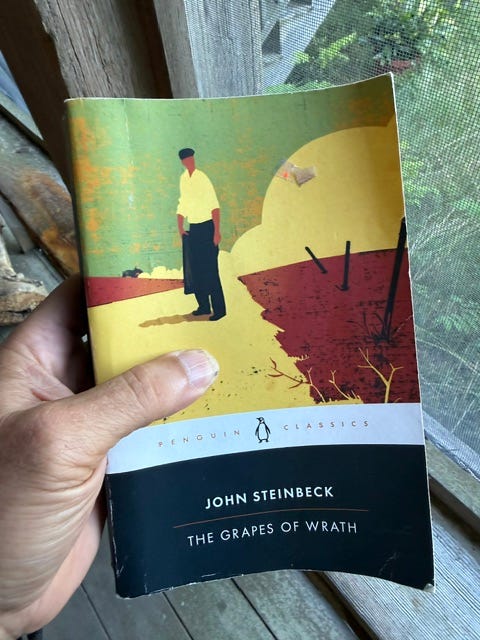
The passages are from Chapter 5 of what might be the greatest American novel. Or the most necessary American novel - or maybe just the most prescient. I have taken the liberty of slightly shortening some of the passages; needless to say, read the whole chapter on your way to reading the book. Steinbeck was writing about his own era - the 1930s - but in my opinion would not have been surprised by our own. His topic is the dispossession of tenant farmers from their parched and dying land due to a combination of economic and climatic factors. The Dust Bowl cast tens of thousands of Americans to the roadways on broken cars and horse-drawn wagons searching for jobs, for food, for shelter. Storms called “Black Rollers” put so much dirt in the air that people were found dead in their front yards with their lungs full of dirt, having literally asphyxiated trying to find their own front door. A friend of mine - passed away some years now - grew up in this era and told me that community schoolhouses were always left unlocked so migrating families could find shelter at night. Lone men were required to sleep outside in the woods.
This was the era that Steinbeck wanted to address - one of community responsibility in the face of institutional betrayal and economic collapse. While writing the novel in one long creative lunge, he confided to a friend, “My whole work drive has been aimed at making people understand each other.” I’ve tried my hand at defining what good journalism is, but I don’t think Steinbeck’s formulation can be outdone. Represent the powerless, scrutinize the powerful and protect the future of the children; that’s pretty much it. The future that Steinbeck was trying to protect would see the rise of fascism, the mass killing of World War Two and the wholesale disenfranchisement of people by machinery. The world would eventually recover and adapt, of course, but Steinbeck could not have known that. There were old people in Texas and Oklahoma and New Mexico who could remember being attacked by Comanche Indians and now had to wrap their minds around Nagasaki and Hiroshima. How could a people possibly adjust to that kind of change?
Before starting the book, Steinbeck wrote to a friend named Elizabeth Otis, “I must go over to the interior valleys (in central California). There are five thousand families starving to death over there, not just hungry but actually starving.” After finishing his research, Steinbeck got to work in a shed that was hardly larger than a man lying down and wrote the book in one hundred days, giving his wife reams of hand-written pages that she typed up and sent to his publisher. The manuscript was a quarter million words and in print four months after it was completed. Words like, “fuck,” “shit,” “screw” and “fat ass” were taken out and not put back in until 1996. The book won both a Pulitzer Prize and a Nobel Prize and sold 15 million copies. But the effort “finished him,” Steinbeck told a friend after he was done. “I don’t know whether there will be anything left of me.”
The book is about power, and the opening paragraph frames the entire society: Barefoot children standing one foot atop of the other, as children do; mothers watching their men, worried and silent; men squatting in the dust, confused and angry; and the company men stone-faced and unyielding in their enclosed cars. The paragraph reminds me of the black-and-white photographs of Walker Evans, where you need nothing more to understand the entire tragedy. Steinbeck lets the farmers represent themselves with their simple questions and quick anger - there is nothing complex to understand here - and instead helps us get inside the minds of the company men. A lesser novelist would have had these men be cruel or at least stupid, but Steinbeck wants people to understand each other, so he explains that the company men are human too and in their own kind of hell. At every rung of the ladder, up to bank president, no one has any real choices. This is how machine logic takes over human understanding. This is how slave ships and genocide and even the economic collapse of 2008 can be implemented: one small task at a time by otherwise ordinary and moral men. (I say “men” on purpose; they are no more or less moral than women but run vastly more of the machinery of war, of industry, of business. Individually, they are as trapped as the women, but collectively, they have a lot to answer for.)
The conversation in the dooryard between the bank representatives and the tenant farmers is without quotes, filtered through Steinbeck’s interpretation. That allows him to summarize the economic reality facing both banks and farmers rather than forcing either into awkward expository dialogue. As the imagined bankman explains: : One man on a tractor can take the place of twelve or fourteen families. Pay him a wage and take all the crop. We have to do it. We don’t like to do it.
Then, more unquoted dialogue, free to be unrealistic and overly explanatory because these are not real sentences by real people; they are representative of a broader truth. A greater tragedy. Then arrives the most terrifying quality of the modern era: That complex systems organized by humans can get individuals to do things they would never do on their own. The bank is something else than men, the bankmen say. It happens that every man in the bank hates what the bank does, and yet the bank does it. The bank is something more than men, I tell you. It’s the monster. Men made it but they can’t control it.
The cosmos does not need Satan, the killing fields do not need psychopaths, the slave ships do not need sadists when this is true; a polite young man at a savings and loan in a small town in Iowa in the 1930s will do. Steinbeck saw that the human race could destroy itself by depending on complex systems that only functioned if they ignored the human outcomes they were supposed to protect. In that way, moral people could take part in the dislocation or annihilation of an entire race even though they personally opposed it. When crowds lose control and trample people to death, each individual becomes a murderer simply by trying not to fall, themselves.
One of the most powerful paragraphs in the book - I’m not sure how one would even decide such a thing - is Steinbeck’s description of a tractor at work. These are the tractors that carry out the orders of the bank managers and shareholders and they go straight through everything: fields, gulleys, houses, barnyards. The passage stands out because instead of furthering the plot of a long and brilliant novel, it seems to exist - like all beauty - for its own sake. It was the image of the insect that got me - hardly an obvious comparison for a tractor until I realized, “Oh, he must be watching this come from a great distance on a very flat land.” The phrase “great crawlers” was bold and original and the awkward repetition of “having the incredible strength of insects” made me think that the writer was completely sure of himself and was writing from experience without regard to what readers might think. More crawling, more alien insect motion that doesn’t go fast and doesn’t stop. Diesel tractors; snub-nosed monsters, snouts ploughing up the country. It all captures the essence of a tractor even for people who have never seen one.
And we finally have come to a conversation with quotation marks: Real people using believable and ordinary words. The driver of this great crawler tells a farmer that he’ll be knocking down his house “after dinner” because he’s “got to keep the lines straight.” If there is a better image to describe the relationship between humans and machines, I don’t know what it would be. And if there is a sadder threat in American fiction, I haven’t read it: I’ll be in the window with a rifle. You even come too close and I’ll pot you like a rabbit.
The next ninety years of American history and possibly our future for a good long time are contained in those words. People who kill rabbits for dinner don’t defeat people who run machines in straight lines; it’s never happened. We are - all of us - both in that window and on that tractor, and Steinbeck’s genius was to see that. Our salvation may depend on us seeing that as well.
No posts
Comments
Nothing yet. Say the first thing.
Sign in to join the conversation.