
A courier rode out on the run to summon the Tropa, which was quartered at the Canotillo. Rafaelito loaded the General’s baggage in the coach; it consisted of a typewriter, four swords, one of them bearing the emblem of the Knights of Pythias, three uniforms, the General’s branding iron and a twelve-gallon jug of sotol. And there came the Tropa, a ragged smoke of brown dust miles along the road…they came on the dead run, all Indian shouts and cracking revolvers, until they were only a hundred feet away, then jerked their little cow ponies cruelly to a staggering halt with bleeding mouths, a whirling confusion of men, horses and dust.
This was the Tropa when I first saw them. About a hundred, they were, in all stages of picaresque raggedness; some wore overalls, others the chorro jackets of peons, while one or two sported tight vaquero trousers. A few had shoes, most of them had only cowhide sandals, and the rest were barefooted. Sabas Gutierrez was garbed in an ancient frockcoat, split up the back for riding. Rifles slung across their saddles, four or five cartridge belts crossed over their chests, high, flapping sombreros, immense spurs chiming as they rode, bright-colored serapes strapped on behind – this was their uniform.
The General was with his mother. Outside the door crouched his mistress, weeping…
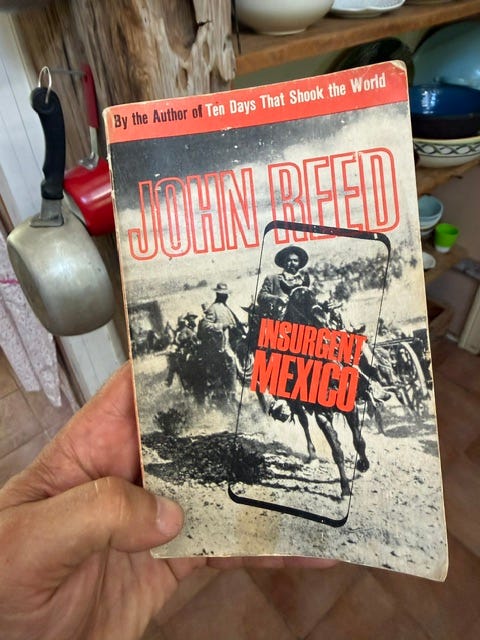
This passage arrives on page fifty of John Silas Reed’s first book, Insurgent Mexico, which he self-published in his twenties after an extended trip with Pancho Villa during the Mexican Revolution in 1914. A committed socialist, Reed would go on to cover violent labor strikes in America as well as the frontlines of the First World War, which he decried as a “traders war.” He died of typhus in Moscow at age 33 after covering the Russian Revolution and calling for a communist uprising in the United States. Reed famously wrote Ten Days That Shook The World, which was later turned into a movie called Reds, with Warren Beatty as a John Reed-type character. The passage, above, is near the beginning of a chapter called, The General Goes To War, which describes Villa’s sudden decamping from a town of Las Nieves. The Spanish word tropa means troop, and Villa’s tropa were light cavalry drawn from the impoverished Mestizo and Indigenous populations of northern Mexico. They were extraordinarily courageous and violent and colorful. Executing prisoners was a sport, combat was a sport, dying was a sport. Villa himself was eventually assassinated at an estate granted to him by the Mexican government.
Reed was an early exemplar of “modern journalism” which used first-person narrative, great attention to detail and novel-like narrative to make readers feel not just that they are being informed – the point of all journalism – but actually “there.” We are delivered an unapologetic cascade of Spanish names and terms – including Tropa itself - and expected to figure it out as if we ourselves had just stepped off a train at Las Nieves. Using foreign terms and place names without explanation immediately gives the reader an authentic-feeling experience that can even be a little flattering: “Does John Reed really think I’m one of the anointed who already knows all this stuff?” We are also experiencing the dizzying culture shock that Reed himself must have gone through, seeing and hearing many unfamiliar things that never get fully explained. And the words that are too arcane or regional to be understood don’t really matter because nothing hinges on them; sotol is a local drink made of cactus, but Reed doesn’t need to tell us that. He might not even know, himself; sotol is just the name other men use for a nasty clear liquid that they keep passing around in a jug.
Reed’s list of Pancho Villa’s belongings have zero news value but also put you, the reader, in a scene you not could not possibly have conjured on your own. If asked what Villa traveled with, you would never have guessed, “Four swords, a typewriter, a branding iron and a 12-gallon jug of sotol.” (Twelve gallons. And what was the branding iron for?) This kind of detail illuminates nothing of importance but allows for a journey of the mind that only film, at its best, can rival. And now we are come to the literature of it: A ragged smoke of brown dust. Smoke is a substance, not a concrete object, but violating normal usage like this sends a shiver down my spine. We are forging new language here, present at the birth of something where all is a little different but nothing is impossible.
And then the pell-mell description of the men themselves: Some wore overalls, others the chorro jackets of peons, while one or two sported tight vaquero trousers. A few had shoes, most of them had only cowhide sandals, and the rest were barefooted. Sabas Gutierrez was garbed in an ancient frockcoat, split up the back for riding. The terms – peons, frockcoats, vaqueros – feel of another era, and who knows who Sabas Gutierrez is but it clearly doesn’t matter. The first two sentences have a similar pattern – a tripartite division of one group, another group and then the rest. It allows for a broad but also detailed description that makes us see these men as if they were rearing and plunging on their horses right in front of us. These are poor men, mostly shoeless, and uncivilized enough to split a frock coat up the back to sit a horse. Frock coat is fused into one word – frockcoat – and barefooted is a past-participle adjective that is technically correct but entirely archaic. I don’t believe that was a random choice by the young John Reed. I believe he was deliberately trying to create an atmosphere of an era gone by. Northern Mexico was the last expression of an iconic era in American history known as “The West.” It involved, in our imagination, guns, horses, trains, alcohol, honor and violence – all of which were in abundant supply in Mexico in the early part of the Twentieth Century.
A later author, Cormac McCarthy, made a good living and established himself in the pantheon of great American writers with the same material. Here follows a paragraph from his breathtaking and horrifying book, Blood Meridian, describing an attack of Comanche on a troop of American soldiers in Mexico. I won’t insult you – or Cormac – by asking if he might have come across John Reed in his decades of research.
A legion of horribles, hundreds in number, half naked or clad in costumes attic or biblical or wardrobed out of a fevered dream with the skins of animals and silk finery and pieces of uniform still tracked with the blood of prior owners, coats of slain dragoons, frogged and braided cavalry jackets, one in a stovepipe hat and one with an umbrella and one in white stockings and a bloodstained wedding veil and some in headgear or cranefeathers or rawhide helmets that bore the horns of bull or buffalo and one in a pigeontailed coat worn backwards and otherwise naked and one in the armor of a Spanish conquistador, the breastplate and pauldrons deeply dented with old blows of mace or sabre done in another country by men whose very bones were dust and many with their braids spliced up with the hair of other beasts until they trailed upon the ground and their horses’ ears and tails worked with bits of brightly colored cloth and one whose horse’s whole head was painted crimson red and all the horsemen’s faces gaudy and grotesque with daubings like a company of mounted clowns, death hilarious, all howling in a barbarous tongue and riding down upon them like a horde from a hell more horrible yet than the brimstone land of Christian reckoning, screeching and yammering and clothed in smoke like those vaporous beings in regions beyond right knowing where the eye wanders and the lip jerks and drools.
Obviously, McCarthy’s now iconic paragraph is far longer, more involved and more literary than Reed’s, but you can see the same tripartite descriptions and breathless rhythms. And his word choices also tend towards the archaic (wardrobed), the fused (cranefeathers), and the evocative (clothed in smoke). We even have formal attire used in savage ways in McCarthy pigeontailed coat. The blizzard of details and odd visuals – stovepipe hats, frogged cavalry coats – is unapologetic in its insistence that we be familiar with this world. Beloved items from our genteel civilization are appropriated by people deep in an atavistic bloodlust, and you don’t have to be familiar with Mexico in 1914 to know what that’s going to look like.
As a young writer also reporting on violence and bloodlust, I was helpless to resist the stylistic call of McCarthy’s prose – and its origins in Reed’s groundbreaking work. It is with some embarrassment that I offer my own pale imitation of such language. This is my description of ethnic Kamajor fighters in Sierra Leone during the civil war in 1999:
They had come from the bush, these men, and they’d brought with them their protective magic and their claims of special powers. They wore sackcloth tunics and fishnet shirts studded with crocheted pouches that were supposed to stop bullets. They sewed cowrie shells onto their clothing and wore bone necklaces that hung down over ammo belts and clacked against their guns. One guy had nothing on but shorts and a pink ski parka hood. Another had a headband made of live machine-gun rounds. They stood in angry little clusters around shortwave radios listening to the afternoon BBC and jamming ammo clips into their guns.
I wrote that because I wanted some of Cormac’s magic, of Reed’s brilliance. Luckily, that failed. But it became part of how I – and we all – develop our personal style.
No posts
Comments
Nothing yet. Say the first thing.
Sign in to join the conversation.