
For this month’s Sea Story, Clancy Walker dives into the murky waters of salmon farms to uncover how they’ve come to poison not only wild salmon, but politicians and scientists alike.
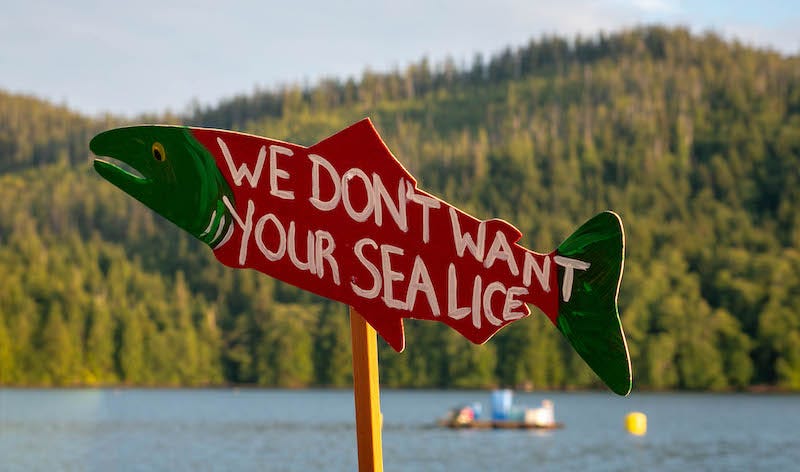
This exclusive preview offers a first look at a feature documentary currently in production, investigating one of the most controversial stories unfolding beneath the surface of the salmon industry. If you'd like to help bring the film to completion, be sure to check out Clancy's fundraiser to support the documentary.
How good science and scientists go bad.
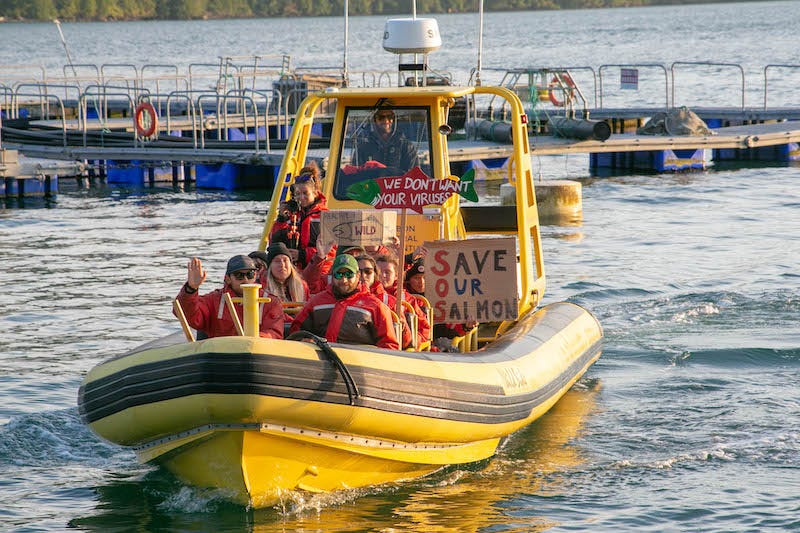
The tiny motorboat slices through the dark water, weaving the tight channels of Vancouver Island on Canada’s west coast. From my position on the bow I frame a shot of the scientist with my camera. A soft twilight shows the foothills and peaks of the Coast Range mountains. Tonight, the scientist is sampling water around a salmon farm, playing a small part in a larger study that is, in turn, part of an even larger investigation. This project is undertaken in good faith by countless scientists and concerned citizens - who are mobilising, organising, collaborating, all for something bigger than themselves, something borderless, something elemental.

I started shooting environmental documentaries with Sea Shepherd while still at university. First I showed them I could hold a camera, second I agreed to disappear into the Southern Ocean for however long they wanted. As the media team, our job was to capture every moment of the Antarctic Whale Defense campaign for an American television show. The show was high drama, high stakes, and I settled into a strange routine that seemed to be twelves hours on, two weeks off. The Southern Ocean is big, and ships move slowly. It takes a long time to find the action. You stare at the radar, then at the horizon, praying someone, somehow, through the fog and endless daylight, will spot the whaling fleet. The alarm suddenly rings. Action stations. Stand by to ram. A whale has been shot through by a harpoon. Ships close-quartering, dodging icebergs, teams tasked with tangling up propellers, warfare. That is how I cut my teeth on documentary.
Now, years later, under Canadian stars, my scientist is collecting water samples that will be filtered for viruses. The theory is that the so-called salmon farms, actually high density factory feedlots, unintentionally cultivate viruses, transmitting those viruses to wild salmon migrating past the farms. To say wild salmon numbers are in decline in areas of salmon farming would be an understatement. In some rivers the number of salmon returning to spawn each year is nearly zero. This research into pathogens and viruses shouldn’t really be called a theory —to an ecologist it’s common sense. “It’s a basic ecological principle,” says my scientist readying the water sampler, “and anyone with a high school education should be able to understand it.” Yet scientists have been gathering data for decades in these waters, as if basic ecological principles did not exist. Whether it’s pathogens or parasites, the results never make it past the bureaucrats to the policy and regulatory level. Drifting on the dark water around a salmon farm that night, it wasn’t the scientific methods, or biological principals, or discussions around data points that confused me, the science was not more confusing than whaling in Antarctica. What confused me was the lack of action on a clearly defined environmental threat. The scientist lifted a heavy bucket of seawater from one side of the boat to the other to balance the vessel, brooding. ‘The burden of proof is on us.’
The Seaspiracy Foundation is funded almost entirely by people who believe the oceans deserve independent investigations and courageous storytelling.
As a Founding Member, you’ll receive behind-the-scenes updates from our work, invitations to members-only Q&As, and the opportunity to vote on future investigations and campaigns. Most importantly, you’ll be helping us build a truly independent organisation dedicated to protecting the oceans while keeping our investigations and educational content free for everyone.
If you’re already subscribed to The Seaspiracy Observer, becoming a Founding Member is easy—simply upgrade your subscription to a paid membership.
In traditional law, the burden of proof—that is the obligation to gather evidence to support a claim—lies with the party asserting the claim, no matter how reasonable the claim may be to scientists. The one seeking to change the status quo must present the proof. Environmental NGOs or citizens suing a corporation must prove that a specific activity is causing harm. In this case, that farming salmon on wild salmon migration corridors impacts wild salmon health. This traditional legal process pretty much explains the reckless abandonment towards the environment throughout modern history. Corporations have the money and resources, while NGO’s and individuals generally don’t. Big business has become a law unto itself and operates with impunity.
Fortunately, the news is not all bad. Traditional legal processes are being challenged. Canada’s Cohen Commission, a federal inquiry charged with explaining the decline of Sockeye Salmon in the Fraser River, examined the evidence, then shifted the burden of proof onto the salmon farming industry and its captive governments. The Cohen Commission flipped the traditional model. Instead of conservationists having to prove that salmon farms are causing irreparable harm, the burden was placed squarely on the government and the salmon farmers to prove that their operations pose only a minimal risk to the Fraser River’s wild salmon. And if the operators could not provide solid scientific evidence by the deadline, the farms along the migration route must be removed.
But the Cohen Commission finished its work ten years prior to my night in that small boat. Clearly the burden of proof is not on the salmon industry, and there is widespread criticism that none of the Cohen Commission’s recommendations have been adequately—if at all—addressed. As runs of wild salmon trend toward zero in areas of salmon farming, coastal ecosystems enter a tailspin. Bears starve, orcas starve, First Nations lose their traditional salmon food source. Ecologies and cultures break down before our eyes. The science was in, but it wasn’t getting through to decision makers. Canadian governments had drunk the corporate kool-aid.
In The New Fish by Saetre & Ostli, the authors recount the experience of a Canadian government scientist who testified at the Cohen Commission – Dr Kristi Miller-Saunders. In 2011, Dr Miller-Saunders published her investigation into the decline of salmon in the Fraser River in the renowned journal Science. Her article showed that a new unnamed virus was a likely culprit. What followed for her career was years of censorship, restricted funding, reduced scope of research, labels from industry like ‘activist’, and references to her work as ‘speculative’ and ‘suspicious.’ This story is not uncommon. Tobacco companies pioneered the playbook. Fossil fuel companies use it to deny the effect of greenhouse gases on atmospheric temperatures. Big companies fund their own “science” to tarnish the reputation of anyone that threatens the bottom line, as Dr Miller-Saunders’ work did in 2011. It didn’t matter that Miller-Saunders was an internationally renowned scientific star. Her employer, the government of Canada, joined with industry to undermine her.
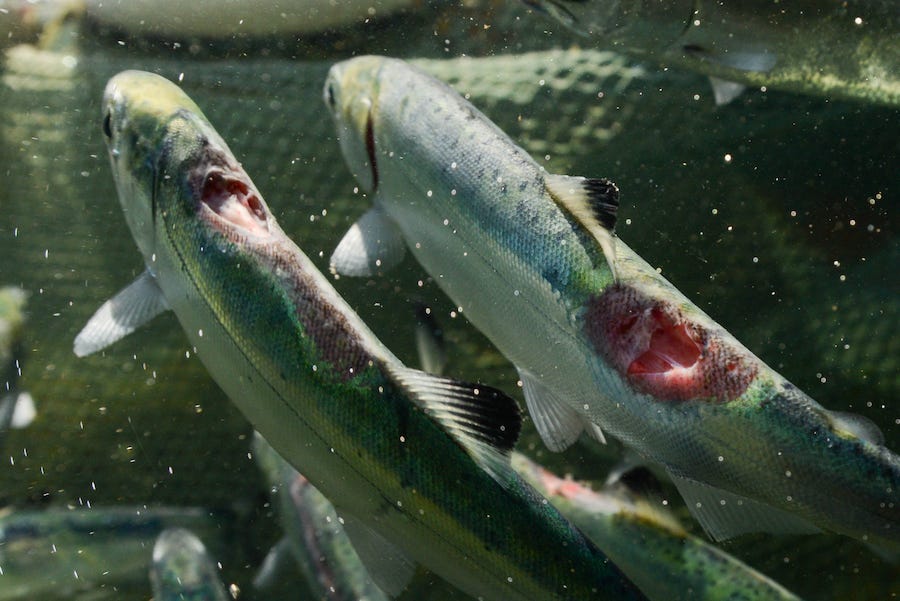
In his book Vanishing Fish, distinguished fisheries scientist Daniel Pauly recalls a day sampling salmon lice with independent biologist Dr Alexandra Morton, someone he refers to as “the foremost expert in British Colombia on these infestations.” Over the course of an hour, Pauly witnessed approximately one hundred juvenile wild salmon pulled from the water and “each and every one a sea louse on it, corresponding to the size of a dinner plate on a human. Some had two.” Morton was sampling along a wild salmon migration corridor where millions of caged salmon were breeding unnaturally high, out-of-season parasites that transfer to the out-migrating wild populations. The level of infestation witnessed that day was a death sentence for these baby salmon before they could ever hope to reach the ocean. Weeks later, Daniel Pauly watched a high ranking government research director publicly declare that Dr Alexandra Morton had spiked the young salmon with individual parasites. ‘I knew that this was a horrible lie and the beginning of a concerted effort to discredit Alexandra’s findings’ wrote Pauly.
This is blatant government capture by the salmon industry, but there are more underhanded operations at play, such as SCAMs, Scientific Certainty Augmentation Methods, also known as the science of doubt promotion. Science focuses on probabilities and cumulative evidence because absolute proof is never attainable. (Science cannot prove that the sun will rise tomorrow; all science can say is that it’s highly probable.) Industry “scientists” — sciostitutes, as the scientist in my boat calls them — are well paid to seize on this uncertainty, using it to discredit legitimate findings to a public without scientific training. This weaponised doubt creates the illusion of an ongoing debate amongst the scientific community. Ultimately, what this achieves for industry is simple—it stops any meaningful change, and it gives policymakers an excuse to do nothing. If matters are taken to court, the legal proceedings can take years. Meanwhile, the status quo is maintained. Business goes on as usual.
Early on in Richard Flanagan’s exposé Toxic: the Rotting Underbelly of Tasmania’s Salmon Industry he sets a tone that could just as easily apply in British Columbia: “Government no longer seemed to be government, regulators no longer were burdened by the need to regulate, rules breakers had through an incomprehensible metamorphosis become rule makers...” Toxic goes on to describe a modern day hellscape of captured governments, science ignored, reckless expansion, environmental catastrophes, species nearing extinction, human health risks, and the loss and degradation of our heart-places and connection to nature.
Later, with the buckets of water samples safely stowed, we go for a ‘barnacle buzz’. A short, breakneck-speed cruise over early morning waters to remove barnacle larvae from the boat before they can settle. Under us – rushing foam, above us – a thumbnail moon rising. The daylight enormity of mountains and pines blends into the monotonal reflection on the dark water. I see clearly now that there are scientists driven by integrity, in science and in themselves, and these are the people that need platforming. I sense a new project is dawning on me. A documentary celebrating the unsung heroes shouldering the burden of proof, the burden of witnessing, the burden of caring, the burden of resistance.
No posts
Comments
Nothing yet. Say the first thing.
Sign in to join the conversation.