
Right. It’s time to talk about the elephant in the room…China.
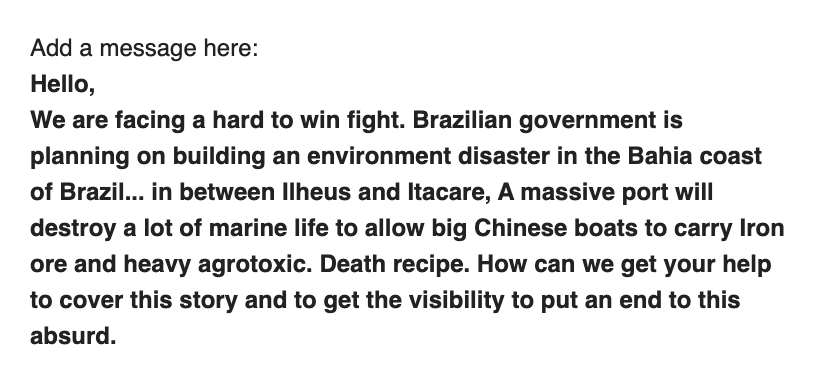
Why? We received two messages recently:
and a friend wrote this article of two Chinese fishing boats off the coast in Costa Rica.
Then I caught up with another friend I hadn’t seen in a few years. He asked me what I was working on and I explained to him what we did at the Seaspiracy Foundation. He laughed and said: man someone needs to stop China. He runs a consultancy firm for Maritime Security, he handles the exact situations that we report on Seaspiracy… IUU fishing, high-seas crimes, ships changing flags etc.. Our bread and butter.
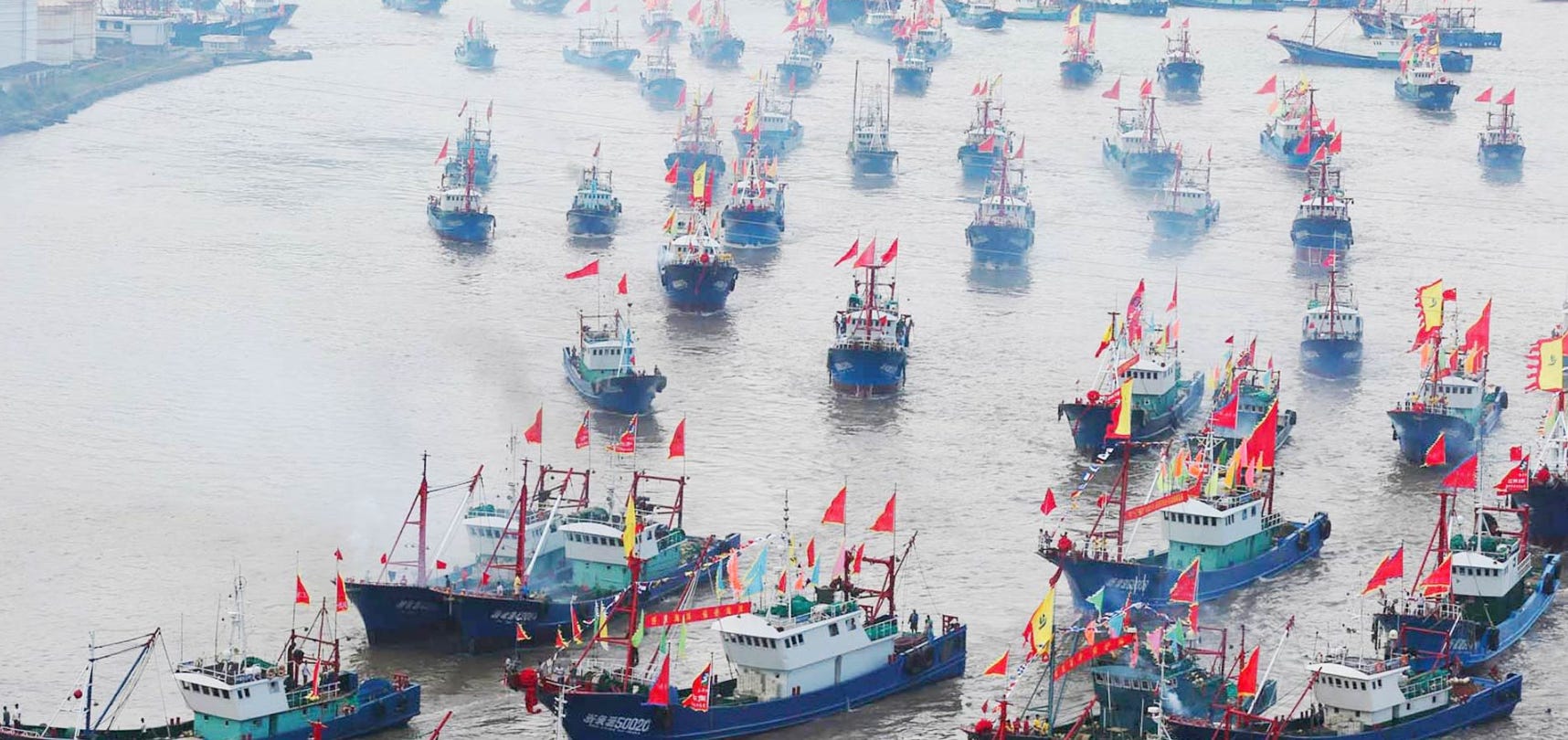
Then came the viral video showing China’s local fishing fleet leaving port simultaneously after its summer fishing moratorium ended:
So to tackle this behemoth of a topic I decided to start with numbers.
Which country has the largest fishing vessel fleet?
China with roughly 500,000 registered vessels.Which country has the largest INDUSTRIAL fishing fleet?
China with approximately 57,000 vessels that operate both in the high seas and in neighbouring EEZs.Which country has the largest distant-water fleet? (known as DWF in the industry)
China with 3,000 official vessels but others estimates the real number is closer to 16,000 (as they operate with other flags etc).
Which country is caught operating IUU (illegal, unreported or unregulated) fishing the most?
China (named by Global Initiative Against Transnational Organized Crime)
Which country spends e most in fisheries subsidies?
China accounted for $7.2 billion of the world's $35.4 billion in fisheries subsidies in 2018.
The Seaspiracy Foundation is funded almost entirely by people who believe the oceans deserve independent investigations and courageous storytelling.
As a Founding Member, you’ll receive behind-the-scenes updates from our work (like this one), invitations to members-only Q&As, and the opportunity to vote on future investigations and campaigns. But most of all you’ll be helping us build a truly independent organisation dedicated to protecting the oceans while keeping our investigations and educational content free for everyone.
If you’re already subscribed to The Seaspiracy Observer, becoming a Founding Member is easy: simply upgrade your subscription to a paid membership.
To feed its increasing middle class —over 94% of its catch ends up back home.
Geo-political power
Initially, China increased its international fishing due to its own waters being intensely overfished. Putting in place local moratoriums for fish-stocks to recover (which is why we see this footage of thousands of boats leaving port after the moratorium ends).
However, in the last decade China has seen how its international fishing presence can grant it geo-political influence abroad, as well as flexing its local influence. (cough South China Sea cough.) Internationally, its distant-water fleet has enabled it to secure enormous deals with poorer debt-ridden nations and expand its maritime presence whilst the US instead has slowly reduced it.
Ian Urbina’s investigation Taking Over from the Inside: China’s Growing Reach Into Local Waters explains these power tactics exceptionally well and also corroborates the trend that I’ve been noticing from campaigns all around the world (for example the email we received regarding the mega-port in Bahia, Brazil, or a video we shared last year exposing Chinese squid jiggers in Argentina.)
Ian Urbina cites other examples in his investigation too:
“In May 2021, Sierra Leone signed an agreement with China to build a new fishing harbor and fishmeal processing factory on a beach near a national park. In response, local organizations pushed for more transparency around the deal, which they said would harm the area’s biodiversity, according to a 2023 report by The Stimson Center.”—excerpt the investigation Taking Over from the Inside
and
“China’s sheer size, ubiquity and poor track record on labor and marine conservation is raising concerns. In Ghana, for instance, industrial trawlers, most of which are owned by China, catch over 100,000 metric tons of fish each year, according to the Environmental Justice Foundation in 2017, and the country’s fishing stocks are now in crisis, as local fishermen’s incomes have dropped by up to 40 percent over the past two decades. “Fishing vessel owners and operators exploit African flags to escape effective oversight and to fish unsustainably and illegally both in sovereign African waters.”—excerpt from the investigation Taking Over from the Inside
read Ian Urbina's investigation
But overfishing is not the end of the story…Many reported IUU fishing and human rights abuses are also rampant on Chinese fishing vessels.
“In the Spring of 2021, an Argentinian crew member named Manuel Quiquinte, on a squid jigger called the Xin Shi Ji 89, contracted Covid while at sea. Owned by the Chinese, the ship was flagged to Argentina and jigging in Argentinian waters. Its crew was a mix of Argentinian and Chinese workers. Several days after Quiquinte fell ill, the Argentine captain called the Chinese owners to ask if the ship could go to shore in Argentina to get medical care. Company officials said no and to keep fishing. Quiquinte died on the ship shortly thereafter, in May.”—excerpt from the investigation Taking Over from the Inside
and
“In one instance, a fishing observer for Ghana’s Fisheries Commission called Emmanuel Essien disappeared without a trace from the Meng Xin 15, beneficially owned by the Chinese company Dalian Meng Xin Ocean Fisheries, on the night of July 5, 2019. The observer’s disappearance came a fortnight after he provided police with video evidence of crew on another ship transferring catch illegally between it and a second vessel, according to local investigative reporting.”—excerpt the investigation Taking Over from the Inside
Throughout the years the international community (ie. the UN and its various treaties) has systematically tried to improve the monitoring of the high seas and overfishing. China has formally signed broad and symbolic agreements in this topic… but rarely has it actually ratified the agreement (which would make it legally binding).
Below some examples:
The ILO Work in Fishing Convention: A specific international labor treaty covering conditions for fishing crews (rest hours, medical care, repatriation, contracts). China signed in 2007 but never ratified it.
UN Fish Stocks Agreement (UNFSA, 1995): the treaty grants boarding and inspection rights to foreign vessels in international waters. —signed but never ratified.
FAO Compliance Agreement (1995): Aims to enhance the role of flag States and ensure that a State strengthens its control over its vessels to ensure compliance with international conservation and management measures. Signed but never ratified
Cape Town Agreement (2012) It's an IMO treaty setting mandatory minimum international safety standards for fishing vessels. Signed but never ratified.
It seems that the only agreement that China signed and ratified was the WTO fishing Subsidies Agreement that bans subsidies: for IUU fishing, for fishing already overfished stocks and for unregulated high-seas fishing. It also outright refused the Global Charter for Fisheries Transparency / Mombasa Declaration (2026). The trend is clear, China accepts broad agreements, but when it comes down to ratifying the mechanisms that would inspect its vessels, monitor compliance, disclose vessel ownership or monitor labor conditions at sea… then those agreements are never ratified or like in the Global Charter for Fisheries Transparency they’re simply refused.
Transparency and good governance: build digital vessel registries linked to the FAO’s Global Record, publish fishing licenses/authorizations/quota allocations, require unique vessel identifiers on industrial vessels, and disclose the ultimate beneficial owners behind vessels and fishing companies
Monitoring and enforcement: stronger vessel tracking and cross-border information sharing, cracking down on flags of convenience specifically, and full implementation of port state measures.
Capacity building: helping lower-income coastal states actually digitize registries and build out their own surveillance and enforcement capability, rather than just setting rules richer nations can meet and poorer ones can’t.
Ocean observation and open data: expanding shared, publicly accessible fisheries data for both management and climate adaptation purposes.
Of course, this seems like a campaign in the making. If you also follow us on social media you’re well aware that we have many media campaigns with Call to Actions targeted at the decision makers. Should we target China next?
If you’re one of our paying members please take the poll below. China is yet to ratify many international agreements... but which one should we focus on? Or should we go elsewhere?
No posts
Comments
Nothing yet. Say the first thing.
Sign in to join the conversation.