
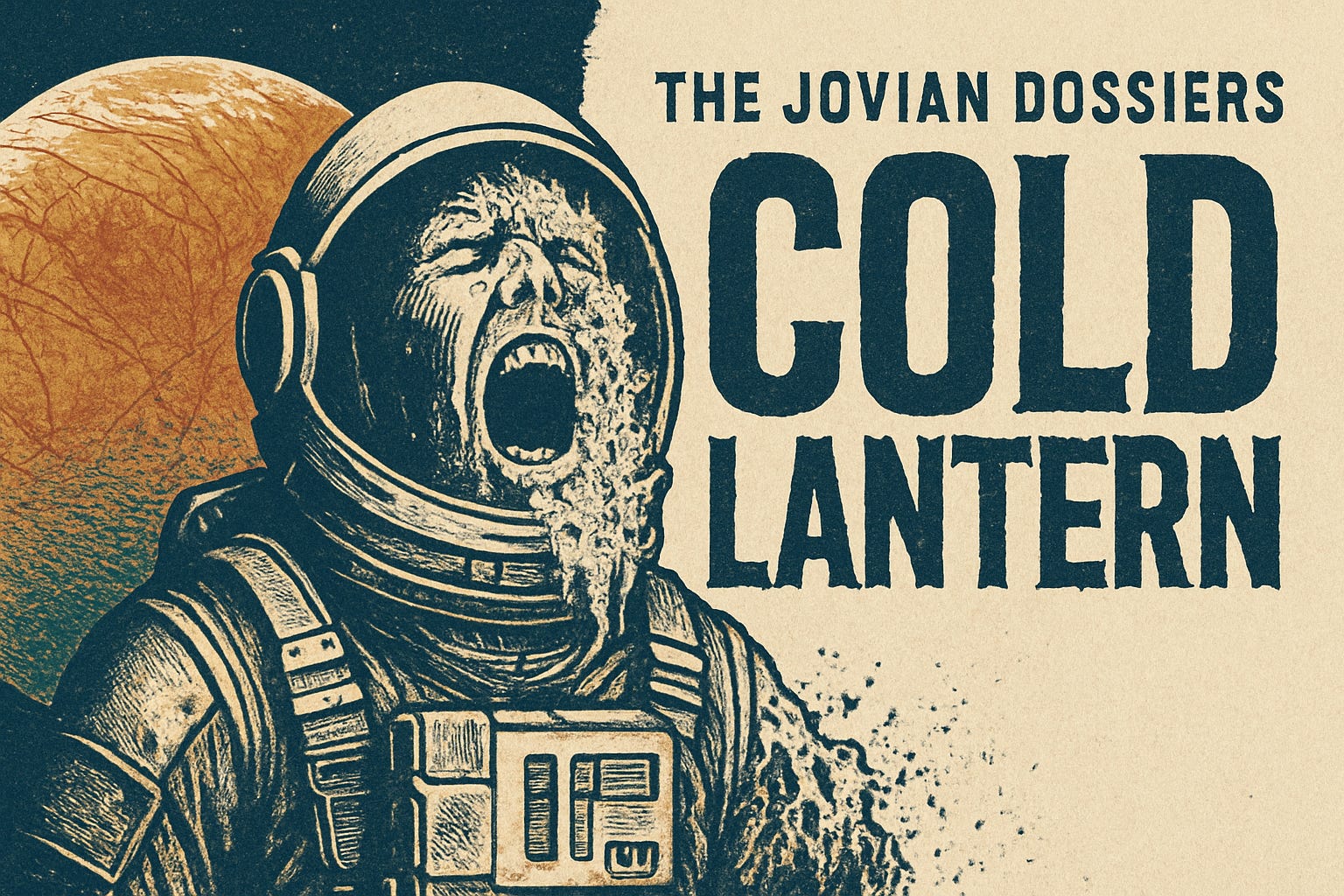
READER NOTICE:
This dossier includes recovered logs, transcripts, and medical telemetry from OPERATION KATABASIS.
Several first-hand accounts describe events as “non-human,” “not language,” or “systemic.” These descriptors are retained because no better terms exist in the record.
If you are reading this for historical review: You have the version we were permitted to write.
If you are reading this because you have been assigned to the Galilean moons: Submit a request for reassignment. If it is denied, resign.
UNITED STATES SPACE FORCE
JOVIAN EXPEDITIONARY COMMAND (JEC)
OFFICE OF OPERATIONAL ASSESSMENT (OOA)
----------------------------------------------------------------
USSF//JOVEX//NOFORN
CONTROLLED DISSEMINATION
Declassify On: 2074-11-19 (Extension Authorized: JEC/CC)
DOCUMENT:
AFTER-ACTION REPORT (AAR) — OPERATION KATABASIS
MISSION TYPE:
EUROPA SUB-ICE PROSPECT / RECOVERY / CONTAMINATION CONTROL
PRIMARY PLATFORM:
USSF CONSTITUTION (ESC-01) “CONSTITUTION”
Expeditionary Sustainment Cruiser — Deep Space Task Force Flagship
SECONDARY ASSETS:
- IPS-9 “MELT LANCE” (Ice Penetrator System)
- QMOD-3 “CASKET” (Quarantine Module)
- EVA SUITS: MK-IV “SABLE” (Cryo/Rad Hard)
- REMOTE VEHICLES: ROV “NEREID” Package (x6)
MISSION WINDOW:
2049-10-03 to 2049-11-19 (UTC)
AO: Jovian System, Europa Vicinity — Sector J-4E, Surface Site: THERA-POINT
COMPILED BY: JEC/OOA (Maj. E. Vance, USSF)
Inputs: 3 ESG, 12 FST, ENG/CONSTITUTION, SDA Det. 6, JEC/S-2
DISTRIBUTION:
JEC Flag / USSF S-2 / USSF S-3 / USSF S-4 / USSF JAG
(Selected annexes withheld under authority of JEC SAP-11 “COLD LANTERN”)
CODENAME NOTE:
“OPERATION KATABASIS” approved by JEC/S-2 (ref: memo JEC-S2-49-771)
Selection rationale: “Descent profile; objective recovery.”
Prior candidate names: [REDACTED]
----------------------------------------------------------------
1. EXECUTIVE SUMMARY
1.1 Mission Intent
Establish a controlled melt-through access point at THERA-POINT, deploy ROV package to survey sub-ice interface conditions, recover pre-identified anomaly-bearing samples, and return payload to CONSTITUTION under QMOD-3 containment for transport to Mars Forward.
1.2 Outcome
OBJ-1 (Access): PARTIALLY MET
OBJ-2 (Survey): NOT MET
OBJ-3 (Recovery): MET (payload mass 41.3 kg)*
OBJ-4 (Containment): FAILED
OBJ-5 (Return Capability): MET (at cost)
*See Annex 10: Intelligence Addendum. Payload classification updated post-event.
1.3 Casualties (Summary)
KIA: 11
MIA: 4
WIA: 9
Exposure Disposition (quarantine/termination): 7
Total Mission Personnel at risk: 38
1.4 Key Determinations
- The incident exploited normal shipboard functions (fluid circulation, humidity control, and standard decon cycles).
- Containment posture assumed a passive hazard. The hazard was not passive.
- Tactical response options were constrained by pressurized-habitat risk and mission return imperatives (Mars resupply dependency).
1.5 Single-Sentence Readout (Leadership)
“We did not lose control of our team; we lost control of a system that was built to keep us alive.”
2. MISSION OBJECTIVES & SUCCESS CRITERIA
OBJ-1: Establish sub-ice access aperture and stabilize bore geometry ≤ 0.4 m drift.
OBJ-2: Deploy NEREID ROV package; acquire 6 hours of interface survey telemetry.
OBJ-3: Recover anomaly-bearing samples into SCC-12 series containers; transfer to QMOD-3.
OBJ-4: Maintain Containment Level OX-3 throughout (Outer System Unknown / Active Chemistry).
OBJ-5: Retain return-capable propulsion, comms, and life support redundancy.
Success Criteria:
- Return payload ≥ 20 kg
- Crew exposure ≤ OX-3 thresholds
- No cross-contamination beyond QMOD boundary
- No internal comms degradation beyond Class-II interference
3. ORDER OF BATTLE / PERSONNEL ROSTER
3.1 Task Force Command (CONSTITUTION)
    TF Cmdr: Col. Mara Havel, USSF
    XO: Lt Col. Isaac Renn, USSF
    Chief Engineer: CWO4 S. “Gantry” Okoye, USSF
    SDA Det 6 Lead: Capt. J. Park, USSF
    JAG: Maj. L. Corbett, USSF
3.2 Mission Science Cell (Contracted / Interagency)
    Science Lead: Dr. L. Sato (JPL Liaison)
    Cryo/Geo: Dr. P. Varric (Mars Forward Institute)
    Biohazard Specialist: Dr. R. Anand (JEC Special Advisor)
NOTE: One specialist credential set later reclassified. See Annex 10.
3.3 Security Detachment — 3rd Expeditionary Security Group (3 ESG)
    Det Cmdr: Capt. S. Al-Khatib, USSF
    Squad 1 (EVA Security): 8 pax
    Squad 2 (Shipboard Containment): 8 pax
    Armorer: TSgt. D. Holtz
3.4 Medical — 12th Flight Surgical Team (12 FST)
    Flight Surgeon: Maj. H. Kim, USSF
    Med Tech: TSgt. C. Rivera
    Behavioral Health: [REDACTED]
Roster Note:
Personnel listed as “EXPOSURE DISPOSITION” are omitted by directive.
See MED Annex §9.4 (restricted).
4. VEHICLES / PAYLOADS / SPECIAL EQUIPMENT
IPS-9 “MELT LANCE”
- Reactor: compact thermal source with heat exchanger stack
- Bore stabilization: brine-circulation collar
- Status: LOST (site abandonment)
QMOD-3 “CASKET”
- Negative-pressure containment with independent scrubbers
- Pass-through decon vestibule
- Status: COMPROMISED (see ENG §8.2)
SCC-12 Sample Containers
- 12 units issued; 7 recovered; 1 returned sealed but later opened by order [REDACTED]
Special Equipment (Authorized JEC/S-2)
- Package: [REDACTED]
- Purpose stated: “interface conductivity mapping”
- Purpose observed: [REDACTED]
5. ROE / BIOSAFETY POSTURE
ROE (Pressurized Habitat)
- Kinetic fire restricted inside pressure hull. Approved munitions: frangible only.
- Thermal methods authorized under Containment Level OX-4 with TF Cmdr approval.
- Depressurization authorized only for imminent loss of ship OR to prevent
  uncontrolled spread beyond QMOD boundary.
BIOSAFETY
- Default: OX-3 (Outer System Unknown — Active Chemistry)
- Escalation Triggers:
  (a) unexplained “scale” formation on suit seals
  (b) humidity loop delta-P anomalies with organic signature
  (c) tissue response inconsistent with human healing
  (d) interference across comms/cabling without mechanical fault
6. CHRONOLOGY OF EVENTS (EXCERPT)
T+00:00  IPS-9 begins melt sequence. Bore collar seated. QMOD-3 green.
T+03:12  First anomaly: water loop delta-P irregularities in Bay 2 humidifiers.
T+04:09  EVA Team reports “chalk film” on suit wrists and neck rings.
T+05:31  NEREID ROV feed shows structured deposits at interface (non-random geometry).
T+06:18  MED notes rapid wound closure on Capt. [REDACTED] (laceration from suit latch).
T+06:44  QMOD-3 vestibule alarm: particulate count rising despite scrubber increase.
T+07:02  Internal comms interference begins — intermittent, localized, then spreading.
T+07:11  First fatality (Bay 2) — cause disputed (asphyxia vs “scrubber inversion”).
T+07:14  Containment Level raised to OX-4. TF Cmdr orders compartment isolation.
T+07:19  “Do not open the hatch.” (Voiceprint mismatch; originated from line that should have been dead. See Annex 12.2.)
T+07:33  Squad 2 reports filaments in humidification ducting “like nerve.”
T+07:41  TF Cmdr issues Order K-7: thermal purge of Bay 2 despite pressure risk.
T+08:05  Bay 2 purge initiated. Hull integrity maintained. Contaminant response described as “withdrawing” (ENG log language flagged).
T+08:22  QMOD-3 declared compromised.
T+08:40  TF Cmdr authorizes Protocol BLACK-LATCH (see Annex 9.4 restricted).
T+09:10  CONSTITUTION breaks station-keeping and begins return burn.
7. CASUALTY REPORT (SUMMARY)
KIA: 11
MIA: 4
WIA: 9
Exposure Disposition: 7
Notes:
- Several MIA are presumed unrecoverable due to compartment status and return burn.
- “Exposure Disposition” category created under TF Cmdr authority; legality under review.
8. SYSTEMS FAILURE ANALYSIS (ENG) — HIGHLIGHTS
8.1 Failure Mode A — Humidity Loop Colonization
Deposits formed within humidification media and expanded along temperature gradients. Rate increased with standard decon cycles.
8.2 Failure Mode B — Conductive Interference
Unexplained bridging across cable runs in Bay 2 and adjacent trunks. Interference pattern resembled deliberate routing rather than random shorts.
8.3 Failure Mode C — Filter Media Conversion
Filters were found rigidified into structured deposits. Samples sparked micro-arcs under low voltage as if acting as a conductor.
Engineering Note (flagged for tone):
“The ship behaved as if placed into an environment that wanted to connect everything to everything else.”
11. BOARD OF INQUIRY FINDINGS (EXCERPT)
Finding 11.2:
Containment posture was designed for passive contamination. Evidence indicates the hazard exploited ship circulation as a growth vector.
Finding 11.6:
Codename selection and certain pre-mission authorizations (Annex 10) cannot be fully explained by stated mission objectives.
Finding 11.9:
The Task Force Commander’s decision to enact Protocol BLACK-LATCH prevented a worst-case outcome, but introduced unresolved ethical and legal exposure.
Recommendation 11.A:
Suspend further sub-ice recovery missions pending redesign of life support, quarantine architecture, and ruleset for “active contamination.”
Recommendation 11.C (Restricted):
Establish permanent JEC/S-2 oversight for all Galilean operations.
USSF//JOVEX//NOFORN
JOVIAN EXPEDITIONARY COMMAND (JEC)
DIRECTORATE OF INTELLIGENCE (S-2)
----------------------------------------------------------------
DATE: 2049-09-14 (UTC)
FROM: JEC/S-2 (Col. R. Halvorsen, USSF)
TO: JEC/OOA; JEC/S-3; TF Cmdr, USSF CONSTITUTION (ESC-01)
CC: JEC/CC; JEC/JAG (Limited); Program “COLD LANTERN” Custodian [REDACTED]
SUBJECT: Operation Codename Approval — OPERATION KATABASIS
REF: (A) JEC-S3-OPORD-49-318 “EUROPA SUB-ICE PROSPECT/RECOVERY”
(B) JEC-S2-RISK-49-771 “Outer System Unknowns: Active vs Passive Hazard”
(C) SAP-11 “COLD LANTERN” Annex Authorizations [REDACTED]
1. PURPOSE. Approve mission codename for REF (A) and provide intelligence guidance regarding hazard posture and authorized instrumentation set.
2. CODENAME. “OPERATION KATABASIS” is APPROVED.
a. Stated rationale: Descent profile; sub-ice entry; objective recovery.
b. Noted: Candidate alternatives included “TRITON,” “NEREID,” and “HARBOR.” These are DISAPPROVED. [REDACTED] is not appropriate for distribution outside JEC special access channels.
3. HAZARD POSTURE. All mission elements will treat Europa interface conditions as ACTIVE HAZARD until proven otherwise. “Passive contamination” assumptions do not apply. See REF (B).
a. The interface is expected to exhibit: [REDACTED] conductivity anomalies; non-random deposition; and behavior consistent with gradient seeking.
b. In the event of uncommanded systems coupling (fluid, comms, power), immediate escalation to OX-4 is AUTHORIZED without higher approval.
4. AUTHORIZED INSTRUMENTATION. Per REF (C), the following package is authorized for deployment and shipboard retention:
- Conductivity Mapping Package (CMP) — “LANTERN-3” [REDACTED]
- Containment Enhancement Kit (CEK) — “BLACK-LATCH” [REDACTED]
a. CMP stated purpose: Interface conductivity mapping to support ROV navigation and bore stabilization.
b. CMP additional purpose: [REDACTED]
c. CMP handling: Remains under S-2 custody chain at all times. Science cell access is limited to “need to generate data.” Data product delivery is controlled by S-2.
5. REPORTING. The Task Force Commander will provide S-2 immediate notification upon any of the following triggers:
- structured deposits inconsistent with abiotic precipitation
- interference patterns indicating deliberate routing/coupling
- tissue response following exposure inconsistent with human physiology
- any “voice” artifacts on internal comms (synthetic, replay, or otherwise) [REDACTED]
6. COMMUNICATIONS. Avoid descriptive language that implies intent or agency in preliminary SITREPs. Use “active hazard,” “growth vector,” or “systems coupling.”
a. Do not use: “alive,” “hunting,” “speaking,” “thinking.” Those terms invite the wrong questions from the wrong offices.
b. If compelled to use such terms in medical or engineering logs, route under Annex (C).
7. FINAL. This guidance is not an indication of foreknowledge. It is an indication of discipline. We are going down. We are bringing something back. The only question is whether the system we built to keep us alive will remain ours on the way up.
SIGNED,
[Digital Sig] R. HALVORSEN, Col, USSF
Director of Intelligence, JEC/S-2
CLASSIFICATION AUTHORITY: JEC/S-2
DECLASSIFY ON: 2074-09-14 (Extension Authorized)
----------------------------------------------------------------
[ENDORSEMENTS REDACTED]T+05:31 — INTERFACE VISUAL ACQUIRED (NEREID-TWO)
AO: EUROPA / THERA-POINT / BORE COLLAR PERIMETER
ASSET: IPS-9 “MELT LANCE” (Ice Penetrator System) / EVA TEAM (3 ESG)The first thing Sergeant Mace Kieran learned about Europa was that ‘true’ cold was silent.
On the Constitution there was always something filling the silence; pumps, fans, the faint complaint of metal that faced the black eternity of space. Even at night-cycle the ship breathed. Here, sealed in his suit, clamped into the external cradle of the ‘Nest, with his boots locked and his hands already numb inside pressure gloves, the soundscape collapsed to essentials: his own inhale, the soft whir of the suit circulator, the scratch of his mic against his chin as he swallowed.
And beyond that; Europa, the smallest and least massive of Jupiter’s four Galilean moons.
“EVA One, comm check,” came Captain Al-Khatib in his ear, tight and clipped, the voice of someone who’d repeated the same sentence enough times to file it down to pure function.
“EVA One, green,” Mace said. His voice sounded too close, like it belonged to someone crouched behind him. He glanced out of habit, which was stupid; the suit collar and helmet rim gave him a stable horizon but stole his peripheral vision. “Audio’s clean. Pressure steady. CO₂ scrub nominal.”
“EVA Two.”
“EVA Two green,” Corporal Sera Vonn answered. She was a pale dot of suit light on the other side of the cradle, a geometry of carbon composite and hard points and tether lines, attached to the outer hull of their surface support vehicle, the SSTV Peregrine, callsign “Nest”. Only her helmet lamp moved, sweeping across the black-to-gray curve of the moon.
“EVA Three.”
“Green,” said the tech from Engineering, Warrant Tsu. “Radiation monitor’s reading ugly but within mission tolerance.”
Al-Khatib exhaled into the channel. Not a sigh. A release. “Copy. Stand by for external hatch cycle.”
A low thunk traveled through Mace’s boots as the outer hatch mechanism unlocked. The Constitution – even in a tethered hover, even with her belly turned away from Jupiter’s radiation belts – felt massive and alive. Her hull panels were matte and scarred with micrometeor pitting, her radiators folded like black wings, her maneuvering jets arranged around her like the pores on the skin of a giant.
The Constitution was the Space Forces first large-scale “naval vessel.” She was officially a Task Force Flagship, Deep Space (TFF-DS), but every Guardian called her a battleship, if only to rub it in their water navy brethren’s faces.
They weren’t landing. Nobody “landed” on Europa unless they were trying to die in a specific way. They hovered low over THERA-POINT with their thick belly radiation plate shields pointed toward Jupiter and their RCS thrusters kept the ship ready to shove off the moment anybody said the words we’re compromised.
Those words had been in the OPORD. So had active hazard.
The hatch iris opened and Europa hit him with a diffused light that originated from the gas giant it orbited.
It was reflected sunlight from a sun 484 million miles away, filtered through the pallor of ice and the faint auroral smear that Jupiter threw like a bruise across the sky. Everything looked rinsed and faded. Like the world had been bleached.
A few kilometers away the Melt Lance was already down.
IPS-9 sat on the ice like a squat, purposeful tower: a heat stack, a bore collar, brine circulation lines coiled and secured, the whole assembly surrounded by a skirt of shielding that looked too thin to keep the cold at bay. A plume of vapor drifted away in a lazy arc and froze into glittering dust before it could decide what it wanted to be.
It was clean, efficient, and a marvel of human engineering. A drill team’s dream.
The Melt Lance had left Earth long before the Constitution had broken station at Mars. Using the most advanced AI and billions in private contracts, the Lance had launched, landed, set-up, and begun drilling without any human intervention.
“Mace,” Al-Khatib said, using his name like a tether. “Eyes on the collar. You see anything that isn’t supposed to be there, you call it. You don’t touch it unless I tell you to.”
“Roger,” Mace said. With a new cold war brewing over Mars, there was also a chance the CNSA or Roscosmos had sent their own AI buddies as well, one could never assume they were alone – even in the darkness of space.
Mace released from the cradle. His boots let go of the magnetic locks with a soft clack that barely registered. The tether line paid out, and for a moment he floated between ship and moon, a helpless bead of meat and water wrapped in a pressure suit.
Europa’s gravity pulled at him like a slow decision, finally winning the tug of war.
This was Mace’s first free-fall since leaving Earth. The descent was almost mindboggling slow with only a thirteen percent pull of Earth’s, he was ‘rocketing’ towards the surface at a lazy 1.274 m/s². Finally, Mace gave the suit’s thrusters tiny puffs of nitrogen, gentle as breath.
He drifted down toward the surface, following Al-Khatib’s pace. The ice below was not smooth; it was ridged and shattered, a frozen sea that had been hit with blunt force and froze. Repeatedly. Since creation itself.
He touched down and the ice took him without notice.
No crunch. No give. Just the hard certainty of a world that had never been warm.
“Contact,” he said, digging the crampons on his feet into the ice. “Down and stable.”
Vonn landed beside him, her boots scuffing up a whisper of frost. Tsu came last, carrying a soft-case instrument pack and looking like a man about to perform surgery on a god.
The Melt Lance’s heat stack radiated a faint shimmer in Mace’s visor HUD – false colors mapped over reality, a trick of the eye, giving the ice a fevered aura. The bore collar was anchored, brine lines snaked out to a skid module, and the access vestibule stood upright like a coffin someone hadn’t bothered to bury.
The AI had set up the drill perfectly.
The quarantine modules, the QMOD’s, had arrived with the Constitution and were still attached to their racks on the side of the hull. Each pod was waiting like a mouth, ready to engulf whatever the Melt Lance dug up.
“EVA team, form on me,” Al-Khatib said. “You’re in the red zone from this point. Discipline tight. ROE as directed.”
They moved in a tight triangle around the collar, slow and deliberate, tethers managed, suit telemetry running. The Melt Lance had been melting for over a month. Somewhere below them, thermal energy was convincing molecules who had been joined since time itself to stop holding hands, and break free their secrets.
As they made their final turn, Mace’s arm shot up. Silently, holding the team’s advance.
A seam of darker ice ran through the collar’s perimeter like a vein.
Mace crouched. The suit servos hummed, translating his bent knees into a slow mechanical fold. He brought his helmet lamp down and watched the seam.
It wasn’t a crack.
Cracks were natural and had jagged edges. This had… boundaries.
“Looks like brine infiltration,” Tsu said, voice muffled by his own caution.
“Yeah,” Vonn said. “It’s probably just a wet line, follow it back to the brine tank.”
Mace stared. The seam shimmered faintly, a thin film catching light.
A brine bloom was plausible. It was a safe answer that didn’t get memos from S-2, and didn’t keep them on the surface longer than their nerves would let them.
They weren’t the first humans to set foot on Europa, that honor belonged to Satnam Tsurutani of the ISRO, they weren’t even the hundredth. But they were the first humans to step on the moon in over a year, and they were alone.
Mace’s visor tagged the area: TEMP: 129 K. RAD: HIGH. PARTICULATE: LOW.
He zoomed the helmet cam.
The seam resolved into a line of granular deposits. Salt. Minerals. Fine chalk.
But not scattered. Not random. Not natural.
They formed tiny, repeated arcs along the boundary, like a series of parentheses marching in a disciplined row.
Mace felt his mouth go dry inside the helmet.
“Constitution, EVA One,” he said, and the words came out flatter than he meant. “Seeing deposits at bore collar seam. Chalk-like. Patterned.”
There was a beat of silence. It felt like when the comms dropped, but this wasn’t that. This was breath bated.
“Define patterned,” Al-Khatib said carefully, finally breaking the quiet.
Mace swallowed. His throat clicked on the mic.
“They’re… organized. Like repeated shapes. Regular spacing.”
“Engineering,” Al-Khatib snapped.
Tsu didn’t answer right away. He’d leaned in too, lamp almost touching the ice. He raised a gloved hand – and the suit’s proximity sensor chimed, causing him to snap his hand back.
“Not precipitation,” Tsu said. “If it were abiotic it’d be… messier. This looks like intelligence. Like it decided to set a boundary.”
“Language,” Al-Khatib warned.
Tsu paused. Corrected himself. “This looks like a boundary effect. Non-random deposition.”
That, at least, was allowed.
Mace forced himself to breathe slowly. Like any career soldier, he’d been trained to treat panic like a chemical leak of the mind. Identify it, isolate it, don’t let it into your system.
Eurpoa didn’t care about his training.
“EVA One,” Al-Khatib said, “mark it. No contact. We’ll let a QMOD eat it up.”
“Roger.”
Mace reached for his marker puck – an adhesive beacon with a blinking infared strobe. He pressed it to the ice three feet from the seam. It stuck with a soft tap.
As he pulled away, the chalk line shifted.
Not much. Not like a snake. Not like a creature.
Like powder settling.
Except there was no wind.
No air.
No reason for it to have moved.
Mace froze. His helmet lamp was steady on the seam. The tiny parentheses – those repeated arcs – had tightened, as if the line had drawn itself a fraction closer to the infrared light of the beacon.
He stared hard, searching for the lie. Looking for a trick of light. A visor artifact. A compression glitch.
His suit telemetry pulsed.
HUMIDITY: +0.3%
He frowned. Inside the suit? That didn’t make sense. The scrubbers regulated humidity, kept it comfortable. A three-tenths spike meant one of two things: his own sweat rate had changed, or something in the system had changed.
“Mace?” Vonn said. “You see that?”
He didn’t answer right away because if he said yes, it became real.
Tsu’s breathing picked up. A subtle rasp on the mic.
“Constitution,” Mace said. “We’ve got a—”
His words cut out.
Not like a failure. Like somebody had muted him.
He blinked, startled. His HUD flashed COMMS: DEGRADED then cleared.
He tried again. “Constitution, EVA One. Comms glitch. Say again – deposits appear to have shifted slightly toward the beacon.”
Static whispered, then Al-Khatib’s voice returned, sharper now. “Copy. EVA team, back it up. Two steps. Slow.”
They moved back from the off-color line as a unit, careful not to snag tethers. Mace kept his lamp on the seam.
The chalk line did not follow them.
It followed the beacon. It was a straight line from the collar to the beacon now, pooling slightly.
It crept in tiny increments, a lazy migration toward warmth, toward metal, toward the place where a new form of heat had made its acquaintance.
Mace’s skin prickled beneath the suit liner. He hated that reaction. There was no air to raise his hair. No cold to gooseflesh him. It was all in his nerves, an animal part of him trying to tell the rest of him something without knowing the words.
“ROV feed?” Al-Khatib demanded.
“Spooling,” someone said – Dr. Sato, up on the ship. Her voice had the careful brightness of a person who had spent her life around dangerous things and still believed they could be understood. “NEREID-Two is at the interface. You’ve got video now.”
Mace’s visor flickered and the world split.
On the left: his helmet cam, Europa ice, the collar, the creeping chalk on its long march to the beacon.
On the right: NEREID-Two’s feed – a descent into a tunnel of steaming brine and darkness. The ROV’s lights painted the bore walls in sickly blues and whites. Meltwater swirled and froze in wisps. The camera jittered as it passed through the collar’s shadow and into the throat below.
Then the ice ended.
Not abruptly. It softened into a semi-transparent layer, a slush that gave way to water that looked more like a spoiled jello. It looked thick. Heavy. Like it had been waiting a long time to be disturbed.
At the interface, something glimmered.
A field of deposits clung to the underside of the ice like frost on a window. They weren’t the geometric shapes of ice, but the parentheses of their new chalk line anomaly.
The same arcs.
Repeated.
Regular.
And threaded between them faint filaments, almost invisible until NEREID’s light caught them just right.
They weren’t floating like organic strings. They were anchored, routed, stretched with purpose across the interface like the wiring on a board.
Mace heard Vonn whisper, “No.”
Tsu made a sound that might’ve been a prayer or an engineer’s reflexive protest against the universe.
Dr. Sato spoke softly, almost reverently. “Look at the pattern, it’s perfect.”
Al-Khatib’s voice cut through them all. “Sato, don’t—”
But she was already going. “This isn’t random. It’s not precipitation. It’s— it’s arranged.”
Mace watched the ROV drift closer. Its thrusters stirred the water, sending a lazy current across the field.
The filaments responded.
Not violently. Not like a predator lunging.
Like a plant turning toward light.
They tightened, drawing into a pattern that mirrored the ROV’s movement, mapping its approach in silent, patient adjustments.
“Constitution,” Mace said, and he forced every syllable to stay inside the lane of permitted language, “active hazard confirmed. Interface exhibits non-random structured deposits and filaments. Request posture escalation.”
This time the comms didn’t cut out. Instead, the channel filled with the sound of the ship – distant, filtered, urgent. People moving. A chair scraping. A hiss of someone taking their mic off mute too fast.
Then Col. Havel’s voice came on, calm in the way good commanders were able to be.
“EVA One, this is Havel. You have eyes on the interface. Confirm: are those filaments anchored to ice, or free in the water column?”
Mace stared at the feed. The filaments weren’t drifting. They were routed. Anchored at one end, stretched across, anchored again. Like a net. Like nerves. Like –
He stopped himself.
“Anchored,” he said. “They’re… attached. Routed along the interface.”
“Copy,” Havel said. “All stations, raise to OX-4. Initiate containment discipline. EVA team: no further proximity. Prepare to withdraw to ship.”
The words should’ve been relief. Instead they were a door closing behind him.
They couldn’t stop the Melt Lance. Its AI computer was in full control.
As it kept melting, the interface below them was waking up.
The chalk line at the collar had fully encased the beacon now – kissed it in a neat, delicate curve – and began to thicken, as if it had found what it came for. The infrared light had already been extinguished under the chalk crust.
Mace backed away with the others, slow and controlled. His tether tugged gently at his waist. The Constitution hung above them, a dark protective shape against Jupiter’s distant storm eye.
As they withdrew, his suit beeped again.
HUMIDITY: +0.6%
He frowned.
Swallowed.
Listened.
In the background of the comms, barely audible under the clipped confirmations and procedures, there was a sound like faint tapping.
Not on his helmet.
Not on the ice.
On the line.
A rhythmic, patient interference, like something testing the circuit the way you test a door handle before you commit to opening it.
Mace didn’t tell anyone.
Not yet.
He just let the tether pull him backward, away from the collar, away from the creeping chalk, and toward the hatch that would take him back into the warm safety of the Constitution.
T+06:44 — CONTAINMENT POSTURE: OX-4 AUTHORIZED
AO: EUROPA / THERA-POINT / SURFACE ZONE
ASSET: SSTV PEREGRINE (Surface Support / Transfer Vehicle), callsign “NEST”
The return trip was supposed to be the calm part.
Comments
Nothing yet. Say the first thing.
Sign in to join the conversation.